×
Request Free Sample ×

Kindly complete the form below to receive a free sample of this Report

* Please use a valid business email

Leading companies partner with us for data-driven Insights

clients tt-cursor
Hero Background

India Waste Management Market

ID: MRFR/Equip/19880-HCR
128 Pages
Garvit Vyas
February 2026

India Waste Management Market Research Report Information By Waste Type (Industrial Waste, Municipal Solid Waste, Hazardous Waste, E-waste, Plastic Waste and Bio-medical Waste), By Disposal Methods (Landfill, Incineration, Dismantling and Recycling), By Type of Ownership (Public, Private and Public-private Partnership) – India Market Forecast Till 2035

Share:
Download PDF ×

We do not share your information with anyone. However, we may send you emails based on your report interest from time to time. You may contact us at any time to opt-out.

India Waste Management Market Infographic
Purchase Options

India Waste Management Market Summary

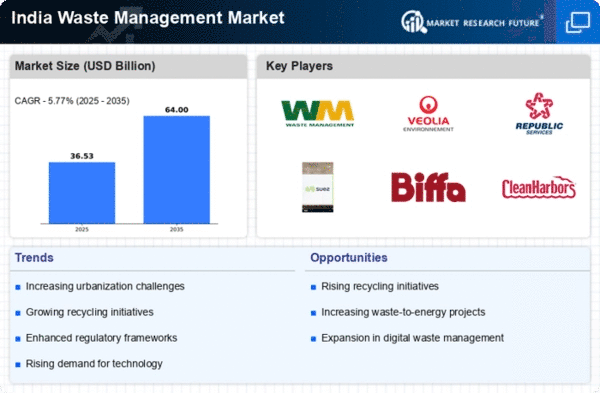
As per Market Research Future analysis, the India Waste Management Market Size was estimated at 14.86 USD Billion in 2024. The India Waste Management industry is projected to grow from 15.82 USD Billion in 2025 to 29.71 USD Billion by 2035, exhibiting a compound annual growth rate (CAGR) of 6% during the forecast period 2025 - 2035

Key Market Trends & Highlights

The India Waste Management Market is poised for substantial growth driven by technological advancements and increasing regulatory support.

  • Technological advancements in waste management are reshaping operational efficiencies across the sector.
  • Government initiatives and regulations are fostering a more structured approach to waste management practices.
  • The rise of circular economy practices is encouraging sustainable waste disposal and resource recovery methods.
  • Key market drivers include growing urbanization and public awareness regarding environmental concerns.

Market Size & Forecast

2024 Market Size 14.86 (USD Billion)
2035 Market Size 29.71 (USD Billion)
CAGR (2025 - 2035) 6.5%

Major Players

Ramky Enviro Engineers Limited (IN), SUEZ India (IN), Waste Management Inc (US), Tata Projects Limited (IN), Greenko Group (IN), Jindal Saw Limited (IN), Biomass Power Limited (IN), Gujarat Ambuja Exports Limited (IN)

Our Impact
Enabled $4.3B Revenue Impact for Fortune 500 and Leading Multinationals
Partnering with 2000+ Global Organizations Each Year
30K+ Citations by Top-Tier Firms in the Industry

India Waste Management Market Trends

The India Waste Management Market is currently undergoing a transformative phase, driven by increasing urbanization and a growing awareness of environmental sustainability. As cities expand, the volume of waste generated rises, necessitating innovative solutions for effective waste disposal and recycling. The government has implemented various initiatives aimed at enhancing waste management practices, which appear to be fostering a more organized approach to handling waste.

Furthermore, the integration of technology in waste management processes is gaining traction, suggesting a shift towards more efficient and sustainable practices. In addition to governmental efforts, private sector participation is becoming more pronounced, with numerous companies entering the market to provide advanced waste management solutions. This trend indicates a collaborative approach between public and private entities, which may lead to improved infrastructure and services. The emphasis on circular economy principles is also noteworthy, as stakeholders increasingly recognize the potential for waste to be repurposed and reused. 

Overall, the India Waste Management Market seems poised for growth, with various factors converging to create a more sustainable future for waste management in the country.

Technological Advancements in Waste Management

The integration of technology into waste management processes is becoming increasingly prevalent. Innovations such as smart bins, waste tracking systems, and automated sorting facilities are enhancing efficiency and reducing operational costs. This trend indicates a move towards data-driven decision-making, which may lead to improved waste collection and recycling rates.

Government Initiatives and Regulations

Government policies aimed at improving waste management practices are gaining momentum. Initiatives focused on reducing plastic usage and promoting recycling are being implemented at various levels. This regulatory framework appears to encourage both public and private sectors to invest in sustainable waste management solutions.

Rise of Circular Economy Practices

The concept of a circular economy is gaining traction within the India Waste Management Market. Stakeholders are increasingly recognizing the value of reusing and recycling materials, which could lead to reduced waste generation. This shift towards sustainability suggests a long-term commitment to environmental stewardship and resource conservation.

India Waste Management Market Drivers

Government Policies and Regulations

The role of government policies and regulations is pivotal in shaping the India Waste Management Market. The government has implemented various initiatives aimed at improving waste management practices, such as the Swachh Bharat Mission, which emphasizes cleanliness and waste segregation at the source. Additionally, the Plastic Waste Management Rules mandate the reduction of single-use plastics, thereby encouraging recycling and responsible waste disposal. These regulations are likely to create a more structured waste management framework, fostering investment in infrastructure and technology. As a result, the market is expected to witness a significant increase in funding and support for waste management projects, potentially reaching a valuation of USD 14 billion by 2026.

Investment in Infrastructure Development

Investment in infrastructure development is crucial for the advancement of the India Waste Management Market. The government and private sector are increasingly recognizing the need for robust waste management infrastructure to handle the growing waste volumes. Initiatives such as the National Mission for Clean Ganga and various state-level projects aim to enhance waste processing facilities and promote recycling. It is estimated that the investment in waste management infrastructure could reach USD 10 billion by 2025, driven by both public and private funding. This influx of capital is expected to facilitate the establishment of modern waste treatment plants and enhance the overall efficiency of waste management systems. As infrastructure improves, the capacity to manage waste effectively will likely increase, contributing to a more sustainable waste management ecosystem.

Growing Urbanization and Population Density

Urbanization is a driving force behind the growth of the India Waste Management Market. With an increasing population density in urban areas, the volume of waste generated is escalating rapidly. It is estimated that urban areas contribute to over 60% of the total waste generated in India, which poses significant challenges for waste management systems. This trend necessitates the development of efficient waste collection and disposal mechanisms. The market is likely to adapt by investing in modern waste treatment facilities and expanding recycling capabilities. As cities continue to grow, the demand for effective waste management solutions will intensify, potentially leading to a market growth rate of around 8% annually over the next five years.

Public Awareness and Environmental Concerns

Public awareness regarding environmental issues is increasingly influencing the India Waste Management Market. As citizens become more conscious of the impact of waste on the environment, there is a growing demand for sustainable waste management practices. Campaigns promoting waste segregation, recycling, and composting are gaining traction, leading to a cultural shift towards responsible waste disposal. This heightened awareness is likely to drive consumer preferences towards companies that prioritize sustainability in their operations. Consequently, businesses in the waste management sector may need to adapt their strategies to align with these changing consumer expectations, potentially resulting in a more competitive market landscape. The emphasis on environmental sustainability could lead to an increase in investments in eco-friendly waste management technologies.

Technological Innovations in Waste Management

The India Waste Management Market is experiencing a surge in technological innovations that enhance waste processing and recycling efficiency. Advanced technologies such as artificial intelligence, machine learning, and IoT are being integrated into waste management systems. For instance, smart bins equipped with sensors can monitor waste levels and optimize collection routes, thereby reducing operational costs. The market is projected to grow at a CAGR of approximately 7.5% from 2025 to 2030, driven by these technological advancements. Furthermore, the adoption of automated sorting systems is expected to increase recycling rates, which currently stand at around 30% in India. This shift towards technology not only improves operational efficiency but also promotes sustainable practices within the industry.


Market Segment Insights

By Waste Type: Plastic (Largest) vs. E-waste (Fastest-Growing)

In the India waste management market, plastic waste accounts for the largest share among various waste types, reflecting the country's burgeoning consumption of plastic products. Following plastic, hazardous and bio-medical waste also comprise significant portions, while e-waste is emerging as a critical concern due to rapid technology adoption. The distribution indicates a pressing need for effective waste management solutions across these dominant waste types. Growth trends in the waste management segment are driven by regulatory frameworks and heightened public awareness regarding environmental impacts. E-waste is experiencing the fastest growth rate, fueled by an increase in electronic consumption and the subsequent lifecycle management challenges. Meanwhile, initiatives aimed at plastic waste reduction have prompted innovations in recycling technologies, positively affecting the overall waste management landscape.

Plastic (Dominant) vs. E-waste (Emerging)

Plastic waste plays a dominant role in the waste composition, primarily due to the extensive use of plastic in consumer products, packaging, and manufacturing processes. The large volume of plastic waste poses significant challenges, leading to increasing initiatives focused on recycling and responsible disposal methods. In contrast, e-waste represents an emerging concern that is gaining attention due to the rapid obsolescence of electronic devices and gadgets. This segment demands tailored waste management strategies to recover valuable materials and minimize environmental hazards associated with improper disposal. Both segments highlight the need for robust infrastructural developments and public engagement to create a sustainable waste management ecosystem.

By Service: Recycling (Largest) vs. Composting & Anaerobic Digestion (Fastest-Growing)

In the India waste management market, Recycling is the largest segment, significantly influencing the overall market structure. Open Dumping and Landfill follow, representing established but less desirable practices. Incineration/Combustion holds a smaller share but is essential for reducing volume, while Composting & Anaerobic Digestion is rapidly gaining traction as urban areas focus on organic waste management practices. The distribution reflects an evolving market prioritizing environmental sustainability. Growth trends in this segment are driven by increased awareness of sustainable waste practices and government regulations promoting composting and recycling initiatives. The push towards circular economy practices is fostering rapid development in Composting & Anaerobic Digestion, while recycling systems are improving operational efficiencies. These trends indicate a shift towards more environmentally friendly waste management solutions, aligning with international sustainability goals.

Recycling (Dominant) vs. Composting & Anaerobic Digestion (Emerging)

Recycling stands as the dominant service type within this market, characterized by robust infrastructure and extensive collection systems, enabling effective material recovery. Its significance lies in preserving resources and reducing landfill reliance, critical in a rapidly urbanizing India. Conversely, Composting & Anaerobic Digestion represents the emerging frontier in waste management, gaining momentum due to growing organic waste volumes and support from local governments. This segment focuses on transforming organic materials into valuable compost or biogas, presenting a sustainable solution to waste challenges. Both segments reflect the market's shift towards more innovation-driven, eco-friendly approaches, positioning them crucially in India's waste management future.

By End User: Residential (Largest) vs. Commercial (Fastest-Growing)

The India waste management market shows a diverse distribution among its end user segments, with the residential sector holding the largest market share. This segment is driven by the increasing population and urbanization, leading to a significant rise in household waste generation. In contrast, the commercial segment is rapidly catching up, fueled by the growing number of businesses and institutions emphasizing sustainable waste management practices. Growth trends in the waste management sector reveal robust expansion in both residential and commercial segments. The residential sector continues to benefit from increased awareness of waste segregation and recycling, while the commercial sector is propelled by regulatory pressures and corporate sustainability goals. This dual growth is indicative of a shifting mindset towards environmental responsibility across all end users in the market.

Residential (Dominant) vs. Commercial (Emerging)

The residential segment stands as the dominant force in the waste management market due to the consistent and heavy waste output from households. This includes organic waste, recyclables, and electronic waste, driven by urban lifestyles. Innovations in waste collection and segregation methods have significantly enhanced efficiency in this segment. On the other hand, the commercial segment is emerging strongly as businesses adopt stringent waste management policies and practices. These enterprises are not only looking to comply with regulations but also to enhance their brand image through sustainable practices. The trends indicate that while residential waste management is established and widespread, the commercial sector's rapid growth is reshaping the market landscape.

Get more detailed insights about India Waste Management Market

Regional Insights

North America : Sustainable Practices Leader

The North American waste management market is driven by stringent regulations and a growing emphasis on sustainability. The U.S. holds the largest market share at approximately 60%, followed by Canada at around 25%. Regulatory catalysts, such as the EPA's initiatives, are pushing for advanced waste management technologies and recycling programs, enhancing market growth. Demand for waste-to-energy solutions is also on the rise, reflecting a shift towards circular economy practices. Leading countries in this region include the United States and Canada, with a competitive landscape featuring major players like Waste Management Inc. and Republic Services. The presence of innovative companies focusing on recycling and waste-to-energy technologies is notable. The market is characterized by partnerships between public and private sectors, enhancing service delivery and operational efficiency. Key players are investing in technology to improve waste processing and management efficiency.

Europe : Regulatory Framework Innovator

Europe's waste management market is characterized by robust regulatory frameworks aimed at promoting recycling and reducing landfill waste. The European Union's Circular Economy Action Plan is a significant driver, with member states required to meet ambitious recycling targets. Germany and the UK are the largest markets, holding approximately 30% and 20% of the market share, respectively. The focus on sustainable waste management practices is leading to increased investments in recycling technologies and infrastructure. Germany, the UK, and France are leading countries in this sector, with a competitive landscape featuring key players like SUEZ and Veolia. The market is witnessing a shift towards innovative waste management solutions, including digital platforms for waste tracking and management. The presence of strong local players and multinational corporations is fostering competition and driving technological advancements in waste processing and recycling.

Asia-Pacific : Emerging Market Potential

The Asia-Pacific waste management market is experiencing rapid growth due to urbanization and increasing waste generation. India and China are the largest markets, with India holding approximately 40% of the market share, followed by China at around 30%. Government initiatives aimed at improving waste management infrastructure and promoting recycling are key growth drivers. The region is also witnessing a rise in public awareness regarding waste segregation and management, further boosting demand for effective waste solutions. 

India, China, and Japan are the leading countries in this market, with a competitive landscape featuring key players like Ramky Enviro Engineers and Tata Projects. Driven by the government's Swachh Bharat Mission 2.0 and the increasing adoption of circular economy principles, the waste management market in India is transitioning from traditional disposal methods toward advanced, tech-enabled resource recovery systems. The presence of both local and international companies is enhancing competition, leading to innovative waste management solutions. Investments in technology and infrastructure are crucial for addressing the challenges posed by increasing waste generation and urbanization in the region.

Middle East and Africa : Resource-Rich Opportunities

The Middle East and Africa waste management market is evolving, driven by increasing urbanization and government initiatives aimed at improving waste management practices. The UAE and South Africa are the largest markets, holding approximately 35% and 25% of the market share, respectively. Regulatory frameworks are being established to promote sustainable waste management, with a focus on recycling and waste-to-energy projects. The region's growing population and economic development are further fueling demand for efficient waste management solutions. Leading countries in this region include the UAE, South Africa, and Nigeria, with a competitive landscape featuring key players like Greenko Group and Jindal Saw Limited. The market is characterized by a mix of local and international companies, fostering innovation and investment in waste management technologies. Public-private partnerships are becoming increasingly common, enhancing service delivery and operational efficiency in waste management practices.

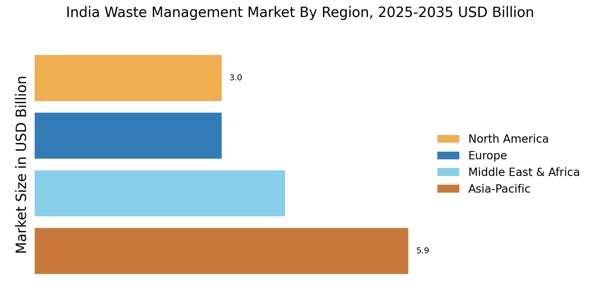
India Waste Management Market Regional Image

Key Players and Competitive Insights

The waste management market in India is currently characterized by a dynamic competitive landscape, driven by increasing urbanization, regulatory pressures, and a growing emphasis on sustainability. Major players are actively positioning themselves to capitalize on these trends through various strategic initiatives. For instance, Waste Management Inc (US) has been focusing on enhancing its technological capabilities, particularly in waste-to-energy solutions, which aligns with the country's push towards renewable energy. Similarly, Veolia Environnement SA (FR) has been expanding its service offerings in waste recycling and resource recovery, indicating a shift towards a circular economy model. These strategies collectively contribute to a competitive environment that is increasingly focused on innovation and sustainability. Key business tactics within this market include localizing operations and optimizing supply chains to enhance efficiency and reduce costs. The competitive structure appears moderately fragmented, with several key players vying for market share while also facing competition from numerous local firms. This fragmentation allows for diverse service offerings but also necessitates strategic collaborations among major players to strengthen their market positions. In August 2025, Republic Services Inc (US) announced a partnership with local municipalities in India to implement advanced recycling programs aimed at reducing landfill waste. This initiative not only enhances their operational footprint but also aligns with the Indian government's objectives for waste management. The strategic importance of this partnership lies in its potential to improve community engagement and foster a sustainable waste management culture. In September 2025, SUEZ SA (FR) launched a new digital platform designed to optimize waste collection routes and improve operational efficiency. This move reflects a broader trend towards digital transformation within the industry, as companies seek to leverage technology to enhance service delivery. The significance of this development is underscored by the increasing demand for smart waste management solutions that can adapt to urban challenges. In October 2025, Clean Harbors Inc (US) expanded its hazardous waste management services in India, focusing on industrial sectors that require specialized waste disposal solutions. This expansion is strategically important as it allows the company to tap into a niche market with high growth potential, particularly in the context of stringent environmental regulations. Such moves indicate a trend towards specialization in waste management services, catering to specific industry needs. As of November 2025, current competitive trends in the waste management market are heavily influenced by digitalization, sustainability initiatives, and the integration of artificial intelligence. Strategic alliances are increasingly shaping the landscape, enabling companies to pool resources and expertise to tackle complex waste management challenges. Looking ahead, competitive differentiation is likely to evolve from traditional price-based competition to a focus on innovation, technological advancements, and supply chain reliability. This shift suggests that companies that prioritize sustainable practices and technological integration will be better positioned to thrive in the future.

Key Companies in the India Waste Management Market include

Industry Developments

August 2023:The Brihanmumbai Municipal Corporation (BMC) studied the highly effective 'Indore model' of waste management to improve solid waste management (SWM) in Mumbai. This strategy has played a key role in Indore, often referred to as the 'Mini Mumbai' of Madhya Pradesh, retaining its status as the cleanest city in India for six consecutive years.

March 2023:Bharat Petroleum Corporation Limited (BPCL), recognized as a 'Maharatna' and listed in the Fortune Global 500, launched a unique program called "Sound Management of Waste Disposal (SMWD)" as part of their sustainability efforts. This initiative is centered on minimizing and repurposing electronic waste. BPCL's goal is to achieve zero-waste-to-landfill accreditation at all operational refineries and marketing sites by the year 2025.

In 2023:Jaipur-based waste management startup WeVOIS, in its pre-Series A round of funding, achieved total funding of USD 4 million at the valuation of USD 10 million using a mixture of debt and equity. WeVOIS has appreciably mothered the environment of more than 2.5 million people in 18 cities of India, inclusive of Jaipur, Dehradun, Sikar, Gwalior, and Jaisalmer.

The company's performance in the last year was even more laudable, with growth of 250% in terms of annual revenue and customer acquisition figures growing by 60% over the last 6 months, with the company maintaining a zero rate of customer churn since the commencement of its operations.

Future Outlook

India Waste Management Market Future Outlook

The India Waste Management Market is projected to grow at a 6.5% CAGR from 2025 to 2035, driven by urbanization, regulatory support, and technological advancements.
The future of the India Waste Management Market is anchored in the rapid scaling of waste-to-energy projects and the rigorous enforcement of circular economy mandates. As urbanization intensifies, the market will increasingly rely on AI-driven sorting and digital tracking to manage escalating waste volumes. This transition fosters a sustainable ecosystem where resource recovery and modernized collection systems replace traditional landfilling practices.

New opportunities lie in:

  • Development of smart waste segregation systems for urban areas. Expansion of waste-to-energy facilities to harness renewable energy. Implementation of digital platforms for efficient waste tracking and management.

By 2035, the India Waste Management Market is expected to be robust, driven by innovation and sustainable practices.

Market Segmentation

India Waste Management Market Waste Type Outlook

  • Industrial Waste
  • Municipal Solid Waste
  • Hazardous Waste
  • E-waste
  • Plastic Waste
  • Bio-medical Waste

India Waste Management Market Disposal Methods Outlook

  • Landfill
  • Incineration
  • Dismantling
  • Recycling

India Waste Management Market Type of Ownership Outlook

  • Public
  • Private
  • Public-private Partnership

Report Scope

MARKET SIZE 2024 14.86(USD Billion)
MARKET SIZE 2025 15.82(USD Billion)
MARKET SIZE 2035 29.71(USD Billion)
COMPOUND ANNUAL GROWTH RATE (CAGR) 6.5% (2025 - 2035)
REPORT COVERAGE Revenue Forecast, Competitive Landscape, Growth Factors, and Trends
BASE YEAR 2024
Market Forecast Period 2025 - 2035
Historical Data 2019 - 2024
Market Forecast Units USD Billion
Key Companies Profiled Ramky Enviro Engineers Limited (IN), SUEZ India (IN), Waste Management Inc (US), Tata Projects Limited (IN), Greenko Group (IN), Jindal Saw Limited (IN), Biomass Power Limited (IN), Gujarat Ambuja Exports Limited (IN)
Segments Covered Waste Type, Disposal Methods, Type of Ownership
Key Market Opportunities Adoption of advanced recycling technologies enhances efficiency in the India Waste Management Market.
Key Market Dynamics Rising regulatory pressures and technological advancements drive innovation in India's waste management sector.
Countries Covered North America, Europe, APAC, South America, MEA
Leave a Comment

FAQs

What is the current valuation of the India Waste Management Market?

The India Waste Management Market was valued at 14.86 USD Billion in 2024.

What is the projected market size for the India Waste Management Market by 2035?

The market is projected to reach 29.71 USD Billion by 2035.

What is the expected CAGR for the India Waste Management Market during the forecast period?

The expected CAGR for the market from 2025 to 2035 is 6.5%.

Which waste types are the largest contributors to the market?

Municipal Solid Waste and Industrial Waste are the largest contributors, with valuations of 10.0 and 5.0 USD Billion respectively.

What disposal methods dominate the India Waste Management Market?

Landfill and Recycling are the dominant disposal methods, valued at 10.0 and 9.71 USD Billion respectively.

Download Free Sample

Kindly complete the form below to receive a free sample of this Report

Compare Licence

×
Features License Type
Single User Multiuser License Enterprise User
Price $4,950 $5,950 $7,250
Maximum User Access Limit 1 User Upto 10 Users Unrestricted Access Throughout the Organization
Free Customization
Direct Access to Analyst
Deliverable Format
Platform Access
Discount on Next Purchase 10% 15% 15%
Printable Versions