×
Request Free Sample ×

Kindly complete the form below to receive a free sample of this Report

* Please use a valid business email

Leading companies partner with us for data-driven Insights

clients tt-cursor
Hero Background

Hardware Acceleration Market

ID: MRFR/SEM/6777-HCR
111 Pages
Ankit Gupta
February 2026

Hardware Acceleration Market Size, Share and Research Report By Type (Graphics Processing Unit, Video Processing Unit, AI Accelerator, Regular Expression Accelerator, Cryptographic Accelerator and Others), By Application (Deep Learning Training, Public Cloud Inference, Enterprise Inference and Others), By End User (IT and Telecommunication, BFSI, Retail, Hospitality, Logistics, Automotive, Healthcare, Energy and Others), And By Region (North America, Europe, Asia-Pacific, And Rest Of The World) –Industry Forecast Till 2035

Share:
Download PDF ×

We do not share your information with anyone. However, we may send you emails based on your report interest from time to time. You may contact us at any time to opt-out.

Hardware Acceleration Market Infographic
Purchase Options

Hardware Acceleration Market Summary

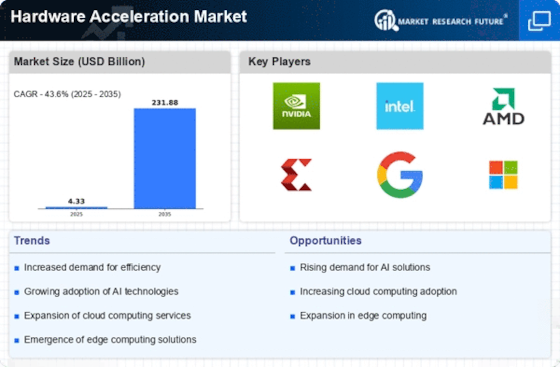
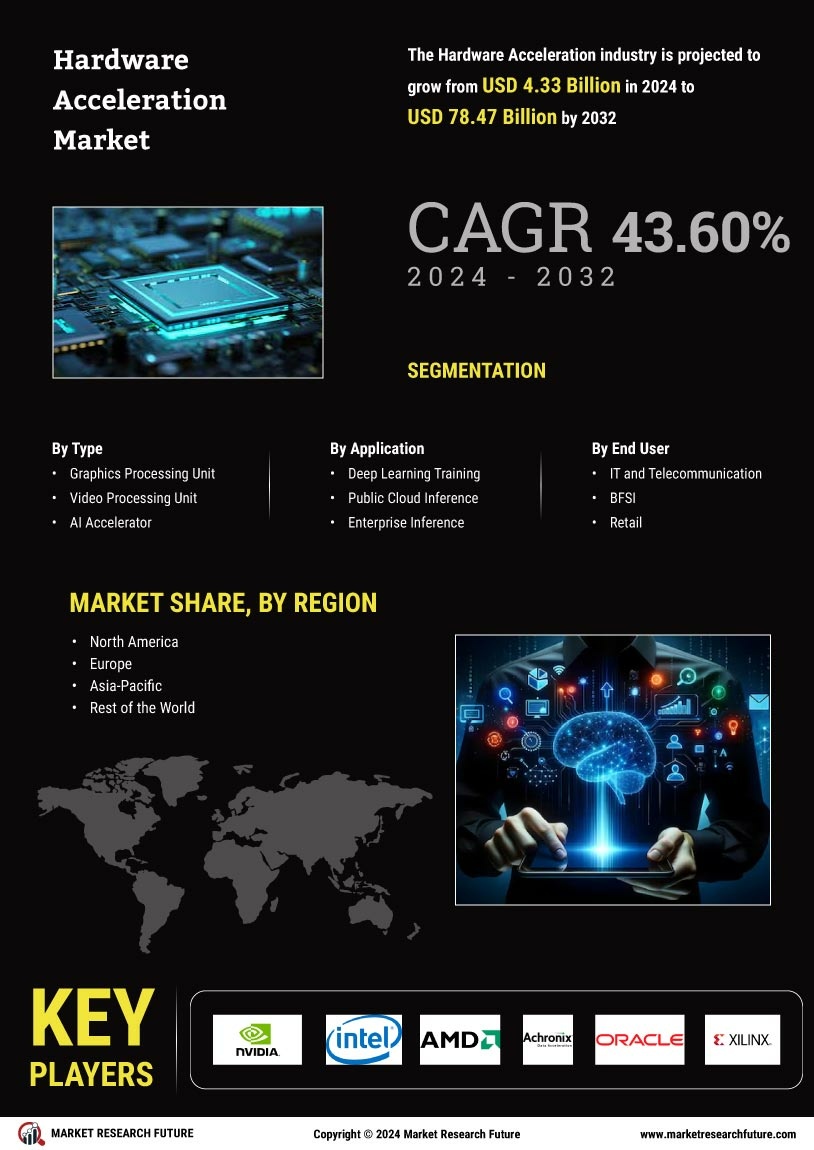
As per Market Research Future analysis, the Hardware Acceleration Market Size was estimated at 4.33 USD Billion in 2024. The Hardware Acceleration industry is projected to grow from 6.218 USD Billion in 2025 to 231.88 USD Billion by 2035, exhibiting a compound annual growth rate (CAGR) of 43.6% during the forecast period 2025 - 2035

Key Market Trends & Highlights

The Hardware Acceleration Market is poised for substantial growth driven by technological advancements and increasing demand for high-performance solutions.

  • The rise of AI and machine learning is significantly influencing hardware acceleration strategies across various sectors.
  • North America remains the largest market, while Asia-Pacific is emerging as the fastest-growing region in hardware acceleration.
  • Graphics Processing Units dominate the market, whereas AI accelerators are rapidly gaining traction as the fastest-growing segment.
  • Increasing demand for high-performance computing and advancements in GPUs are key drivers propelling market expansion.

Market Size & Forecast

2024 Market Size 4.33 (USD Billion)
2035 Market Size 231.88 (USD Billion)
CAGR (2025 - 2035) 43.6%

Major Players

NVIDIA (US), Intel (US), AMD (US), Xilinx (US), Google (US), Microsoft (US), Amazon (US), IBM (US), Qualcomm (US)

Our Impact
Enabled $4.3B Revenue Impact for Fortune 500 and Leading Multinationals
Partnering with 2000+ Global Organizations Each Year
30K+ Citations by Top-Tier Firms in the Industry

Hardware Acceleration Market Trends

The Hardware Acceleration Market is currently experiencing a transformative phase, driven by the increasing demand for enhanced computational efficiency across various sectors. Organizations are increasingly adopting hardware acceleration technologies to optimize performance, reduce latency, and improve energy efficiency. This trend is particularly evident in industries such as artificial intelligence, machine learning, and data analytics, where the need for rapid processing capabilities is paramount. As businesses strive to remain competitive, the integration of specialized hardware solutions is becoming a strategic imperative. Furthermore, the proliferation of cloud computing services is facilitating broader access to hardware acceleration technologies, enabling even smaller enterprises to leverage these advancements. In addition, the Hardware Acceleration Market is witnessing a surge in innovation, with companies investing heavily in research and development to create more powerful and efficient hardware solutions. This focus on innovation is likely to lead to the emergence of new products and technologies that cater to the evolving needs of various industries. As the market continues to mature, collaboration between hardware manufacturers and software developers is expected to intensify, fostering an ecosystem that supports seamless integration and enhanced performance. Overall, the Hardware Acceleration Market appears poised for substantial growth, driven by technological advancements and the increasing reliance on high-performance computing solutions.

Rise of AI and Machine Learning

The Hardware Acceleration Market is significantly influenced by the growing adoption of artificial intelligence and machine learning technologies. As these applications require substantial computational power, specialized hardware solutions are being developed to meet the demands of complex algorithms and data processing tasks.

Cloud-Based Solutions

The shift towards cloud computing is reshaping the Hardware Acceleration Market. Organizations are increasingly utilizing cloud-based hardware acceleration services, which provide scalable and flexible solutions, allowing businesses to access advanced computational resources without the need for extensive on-premises infrastructure.

Focus on Energy Efficiency

There is a notable trend towards energy-efficient hardware solutions within the Hardware Acceleration Market. As environmental concerns rise, companies are prioritizing the development of technologies that not only enhance performance but also minimize energy consumption, aligning with sustainability goals.

Hardware Acceleration Market Drivers

Emergence of Edge Computing

The emergence of edge computing is reshaping the Hardware Acceleration Market by facilitating real-time data processing closer to the source of data generation. This shift is particularly relevant in sectors such as IoT, autonomous vehicles, and smart cities, where low latency and high-speed processing are paramount. By leveraging hardware acceleration at the edge, organizations can achieve improved performance and reduced bandwidth costs. Market analyses indicate that the edge computing segment is poised for rapid growth, potentially doubling its market size within the next five years. This trend highlights the increasing importance of hardware acceleration in enabling efficient and responsive computing solutions.

Growing Adoption of Cloud Gaming

The growing adoption of cloud gaming is a significant driver for the Hardware Acceleration Market. As more consumers turn to cloud-based gaming platforms, the demand for hardware acceleration technologies that enhance gaming experiences is on the rise. These technologies enable seamless graphics rendering and reduce latency, which are critical for user satisfaction. Industry expert's indicates that the cloud gaming sector is expected to expand at a compound annual growth rate of approximately 20% over the next few years. This growth not only reflects changing consumer preferences but also emphasizes the vital role of hardware acceleration in delivering high-quality gaming experiences.

Increased Focus on Data Security

Increased focus on data security is becoming a pivotal driver in the Hardware Acceleration Market. As cyber threats evolve, organizations are prioritizing the implementation of robust security measures, which often require hardware acceleration to process encryption and decryption tasks efficiently. The integration of hardware-based security solutions can significantly enhance the performance of security protocols, making them more effective against potential breaches. Industry expert's suggest that the demand for hardware acceleration in security applications is likely to grow, with projections indicating a rise in investment in security technologies. This trend underscores the critical intersection of hardware acceleration and data protection in today's digital landscape.

Advancements in Graphics Processing Units (GPUs)

The Hardware Acceleration Market is significantly influenced by advancements in Graphics Processing Units (GPUs). These technological improvements have enabled GPUs to handle complex computations more efficiently, making them indispensable in fields such as gaming, artificial intelligence, and machine learning. The introduction of new architectures and enhanced parallel processing capabilities has led to a marked increase in GPU adoption. Market data suggests that the GPU segment is expected to account for a substantial share of the Hardware Acceleration Market, with projections indicating a growth rate exceeding 10% annually. This trend underscores the critical role that GPUs play in driving innovation and performance enhancements across various applications.

Increasing Demand for High-Performance Computing

The Hardware Acceleration Market is experiencing a notable surge in demand for high-performance computing solutions. This demand is primarily driven by the need for faster processing capabilities in various sectors, including finance, healthcare, and scientific research. As organizations increasingly rely on data-intensive applications, the necessity for hardware acceleration becomes apparent. According to recent estimates, the market for high-performance computing is projected to grow at a compound annual growth rate of over 7% through the next few years. This growth is indicative of a broader trend where businesses seek to enhance their computational capabilities, thereby propelling the Hardware Acceleration Market forward.

Market Segment Insights

Hardware Acceleration Market Type Insights

The Hardware Acceleration Market segmentation, based on type includes graphics processing unit, video processing unit, AI accelerator, regular expression accelerator, cryptographic accelerator and others. The graphics processing unit segment dominated the market. The rise is attributed to the widespread use of GPU in several industries. Customers gain from GPU-enabled hardware acceleration in all supported programs, including watching videos, playing games, or performing any activity that involves quick mathematical computations. In the browser, it enables much smoother browsing and media viewing, which helps drive market development.

In 2021, GPU hardware acceleration for AI tasks became popular, and it is currently expanding in fields like deep learning for inference and training in gadgets like autonomous cars, industrial robots, and more.

Hardware Acceleration Market Application Insights

The Hardware Acceleration Market segmentation, based on application, includes deep learning training, public cloud inference, enterprise inference and others. The deep learning training category generated the most income. In the aforementioned forecast period, the market for hardware acceleration is anticipated to grow due to the rising demand for hardware acceleration for video encoding and decoding as well as the widespread use of hardware acceleration tools in deep learning training applications.

Figure 1: Hardware Acceleration Market, by Application, 2022 & 2032 (USD Billion)

Source: Secondary Research, Primary Research, MRFR Database and Analyst Review

Hardware Acceleration Market End User Insights

The Hardware Acceleration Market segmentation, based on end user, includes IT and Telecommunication, BFSI, Retail, Hospitality, LogisticsAutomotive, Healthcare, Energy and Others. The BFSI category generated the most income. The need for hardware accelerators is expected to be very high in the banking and financial services, information technology, and technology sectors because to the ongoing desire for better performance in this industry. The present investments in the telecom and IT sectors in developing nations like China & India are also projected to increase demand for hardware accelerators in these nations.

Get more detailed insights about Hardware Acceleration Market

Regional Insights

North America : Innovation and Leadership Hub

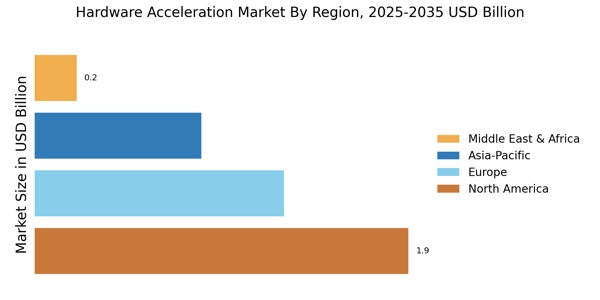
North America is the largest market for hardware acceleration, holding approximately 45% of the global share. The region benefits from a robust technological infrastructure, significant investments in AI and machine learning, and a strong presence of leading companies. Regulatory support for innovation and research further drives growth, with initiatives aimed at enhancing digital transformation across industries. The United States is the primary contributor, with key players like NVIDIA, Intel, and Google leading the charge. The competitive landscape is characterized by rapid advancements in GPU technology and cloud computing solutions. The presence of major tech firms fosters a vibrant ecosystem, ensuring continuous innovation and market expansion.

Europe : Emerging Market with Potential

Europe is witnessing a significant rise in the hardware acceleration market, currently holding around 30% of the global share. The region's growth is driven by increasing demand for high-performance computing and stringent regulations promoting energy efficiency. Initiatives from the European Union to support digital transformation and innovation are also key catalysts for market expansion, enhancing competitiveness in the global arena. Leading countries include Germany, France, and the UK, where major players like AMD and IBM are actively investing in R&D. The competitive landscape is evolving, with a focus on sustainable technologies and partnerships between tech firms and research institutions. This collaboration is crucial for driving advancements in hardware acceleration solutions.

Asia-Pacific : Rapid Growth and Adoption

Asia-Pacific is emerging as a powerhouse in the hardware acceleration market, accounting for approximately 20% of the global share. The region's growth is fueled by rapid digitalization, increasing investments in AI, and a growing demand for cloud services. Countries like China and India are at the forefront, supported by government initiatives aimed at boosting technology adoption and innovation in various sectors. China leads the market, with significant contributions from local companies and international players like Qualcomm and Intel. The competitive landscape is marked by aggressive investments in semiconductor manufacturing and partnerships to enhance technological capabilities. This dynamic environment is expected to drive further growth in hardware acceleration solutions across the region.

Middle East and Africa : Emerging Frontier for Technology

The Middle East and Africa region is gradually emerging in the hardware acceleration market, currently holding about 5% of the global share. The growth is driven by increasing investments in technology infrastructure and a rising demand for advanced computing solutions. Governments are actively promoting digital transformation initiatives, which are expected to catalyze market expansion in the coming years. Leading countries include South Africa and the UAE, where local and international players are beginning to establish a presence. The competitive landscape is still developing, with opportunities for growth in sectors such as finance and telecommunications. As the region continues to invest in technology, hardware acceleration solutions are likely to gain traction, fostering innovation and economic development.

Hardware Acceleration Market Regional Image

Key Players and Competitive Insights

The Hardware Acceleration Market is currently characterized by intense competition and rapid technological advancements, driven by the increasing demand for high-performance computing across various sectors, including artificial intelligence, data analytics, and cloud computing. Major players such as NVIDIA (US), Intel (US), and AMD (US) are strategically positioned to leverage their technological expertise and extensive product portfolios. NVIDIA (US) continues to focus on innovation in GPU technology, while Intel (US) emphasizes its transition towards integrated hardware solutions. AMD (US) is enhancing its competitive edge through aggressive pricing strategies and product diversification. Collectively, these strategies contribute to a dynamic competitive environment, where innovation and technological prowess are paramount.In terms of business tactics, companies are increasingly localizing manufacturing and optimizing supply chains to enhance operational efficiency and reduce costs. The market structure appears moderately fragmented, with a mix of established players and emerging startups. The collective influence of key players shapes market dynamics, as they engage in strategic partnerships and collaborations to bolster their market presence and technological capabilities.

In August NVIDIA (US) announced the launch of its latest GPU architecture, which is designed to accelerate AI workloads significantly. This strategic move not only reinforces NVIDIA's leadership in the hardware acceleration space but also aligns with the growing trend of AI integration across industries. The introduction of this architecture is expected to enhance performance metrics, thereby attracting a broader customer base seeking cutting-edge solutions.

In September Intel (US) unveiled its new line of hardware accelerators aimed at optimizing cloud computing environments. This initiative reflects Intel's commitment to enhancing its product offerings in response to the increasing demand for efficient cloud solutions. By focusing on cloud optimization, Intel positions itself as a key player in the evolving landscape of hardware acceleration, potentially capturing a larger share of the market.

In July AMD (US) entered into a strategic partnership with a leading cloud service provider to develop customized hardware solutions tailored for specific workloads. This collaboration signifies AMD's proactive approach to addressing the unique needs of cloud customers, thereby enhancing its competitive positioning. Such partnerships are likely to foster innovation and drive the development of specialized hardware solutions that cater to diverse market demands.

As of October the competitive landscape is increasingly defined by trends such as digitalization, sustainability, and the integration of artificial intelligence. Strategic alliances among key players are shaping the current market dynamics, facilitating knowledge sharing and resource optimization. Looking ahead, competitive differentiation is expected to evolve, with a pronounced shift from price-based competition towards innovation, technological advancement, and supply chain reliability. Companies that can effectively navigate these trends are likely to secure a competitive advantage in the Hardware Acceleration Market.

Key Companies in the Hardware Acceleration Market include

Industry Developments

October 2018: NVIDIA has created an open-source GPU acceleration platform for major businesses and organisations to analyze enormous amounts of data and make data-driven choices and business predictions at unprecedented speeds. This platform is specifically built for data science and machine learning. This GPU acceleration is thought to be able to accurately detect credit card fraud, analyze client purchase patterns, and more.

Future Outlook

Hardware Acceleration Market Future Outlook

The Hardware Acceleration Market is projected to grow at a remarkable 43.6% CAGR from 2025 to 2035, driven by advancements in AI, machine learning, and data processing technologies.

New opportunities lie in:

  • Development of specialized AI hardware for edge computing applications.
  • Integration of hardware acceleration in cloud service offerings.
  • Creation of customized solutions for high-performance computing sectors.

By 2035, the market is expected to be robust, reflecting substantial growth and innovation.

Market Segmentation

Hardware Acceleration Market Type Outlook

  • Graphics Processing Unit
  • Video Processing Unit
  • AI Accelerator
  • Regular Expression Accelerator
  • Cryptographic Accelerator
  • Others

Hardware Acceleration Market End User Outlook

  • IT and Telecommunication
  • BFSI
  • Retail
  • Hospitality
  • Logistics
  • Automotive
  • Healthcare
  • Energy
  • Others

Hardware Acceleration Market Application Outlook

  • Deep Learning Training
  • Public Cloud Inference
  • Enterprise Inference
  • Others

Report Scope

MARKET SIZE 20244.33(USD Billion)
MARKET SIZE 20256.218(USD Billion)
MARKET SIZE 2035231.88(USD Billion)
COMPOUND ANNUAL GROWTH RATE (CAGR)43.6% (2025 - 2035)
REPORT COVERAGERevenue Forecast, Competitive Landscape, Growth Factors, and Trends
BASE YEAR2024
Market Forecast Period2025 - 2035
Historical Data2019 - 2024
Market Forecast UnitsUSD Billion
Key Companies ProfiledNVIDIA (US), Intel (US), AMD (US), Xilinx (US), Google (US), Microsoft (US), Amazon (US), IBM (US), Qualcomm (US)
Segments CoveredType, Application, End User, Region
Key Market OpportunitiesIntegration of artificial intelligence in the Hardware Acceleration Market enhances processing efficiency and performance.
Key Market DynamicsRising demand for efficient computing drives innovation in hardware acceleration technologies across various industries.
Countries CoveredNorth America, Europe, APAC, South America, MEA

Market Highlights

Author
Ankit Gupta
Senior Research Analyst

Ankit Gupta is an analyst in market research industry in ICT and SEMI industry. With post-graduation in "Telecom and Marketing Management" and graduation in "Electronics and Telecommunication" vertical he is well versed with recent development in ICT industry as a whole. Having worked on more than 150+ reports including consultation for fortune 500 companies such as Microsoft and Rio Tinto in identifying solutions with respect to business problems his opinions are inclined towards mixture of technical and managerial aspects.

Leave a Comment

FAQs

What is the current valuation of the Hardware Acceleration Market as of 2024?

The Hardware Acceleration Market was valued at 4.33 USD Billion in 2024.

What is the projected market size for the Hardware Acceleration Market in 2035?

The market is projected to reach 231.88 USD Billion by 2035.

What is the expected CAGR for the Hardware Acceleration Market during the forecast period 2025 - 2035?

The expected CAGR for the Hardware Acceleration Market during 2025 - 2035 is 43.6%.

Which companies are considered key players in the Hardware Acceleration Market?

Key players include NVIDIA, Intel, AMD, Xilinx, Google, Microsoft, Amazon, IBM, and Qualcomm.

What segment of the Hardware Acceleration Market had the highest valuation in 2024?

The Graphics Processing Unit segment had the highest valuation at 75.0 USD Billion in 2024.

How does the Deep Learning Training application segment perform in the Hardware Acceleration Market?

The Deep Learning Training application segment was valued at 66.0 USD Billion in 2024.

Research Approach

Research Methodology on Hardware Acceleration Market

Abstract

This research report presents a comprehensive research methodology to identify the potential of hardware acceleration technology in the global hardware acceleration market. It outlines the various methods of data procurement using both primary and secondary research. The approaches used covered bottom-up, top down, and factor analysis. In order to ensure the accuracy and validity of forecast data, time series analysis and demand side/supply side data triangulation were used. The results of this research will help to make informed decisions regarding the market and the technological trends.

Introduction

Hardware acceleration technology is a form of technology that increases automated hardware by increasing the efficiency of data processing and computational power. The use of hardware acceleration technology broadens its usage spectrum, resulting in increased efficiency and cut costs. In the current market, hardware acceleration technology works in conjunction with other aspects of technology such as AI and augmented reality. This hardware acceleration technology has caused the hardware acceleration market to reach new heights and now many major players are looking to capitalize on the potential of the technology.

Research Methodology

This research methodology is aimed at providing a comprehensive assessment of the hardware acceleration market and the potential of hardware acceleration technology. In order to assess the current market and its potential, both primary and secondary research techniques are to be employed.

Primary Research

Primary research plays a crucial role in providing accurate and reliable insights into the market. A variety of primary research methods were employed for this project. First, interviews were conducted to get a better understanding of the market. Industry experts and market leaders were consulted to get an understanding of the market structure and trends. Online surveys were also conducted to gain insight into consumer trends, preferences, and general feelings about the hardware acceleration technology.

Secondary Research

Secondary research is the most widely used form of research in businesses and forms a crucial part of this research methodology. It provides a comprehensive overview of the prevailing market conditions and various external factors that affect the market. The primary source of data for this research was the Internet. A variety of sources were used, such as the websites of industry associations, market research reports, company websites, promotional material, and professional publications.

Approaches

Bottom-Up Approach

The bottom-up approach, also known as the grassroots approach, is the process of estimating the actual market size by adding up the individual components that make up the market. This approach was used to connect the dots between the primary and secondary data sources and draw a connection between them.

Top-Down Approach

The top-down approach is the process of estimating the potential market size by deducting external factors such as the macroeconomic environment, international laws, product dynamics, and market trends. The top-down approach was used in conjunction with the bottom-up approach to gain an understanding of the external factors that will shape the future development of hardware acceleration technology and its application within the market.

Factor Analysis

Factor analysis is the process of analyzing the interrelationships between variables to draw a conclusion. Factor analysis is used to assess the impact of different economic, political, and technological factors on the market.

Time Series Analysis

Time series analysis is the process of analyzing historical data in order to project the future movement of the market. This approach was used in order to ensure the accuracy and validity of the forecast data.

Demand Side/Supply Side Data Triangulation

The process of demand-side/supply-side data triangulation is the process of including hard-to-measure variables in the analysis. This is done by incorporating the demand-side data from the consumers and the supply-side data from manufacturers into the analysis. This was done in order to gain an understanding of the actual dynamics of the market.

Conclusion

This research report presents a comprehensive research methodology to identify the potential of hardware acceleration technology in the global hardware acceleration market. It outlines the various methods of data procurement using both primary and secondary research. The approaches used covered bottom-up, top down, and factor analysis. In order to ensure the accuracy and validity of forecast data, time series analysis and demand side/supply side data triangulation were employed. The results of this research will help to make informed decisions regarding the market and the technological trends along with the market forecast from 2023 to 2030.

Download Free Sample

Kindly complete the form below to receive a free sample of this Report

Compare Licence

×
Features License Type
Single User Multiuser License Enterprise User
Price $4,950 $5,950 $7,250
Maximum User Access Limit 1 User Upto 10 Users Unrestricted Access Throughout the Organization
Free Customization
Direct Access to Analyst
Deliverable Format
Platform Access
Discount on Next Purchase 10% 15% 15%
Printable Versions