×
Request Free Sample ×

Kindly complete the form below to receive a free sample of this Report

* Please use a valid business email

Leading companies partner with us for data-driven Insights

clients tt-cursor
Hero Background

Automotive Software Market

ID: MRFR/AT/5771-HCR
100 Pages
Swapnil Palwe
February 2026

Automotive Software Market Research Report By Application (Adaptive Cruise Control, Driver Monitoring Systems, Infotainment Systems, Telematics, Vehicle Management Systems), By Software Type (Operating Systems, Middleware, Application Software, Device Management Software), By End Use (Passenger Cars, Commercial Vehicles, Fleet Management, Autonomous Vehicles), By Deployment Type (On-Premises, Cloud-Based, Hybrid) and By Regional (North America, Europe, South America, Asia Pacific, Middle East and Africa) - Forecast to 2035

Share:
Download PDF ×

We do not share your information with anyone. However, we may send you emails based on your report interest from time to time. You may contact us at any time to opt-out.

Automotive Software Market Infographic
Purchase Options

Automotive Software Market Summary

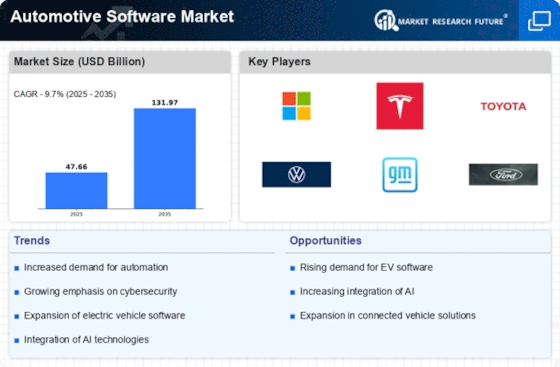
As per Market Research Future analysis, the Automotive Software Market Size was estimated at 47.66 USD Billion in 2024. The Automotive Software industry is projected to grow from 52.29 USD Billion in 2025 to 131.97 USD Billion by 2035, exhibiting a compound annual growth rate (CAGR) of 9% during the forecast period 2025 - 2035

Key Market Trends & Highlights

The Automotive Software Market is experiencing robust growth driven by technological advancements and evolving consumer demands.

  • The rise of connected vehicles is reshaping the automotive landscape, particularly in North America.
  • A strong focus on autonomous driving technologies is evident, with significant investments in Asia-Pacific.
  • Cybersecurity has become a critical concern, prompting manufacturers to enhance their software defenses.
  • The integration of Advanced Driver Assistance Systems (ADAS) and the growing demand for Electric Vehicles (EVs) are key drivers propelling market expansion.

Market Size & Forecast

2024 Market Size 47.66 (USD Billion)
2035 Market Size 131.97 (USD Billion)
CAGR (2025 - 2035) 9.7%

Major Players

Microsoft (US), Tesla (US), Toyota (JP), Volkswagen (DE), General Motors (US), Ford (US), NVIDIA (US), Bosch (DE), Daimler (DE)

Our Impact
Enabled $4.3B Revenue Impact for Fortune 500 and Leading Multinationals
Partnering with 2000+ Global Organizations Each Year
30K+ Citations by Top-Tier Firms in the Industry

Automotive Software Market Trends

The Automotive Software Market is currently experiencing a transformative phase, driven by advancements in technology and evolving consumer expectations. As vehicles become increasingly connected and autonomous, the demand for sophisticated software solutions including auto SaaS platforms is on the rise. This market encompasses a wide range of applications, including vehicle control systems, infotainment, and advanced driver-assistance systems (ADAS) and cloud-based services developed by leading auto software companies.

The integration of artificial intelligence and machine learning into automotive software is reshaping how manufacturers approach vehicle design and functionality. Furthermore, the growing emphasis on sustainability and electric vehicles is prompting innovation within automobile industry software, particularly in areas such as energy management, battery optimization, and vehicle-to-grid communication. In addition to technological advancements, regulatory changes are influencing the Automotive Software Market. 

Governments worldwide are implementing stricter emissions standards and safety regulations, which necessitate the development of compliant software solutions. This regulatory landscape creates both challenges and opportunities for software providers, as they must adapt to new requirements while also striving to enhance user experience. As the market continues to evolve, collaboration between automotive manufacturers and software developers appears essential for fostering innovation and ensuring that vehicles meet the demands of modern consumers. Overall, the Automotive Software Market is poised for substantial growth, driven by a confluence of technological, regulatory, and consumer trends.

Rise of Connected Vehicles

The trend towards connected vehicles is reshaping the Automotive Software Market. As vehicles increasingly integrate with the internet and other devices, the demand for software that facilitates communication and data exchange is growing. This connectivity enhances user experience, enabling features such as real-time navigation, remote diagnostics, and over-the-air updates.

Focus on Autonomous Driving

The pursuit of autonomous driving technology is a significant trend within the Automotive Software Market. Manufacturers are investing heavily in software solutions that support various levels of automation. This includes advanced algorithms for perception, decision-making, and control, which are crucial for the safe operation of self-driving vehicles.

Emphasis on Cybersecurity

As vehicles become more connected, the importance of cybersecurity in the Automotive Software Market is increasing. Protecting vehicles from cyber threats is paramount, leading to the development of robust security measures within software solutions. This trend reflects a growing awareness of the potential risks associated with vehicle connectivity.

Automotive Software Market Drivers

Rise of Mobility as a Service (MaaS)

The rise of Mobility as a Service (MaaS) is reshaping the Automotive Software Market. MaaS platforms integrate various transportation services into a single accessible and customer-friendly interface, allowing users to plan, book, and pay for multiple modes of transport. This trend is gaining traction as urbanization increases and consumers seek more flexible transportation options. By 2025, the MaaS market is anticipated to grow significantly, with software solutions at its core, facilitating seamless connectivity between different transport modes. Automotive software developers are thus focusing on creating robust platforms that support real-time data sharing and user-friendly interfaces, which are essential for the success of MaaS initiatives. This evolution in transportation is likely to drive further innovation and investment in the Automotive Software Market.

Increased Focus on Vehicle Cybersecurity

Increased focus on vehicle cybersecurity is becoming a critical driver in the Automotive Software Market. As vehicles become more connected and reliant on software, the risk of cyber threats escalates. In 2025, it is estimated that the automotive cybersecurity market will reach over 5 billion USD, reflecting the urgent need for robust security measures. Manufacturers are investing heavily in developing software solutions that protect against hacking and data breaches, ensuring the safety of both vehicles and their occupants. This heightened emphasis on cybersecurity not only safeguards consumer trust but also complies with emerging regulations aimed at enhancing vehicle security. Consequently, the demand for advanced cybersecurity software is likely to propel growth within the Automotive Software Market.

Growing Demand for Electric Vehicles (EVs)

The growing demand for Electric Vehicles (EVs) is significantly influencing the Automotive Software Market. As consumers become more environmentally conscious, the shift towards EVs is accelerating, with sales expected to surpass 10 million units by 2025. This transition necessitates advanced software solutions for battery management systems, energy optimization, and vehicle-to-grid communication. Automotive software plays a crucial role in enhancing the performance and efficiency of EVs, which in turn drives the demand for innovative software solutions. Furthermore, the increasing investment in charging infrastructure and government incentives for EV adoption are likely to bolster the Automotive Software Market, as manufacturers seek to integrate cutting-edge software to meet evolving consumer expectations.

Integration of Advanced Driver Assistance Systems (ADAS)

The integration of Advanced Driver Assistance Systems (ADAS) is a pivotal driver in the Automotive Software Market. ADAS technologies enhance vehicle safety and improve the driving experience by providing features such as lane-keeping assistance, adaptive cruise control, and automatic emergency braking. As of 2025, the market for ADAS is projected to reach approximately 30 billion USD, reflecting a compound annual growth rate of around 15%. This growth is largely attributed to increasing consumer demand for safety features and regulatory mandates aimed at reducing road accidents. Consequently, automotive software developers are focusing on creating sophisticated algorithms and software solutions that support these systems, thereby driving innovation within the Automotive Software Market.

Adoption of Artificial Intelligence (AI) in Automotive Software

The adoption of Artificial Intelligence (AI) in automotive software is a transformative driver in the Automotive Software Market. AI technologies are being integrated into various automotive applications, including predictive maintenance, personalized in-car experiences, and autonomous driving systems. By 2025, the AI in automotive market is projected to exceed 10 billion USD, indicating a robust growth trajectory. This surge is driven by the need for enhanced efficiency, improved safety, and superior user experiences. Automotive software developers are increasingly leveraging AI to analyze vast amounts of data, enabling real-time decision-making and optimizing vehicle performance. As AI continues to evolve, its integration into automotive software is likely to redefine industry standards and consumer expectations, further propelling the Automotive Software Market.

Market Segment Insights

By Application: Adaptive Cruise Control (Largest) vs. Telematics (Fastest-Growing)

In the Automotive Software Market, the Application segment is crucial, with notable distribution among Adaptive Cruise Control, Driver Monitoring Systems, Infotainment Systems, Telematics, and Vehicle Management Systems. Adaptive Cruise Control holds the largest market share, reflecting a significant consumer preference for advanced safety features that enhance driving comfort and efficiency. In contrast, Telematics is rapidly gaining traction, propelled by increasing demand for connected vehicles and real-time data services, indicating a shift toward technology that supports smarter driving solutions. Growth trends in this segment are driven by evolving consumer expectations for safety and connectivity in vehicles. The rising popularity of autonomous driving technology also fuels the demand for sophisticated software systems, such as Driver Monitoring Systems, which ensure driver safety. As automakers integrate more digital solutions, the software landscape continues to evolve, with Infotainment Systems enhancing passenger experience through seamless connectivity and entertainment options, thus boosting the overall market growth prospects for these applications.

Adaptive Cruise Control (Dominant) vs. Vehicle Management Systems (Emerging)

Adaptive Cruise Control has established itself as a dominant force in the Automotive Software Market, fundamentally changing the way vehicles operate on the road by using sensors and algorithms to maintain safe distances between cars. This technology enhances driver convenience and safety, aligning with consumer demands for smarter vehicles. On the other hand, Vehicle Management Systems, while currently viewed as emerging, are gaining momentum due to their pivotal role in the management of fleet operations, vehicle maintenance, and optimization of logistics. As vehicle connectivity increases, these systems are expected to evolve rapidly, incorporating artificial intelligence and data analytics for better performance and efficiency, making them essential for future automotive applications.

By Software Type: Application Software (Largest) vs. Device Management Software (Fastest-Growing)

In the Automotive Software Market, the software type segment showcases a diverse distribution of market share among its values. Application Software stands out as the largest contributor, primarily due to its essential role in enhancing vehicle functionalities and user experience through infotainment, navigation, and connected services. Middleware and Operating Systems follow, each playing critical roles in ensuring the integration and communication between various software components embedded in vehicles. Device Management Software, while smaller, is gaining traction as vehicles increasingly depend on connectivity and over-the-air updates, driving its adoption in the market.

Operating Systems (Dominant) vs. Middleware (Emerging)

Operating Systems represent a dominant force in the Automotive Software Market, providing the crucial foundation for managing hardware and executing applications efficiently. They are integral to performance, stability, and user experience in vehicles. In contrast, Middleware is emerging as a significant player, facilitating communication between disparate systems within the vehicle and enabling data flow from sensors to applications. As automotive technologies evolve, the reliance on Middleware to harmonize various components is increasing, making it a vital focus area for software development. This shift underscores the growing complexity of vehicle software architectures and the need for more robust middleware solutions to support advanced functionalities.

By End Use: Passenger Cars (Largest) vs. Autonomous Vehicles (Fastest-Growing)

In the automotive software market, the end use segment showcases a diverse distribution among passenger cars, commercial vehicles, fleet management, and autonomous vehicles. Passenger cars hold the largest market share due to their extensive adoption of advanced software systems for navigation, entertainment, and safety enhancements. Commercial vehicles follow closely, driven by the need for efficiency and compliance in logistics. Meanwhile, autonomous vehicles are gaining traction as technology advances, attracting significant investment and interest.

Passenger Cars (Dominant) vs. Autonomous Vehicles (Emerging)

Passenger cars are firmly positioned as the dominant segment in the automotive software market, leveraging software for enhanced user experience, safety features, and connectivity. This segment benefits from consumer demand for innovative technology, including infotainment systems and driver-assist features. In contrast, autonomous vehicles represent an emerging force within the industry, driven by rapid technological advancements and substantial R&D investments from automakers. As the market shifts towards automation, software solutions tailored for autonomous functions are evolving, paving the way for new business models and opportunities.

By Deployment Type: Cloud-Based (Largest) vs. On-Premises (Fastest-Growing)

The Automotive Software Market has seen a significant shift in deployment preferences, with cloud-based solutions taking the lead in market share. Organizations are gravitating towards cloud-based platforms due to their enhanced scalability, accessibility, and flexibility, allowing for seamless integration with IoT and connected vehicles. On-premises solutions, while still relevant for certain sectors, continue to lose ground to cloud models, reflecting a changing landscape where agility is paramount.

Cloud-Based (Dominant) vs. On-Premises (Emerging)

Cloud-based deployment solutions are redefining the Automotive Software Market by offering extensive capabilities, including real-time data processing, advanced analytics, and superior collaboration tools. This dominance is driven by the increasing adoption of IoT and predictive analytics in automotive applications. Conversely, on-premises deployment models are becoming less favored, as they require substantial infrastructure investments and maintenance. However, they remain an emerging choice for companies needing tighter control over data and compliance with stringent regulations. Their ability to offer security and robustness continues to appeal to organizations prioritizing data governance.

Get more detailed insights about Automotive Software Market

Regional Insights

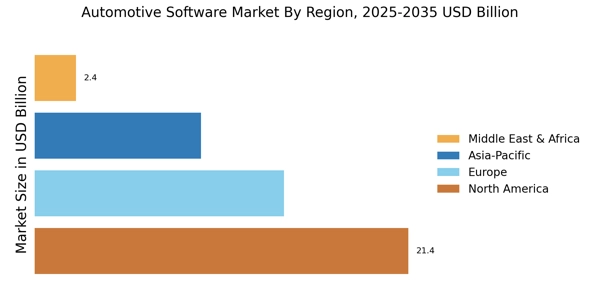
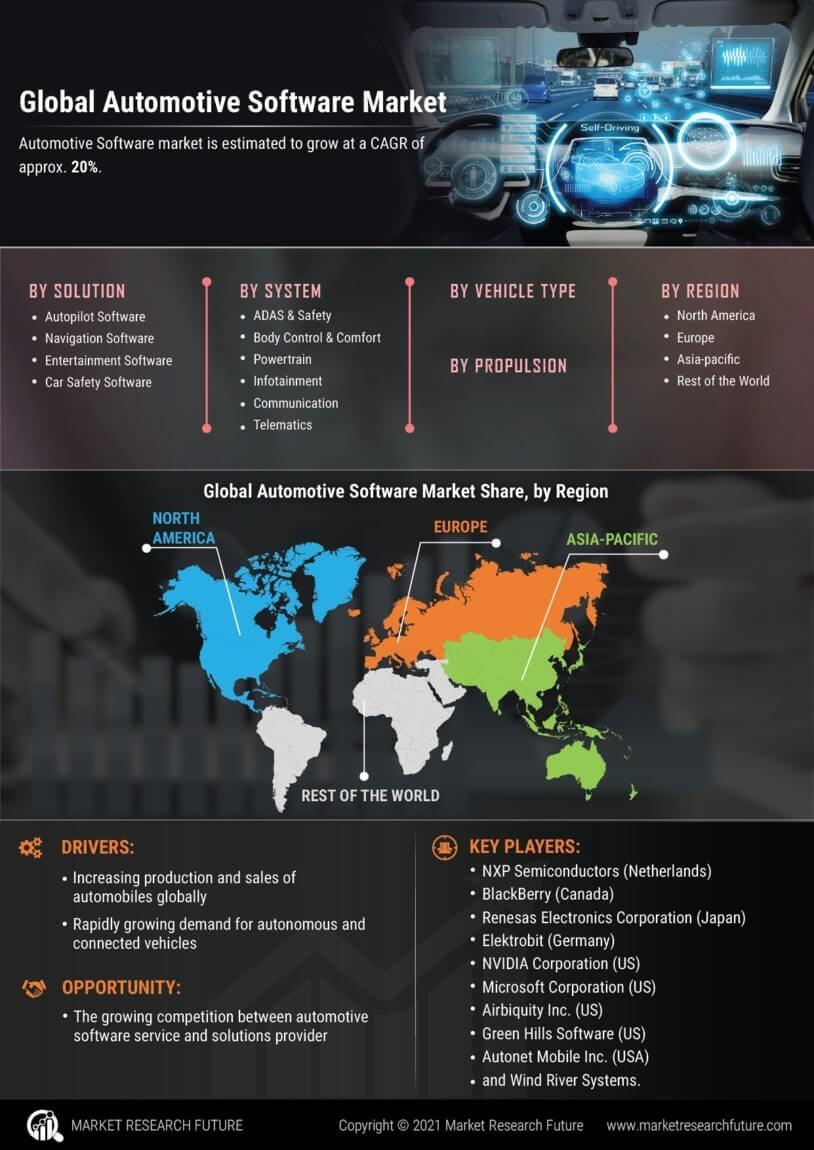
North America led the market with a valuation of 17.3 USD Billion in 2023, highlighting its majority holding in the industry due to advanced technology adoption and a strong automotive sector. Europe followed closely with a valuation of 13.5 USD Billion, presenting itself as a significant contributor thanks to its robust automotive manufacturing and innovation landscape.

The APAC region, valued at 9.0 USD Billion, demonstrated considerable growth opportunities driven by increasing vehicle production and the rising demand for connected vehicles.

South America, though smaller with a valuation of 2.0 USD Billion, gradually gained traction as the automotive industry there evolved. Meanwhile, the MEA segment, valued at 1.65 USD Billion, reflected the emerging markets focusing on advanced automotive technologies and software solutions.

These trends shaped the Automotive Software Market data, offering various growth drivers, including increased demand for electrification and smart mobility solutions, while also presenting challenges such as cybersecurity concerns and integration complexities within automotive systems.

The segmentation of the Automotive Software Market revealed diverse opportunities for stakeholders aiming to capitalize on the expanding automotive landscape.

Automotive Software Market Regional Image

Key Players and Competitive Insights

The Automotive Software Market is experiencing significant growth driven by advancements in automotive technology, electrification trends, and the rise of connected vehicles. As the automotive industry transitions toward more automated driving systems and enhanced functionality, the demand for robust software solutions continues to increase. Competitively, the landscape is marked by key players leveraging technological innovations, partnerships, and strategic acquisitions to strengthen their market position. The competitive insights within this sector reveal that companies are focusing on developing specialized software platforms tailored to diverse automotive applications, including engine management, predictive maintenance, vehicle-to-everything communication, and driver-assistance systems. This evolving market is characterized by a blend of traditional automotive manufacturers and new-age tech firms collaborating to create an ecosystem that supports both hardware and software integration. Renesas has established itself as a formidable player in the Automotive Software Market, specializing in semiconductor solutions essential for vehicle functionality. The company's strength lies in its comprehensive portfolio of automotive software that enhances system efficiency, safety, and performance for a wide range of vehicle applications. Renesas capitalizes on its expertise in microcontrollers and system-on-chip solutions tailored for advanced driver-assistance systems and electric vehicles. Its commitment to innovation is reflected through ongoing research and development efforts, positioning Renesas as a leader in secure automotive solutions that comply with industry standards and regulations. The company's strategic alliances with automotive OEMs further augment its presence in the market, allowing it to effectively address the challenges posed by an increasingly complex automotive landscape. Harman is recognized for its innovative approach to connectivity and consumer electronics within the Automotive Software Market. As a subsidiary of a major telecommunications company, Harman provides a suite of software solutions that enhance the in-vehicle experience through integrated infotainment systems and intelligent connected services. The company focuses on delivering seamless connectivity and data-driven insights, aiding automotive manufacturers in creating a more personalized user experience for drivers and passengers. Harman's strong emphasis on advancing connected car solutions, including over-the-air updates and enhanced cybersecurity measures, solidifies its position within the automotive sector. Moreover, its collaborations with various automotive makers allow it to stay at the forefront of evolving automotive trends, emphasizing the importance of user experience in a rapidly changing market environment.

Key Companies in the Automotive Software Market include

Industry Developments

  • Q2 2024: Volkswagen and Mobileye expand partnership to develop advanced driver-assistance software Volkswagen announced an expanded partnership with Mobileye to co-develop next-generation driver-assistance and autonomous driving software for its upcoming electric vehicle lineup.
  • Q2 2024: Aptiv acquires Wind River for $4.3 Billion to boost automotive software capabilities Aptiv completed its acquisition of Wind River, a leading provider of embedded software, to strengthen its position in the automotive software market and accelerate the development of software-defined vehicles.
  • Q3 2024: Tesla launches new in-car app store for third-party automotive software Tesla unveiled an in-car app store, allowing third-party developers to offer software applications directly to Tesla vehicle owners, marking a significant step in the automotive software ecosystem.
  • Q3 2024: Renault and Google deepen partnership to build software-defined vehicles Renault Group and Google announced a new phase in their collaboration, focusing on co-developing a software platform for future Renault vehicles, leveraging Google’s cloud and AI technologies.
  • Q2 2024: Bosch opens new automotive software development center in Stuttgart Bosch inaugurated a new facility in Stuttgart dedicated to automotive software engineering, aiming to accelerate innovation in connected and autonomous vehicle technologies.
  • Q1 2024: General Motors appoints new Chief Software Officer to lead digital transformation General Motors named a new Chief Software Officer to oversee the company’s growing software operations, reflecting the automaker’s strategic focus on software-driven vehicle features.
  • Q2 2024: Continental wins major contract to supply software for Hyundai’s next-gen EVs Continental AG secured a multi-year contract to provide advanced vehicle software for Hyundai’s upcoming electric vehicle models, focusing on connectivity and safety features.
  • Q3 2024: Nvidia and Mercedes-Benz launch new AI-powered automotive software platform Nvidia and Mercedes-Benz jointly launched a new AI-driven software platform designed to power next-generation infotainment and autonomous driving systems in Mercedes vehicles.
  • Q1 2025: BlackBerry QNX secures contract with Toyota for in-vehicle software platform BlackBerry’s QNX division announced a new contract to supply its secure automotive software platform for Toyota’s future connected vehicles.
  • Q2 2025: Rivian raises $1.2 billion to expand automotive software R&D Electric vehicle maker Rivian closed a $1.2 billion funding round to accelerate research and development of its proprietary automotive software stack, including over-the-air updates and driver-assistance features.
  • Q2 2025: Ford launches new software update platform for connected vehicles Ford introduced a new over-the-air software update platform, enabling real-time delivery of new features and security patches to its connected vehicle fleet.
  • Q1 2025: Stellantis acquires automotive software startup aiMotive Stellantis completed the acquisition of aiMotive, a Budapest-based automotive software startup specializing in autonomous driving technologies, to bolster its software development capabilities.

Future Outlook

Automotive Software Market Future Outlook

The Automotive Software Market is projected to grow at a 9.7% CAGR from 2025 to 2035, driven by advancements in connected vehicles, autonomous driving technologies, and increasing demand for software-based solutions.

New opportunities lie in:

  • Development of advanced driver-assistance systems (ADAS) software solutions. Integration of AI-driven predictive maintenance platforms for fleet management. Expansion of cybersecurity software tailored for automotive applications.

By 2035, the Automotive Software Market is expected to be robust, reflecting substantial growth and innovation.

Market Segmentation

Automotive Software Market End Use Outlook

  • Passenger Cars
  • Commercial Vehicles
  • Fleet Management
  • Autonomous Vehicles

Automotive Software Market Application Outlook

  • Adaptive Cruise Control
  • Driver Monitoring Systems
  • Infotainment Systems
  • Telematics
  • Vehicle Management Systems

Automotive Software Market Software Type Outlook

  • Operating Systems
  • Middleware
  • Application Software
  • Device Management Software

Automotive Software Market Deployment Type Outlook

  • On-Premises
  • Cloud-Based
  • Hybrid

Report Scope

MARKET SIZE 2024 47.66(USD Billion)
MARKET SIZE 2025 52.29(USD Billion)
MARKET SIZE 2035 131.97(USD Billion)
COMPOUND ANNUAL GROWTH RATE (CAGR) 9.7% (2025 - 2035)
REPORT COVERAGE Revenue Forecast, Competitive Landscape, Growth Factors, and Trends
BASE YEAR 2024
Market Forecast Period 2025 - 2035
Historical Data 2019 - 2024
Market Forecast Units USD Billion
Key Companies Profiled Microsoft (US), Tesla (US), Toyota (JP), Volkswagen (DE), General Motors (US), Ford (US), NVIDIA (US), Bosch (DE), Daimler (DE)
Segments Covered Application, Software Type, End Use, Deployment Type, Regional
Key Market Opportunities Integration of advanced driver-assistance systems (ADAS) enhances safety and drives demand in the Automotive Software Market.
Key Market Dynamics Rising demand for advanced driver assistance systems drives innovation in automotive software development and integration.
Countries Covered North America, Europe, APAC, South America, MEA

Market Highlights

Author
Swapnil Palwe
Team Lead - Research

With a technical background as Bachelor's in Mechanical Engineering, with MBA in Operations Management , Swapnil has 6+ years of experience in market research, consulting and analytics with the tasks of data mining, analysis, and project execution. He is the POC for our clients, for their consulting projects running under the Automotive/A&D domain. Swapnil has worked on major projects in verticals such as Aerospace & Defense, Automotive and many other domain projects. He has worked on projects for fortune 500 companies' syndicate and consulting projects along with several government projects.

Leave a Comment

FAQs

What is the projected market valuation of the Automotive Software Market by 2035?

The Automotive Software Market is projected to reach a valuation of 131.97 USD Billion by 2035.

What was the market valuation of the Automotive Software Market in 2024?

In 2024, the Automotive Software Market had a valuation of 47.66 USD Billion.

What is the expected CAGR for the Automotive Software Market during the forecast period 2025 - 2035?

The expected CAGR for the Automotive Software Market during the forecast period 2025 - 2035 is 9.7%.

Which application segment is expected to grow the most in the Automotive Software Market?

The Infotainment Systems segment, valued at 15.0 USD Billion in 2024, is expected to grow significantly, reaching 40.0 USD Billion by 2035.

What are the key players in the Automotive Software Market?

Key players in the Automotive Software Market include Microsoft, Tesla, Toyota, Volkswagen, General Motors, Ford, NVIDIA, Bosch, and Daimler.

How does the Cloud-Based deployment type compare to others in the Automotive Software Market?

The Cloud-Based deployment type, valued at 20.0 USD Billion in 2024, is projected to grow to 60.0 USD Billion by 2035, indicating strong demand.

What is the valuation range for Driver Monitoring Systems in the Automotive Software Market?

The Driver Monitoring Systems segment is valued between 4.0 USD Billion and 12.0 USD Billion, reflecting its growing importance.

What is the expected growth for the Autonomous Vehicles segment by 2035?

The Autonomous Vehicles segment is anticipated to grow from 12.66 USD Billion in 2024 to approximately 30.97 USD Billion by 2035.

Which software type is projected to have the highest valuation by 2035?

Application Software is projected to grow from 20.0 USD Billion in 2024 to 55.0 USD Billion by 2035, indicating robust growth.

What is the valuation range for Vehicle Management Systems in the Automotive Software Market?

The Vehicle Management Systems segment is valued between 13.66 USD Billion and 34.97 USD Billion, showcasing its potential in the market.

Research Approach

Research Methodology on Automotive Software Market

1. Introduction

The Automotive Software market is a rapidly growing and lucrative global market, driven by steadily increasing vehicle sales worldwide and consumer preferences for more connected and automated vehicles, in terms of comfort and convenience.

Automotive software is increasingly playing a major role in the automotive industry as it streamlines the production process and finally contributes to improved quality and cost of components or systems. With the rapid development in automotive software and the surging awareness for safety-critical applications, the trends for this software is on a rise in recent years. Some of the factors that are driving the growth of the market include rising demand for connected services, increasing popularity of autonomous vehicles and an overall increase in the implementation of software in vehicles for diverse functionalities.

2. Research Objectives

The primary objective of this research project is to analyse the Automotive Software market and the factors affecting the market. The following research objectives were made:

  • To identify the market size of the automotive software market and its various segments.
  • To identify the factors driving the growth of the market.
  • To analyse the competitive landscape of the automotive software market.
  • To analyze the future trends of the automotive software market.

3. Research Methodology

The research methodology used in this project is based on Secondary research and Primary research.

3.1 Secondary Research

Secondary research involves the assessment and validation of data gathered by various sources to provide an in-depth understanding of the market scenario, historical data, and current trends. Secondary research provides information about market size, industry analysis, market dynamics and key market players. Moreover, the key manufacturers’ orders and the related market data are studied by leveraging our extensive network of industry experts. Industry websites, press releases, relevant magazines, and other publications are examined to retrieve data used to prepare the research report.

3.2 Primary Research

Primary research focuses on understanding the customer’s needs and preferences. Primary research is used to assess the market size of the automotive software market and various related market components. An online survey is conducted to estimate the demand for automotive software services. The questionnaire includes questions on automotive usage, the purpose of using automotive software, and customer expectations. The survey is conducted among automotive software users. In order to validate the data, interviews are conducted with industry experts including product developers, civil engineers, automotive engineers, and other experts from related industries.

4. Data Collection and Analysis

Data collected from the secondary and primary research methods are quality checked, analyzed and validated by a team of professional experts for accuracy. The data is then used to generate reports. The data analysis approach used in this research study includes analysis of market sizing, segmentation, competitive landscape, and pricing structure.

  • Market Sizing: The estimated data is gathered from marketplace intelligence reports as well as industry survey reports. It is analysed by research analysts and validated by industry experts.

  • Segmentation: The data values are used to segment the automotive software market into various regions, vehicle segments, types, automakers, and sales channels. The market size and growth rate of various segments are calculated.

  • Competitive Landscape: Analysis of data is done to understand the competitive landscape of the Automotive Software market. The data gathered from the research studies are consolidated to study the strength and weaknesses of the key stakeholders in the market.

  • Pricing Structure: The pricing structure of the Automotive Software market is also analyzed. The cost associated with each type of automotive software is considered and compared.

Download Free Sample

Kindly complete the form below to receive a free sample of this Report

Compare Licence

×
Features License Type
Single User Multiuser License Enterprise User
Price $4,950 $5,950 $7,250
Maximum User Access Limit 1 User Upto 10 Users Unrestricted Access Throughout the Organization
Free Customization
Direct Access to Analyst
Deliverable Format
Platform Access
Discount on Next Purchase 10% 15% 15%
Printable Versions