×
Request Free Sample ×

Kindly complete the form below to receive a free sample of this Report

* Please use a valid business email

Leading companies partner with us for data-driven Insights

clients tt-cursor
Hero Background

Under Floor Heating Market

ID: MRFR/PCM/0331-HCR
110 Pages
Sakshi Gupta
February 2026

Under Floor Heating Market Research Report Information By Component (Electric System Components [Heating Cables, Heating Mats, Sensors and Thermostats], Hydronic System Components [Heating Pipes, Manifolds, Sensors and Thermostats]), By Subsystem (Heating Systems [Pipes, Cables and Distribution Units], Control Systems [Sensors and Control Interfaces]), By System Type (Dry/Electric, Wet/Hydronic), By Offering (Hardware,Services), By Installation Type (New Installations, Retrofit Installations) And By Region – Market Forecast Till 2035.

Share:
Download PDF ×

We do not share your information with anyone. However, we may send you emails based on your report interest from time to time. You may contact us at any time to opt-out.

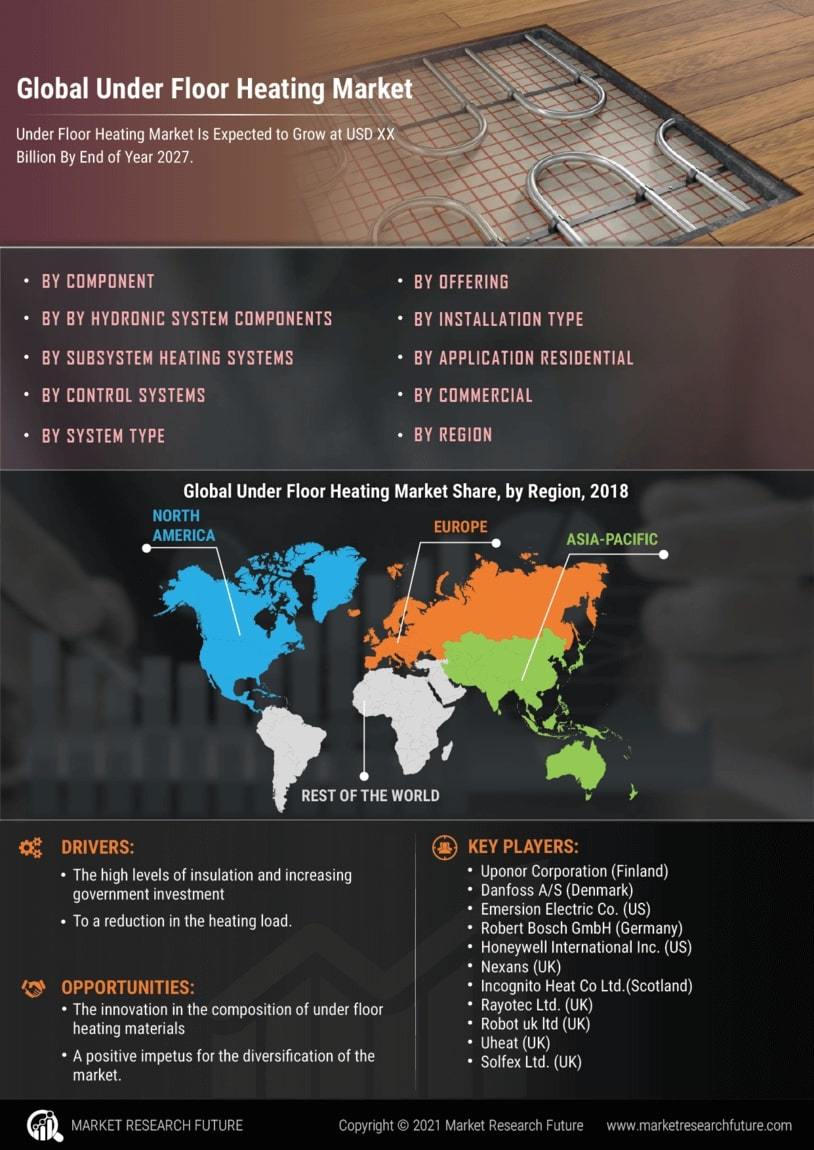
Under Floor Heating Market Infographic
Purchase Options

Under Floor Heating Market Summary

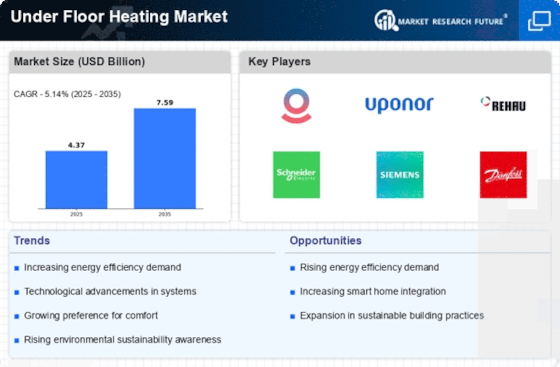
As per Market Research Future analysis, the Under Floor Heating Market Size was estimated at 4.37 USD Billion in 2024. The Under Floor Heating industry is projected to grow from 4.595 USD Billion in 2025 to 7.586 USD Billion by 2035, exhibiting a compound annual growth rate (CAGR) of 5.14% during the forecast period 2025 - 2035

Key Market Trends & Highlights

The Under Floor Heating Market is experiencing robust growth driven by technological advancements and a focus on sustainability.

  • Technological advancements are enhancing the efficiency and appeal of under floor heating systems.
  • The market is increasingly integrating with smart home technologies, reflecting a shift towards automation and convenience.
  • In North America, the demand for dry/electric systems remains dominant, while the Asia-Pacific region shows rapid growth in wet/hydronic solutions.
  • Rising energy efficiency standards and growing demand for comfort and aesthetics are key drivers propelling market expansion.

Market Size & Forecast

2024 Market Size 4.37 (USD Billion)
2035 Market Size 7.586 (USD Billion)
CAGR (2025 - 2035) 5.14%

Major Players

Warmup (GB), Uponor (FI), Rehau (DE), Schneider Electric (FR), Siemens (DE), Danfoss (DK), Nexans (FR), Wavin (NL), ThermoSoft (US)

Our Impact
Enabled $4.3B Revenue Impact for Fortune 500 and Leading Multinationals
Partnering with 2000+ Global Organizations Each Year
30K+ Citations by Top-Tier Firms in the Industry

Under Floor Heating Market Trends

The Under Floor Heating Market is currently experiencing a notable transformation, driven by a combination of technological advancements and evolving consumer preferences. As energy efficiency becomes increasingly paramount, many homeowners and builders are gravitating towards under floor heating systems, which offer a more uniform heat distribution compared to traditional heating methods. This shift is further supported by the growing awareness of environmental sustainability, prompting a demand for systems that utilize renewable energy sources. Consequently, manufacturers are innovating to provide solutions that not only enhance comfort but also align with eco-friendly practices. In addition to energy efficiency, the Under Floor Heating Market is witnessing a rise in smart home integration. Consumers are increasingly seeking systems that can be controlled remotely, allowing for greater convenience and customization. This trend is indicative of a broader movement towards automation in residential settings, where technology plays a crucial role in enhancing the user experience. Furthermore, the expansion of the construction sector, particularly in emerging economies, is likely to bolster the market, as more buildings incorporate under floor heating as a standard feature. Overall, the Under Floor Heating Market appears poised for continued growth, driven by innovation and changing consumer demands.

Technological Advancements

The Under Floor Heating Market is benefiting from rapid technological innovations. New materials and control systems are enhancing efficiency and user experience. Smart thermostats and sensors are becoming commonplace, allowing for precise temperature regulation and energy savings.

Sustainability Focus

There is a growing emphasis on sustainability within the Under Floor Heating Market. Consumers are increasingly aware of their environmental impact, leading to a preference for systems that utilize renewable energy sources. This trend is prompting manufacturers to develop eco-friendly solutions.

Integration with Smart Homes

The integration of under floor heating systems with smart home technology is on the rise. Homeowners are seeking solutions that offer remote control and automation, enhancing convenience and comfort. This trend reflects a broader shift towards connected living environments.

Under Floor Heating Market Drivers

Rising Energy Efficiency Standards

The Under Floor Heating Market is experiencing a notable shift due to increasing energy efficiency standards imposed by regulatory bodies. These standards aim to reduce energy consumption and greenhouse gas emissions, prompting builders and homeowners to adopt more efficient heating solutions. electric underfloor heating systems, which provide uniform heat distribution and reduce energy waste, align well with these standards. As a result, the market is projected to grow, with estimates suggesting a compound annual growth rate of around 7% over the next few years. This trend indicates a strong preference for energy-efficient heating solutions, positioning under floor heating as a viable option for both new constructions and renovations.

Expansion of Construction Activities

The Under Floor Heating Market is poised for growth, driven by the expansion of construction activities across various sectors. As urbanization continues to accelerate, there is a rising need for efficient heating solutions in both residential and commercial buildings. Under floor heating systems are increasingly being integrated into new construction projects due to their energy efficiency and space-saving benefits. According to recent statistics, the construction sector is projected to grow at a rate of approximately 5% annually, which bodes well for the adoption of under floor heating technologies. This expansion presents a significant opportunity for manufacturers and suppliers within the under floor heating market.

Increased Awareness of Health Benefits

There is a growing awareness among consumers regarding the health benefits associated with under floor heating systems. The Under Floor Heating Market is capitalizing on this trend, as these systems can help reduce allergens and dust circulation, creating a healthier indoor environment. Unlike traditional heating methods, under floor heating provides a more consistent temperature, which can be beneficial for individuals with respiratory issues. As health consciousness rises, consumers are more inclined to invest in heating solutions that promote well-being. This shift in consumer behavior is likely to drive demand for under floor heating systems, further solidifying their position in the market.

Growing Demand for Comfort and Aesthetics

Consumer preferences are evolving, with an increasing emphasis on comfort and aesthetics in residential and commercial spaces. The Under Floor Heating Market is benefiting from this trend, as under floor heating systems offer a discreet and visually appealing alternative to traditional radiators. By eliminating visible heating elements, these systems enhance the overall design of interiors. Furthermore, the consistent warmth provided by under floor heating contributes to a more comfortable living environment. Market data indicates that the demand for under floor heating solutions is expected to rise, particularly in luxury and high-end residential projects, where comfort and design are paramount.

Technological Innovations in Heating Solutions

Technological advancements are playing a crucial role in shaping the Under Floor Heating Market. Innovations such as smart thermostats, energy-efficient heating cables, and advanced control systems are enhancing the functionality and efficiency of under floor heating systems. These technologies allow for better temperature regulation and energy management, appealing to environmentally conscious consumers. Market analysis suggests that the integration of smart technology into heating solutions could lead to a significant increase in market penetration. As consumers seek more control over their heating systems, the demand for technologically advanced under floor heating solutions is expected to rise, driving market growth.

Market Segment Insights

By System Type: Dry/Electric (Largest) vs. Wet/Hydronic (Fastest-Growing)

In the Under Floor Heating Market, the Dry/Electric system type dominates the landscape, holding a significant share due to its ease of installation and lower upfront costs. This system is particularly favored in residential settings where rapid heating and energy efficiency are crucial. On the other hand, the Wet/Hydronic system has carved a niche in the commercial sector, growing steadily as more installations adapt to this method, which is known for its higher energy efficiency and effectiveness in larger spaces.

System Type: Dry/Electric (Dominant) vs. Wet/Hydronic (Emerging)

The Dry/Electric under floor heating system is characterized by its straightforward installation process, flexibility, and immediate warmth, making it the preferred choice for homeowners seeking efficient heating solutions. This system primarily utilizes electric cables or mats installed directly under the floor surface, allowing for a quick and easy setup. Conversely, the Wet/Hydronic system circulates warm water through pipes laid beneath the flooring, which is gaining traction among commercial establishments. This emerging technology benefits from long-term energy savings and is increasingly being adopted in eco-conscious constructions due to its ability to integrate with renewable energy sources.

By Offering: Hardware (Largest) vs. Services (Fastest-Growing)

In the Under Floor Heating Market, the segment distribution shows a significant dominance of hardware offerings. Hardware solutions encompass a range of products including heating cables, mats, thermostats, and manifolds, constituting the largest part of the market. Meanwhile, the services segment, which includes installation, maintenance, and consultation, is gaining traction, appealing to consumers seeking comprehensive solutions for their heating needs. This trend illustrates a balanced yet distinct division between tangible products and value-added services in the market.

Offering: Hardware (Dominant) vs. Services (Emerging)

Hardware in the Under Floor Heating Market acts as the backbone of system installations, featuring products that are essential for effective heating. The segment is characterized by its reliability and performance, with key players focusing on innovation to improve energy efficiency and user experience. On the other hand, the services segment is emerging quickly, driven by a growing awareness of the importance of professional installation and maintenance. As consumers become more environmentally conscious, the demand for expert services that can optimize heating solutions is accelerating, highlighting a shift towards holistic solutions. As such, both segments play crucial roles, with hardware establishing a steady foundation and services offering growth potential.

By Installation Type: New Installations (Largest) vs. Retrofit Installations (Fastest-Growing)

The Under Floor Heating Market exhibits a strong preference towards new installations, which constitute the largest segment within the overall market. This preference is driven by the rising construction activities globally, particularly in residential and commercial sectors where new buildings increasingly adapt under floor heating systems for energy efficiency and comfort. Retrofit installations, while smaller in share, are rapidly gaining traction as older infrastructures seek modernization to improve heating efficiency, making them a significant part of the market's landscape.

Installation Type: New Installations (Dominant) vs. Retrofit Installations (Emerging)

New installations are a dominant force in the Under Floor Heating Market, mainly fueled by an increase in construction projects and a growing consumer preference for energy-efficient heating solutions. These systems are increasingly integrated into new constructions, providing a competitive edge in terms of heating efficiency and aesthetic appeal compared to traditional heating methods. Conversely, retrofit installations represent an emerging segment, benefitting from the need to upgrade existing heating systems in older buildings. Many property owners are opting for retrofits due to rising energy costs and a sense of environmental responsibility, highlighting its potential for growth as older infrastructures modernize.

By Information: Electric System Components (Largest) vs. Hydronic System Components (Fastest-Growing)

In the Under Floor Heating Market, Electric System Components hold the largest market share due to their widespread adoption in residential and commercial settings. These components are favored for their ease of installation and ability to provide consistent and controllable heating. On the other hand, Hydronic System Components are emerging rapidly, appealing to consumers looking for energy-efficient alternatives. As energy prices rise, the demand for hydronic systems that utilize water as a heating medium is also increasing, thus carving out their share of the market.

Heating System: Electric Components (Dominant) vs. Hydronic Components (Emerging)

Electric System Components are currently the dominant choice in the Under Floor Heating Market, recognized for their efficiency, quick installation, and flexibility that cater to various building layouts. They operate using electric wires or mats to generate heat, providing a responsive heating solution. Conversely, Hydronic System Components are an emerging alternative, utilizing heated water circulated through pipes to deliver heat. These systems are increasingly popular for their energy-saving potential, particularly in larger buildings and those with higher thermal mass. As sustainability becomes a focal point, hydronic control systems are expected to gain traction among eco-conscious consumers.

By Subsystem: Heating Systems (Largest) vs. Control Systems (Fastest-Growing)

The Under Floor Heating Market is segmented into Heating Systems and Control Systems, with Heating Systems commanding the largest share of the market. These systems encompass a variety of technologies designed for efficient heat distribution, with a significant portion of market participants favoring radiant floor heating methods. On the other hand, Control Systems, while currently lower in market share, are showing remarkable growth due to increasing demand for smart home integration and energy management across residential and commercial properties.

Systems: Heating (Dominant) vs. Control (Emerging)

Heating Systems are established as the dominant technology in the Under Floor Heating Market, known for their versatility and efficiency in maintaining thermal comfort. These systems offer different heating methods, including electric and hydronic systems, catering to diverse consumer needs. Conversely, Control Systems represent an emerging segment, gaining traction as their capabilities for energy savings and automated comfort control become increasingly recognized. Manufacturers are innovating with user-friendly interfaces, enhancing compatibility with smart home devices, and promoting energy-efficient features that appeal to eco-conscious consumers, leading to a more favorable market perception.

Get more detailed insights about Under Floor Heating Market

Regional Insights

North America : Energy Efficiency Leader

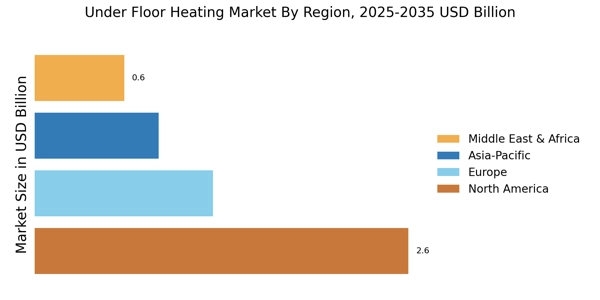
The North American under floor heating market is driven by increasing energy efficiency regulations and a growing preference for sustainable heating solutions. The U.S. holds the largest market share at approximately 60%, followed by Canada at around 25%. The demand for energy-efficient heating systems is further fueled by government incentives and consumer awareness regarding energy savings. Leading the market are the U.S. and Canada, with significant contributions from key players like ThermoSoft and Schneider Electric. The competitive landscape is characterized by innovation and technological advancements, with companies focusing on smart heating solutions. The presence of established brands and a growing number of residential and commercial projects are expected to enhance market growth in the region.

Europe : Innovative Heating Solutions

Europe is witnessing robust growth in the under floor heating market, driven by stringent energy efficiency regulations and a shift towards renewable energy sources. Germany and the UK are the largest markets, holding approximately 30% and 25% market shares, respectively. The European Union's commitment to reducing carbon emissions is a significant catalyst for the adoption of under floor heating systems. Key players like Uponor and Rehau are leading the competitive landscape, supported by a strong presence of local manufacturers. The market is characterized by innovation, with a focus on smart technologies and integration with renewable energy systems. The increasing demand for energy-efficient solutions in both residential and commercial sectors is expected to further propel market growth in Europe.

Asia-Pacific : Emerging Market Potential

The Asia-Pacific region is experiencing rapid urbanization, which is significantly driving the demand for under floor heating systems. China and Japan are the largest markets, accounting for approximately 40% and 20% of the market share, respectively. The increasing focus on energy-efficient heating solutions and government initiatives promoting sustainable construction practices are key growth drivers in this region. China's growing middle class and rising disposable incomes are leading to increased investments in residential heating solutions. The competitive landscape features key players like Siemens and Nexans, who are focusing on expanding their product offerings and enhancing technological capabilities. The region's market is expected to grow as more consumers recognize the benefits of under floor heating systems in terms of comfort and energy savings.

Middle East and Africa : Untapped Market Opportunities

The Middle East and Africa region is gradually recognizing the benefits of under floor heating systems, driven by increasing construction activities and a growing interest in modern heating solutions. The UAE and South Africa are the largest markets, holding approximately 35% and 20% market shares, respectively. The region's focus on energy efficiency and sustainable building practices is expected to catalyze market growth in the coming years. Key players like Wavin and Danfoss are establishing a presence in this emerging market, focusing on innovative solutions tailored to local needs. The competitive landscape is evolving, with an increasing number of local manufacturers entering the market. As awareness of under floor heating benefits grows, the region is poised for significant growth in this sector.

Under Floor Heating Market Regional Image

Key Players and Competitive Insights

The Under Floor Heating Market is currently characterized by a dynamic competitive landscape, driven by increasing demand for energy-efficient heating solutions and advancements in technology. Key players such as Warmup (GB), Uponor (FI), and Danfoss (DK) are strategically positioning themselves through innovation and regional expansion. Warmup (GB) focuses on enhancing product offerings with smart technology integration, while Uponor (FI) emphasizes sustainable solutions and partnerships to broaden its market reach. Danfoss (DK) is actively pursuing digital transformation initiatives to optimize its operations and improve customer engagement. Collectively, these strategies contribute to a competitive environment that is increasingly focused on technological advancement and sustainability.
In terms of business tactics, companies are localizing manufacturing to reduce costs and improve supply chain efficiency. The Under Floor Heating Market appears moderately fragmented, with several key players exerting influence over various regional markets. This fragmentation allows for niche players to thrive, while larger companies leverage their scale to optimize operations and enhance product offerings. The collective influence of these key players shapes market dynamics, as they compete not only on price but also on innovation and service quality.
In August 2025, Warmup (GB) launched a new range of smart underfloor heating systems that integrate with home automation platforms. This strategic move is significant as it aligns with the growing consumer preference for smart home technologies, potentially enhancing Warmup's market share in the premium segment. The integration of smart technology not only improves user experience but also positions the company as a leader in innovation within the sector.
In September 2025, Uponor (FI) announced a partnership with a leading renewable energy provider to develop hybrid heating solutions. This collaboration is crucial as it reflects Uponor's commitment to sustainability and its strategy to offer comprehensive heating solutions that meet the evolving needs of environmentally conscious consumers. By aligning with renewable energy initiatives, Uponor enhances its brand reputation and expands its market presence in the green technology space.
In July 2025, Danfoss (DK) unveiled a new digital platform aimed at optimizing energy management for underfloor heating systems. This initiative is particularly relevant as it underscores Danfoss's focus on digital transformation and its efforts to provide customers with advanced tools for energy efficiency. The platform not only enhances operational efficiency but also positions Danfoss as a forward-thinking player in the market, capable of meeting the demands of a tech-savvy consumer base.
As of October 2025, current competitive trends in the Under Floor Heating Market are increasingly defined by digitalization, sustainability, and the integration of artificial intelligence. Strategic alliances are becoming more prevalent, as companies recognize the value of collaboration in enhancing product offerings and market reach. Looking ahead, competitive differentiation is likely to evolve from traditional price-based competition to a focus on innovation, technology integration, and supply chain reliability. This shift suggests that companies that prioritize these aspects will be better positioned to thrive in an increasingly competitive landscape.

Key Companies in the Under Floor Heating Market include

Industry Developments

Danfoss Icon2 system, which offers hydronic underfloor heating precise and effective control, was introduced into the market by Danfoss in February 2023.

March 2022: Unitherm Heating Systems launched a complete underfloor heating solution package targeting UK contractors and developers. Unitherm, on the other hand, claims it can deliver an entire design and precise quote within 48 hours after receiving the order.

Feenstra also introduced a traditional single-family house high-temperature heating pump system in the Netherlands that can be easily substituted with the commonly used gas centralized heating boilers in January 2022.

In November 2021, nVent Electric PLC launched its commercial software, enhanced with features such as work packing and heat mapping. It also presented software that has the ability to discipline a heat management system design alongside integrating 3D plant modeling systems provided by the client.

Daikin has also recently launched its Daikin Altherma 3 H MT model back in November 2021. It is another additional product to their growing list of sustainable heating systems that provide consistent temperatures regardless of geographical location. What sets this kind of heating system apart is the fact that it is designed to heat water using external air – as long as that temperature is above -28°C, hot water will be produced without any issue.

As an example of the current device availability, Meross, an electrical floor heating system manufacturer based in China, introduced an internet-connected thermostat in November 2021, broadening the user base. The innovative device is built to operate out of a screen made of glass and includes a clickable LED light that illuminates when the user is managing the heater system, greatly simplifying the process of widescale heating with the added bonus of looking sophisticated.

As an illustration, in February 2021, British Polypipe Group PLC, a manufacturer of water and weather control systems, said it had completed the buyout of the British Company – Nu-Heats (Holdings) Limited – which is also engaged in selling sustainable underfloor heating systems, air and ground source heat pumps, and other equipment for producing energy – on a cash-free and debt-free basis with a total value of 27 million British pounds.

Esteemed Polypipe Group will further strengthen its market position with the new acquisition that enables expansion of the underfloor heating competencies and methods for combining underfloor heating, heat pumps and air-based climate managing systems.

Future Outlook

Under Floor Heating Market Future Outlook

The Under Floor Heating Market is projected to grow at a 5.14% CAGR from 2025 to 2035, driven by increasing energy efficiency demands and technological advancements.

New opportunities lie in:

  • Expansion into smart home integration solutions
  • Development of eco-friendly heating materials
  • Partnerships with construction firms for new builds

By 2035, the market is expected to be robust, driven by innovation and strategic partnerships.

Market Segmentation

Under Floor Heating Market Offering Outlook

  • Hardware
  • Services

Under Floor Heating Market Subsystem Outlook

  • Heating Systems
  • Control Systems

Under Floor Heating Market Information Outlook

  • Electric System Components
  • Hydronic System Components

Under Floor Heating Market System Type Outlook

  • Dry/Electric
  • Wet/Hydronic

Under Floor Heating Market Installation Type Outlook

  • New Installations
  • Retrofit Installations

Report Scope

MARKET SIZE 2024 4.37(USD Billion)
MARKET SIZE 2025 4.595(USD Billion)
MARKET SIZE 2035 7.586(USD Billion)
COMPOUND ANNUAL GROWTH RATE (CAGR) 5.14% (2025 - 2035)
REPORT COVERAGE Revenue Forecast, Competitive Landscape, Growth Factors, and Trends
BASE YEAR 2024
Market Forecast Period 2025 - 2035
Historical Data 2019 - 2024
Market Forecast Units USD Billion
Key Companies Profiled Warmup (GB), Uponor (FI), Rehau (DE), Schneider Electric (FR), Siemens (DE), Danfoss (DK), Nexans (FR), Wavin (NL), ThermoSoft (US)
Segments Covered Component, Subsystem, System Type, Offering, Installation Type, Region – Market Forecast Till 2035.
Key Market Opportunities Integration of smart home technology enhances efficiency in the Under Floor Heating Market.
Key Market Dynamics Rising consumer preference for energy-efficient heating solutions drives innovation and competition in the under floor heating market.
Countries Covered North America, Europe, APAC, South America, MEA

Market Highlights

Author
Sakshi Gupta
Research Analyst Level II

I have about two years of experience working in the consumer goods and retail industries and I am a biotech graduate.A tech-savvy analytically focused professional with a strong capabilities in identification, concept generation, and strategy evaluation. I can produce data-driven solutions while fusing unusual viewpoints with original concepts. I have been extensively working on business case studies, competitive & comparative analyses, and strategic reports. My primary areas of experience include client management, financial analysis, supply chain evaluation, market entry strategy evaluation, and estimating and forecasting market size.

Leave a Comment

FAQs

What is the current valuation of the Under Floor Heating Market as of 2024?

The Under Floor Heating Market was valued at 4.37 USD Billion in 2024.

What is the projected market valuation for the Under Floor Heating Market in 2035?

The market is projected to reach 7.586 USD Billion by 2035.

What is the expected CAGR for the Under Floor Heating Market during the forecast period 2025 - 2035?

The expected CAGR for the Under Floor Heating Market during 2025 - 2035 is 5.14%.

Which companies are considered key players in the Under Floor Heating Market?

Key players include Warmup, Uponor, Rehau, Schneider Electric, Siemens, Danfoss, Nexans, Wavin, and ThermoSoft.

What are the two main system types in the Under Floor Heating Market?

The two main system types are Dry/Electric and Wet/Hydronic systems.

What was the market size for Dry/Electric systems in 2024?

The market size for Dry/Electric systems was 2.185 USD Billion in 2024.

Research Approach

Research Methodology on Under Floor Heating Market

This report is prepared to offer an in-depth analysis of the current market size of the Under Floor Heating Market across the globe and its forecast till 2030. For this, extensive research and analysis have been conducted extensively to capture the market dynamics accurately. Also, a thorough investigation was conducted to assess the current trends, market outlook, drivers, restraints, and opportunities that exist in the market. The report aims to provide the stakeholders with an accurate assessment of the market and key insights into the Under Floor Heating Market.

Research Objectives

The primary objective of this report is to offer an exhaustive assessment of the Under Floor Heating Market across the globe. The analysis presented in the report has been conducted across various regions and countries including- North America, Europe, Asia-Pacific, and the Rest of the World. This report covers different aspects of the Under Floor Heating Market such as the size of the market, revenue estimation, market drivers, challenges, value chain analysis, and regional and country-level market analysis.

Research Sources and Methods

The research sources used for the compilation of this report included industry publications, secondary sources, industry associations, and printed and online sources. The report covers an in-depth analysis of the Under Floor Heating Market by using various Nationally recognized organizations and companies’ data sources. The secondary data used for market sizing and market forecasting has come from primary data sources such as news articles, magazines, surveys, and interviews. The primary data sources have been supplemented by industry bodies.

Market Size Estimation

The market size estimation conducted in this study was based on a bottom-up approach. To determine the market size and the estimated total market, a combination of top-down and bottom-up approaches has been employed. The Under Floor Heating Market size estimated in the bottom-up approach has been validated using the top-down approach. Multiple data points have been gathered and analyzed to ascertain the accurate market size of the Under Floor Heating market. Once the market size was determined, the next step was to compute the revenue estimation and market share of the key players operating in the Under Floor Heating market.

Demand Side Data Triangulation

The market size was determined based on the demand-side data triangulation approach. This approach included an in-depth review and analysis of market dynamics, penetration of Under Floor Heating systems, current and future trends in the demand for Under Floor Heating systems, the market size across different regions and a review of the various market participants.

Supply Side Data Triangulation

The supply-side data triangulation used in this study was based on the historical data regarding the Under Floor Heating market, and the input from the interviews conducted with different market participants, such as production companies, suppliers, distributors, and research institutes. This supply-side data triangulation approach has been used to estimate the market size and its further analysis for different regions.

Market Forecasting

The market forecast presented in this report was derived based on an in-depth analysis of the market dynamics, past and future market trends, and the present and future market size. The market is expected to witness growth in the coming years due to various factors such as increasing demand for energy-efficient systems, rising technological advancements in the field of Under Floor Heating systems, and the increasing proliferation of such systems in residential and commercial applications. The forecast presented in this report is based on a detailed time-series analysis, which includes various macroeconomic indicators such as GDP, population growth, global industrial output, and various others.

Data Analysis

The market analysis conducted in this study was based on an in-depth analysis of the extensive data gathered from various sources. This includes demand-side data, supply-side data, macroeconomic indicators, and various other factors. The collected data was analyzed using various analytical tools such as factor analysis, linear regression analysis, and others to draw meaningful conclusions. The data analysis was further segmented into regional and country-level components to gain a better understanding of the market dynamics.

Conclusion

The research conducted in this report is comprehensive and provides a thorough assessment of the Under Floor Heating Market across the globe. This report provides an in-depth analysis of the market size, current and future market trends, market drivers, restraints, and opportunities. The report also covers an in-depth analysis of the competitive landscape, market strategies, value chain analysis, regional and country-level market analysis, and other factors that impact the Under Floor Heating Market.

Download Free Sample

Kindly complete the form below to receive a free sample of this Report

Compare Licence

×
Features License Type
Single User Multiuser License Enterprise User
Price $4,950 $5,950 $7,250
Maximum User Access Limit 1 User Upto 10 Users Unrestricted Access Throughout the Organization
Free Customization
Direct Access to Analyst
Deliverable Format
Platform Access
Discount on Next Purchase 10% 15% 15%
Printable Versions