Workforce Management Market

劳动力管理市场规模、份额和研究报告:按软件类型(考勤管理、员工排班、绩效管理、请假管理、劳动力分析)、按部署类型(云、内部部署、混合)、按组织规模(小型企业、中型企业、大型企业)、按最终使用行业(医疗保健、零售、制造、酒店、银行和金融服务)以及按地区(北美、欧洲、南美、亚太、中东和非洲)- 行业预测到2035年
ID: MRFR/ICT/1763-CR 200 Pages Aarti Dhapte Last Updated: September 21, 2026
Workforce Management Market
Market Size
Forecast Period2025 - 2035
CAGR (2025 - 2035)8.01%
2024 Market Size$ 8.58 Billion
2025 Market Size$ 9.27 Billion
2035 Market Size$ 20.03 Billion
Key Players
Kronos
ADP
Ceridian
Workday
SAP
Oracle
Opportunities
  • Rising Demand for Operational Efficiency
  • Increased Focus on Compliance and Regulation
  • Emphasis on Employee Well-being and Engagement

Workforce Management Market 摘要

根据市场研究未来的分析,劳动力管理市场规模在2024年预计为85.8亿美元。劳动力管理行业预计将从2025年的92.67亿美元增长到2035年的200.3亿美元,在2025年至2035年的预测期内,年均复合增长率(CAGR)为8.01%。

主要市场趋势和亮点

劳动力管理市场正在经历由技术进步和不断变化的工作场所动态驱动的变革性转变。

  • 人工智能的整合正在重塑整个行业的运营流程。
  • 员工参与仍然是一个焦点,影响着北美和亚太地区的战略。
  • 基于云的解决方案主导市场,而混合模型在应对变化的工作环境中迅速获得关注。
  • 对运营效率的需求上升以及对合规性的关注增加是推动市场增长的关键因素。

市场规模与预测

2024市场规模 85.8(十亿美元)
2035市场规模 200.3(十亿美元)
复合年增长率(2025 - 2035) 8.01%

主要参与者

Kronos(美国),ADP(美国),Ceridian(美国),Workday(美国),SAP(德国),Oracle(美国),Ultimate Software(美国),Paychex(美国),Zenefits(美国)

Workforce Management Market Drivers

运营效率的需求上升

劳动力管理市场正在经历对运营效率的显著需求激增。组织越来越认识到优化劳动力以提高生产力和降低成本的必要性。根据最近的数据,实施有效劳动力管理解决方案的公司可以实现高达30%的生产力提升。这一趋势是由于简化流程和改善资源分配的必要性。随着企业努力保持竞争力,对运营效率的关注可能会推动劳动力管理市场的增长。此外,先进分析和报告工具的整合使组织能够做出数据驱动的决策,从而增强其运营能力。

对合规性和法规的关注增加

劳动力管理市场正在见证对合规性和法规的关注增加。组织面临越来越大的压力,必须遵守劳动法和法规,这需要强大的劳动力管理解决方案。这些解决方案的实施帮助企业避免高昂的罚款和法律问题。最近的数据表明,投资于以合规为重点的劳动力管理系统的公司可以将与合规相关的成本降低高达25%。这一趋势可能会推动劳动力管理市场的增长,因为组织优先考虑合规以降低风险。此外,劳动力管理软件中合规功能的整合正成为企业的标准期望。

强调员工福祉和参与度

对员工福祉和参与度的强调正成为劳动力管理市场的关键驱动力。组织越来越认识到营造积极工作环境以提高员工满意度和留任率的重要性。最近的研究表明,优先考虑员工参与的公司可以实现20%的生产力提升。这种对福祉的关注促使企业投资于促进更好沟通、反馈和支持员工的劳动力管理解决方案。随着对这种解决方案的需求增长,劳动力管理市场可能会扩大,推动创造一个更有参与感和积极性的劳动力的需求。

劳动力管理中的技术进步

技术进步在塑造劳动力管理市场中发挥着关键作用。复杂软件解决方案的出现,包括预测分析和机器学习,正在改变组织管理劳动力的方式。这些技术促进了对劳动力需求的更好预测,并提高了排班效率。最近的统计数据显示,利用先进劳动力管理工具的公司可以将劳动力成本降低约20%。随着组织越来越多地采用这些技术,劳动力管理市场有望实现显著增长。技术的持续演变不仅提高了运营效率,还通过提供更灵活的工作安排增强了员工满意度。

向远程和灵活工作安排的转变

向远程和灵活工作安排的转变正在显著影响劳动力管理市场。随着组织适应变化的工作环境,对有效管理远程团队的需求日益增长。这一趋势导致对支持远程监控、排班和绩效跟踪的劳动力管理解决方案的需求增加。最近的调查显示,约70%的公司现在正在利用劳动力管理工具有效管理远程员工。这一转变可能会继续推动劳动力管理市场的增长,因为企业寻求在灵活的工作环境中保持生产力和参与度。

市场细分洞察

按软件类型:考勤管理(最大)与劳动力分析(增长最快)

在劳动力管理市场中,考勤管理占据主导地位,拥有最大的市场份额。紧随其后的是员工排班和绩效管理,它们在市场中也发挥着重要作用。请假管理的市场份额较小,但至关重要,而劳动力分析由于对数据驱动决策的日益关注而受到关注。这种分布突显了一个多样化的竞争格局,传统和新兴解决方案共存。

考勤管理(主导)与劳动力分析(新兴)

考勤管理被认为是劳动力管理市场中主导的软件类型。该细分市场对于准确跟踪员工工时、确保合规性和降低劳动成本至关重要。组织优先考虑这款软件,因为它在劳动力优化中扮演着基础角色。相比之下,劳动力分析是一个新兴细分市场,因其将原始数据转化为战略洞察的能力而迅速获得关注。公司越来越多地利用分析来优化人员配置、改善绩效指标和增强员工参与度。因此,尽管考勤管理仍然至关重要,但劳动力分析正在开辟出一个重要的细分市场,因为组织寻求利用数据来增强决策能力。

按部署类型:云(最大)与混合(增长最快)

劳动力管理市场正在经历部署类型的重大变化,目前基于云的解决方案占据最大的市场份额。组织欣赏云部署所提供的可扩展性、可访问性和成本效益。同时,混合系统正在迅速发展,因其能够结合云和本地基础设施的优势。这种分布突显了在劳动力管理解决方案中偏向灵活性和敏捷性的明显趋势。

云(主导)与本地(新兴)

在当前的劳动力管理市场中,云部署作为主导力量脱颖而出,许多组织因其易于集成和较低的前期成本而偏爱它。另一方面,本地解决方案作为一种替代方案正在出现,适合那些优先考虑数据控制和安全性的企业。虽然云系统允许远程访问和实时更新,但本地设置满足了对合规性和操作要求严格的组织的独特需求。这些部署的对比特征突显了企业在劳动力管理中所面临的多样化需求。

按组织规模:小型企业(最大)与大型企业(增长最快)

在劳动力管理市场中,组织规模的市场份额分布揭示了一个独特的格局。小型企业占据最大的市场份额,表明它们的显著存在以及对量身定制的可扩展劳动力解决方案的持续需求。该细分市场依赖于经济实惠和易于实施,使其成为初创企业和地方企业的首选。另一方面,大型企业作为市场中增长最快的细分市场正在崛起。它们的增长主要是由于对先进劳动力解决方案的需求,以管理复杂的运营并提高效率。技术创新和日益增加的合规要求推动了对量身定制的劳动力管理系统的需求,以应对大型组织面临的独特挑战。

小型企业:主导与大型企业:新兴

小型企业在劳动力管理市场中占据主导地位,因为它们具有广泛的适应性和利用适合其运营规模的定制解决方案的能力。这些组织通常寻求经济实惠的技术,以简化流程而无需大量内部资源。与此同时,大型企业作为一个重要的细分市场,寻求更复杂的劳动力管理解决方案。它们的特点是复杂的组织结构,需要分析、自动化和与现有系统集成等高级功能。随着大型企业对这些技术的投资,它们不仅提高了运营效率,还为其在市场中快速增长的份额做出了贡献。

按最终使用行业:医疗保健(最大)与零售(增长最快)

在劳动力管理市场中,医疗保健行业占据最大的市场份额,反映出医院和诊所对高效人员配置和合规管理的迫切需求。该细分市场受到对医疗服务需求不断增加和管理多样化劳动力的复杂性推动,导致其在市场中占据重要地位。与此同时,零售行业正在迅速发展,因为它与技术进步和客户体验提升相一致,随着企业适应不断变化的消费者需求和劳动力管理技术,显示出良好的增长前景。

医疗保健:主导与零售:新兴

医疗保健细分市场在劳动力管理市场中占据主导地位,原因在于严格的法规和优化员工排班以满足患者护理需求的必要性。医疗保健组织越来越依赖先进的劳动力管理解决方案来处理合规性、效率和人力资源的复杂性。另一方面,零售行业正在迅速崛起,推动其对动态劳动力管理工具的需求,以适应季节性招聘和工作流程调整。零售公司正在采用分析和自动化来提高运营效率、改善员工参与度,并更好地管理客户流量的波动。

获取关于Workforce Management Market的更多详细见解

区域洞察

North America : Market Leader in Workforce Solutions

North America is the largest market for workforce management solutions, accounting for approximately 45% of the global market share. The region's growth is driven by technological advancements, increasing demand for automation, and stringent labor regulations. Companies are increasingly adopting cloud-based solutions to enhance operational efficiency and compliance with labor laws. The U.S. and Canada are the primary contributors to this growth, with a strong focus on integrating AI and analytics into workforce management systems. The competitive landscape in North America is robust, featuring key players such as Kronos, ADP, and Ceridian. These companies are continuously innovating to meet the evolving needs of businesses. The presence of a large number of SMEs and large enterprises further fuels the demand for effective workforce management solutions. Additionally, the region benefits from a well-established IT infrastructure, enabling seamless integration of advanced technologies into workforce management practices.

Europe : Emerging Trends in Workforce Management Market

Europe is witnessing significant growth in the workforce management market, holding approximately 30% of the global share. The region's expansion is largely driven by regulatory requirements, such as GDPR, which necessitate robust data management solutions. Additionally, the increasing focus on employee well-being and productivity is pushing organizations to adopt advanced workforce management systems. Countries like Germany and the UK are leading this growth, emphasizing compliance and efficiency in workforce operations. The competitive landscape in Europe is characterized by a mix of established players and innovative startups. Key companies such as SAP and Oracle are at the forefront, offering comprehensive solutions tailored to meet regional needs. The presence of diverse industries, from manufacturing to services, creates a dynamic environment for workforce management solutions. As organizations seek to enhance operational efficiency, the demand for integrated systems that support remote work and flexible scheduling is on the rise.

Asia-Pacific : Rapid Growth in Workforce Solutions

Asia-Pacific is emerging as a significant player in the workforce management market, accounting for approximately 20% of the global share. The region's growth is fueled by rapid industrialization, a growing labor force, and increasing adoption of digital technologies. Countries like China and India are leading this trend, with a strong emphasis on enhancing productivity and operational efficiency through advanced workforce management solutions. The demand for cloud-based systems is particularly high, driven by the need for scalability and flexibility in workforce operations. The competitive landscape in Asia-Pacific is diverse, with both The Workforce Management Market share. Companies such as Workday and Ultimate Software are expanding their presence, while local firms are innovating to cater to regional needs. The increasing focus on employee engagement and performance managementis shaping the market, as organizations seek to leverage technology to optimize their workforce. As the region continues to grow, the demand for integrated solutions that support diverse work environments is expected to rise.

Middle East and Africa : Growing Demand for Workforce Solutions

The Middle East and Africa region is gradually emerging in the workforce management market, holding about 5% of the global share. The growth is driven by increasing investments in technology and a rising focus on improving labor productivity. Countries like the UAE and South Africa are at the forefront, implementing workforce management solutions to enhance operational efficiency and compliance with local labor laws. The region's diverse economic landscape presents unique opportunities for tailored workforce management solutions. The competitive landscape in the Middle East and Africa is evolving, with both international and regional players entering the market. Companies are increasingly recognizing the importance of effective workforce management in achieving business objectives. The presence of key players, along with a growing number of startups, is fostering innovation and competition. As organizations in this region seek to adapt to changing workforce dynamics, the demand for comprehensive solutions that address local challenges is expected to grow.
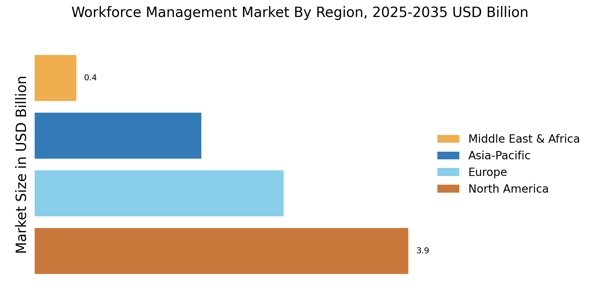

Workforce Management Market Regional Image

主要参与者和竞争洞察

The Workforce Management Market is currently characterized by a dynamic competitive landscape, driven by technological advancements and an increasing demand for efficient labor management solutions. Key players such as Kronos (US), ADP (US), and Workday (US) are strategically positioning themselves through innovation and digital transformation initiatives. Kronos (US) focuses on enhancing its cloud-based solutions, while ADP (US) emphasizes integration capabilities with existing HR systems. Workday (US) is investing heavily in artificial intelligence to streamline workforce analytics, thereby shaping a competitive environment that prioritizes technological prowess and customer-centric solutions.In terms of business tactics, companies are increasingly localizing their services to cater to regional market needs, which appears to be a response to the diverse regulatory environments across different countries. The Workforce Management Market is moderately fragmented, with a mix of established players and emerging startups. This fragmentation allows for a variety of solutions tailored to specific industry requirements, while the collective influence of key players drives innovation and sets industry standards.
In August Kronos (US) announced a partnership with a leading AI firm to enhance its workforce analytics capabilities. This strategic move is likely to bolster its competitive edge by providing clients with deeper insights into employee performance and productivity. Such advancements may enable Kronos (US) to attract a broader client base seeking data-driven decision-making tools.
In September ADP (US) launched a new suite of mobile applications aimed at improving employee engagement and self-service capabilities. This initiative reflects a growing trend towards mobile-first solutions in workforce management, suggesting that ADP (US) is keen on enhancing user experience and accessibility. By prioritizing mobile technology, ADP (US) may strengthen its market position and appeal to a younger workforce increasingly reliant on mobile devices.
In July Workday (US) unveiled a new AI-driven feature within its platform designed to predict workforce trends and optimize staffing levels. This innovation not only showcases Workday's commitment to leveraging cutting-edge technology but also positions it as a thought leader in predictive analytics within the workforce management sector. Such capabilities could provide clients with a competitive advantage in workforce planning and resource allocation.
As of October the competitive trends in the Workforce Management Market are increasingly defined by digitalization, sustainability, and the integration of artificial intelligence. Strategic alliances among key players are shaping the landscape, fostering innovation and collaboration. Looking ahead, it appears that competitive differentiation will evolve from traditional price-based competition to a focus on technological innovation, enhanced user experience, and supply chain reliability, indicating a shift towards a more sophisticated and integrated approach to workforce management.

Workforce Management Market市场的主要公司包括

Recent Industry Developments

  • Q3 2026: Kronos (US): No qualifying official news found under the supplied company name within the specified 8-month period.
  • Q3 2026: ADP (US): ADP WorkForce Suite was recognized in Nucleus Research’s 2026 Workforce Management Technology Value Matrix, highlighting its workforce scheduling, forecasting, mobile enablement, and HCM integration capabilities.
  • Q3 2026: Ceridian (US): No qualifying official news found under the supplied company name within the specified 8-month period.
  • Q3 2026: Workday (US): Workday detailed its workforce management suite combining time tracking, absence management, scheduling, labor optimization, and an AI-powered Workforce Management Agent for automating scheduling and time-management workflows.

Recent developments in the Global Workforce Management Market have shown a dynamic landscape with significant growth and innovation. In August 2023, Workday announced new features aimed at enhancing workforce planning and analytics, showcasing the increasing focus on data-driven making. In the same month, SAP introduced a cloud-based solution integrating Artificial Intelligence to HR processes. 

Notably, a major acquisition occurred in July 2023 when Ultimate Software acquired a smaller HR tech firm to expand its technological capabilities and offer more comprehensive solutions, emphasizing the trend toward consolidation in the sector. 

Additionally, in the past few years, companies like Kronos and Ceridian have significantly enhanced their product offerings to better address remote work challenges accelerated by the pandemic. The global market valuation for workforce management solutions has been on an upward trajectory, attributed to the rising demand for efficiency and productivity tools, along with the ongoing trend toward remote and hybrid work environments, resulting in companies increasingly recognizing the need for advanced management solutions to adapt to these changes.

未来展望

Workforce Management Market 未来展望

劳动力管理市场预计在2025年至2035年期间以8.01%的年均增长率增长,推动因素包括技术进步、劳动成本上升和对运营效率的需求。

到2035年,劳动力管理市场预计将强劲,反映出显著的增长和创新。

市场细分

劳动力管理市场软件类型展望

  • 时间和考勤管理
  • 员工排班
  • 绩效管理
  • 请假管理
  • 劳动力分析

劳动力管理市场部署类型展望

  • 云
  • 本地
  • 混合

劳动力管理市场最终使用行业展望

  • 医疗保健
  • 零售
  • 制造
  • 酒店业
  • 银行和金融服务

劳动力管理市场组织规模展望

  • 小型企业
  • 中型企业
  • 大型企业

报告范围

MARKET SIZE 2024 8.58(USD Billion)
MARKET SIZE 2025 9.267(USD Billion)
MARKET SIZE 2035 20.03(USD Billion)
COMPOUND ANNUAL GROWTH RATE (CAGR) 8.01% (2025 - 2035)
REPORT COVERAGE Revenue Forecast, Competitive Landscape, Growth Factors, and Trends
BASE YEAR 2024
Market Forecast Period 2025 - 2035
Historical Data 2019 - 2024
Market Forecast Units USD Billion
Key Companies Profiled Kronos (US), ADP (US), Ceridian (US), Workday (US), SAP (DE), Oracle (US), Ultimate Software (US), Paychex (US), Zenefits (US)
Segments Covered Software Type, Deployment Type, Organization Size, End Use Industry, Regional
Key Market Opportunities Integration of artificial intelligence for enhanced workforce scheduling and productivity optimization in the Workforce Management Market.
Key Market Dynamics Rising demand for automation and analytics in workforce management drives competitive differentiation and operational efficiency.
Countries Covered North America, Europe, APAC, South America, MEA

Frequently Asked Questions

到2035年,劳动力管理市场的预计市场估值是多少?

劳动力管理市场预计到2035年将达到200.3亿美元的估值。

2024年劳动力管理市场的市场估值是多少?

在2024年,劳动力管理市场的估值为85.8亿美元。

在2025年至2035年的预测期内,劳动力管理市场的预期年均增长率(CAGR)是多少?

在2025年至2035年的预测期内,劳动力管理市场的预期年均增长率为8.01%。

哪些软件类型在劳动力管理市场中处于领先地位?

领先的软件类型包括时间和考勤管理,估值为59.2亿美元,以及员工排班,估值为40.2亿美元。

部署类型如何影响劳动力管理市场?

预计云部署将占主导地位,预计价值为80亿美元,而本地和混合部署预计分别达到50亿美元和70.3亿美元。

推动劳动力管理市场的主要终端使用行业是什么?

主要终端使用行业包括银行和金融服务,预计达到74.3亿美元,以及医疗保健,预计增长到40亿美元。

在劳动力管理市场中,哪些组织规模的细分市场最为突出?

大型企业预计将以100.3亿美元的估值领先,其次是中型企业,估值为60亿美元。

劳动力管理市场的主要参与者是谁?

主要参与者包括Kronos、ADP、Ceridian、Workday、SAP、Oracle、Ultimate Software、Paychex和Zenefits。

劳动力管理市场中绩效管理软件的预计增长是多少?

绩效管理软件预计到2035年将增长到30.5亿美元。

劳动力管理市场的增长在不同组织规模之间的比较如何?

该市场在所有组织规模中显示出显著增长,预计到2035年,小型企业将达到40亿美元,大型企业将达到100.3亿美元。

作者
Author Author Profile Aarti Dhapte LinkedIn AVP - Research
A consulting professional focused on helping businesses navigate complex markets through structured research and strategic insights. I partner with clients to solve high-impact business problems across market entry strategy, competitive intelligence, and opportunity assessment. Over the course of my experience, I have led and contributed to 100+ market research and consulting engagements, delivering insights across multiple industries and geographies, and supporting strategic decisions linked to $500M+ market opportunities. My core expertise lies in building robust market sizing, forecasting, and commercial models (top-down and bottom-up), alongside deep-dive competitive and industry analysis. I have played a key role in shaping go-to-market strategies, investment cases, and growth roadmaps, enabling clients to make confident, data-backed decisions in dynamic markets.

Research Approach


Secondary Research

The secondary research process involved comprehensive analysis of regulatory databases, enterprise technology journals, HR industry publications, and authoritative economic institutions. Key sources included the U.S. Department of Labor (DOL) and Bureau of Labor Statistics (BLS) for employment trends and wage data, International Labour Organization (ILO) for global workforce statistics, Organisation for Economic Co-operation and Development (OECD) Employment Outlook Database, Eurostat Labour Market Data and Digital Economy Reports, national workforce agencies (including National Association of State Workforce Agencies - NASWA), Society for Human Resource Management (SHRM) industry surveys, HR Technology Conference & Exposition whitepapers, International Association for Human Resource Information Management (IHRIM) technology standards, MRFR HR Technology Research, MRFR Enterprise Applications Tracker, CompTIA IT Industry Business Confidence Index, Software & Information Industry Association (SIIA) enterprise software reports, International Organization for Standardization (ISO) for HR data privacy standards (ISO 30414), Cloud Security Alliance for SaaS security protocols, and labor ministry statistical offices from key markets (UK Office for National Statistics, Statistics Canada, Japan Ministry of Health Labour and Welfare). These sources were utilized to collect employment statistics, regulatory compliance requirements (FLSA, GDPR, GDPR for HR Data), technology adoption metrics, cloud migration trends, and competitive intelligence across workforce management software categories.


Primary Research

To gather both qualitative and quantitative insights, supply-side and demand-side stakeholders were interviewed during the primary research process. CEOs, Chief Product Officers, Heads of Engineering, and VP Sales from payroll integration experts, workforce management software companies, and HCM (Human Capital Management) platforms were examples of supply-side suppliers. The demand-side sources included procurement leads from enterprise organizations, operations managers from healthcare systems, retail chains, manufacturing facilities, and banking institutions, vice presidents of workforce operations, IT directors in charge of HRIS implementations, and chief human resource officers (CHROs). Primary research verified AI-driven analytics product roadmaps, validated market segmentation across cloud deployment methods, and obtained information on business adoption obstacles, subscription price dynamics, and the intricacy of integrating with older ERP systems.

Primary Respondent Breakdown:

By Designation: C-level Executives (32%), Director Level (30%), Others (38%)

By Region: North America (38%), Europe (25%), Asia-Pacific (28%), Rest of World (9%)


Market Size Estimation

Global market valuation was derived through revenue mapping and enterprise adoption analysis. The methodology included:

Identification of 50+ key software vendors across North America, Europe, Asia-Pacific, and Latin America, including pure-play workforce management providers and integrated HCM suite vendors

Product mapping across Time & Attendance Management, Employee Scheduling, Performance Management, Leave Management, and Workforce Analytics modules

Deployment mode segmentation across Cloud (public/private), On-Premises, and Hybrid infrastructure models

Analysis of reported and modeled annual recurring revenue (ARR) specific to workforce management modules, excluding standalone payroll and core HR services where applicable

Coverage of vendors representing 75-80% of global market share in 2024, including primary data from Kronos, ADP, Ceridian, Workday, SAP, and Oracle ecosystems

Extrapolation using bottom-up (enterprise seat count × Average Revenue Per User/ARPU by vertical and region) and top-down (vendor revenue validation against industry spend analysis) approaches to derive segment-specific valuations for Healthcare, Retail, Manufacturing, and Financial Services verticals

Validation against IT budget allocation surveys from MRFR's CIO Agenda and MRFR's Worldwide Semiannual Software Tracker for human capital management categories

下载免费样本

请填写以下表格以获取本报告的免费样本

Global Diameter Signaling Market
案例研究
Information and Communications Technology
Download PDF ×

We do not share your information with anyone. However, we may send you emails based on your report interest from time to time. You may contact us at any time to opt-out.