US Augmented Reality Virtual Reality Market 摘要
主要市场趋势和亮点
市场规模与预测
| 54.0 (USD Billion) | |
| CAGR (2025 - 2035) | 18.3% |
| 54.0 (USD Billion) | |
| CAGR (2025 - 2035) | 18.3% |
The augmented reality-virtual-reality market is currently experiencing a transformative phase, characterized by rapid technological advancements and increasing adoption across various sectors. This market is witnessing a surge in applications, particularly in entertainment, education, and healthcare. Companies are investing heavily in research and development to enhance user experiences and create more immersive environments. As a result, the demand for high-quality hardware and software solutions is on the rise, indicating a shift towards more sophisticated offerings. Furthermore, the integration of artificial intelligence and machine learning into augmented reality and virtual reality technologies is likely to enhance functionality and user engagement, suggesting a promising future for this market. In addition, the augmented reality-virtual-reality market is becoming increasingly accessible to consumers and businesses alike. The proliferation of affordable devices and platforms is enabling wider participation, which may lead to a broader acceptance of these technologies. Educational institutions are incorporating augmented reality and virtual reality into their curricula, while businesses are utilizing these tools for training and simulations. This trend indicates a growing recognition of the potential benefits of immersive technologies, which could reshape how individuals interact with digital content and each other in various environments.
Investment in the augmented reality-virtual-reality market is on the rise, as companies seek to innovate and improve their offerings. This trend is driven by the need for enhanced user experiences and the desire to stay competitive in a rapidly evolving landscape. Organizations are allocating resources to research and development, which may lead to breakthroughs in technology and applications.
The range of applications for augmented reality and virtual reality is expanding significantly. Industries such as healthcare, education, and entertainment are increasingly adopting these technologies for various purposes, including training, simulations, and interactive experiences. This diversification suggests a growing recognition of the value these technologies can provide.
The consumer segment of the augmented reality-virtual-reality market is evolving, with more individuals gaining access to affordable devices and applications. This trend indicates a shift towards mainstream acceptance, as consumers explore new ways to engage with digital content. The increasing availability of user-friendly platforms may further drive adoption.
The augmented reality-virtual-reality market is experiencing a surge in technological advancements, particularly in hardware capabilities. Innovations in graphics processing units (GPUs) and display technologies are enhancing user experiences, making them more immersive and realistic. For instance, the introduction of high-resolution displays and lightweight headsets is likely to attract a broader audience. As of 2025, the market for AR/VR hardware is projected to reach approximately $30 billion, indicating a robust growth trajectory. This growth is driven by the increasing demand for high-quality visual experiences in gaming, education, and training sectors. Consequently, the augmented reality-virtual-reality market is poised for significant expansion as hardware continues to evolve, enabling more sophisticated applications and user engagement.
In the US augmented reality-virtual-reality market, the application segment is primarily driven by Gaming, which commands the largest share due to its immersive experiences and widespread consumer engagement. Following closely is Healthcare, where augmented and virtual reality technologies are revolutionizing training and treatment, capturing a rapidly expanding market interest and investment. As industries increasingly adopt augmented and virtual reality solutions, growth is witnessed across various applications. The gaming sector continues to thrive due to technological innovations and increased adoption rates among gamers, while Healthcare is recognized as the fastest-growing segment thanks to advancements in medical training simulations and patient therapy, prompting a shift towards integrating these technologies into standard practices.
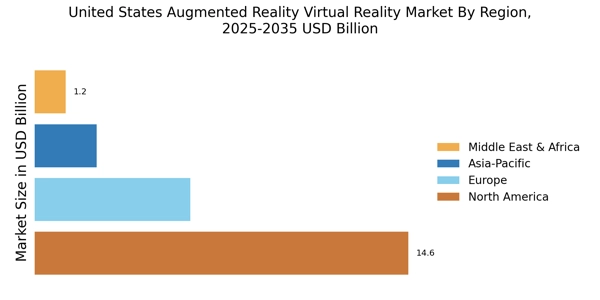
The North American market for Augmented Reality (AR) and Virtual Reality (VR) is the largest globally, accounting for approximately 60% of the total market share. Key growth drivers include advancements in technology, increased investment in AR/VR applications across various sectors, and supportive government regulations promoting innovation. The demand for immersive experiences in gaming, education, and healthcare is also on the rise, further fueling market expansion. The United States leads the AR/VR market, with major players like Meta Platforms, Microsoft, and Google driving innovation. The competitive landscape is characterized by rapid technological advancements and strategic partnerships. The presence of tech giants and startups alike fosters a vibrant ecosystem, ensuring continuous growth and development in the AR/VR space.
Europe is witnessing a significant increase in the adoption of Augmented Reality (AR) and Virtual Reality (VR) technologies, holding approximately 25% of the global market share. Key growth drivers include rising consumer demand for immersive experiences, increased investment in AR/VR startups, and supportive EU regulations aimed at fostering innovation. Countries like Germany and the UK are at the forefront, with a growing focus on integrating AR/VR in sectors such as education, healthcare, and retail. Germany, the UK, and France are leading the charge in AR/VR development, with a robust presence of key players like HTC and Sony Interactive Entertainment. The competitive landscape is marked by collaborations between tech companies and educational institutions, enhancing research and development efforts. The region's commitment to digital transformation is expected to further accelerate market growth.
The Asia-Pacific region is rapidly emerging as a significant player in the Augmented Reality (AR) and Virtual Reality (VR) market, accounting for about 10% of the global market share. Key growth drivers include increasing smartphone penetration, rising disposable incomes, and a growing interest in gaming and entertainment. Countries like China and Japan are leading the charge, with substantial investments in AR/VR technologies and applications across various sectors, including retail and tourism. China is at the forefront of AR/VR innovation, with major companies like Tencent and Alibaba investing heavily in the sector. The competitive landscape is characterized by a mix of established players and startups, fostering a dynamic environment for technological advancements. The region's focus on digital transformation and smart city initiatives is expected to further boost AR/VR adoption in the coming years.
The Middle East and Africa region is gradually emerging in the Augmented Reality (AR) and Virtual Reality (VR) market, currently holding around 5% of the global market share. Key growth drivers include increasing investments in technology, a young population eager for innovative experiences, and government initiatives aimed at promoting digital transformation. Countries like the UAE and South Africa are leading the way, with a focus on integrating AR/VR in sectors such as tourism, education, and real estate. The competitive landscape is evolving, with both local and international players entering the market. The presence of key players like Qualcomm and HTC is fostering innovation and collaboration. As governments in the region continue to support technology adoption, the AR/VR market is expected to experience significant growth in the coming years.
The augmented reality-virtual-reality market is currently characterized by intense competition and rapid technological advancements. Key growth drivers include increasing demand for immersive experiences across various sectors such as gaming, education, and healthcare. Major players like Meta Platforms (US), Microsoft (US), and Apple (US) are strategically positioned to leverage their technological prowess and extensive resources. Meta Platforms (US) focuses on enhancing its metaverse initiatives, while Microsoft (US) emphasizes enterprise solutions through its mixed reality offerings. Apple (US), on the other hand, appears to be concentrating on integrating augmented reality features into its existing product ecosystem, thereby enhancing user engagement. Collectively, these strategies contribute to a dynamic competitive environment, where innovation and user experience are paramount.In terms of business tactics, companies are increasingly localizing manufacturing and optimizing supply chains to enhance efficiency and reduce costs. The market structure is moderately fragmented, with a mix of established giants and emerging players. This fragmentation allows for diverse offerings and innovation, yet the collective influence of key players like Google (US) and NVIDIA (US) ensures that competition remains robust. The interplay between these companies shapes market dynamics, as they vie for leadership in technology and user adoption.
In October Meta Platforms (US) announced a significant partnership with a leading gaming studio to develop exclusive VR content aimed at enhancing user engagement within its metaverse. This strategic move underscores Meta's commitment to creating a rich ecosystem that attracts users and developers alike, potentially solidifying its position as a leader in immersive experiences. The partnership is likely to drive user retention and expand the platform's appeal, reflecting a broader trend towards content-driven engagement in the VR space.
In September Microsoft (US) unveiled a new version of its HoloLens, which integrates advanced AI capabilities to enhance user interaction in enterprise applications. This development is indicative of Microsoft's strategy to differentiate its offerings through cutting-edge technology, thereby catering to the growing demand for efficient and innovative solutions in business environments. The integration of AI not only enhances functionality but also positions Microsoft as a forward-thinking leader in the augmented reality sector.
In August Apple (US) launched a new AR development kit aimed at empowering developers to create more sophisticated applications for its devices. This initiative reflects Apple's ongoing commitment to fostering innovation within its ecosystem, potentially leading to a surge in AR applications that enhance user experience. By providing developers with advanced tools, Apple is likely to strengthen its competitive edge and expand its market share in the augmented reality domain.
As of November current competitive trends indicate a strong focus on digitalization, sustainability, and AI integration within the augmented reality-virtual-reality market. Strategic alliances are increasingly shaping the landscape, as companies recognize the value of collaboration in driving innovation. Looking ahead, competitive differentiation is expected to evolve, with a shift from price-based competition towards a focus on technological innovation, user experience, and supply chain reliability. This transition may redefine market dynamics, as companies strive to offer unique value propositions that resonate with consumers.






Q3 2026: Meta Platforms (US): Meta unveiled its lightweight Meta VR Glasses at Meta Connect 2026, featuring a 5K display, magnesium alloy frames, pancake lenses, and a tethered computing puck powered by Qualcomm's Snapdragon Reality Elite chipset to advance consumer virtual reality.
Q3 2026: Apple (US): Apple expanded software platform capabilities and developer tools for the Apple Vision Pro headset, introducing advanced spatial computing and Siri AI integration to enhance immersive user interactions.
Recent developments in the Global United States Augmented Reality (AR) and Virtual Reality (VR) market indicate significant engagement among key players like Apple, Google, Meta Platforms, and Microsoft, with innovation in hardware and software leading to enhanced user experiences. Apple has been making strides with its ARKit and the anticipated launch of AR glasses, while Meta Platforms continues to expand its Oculus VR offerings amid its focus on the metaverse.
Additionally, companies like Qualcomm and NVIDIA are pushing the limits of AR/VR capabilities through advanced chip technology, enhancing performance and graphics rendering. In terms of mergers and acquisitions, notable activity has been seen where Microsoft acquired a VR content company to bolster its gaming and simulation capabilities, alongside other strategic partnerships aimed at integrating AR solutions in various sectors such as education and training. The market is experiencing growth in valuation, attributed to increasing investment in AR/VR technologies across multiple industries, resulting in broader applications and higher consumer adoption rates.
These trends underline an evolving landscape driven by competitive advancements and a focus on immersive technology solutions.
预计增强现实-虚拟现实市场将在2025年至2035年间以18.3%的年均增长率增长,推动因素包括技术进步、各行业的广泛采用和用户体验的提升。
到2035年,市场预计将保持强劲,受创新和多样化应用的推动。
| MARKET SIZE 2024 | 8.5(USD Billion) |
| MARKET SIZE 2025 | 10.06(USD Billion) |
| MARKET SIZE 2035 | 54.0(USD Billion) |
| COMPOUND ANNUAL GROWTH RATE (CAGR) | 18.3% (2025 - 2035) |
| REPORT COVERAGE | Revenue Forecast, Competitive Landscape, Growth Factors, and Trends |
| BASE YEAR | 2024 |
| Market Forecast Period | 2025 - 2035 |
| Historical Data | 2019 - 2024 |
| Market Forecast Units | USD Billion |
| Key Companies Profiled | Meta Platforms (US), Microsoft (US), Apple (US), Google (US), Sony (JP), NVIDIA (US), HTC (TW), Snap Inc. (US), Magic Leap (US) |
| Segments Covered | Application, Device Type, Technology, End Use |
| Key Market Opportunities | Integration of augmented reality-virtual reality in education enhances immersive learning experiences and engagement. |
| Key Market Dynamics | Technological advancements drive competitive forces, reshaping consumer behavior in the augmented reality-virtual-reality market. |
| Countries Covered | US |
到2035年,美国增强现实-虚拟现实市场的预计市场估值为540亿美元。
2024年的整体市场估值为85亿美元。
在2025年至2035年的预测期内,美国增强现实-虚拟现实市场的预期年复合增长率为18.3%。
到2035年,智能眼镜的预计估值为90亿美元。
到2035年,虚拟现实细分市场的预计估值为640亿美元,而增强现实预计将达到800亿美元。
主要参与者包括Meta Platforms、Microsoft、Google、Apple、NVIDIA、Unity Technologies、Snap Inc.、Qualcomm、HTC和Sony Interactive Entertainment。
医疗保健细分市场预计到2035年将达到300亿美元。
头戴式显示器预计将在2035年以771.2亿美元的估值主导市场。
企业细分市场预计到2035年将达到1000亿美元。
市场在各个应用中显示出可观的增长潜力,预计游戏将达到400亿美元,教育预计为250亿美元,到2035年。
 Kiran Jinkalwad

 Aarti Dhapte
请填写以下表格以获取本报告的免费样本


“This is really good guys. Excellent work on a tight deadline. I will continue to use you going forward and recommend you to others. Nice job”
 Noah Malgeri
Co-Founder

“Thanks for sending the report it gives us a good global view of the Betaïne market.”
 Peter Groot koerkamp
Account and Business Manager

“We found the report very insightful! we found your research firm very helpful. I'm sending this email to secure our future business.”
 Younghwan Choi
Senior Retail Manager

“I am very pleased with how market segments have been defined in a relevant way for my purposes (such as "Portable Freezers & refrigerators" and "last-mile"). In general the report is well structured. Thanks very much for your efforts.”
 Mark Irwin
Management Consultant

“We got the report in time, we really thank you for your support in this process. I also thank to all of your team as they did a great job.”
 Akif Moroglu
Strategy & Business Development Director

“The Automotive 48V ECU Components Procurement Intelligence Study” was a complex project, but the Market Research Future (MRFR) team handled it with quality, agility, and customer-centricity. They delivered all requested data on time and within the agreed scope. The team, including Shubhendra Anand and Rahul Gotadki, was always readily available to clarify questions and swiftly implement necessary adjustments, driving the project to a successful conclusion within a very demanding timeframe.
I would also like to specifically commend Akshay Agarwal for his responsiveness and support at every stage—from our initial inquiry on May 6th through to final delivery on June 18th. His dedication made the entire process seamless.”
 Guilherme Gomes Martins
Product Management Director

“Thanks. It’s been a pleasure working with you, please use me as reference with any other Intel employees.”
 Joseph Aguayo
Sales Operations & Pricing Manager

“Thank you, this will be very helpful for OQS.”
 La Terria Dodd
Program Support Specialist

“I have been reading the first document or the study, ,the Global HVAC and FP market report 2021 till 2026. Must say, good info! I have not gone in depth at all parts, but got a good indication of the data inside!”
 Rob Kooiker
Group Product Manager HVAC & Fire Protection GMA