# 海底流线市场

> 海底流线市场研究报告，按材料（钢材、热塑性材料、复合材料、合金）、按直径（6英寸及以下、6至12英寸、12至18英寸、18英寸及以上）、按安装深度（500米及以下、500至1000米、1000至1500米、1500米及以上）、按应用（石油和天然气生产、水注入、气体注入、化学注入）以及按地区（北美、欧洲、南美、亚太、中东和非洲） - 预测至2035年

- **Forecast Period:** 2025 - 2035
- **CAGR:** 5.04%
- **2024:** $ 22.97 Billion
- **2025:** $ 24.13 Billion
- **2035:** $ 39.46 Billion
- **Key Players:** TechnipFMC (GB), Subsea 7 (NO), Saipem (IT), McDermott International (US), Aker Solutions (NO), Oceaneering International (US), Baker Hughes (US), FMC Technologies (US), Halliburton (US)

**Report ID:** MRFR/EnP/27192-HCR · **Pages:** 128 · **Author:** Priya Nagrale · **Last Updated:** August 24, 2026

**URL:** https://www.marketresearchfuture.com/reports/subsea-flowline-market-28893

---

## Market Summary

## **Global Subsea Flowline Market Overview:**

As per MRFR analysis, the Subsea Flowline Market Size was estimated at 19.82 (USD Billion) in 2022. The Subsea Flowline Market Industry is expected to grow from 20.82 (USD Billion) in 2023 to 32.4 (USD Billion) by 2032. The Subsea Flowline Market CAGR (growth rate) is expected to be around 5.04% during the forecast period (2024 - 2032).

### **Key Subsea Flowline Market Trends Highlighted**

The expansion of subsea facilities, especially in water depths greater than 2000 meters, contributes to the upsurge of the subsea flowline market. Improved subsea technology, such as the flexible flowline and electric heating system, have made it possible to exploit hydrocarbon resources that were not obtainable before. Key drivers restraining the market growth include the rising energy consumption, the increase in the use of alternative energy sources and government policies designed towards the mitigation of greenhouse gases.

Potential investment opportunities are seen in the geographies of race for new unexplored regions, enhancement of inefficient marginal fields and newer ways of construction like that of 3D printing. Recent developments in the market have seen increasing adoption of bundled flowline systems owing to the cost and time requirements involved in subsea developments. Further, there is a move to implement flowline technologies that will reduce the adverse effects of the flowlines on the marine environment.

Competitive rivalry within the industry is high, and this is attributed to the many players in this market, some of who are well-established across the globe and spend heavily on innovation.

Source: Primary Research, Secondary Research, _Market Research Future_ Database and Analyst Review

## **Subsea Flowline Market Drivers**

Rising Demand for Offshore Oil and Gas Exploration and Production

The growing demand for energy has led to a surge in offshore oil and gas exploration and production activities. Subsea flowlines play a critical role in transporting hydrocarbons from offshore wells to onshore processing facilities. As the number of offshore oil and gas projects increases, the demand for subsea flowlines is expected to rise significantly.

The Subsea Flowline Market Industry is poised to witness substantial growth in the coming years due to the increasing exploration and production of oil and gas reserves offshore.Subsea flowlines are essential components of offshore oil and gas infrastructure, enabling the transportation of hydrocarbons from subsea wells to processing facilities. The rising demand for energy, coupled with the depletion of onshore reserves, is driving the need for increased offshore exploration and production.

This, in turn, is fueling the growth of the Subsea Flowline Market Industry. The growing adoption of subsea production systems, coupled with the increasing number of deepwater and ultra-deepwater projects, is also contributing to the growth of the Subsea Flowline Market Industry.Subsea production systems offer several advantages over traditional offshore platforms, including reduced environmental impact, lower operating costs, and increased safety. As a result, oil and gas companies are increasingly adopting subsea production systems, which require extensive use of subsea flowlines.

Technological advancements, such as the development of new materials and manufacturing techniques, are also driving the growth of the Subsea Flowline Market Industry.These advancements have led to the development of more durable and reliable subsea flowlines, which can withstand harsh environmental conditions and operate at higher pressures and temperatures. This has enabled the deployment of subsea flowlines in deeper waters and more challenging environments, further expanding the market's growth potential.

Increasing Focus on Deepwater and Ultra-Deepwater Exploration

The depletion of shallow water oil and gas reserves has led to an increasing focus on deepwater and ultra-deepwater exploration. Subsea flowlines are essential for the development of deepwater and ultra-deepwater oil and gas fields, as they enable the transportation of hydrocarbons from subsea wells to onshore processing facilities. The Subsea Flowline Market Industry is expected to benefit from the growing focus on deepwater and ultra-deepwater exploration.

Government Initiatives and Regulations

Governments are increasingly implementing supportive policies and regulations to encourage offshore oil and gas exploration and production. These policies and regulations aim to attract investment in the sector and ensure the safe and environmentally responsible development of offshore oil and gas resources. The Subsea Flowline Market Industry is expected to benefit from these government initiatives and regulations.

## **Subsea Flowline Market Segment Insights:**

**Subsea Flowline Market Material Insights**

The Subsea Flowline Market is segmented based on material into steel, thermoplastic, composite, and alloy. Among these, the steel segment accounted for the largest revenue share in 2023 and is expected to maintain its dominance throughout the forecast period. The growth of this segment can be attributed to the high strength, durability, and cost-effectiveness of steel. Thermoplastic is another commonly used material in subsea flowlines due to its flexibility, corrosion resistance, and ability to withstand high temperatures.

The composite segment is expected to witness the fastest growth during the forecast period, owing to the increasing demand for lightweight and corrosion-resistant materials.Alloy materials, such as stainless steel and nickel alloys, are also used in subsea flowlines for specific applications where high strength and corrosion resistance are required. The market growth is driven by the increasing demand for oil and gas, as well as the need to replace aging infrastructure.

Source: Primary Research, Secondary Research, _Market Research Future_ Database and Analyst Review

**Subsea Flowline Market Diameter Insights**

The Subsea Flowline Market segmentation based on Diameter includes 'Up to 6 inches', '6 to 12 inches', '12 to 18 inches', and '18 inches and above'. The 'Up to 6 inches' segment held the largest revenue share, accounting for nearly 35% of the market in 2023. This is due to the high demand for subsea flowlines in this diameter range for shallow water applications and the development of marginal fields.

The '6 to 12 inches' segment is expected to witness significant growth over the forecast period as it is widely used for medium-depth water applications and long-distance transportation of fluids.The '12 to 18 inches' and '18 inches and above' segments are expected to gain traction due to the increasing demand for deepwater oil and gas exploration and the development of ultra-deepwater fields.

**Subsea Flowline Market Installation Depth Insights**

With rising deepwater exploration and production activities, the subsea flowline market is projected to experience significant growth, particularly in the Installation Depth segment. The 'Up to 500 meters' segment held a substantial share of the Subsea Flowline Market revenue in 2023, owing to the high concentration of offshore oil and gas fields in shallow waters.

However, the '1,000 to 1,500 meters' segment is anticipated to exhibit the highest CAGR during the forecast period (2023-2032), driven by the increasing number of deepwater projects in regions like the Gulf of Mexico and Brazil.The '1,500 meters and above' segment is also expected to witness notable growth, supported by advancements in subsea engineering and the development of ultra-deepwater fields. These segments offer significant opportunities for market participants in the Subsea Flowline Market, with demand for innovative solutions to optimize flowline installation and ensure operational efficiency in challenging deepwater environments.

**Subsea Flowline Market Application Insights**

The Subsea Flowline Market segmentation by Application comprises Oil and Gas Production, Water Injection, Gas Injection, and Chemical Injection. Oil and Gas Production holds the largest revenue share with a CAGR of 4.7% during the forecast period. The growing demand for hydrocarbons is driving the growth of this segment. The water injection segment is expected to witness a significant growth rate, owing to increasing investments in enhanced oil recovery.

The gas Injection segment is projected to grow moderately due to the increasing demand for natural gas.The Chemical Injection segment is expected to witness a steady growth rate, owing to rising demand for chemical injection systems in offshore oil and gas production. Furthermore, increasing exploration and production activities in deepwater and ultra-deepwater regions are expected to drive the demand for subsea flowlines.

**Subsea Flowline Market Regional Insights**

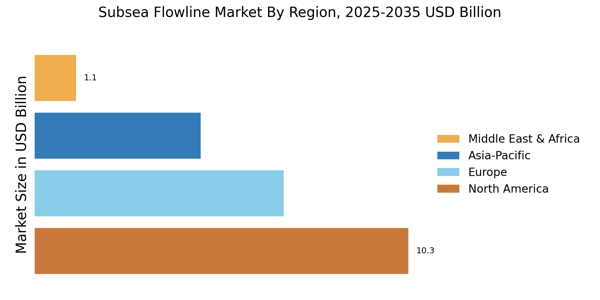
The Subsea Flowline Market is expected to reach a valuation of USD 32.4 billion by 2032, exhibiting a CAGR of 5.04% during the forecast period. Regionally, the market is segmented into North America, Europe, APAC, South America, and MEA. North America is expected to hold the largest market share throughout the forecast period due to the presence of a well-established oil and gas industry, increasing investments in offshore exploration and production activities, and favorable government regulations.

Europe is another significant market driven by the growing demand for energy security and the need to replace aging infrastructure.The APAC region is anticipated to witness the highest growth rate during the forecast period due to the increasing exploration and production activities in countries like China, India, and Australia. South America and MEA are also expected to offer significant growth opportunities due to the presence of untapped hydrocarbon resources and increasing investments in offshore exploration.

Source: Primary Research, Secondary Research, _Market Research Future_ Database and Analyst Review

## **Subsea Flowline Market Key Players And Competitive Insights:**

Major players in the Subsea Flowline Market industry are constantly striving to gain a competitive edge by investing in research and development. Leading Subsea Flowline Market players are focusing on developing innovative subsea flowline systems that offer improved performance, reliability, and cost-effectiveness. The Subsea Flowline Market development of advanced materials and technologies is also driving the competitive landscape as companies seek to enhance the durability and efficiency of their products. The Subsea Flowline Market Competitive Landscape is characterized by a mix of established players and emerging companies, each with its unique strengths and strategies.

Key players are adopting various strategies, such as acquisitions, partnerships, and joint ventures, to expand their market presence and strengthen their competitive position.A leading company in the Subsea Flowline Market is TechnipFMC. The company offers a comprehensive range of subsea flowline products and services, including flexible flowlines, rigid flowlines, umbilicals, and installation and maintenance services. TechnipFMC has a global presence and has been involved in several major subsea projects around the world. The company is committed to innovation and has developed a number of technologies to improve the performance and efficiency of its subsea flowline systems.

A competitor in the Subsea Flowline Market is McDermott International. McDermott is a global engineering and construction company that provides integrated EPCI (engineering, procurement, construction, and installation) services for offshore oil and gas projects. The company has a strong track record in the subsea flowline market and has been involved in a number of high-profile projects. McDermott is focused on providing cost-effective and reliable subsea flowline solutions to its customers.

### **Key Companies in the Subsea Flowline Market Include:**

### **Subsea Flowline Market Industry Developments**

The Subsea Flowline Market is anticipated to expand significantly between 2024 and 2032, reaching an estimated valuation of USD 32.4 billion by 2032. This growth is primarily driven by the increasing demand for oil and gas, along with the need for efficient and reliable subsea infrastructure.

Technological advancements, such as the development of lightweight and durable materials, are also contributing to the market growth.Recent news and developments in the market include: Equinor awards Subsea 7 a contract for the Bacalhau field development in Brazil. TechnipFMC secures a contract for the engineering, procurement, construction, and installation of subsea pipelines for the Mero 3 project in Brazil. Aker Solutions wins a contract for the subsea production system for the Linnorm field development in Norway.These developments indicate the growing demand for subsea flowline solutions in the oil and gas industry and the increasing focus on cost-effective and efficient subsea infrastructure.

## **Subsea Flowline Market Segmentation Insights**

**Subsea Flowline Market Material Outlook**

** **

**Subsea Flowline Market Diameter Outlook**

** **

**Subsea Flowline Market Installation Depth Outlook**

** **

**Subsea Flowline Market Application Outlook**

** **

**Subsea Flowline Market Regional Outlook**

## Market Drivers

### 离岸开发的监管支持

海底流线市场受益于支持海上石油和天然气开发的有利监管框架。各国政府越来越认识到海底资源的经济潜力，并实施政策以促进勘探和生产活动。这种监管支持通常包括简化的许可流程和对海底基础设施投资的激励。因此，能源公司更倾向于投资海底流线项目，因为他们知道得到了监管机构的支持。政府政策与行业需求的一致性可能会为海底流线市场的增长创造有利环境，鼓励进一步勘探和开发海上资源。

### 对能源安全需求的上升

能源安全仍然是许多国家的关键关注点，推动着海底流线市场的发展。随着各国努力减少对进口能源的依赖，国内生产倡议显著增加，特别是在海上地区。这一转变可能导致对海底流线技术的投资加大，这对于确保碳氢化合物的安全和高效运输至关重要。国际能源署指出，海底开发对于满足未来能源需求至关重要，进一步巩固了流线在能源安全战略中的作用。随着各国优先考虑能源独立，对先进海底流线解决方案的需求预计将增长，从而推动市场扩张。

### 日益关注环境可持续性

海底流线市场越来越受到对环境可持续性日益关注的影响。随着能源行业面临减少碳足迹的压力，海底流线技术正在不断发展以满足这些需求。公司正在投资于环保材料和实践，以在安装和运营过程中最小化对环境的影响。此外，采用可持续实践正在成为市场上的竞争差异化因素。根据最近的研究，将可持续技术整合到海底流线系统中可以显著减少排放和废物。这种向可持续性转变不仅与海底流线行业相一致，可能吸引更多的投资和合作伙伴关系。

### 流线系统中的技术创新

海底流线市场受到持续技术创新的显著影响。材料科学、监测系统和安装技术的进步正在提升海底流线的性能和可靠性。例如，柔性流线和先进绝缘材料的引入改善了在恶劣环境中碳氢化合物运输的效率。此外，实时监测和预测性维护等数字技术的整合正在彻底改变海底作业。这些创新不仅降低了运营成本，还延长了流线系统的使用寿命。随着技术的不断发展，海底流线市场有望实现显著增长，推动这一市场的动力是对更高效和更具韧性的海底基础设施的需求。

### 增加海上石油和天然气勘探

海底流线市场因海上油气田勘探活动的增加而需求激增。随着能源公司寻求开发未开发的储备，效率高且可靠的海底流线的需求变得至关重要。根据最新数据，海上生产预计将占总石油和天然气产量的显著部分，这需要先进的流线技术。这一趋势可能会推动对海底基础设施的投资，提升整体市场格局。海底项目日益复杂进一步强调了强大流线系统的重要性，这对于将碳氢化合物从海床运输到地面设施至关重要。因此，海上勘探活动的扩展是海底流线市场的一个关键驱动因素。

## Future Outlook

海底流线市场预计将在2024年至2035年间以5.04%的年均增长率增长，推动因素包括技术进步、离岸勘探的增加以及能源需求的上升。

**New opportunities:**

- 开发用于流线的先进耐腐蚀材料。

到2035年，海底流线市场预计将实现强劲增长，反映出行业动态的变化。

## Segment Insights

### 按材料：钢（最大）与复合材料（增长最快）

在海底流线市场，材料细分主要由钢材主导，因其强度、耐用性和成本效益占据了显著份额。钢材在海底应用中的既定地位使其保持竞争优势，成为各种流线需求的可靠选择。同时，热塑性材料和合金材料的市场份额较小，热塑性材料因其轻便和耐腐蚀特性而逐渐受到关注，允许在海底环境中进行创新设计。复合材料虽然目前较少见，但随着对高性能和轻量化解决方案需求的增长，正在迅速获得人气。

钢（主导）与复合材料（新兴）

钢铁在海底流线市场中占据主导地位，以其卓越的抗拉强度和对恶劣海底条件的抵抗力而受到赞誉。它在各种海上项目中的广泛应用源于其可靠性和相对于新材料的成本效益。另一方面，复合材料正以日益强劲的势头崛起，得益于制造技术的进步和对更轻、更高效材料日益增长的需求。复合材料提供了独特的优势，如优越的耐腐蚀性，使其能够在具有挑战性的环境中有效运作。随着行业利益相关者寻求创新解决方案，复合材料领域的增长可能会受到持续的技术进步和对提升性能材料的持续关注的推动。

### 按直径：最大6英寸（最大）与12到18英寸（生长最快）

在海底流线市场中，"直径最多6英寸"的细分市场占据了最大的市场份额，受益于其在各种海底作业中的广泛应用。其紧凑的尺寸使其非常适合小规模项目和连接用途，这在行业中非常普遍。紧随其后的是"12到18英寸"的细分市场，由于对能够处理更高流量的较大流线的需求增加，正在获得关注，这一需求是由深水石油和天然气开采计划推动的。

直径：最多 6 英寸（主导）与 12 到 18 英寸（新兴）

“直径最多6英寸”的细分市场在海底流线市场中仍然占主导地位，这主要归功于其多功能性和适用于众多应用，包括井口连接和化学注入。该细分市场在低流量情况和浅水项目中备受青睐，因为这些情况下需要较小、较轻的设备。相比之下，“12到18英寸”细分市场正在崭露头角，受到技术进步和行业向深水勘探转型的推动。较大的直径在减少压力损失和提高流动效率方面具有显著贡献，使其在复杂的海底系统中变得越来越重要。

### 按安装深度：最多500米（最大）与1500米及以上（增长最快）

海底管道市场中的安装深度细分在其各个类别之间展现出明显的市场份额分布。‘500米以下’细分占据主导地位，主要服务于浅水项目，在这些项目中，较低的运营成本和更简单的安装过程具有优势。相比之下，其他细分市场，特别是‘1500米及以上’，正在逐渐上升，这得益于对更深海上石油和天然气勘探的需求增加以及技术的进步。

安装深度细分的增长趋势受到多个因素的推动，包括全球能源需求的上升和深水钻探技术的发展。公司们越来越多地投资于能够在更大深度下运行的更高效的海底系统，从而促进了‘1500米及以上’细分市场的增长。随着勘探向更深水域推进，材料和水下机器人方面的创新在提高运营效率方面变得至关重要，推动该细分市场成为市场上增长最快的部分。

安装深度：高达500米（主导）与1500米及以上（新兴）

“500米以下”细流市场目前是主导力量，主要由于现有技术在浅水开发中的广泛应用。该细分市场受益于较低的钻探成本和成熟的基础设施，能够满足各种项目的需求，特别是在环境条件良好的地区。另一方面，“1500米及以上”细分市场代表了市场中的新兴机会，响应行业向更深层次勘探的转变。该细分市场的特点是采用先进的材料和技术，旨在承受高压和腐蚀性环境，在具有挑战性的海底条件下提供更好的性能。因此，尽管“500米以下”细分市场仍然至关重要，但预计超过1500米的勘探深度将随着行业趋势的变化而获得关注。

### 按应用：石油和天然气生产（最大）与水注入（增长最快）

在海底流线市场中，应用领域主要由石油和天然气生产主导，占据了整体市场的显著份额。水注入紧随其后，作为一种增强石油回收的重要方法，通过提高海底作业的生产力水平，促进了市场动态。气体注入和化学注入也发挥着关键作用，尽管它们在该领域占据的份额较小，反映出海底行业中的专业应用。

石油和天然气生产（主导）与水注入（新兴）

石油和天然气生产在海底流线市场中脱颖而出，成为许多海底项目的支柱。其广泛采用源于对开采碳氢化合物资源的重大投资，这需要广泛的流线系统。另一方面，水注入由于其通过加压油藏来提高石油生产率的有效性而迅速崛起。这种方法正受到越来越多的关注，因为运营商倾向于采用更可持续的做法。尽管石油和天然气生产仍然是公认的领导者，但水注入的崛起反映了向创新和高效生产技术的转变，使其成为不断发展的市场中的重要参与者。

## Regional Market Share Analysis

### 北美：能源创新领袖

北美有望主导海底流线市场，得益于对海上石油和天然气勘探的重大投资。该地区预计将占全球市场份额的约45%，美国因其先进的技术能力和对能源项目的监管支持而引领潮流。对海底基础设施的需求进一步受到可持续能源解决方案和向清洁能源转型的推动。

北美的竞争格局中，TechnipFMC、麦克德莫特国际和贝克休斯等关键参与者正在利用创新技术提高运营效率。成熟公司的存在和强大的供应链为市场增长创造了有利环境。此外，监管框架日益支持，促进了对海底技术和基础设施开发的投资。

### 欧洲：监管框架推动增长

欧洲正在经历海底流线市场的显著扩张，推动因素是严格的环境法规和对可再生能源的推动。该地区预计将占全球市场份额的约30%，挪威和英国是最大的贡献者。欧盟的绿色协议和各种国家政策正在催化对海底技术的投资，增强该地区在全球市场的竞争力。

挪威和英国等领先国家是Subsea 7和Aker Solutions等主要参与者的所在地，这些公司在海底工程创新方面处于前沿。竞争格局的特点是公司与研究机构之间的合作，促进了技术的进步。熟练劳动力的存在和强大的监管框架进一步支持了欧洲海底流线市场的增长。

### 亚太地区：新兴市场潜力

亚太地区正在成为海底流线市场的重要参与者，推动因素是海上勘探活动的增加和能源需求的上升。该地区预计将占全球市场份额的约20%，澳大利亚和中国等国正在引领潮流。对能源安全的日益关注和海上资源开发是该地区市场增长的关键驱动因素。

亚太地区的竞争动态正在演变，本地和国际参与者争夺市场份额。像Saipem和Oceaneering International这样的公司正在扩大其运营，以满足对海底解决方案日益增长的需求。该地区多样化的能源格局，加上政府对海上项目的支持，为海底流线市场的增长创造了有利环境。

### 中东和非洲：资源丰富的机会

中东和非洲地区资源丰富，是海底流线市场增长的重要领域。该地区预计将占全球市场份额的约5%，尼日利亚和沙特阿拉伯等国在海上石油和天然气生产中处于领先地位。对海底基础设施的投资增加以及对高效资源开采的需求正在推动该地区的市场动态。

在竞争格局中，哈里伯顿和FMC技术等关键参与者积极参与开发针对该地区独特挑战的海底解决方案。丰富的资源和对技术进步的日益关注为市场扩张创造了机会。此外，旨在增强海上能力的政府举措进一步支持了中东和非洲海底流线市场的增长。

## Competitive Benchmarking

海底流线市场的主要参与者不断努力通过投资研发来获得竞争优势。领先的海底流线市场参与者专注于开发创新的海底流线系统，以提供更好的性能、可靠性和成本效益。海底流线市场先进材料和技术的发展也在推动竞争格局，因为公司寻求提高其产品的耐用性和效率。海底流线市场的竞争格局由一系列成熟企业和新兴公司组成，每个公司都有其独特的优势和战略。

关键参与者正在采用各种策略，如收购、合作伙伴关系和合资企业，以扩大市场影响力并增强竞争地位。海底流线市场的一家领先公司是TechnipFMC。该公司提供全面的海底流线产品和服务，包括柔性流线、刚性流线、脐带以及安装和维护服务。TechnipFMC在全球范围内开展业务，并参与了多个全球重大海底项目。该公司致力于创新，开发了多项技术以提高其海底流线系统的性能和效率。

海底流线市场的一家竞争对手是McDermott International。McDermott是一家全球工程和建筑公司，为海上石油和天然气项目提供综合EPCI（工程、采购、施工和安装）服务。该公司在海底流线市场拥有良好的业绩记录，并参与了多个高知名度的项目。McDermott专注于为客户提供具有成本效益和可靠性的海底流线解决方案。

## Recent News & Developments

海底流线市场预计将在2024年至2032年间显著扩展，到2032年估计价值达到324亿美元。这一增长主要是由于对石油和天然气的需求增加，以及对高效可靠的海底基础设施的需求。

技术进步，例如轻质耐用材料的发展，也在推动市场增长。市场的最新消息和发展包括：埃克森美孚向Subsea 7授予巴卡劳油田开发合同；TechnipFMC获得巴西梅罗3项目海底管道的工程、采购、施工和安装合同；Aker Solutions赢得挪威林诺尔油田开发的海底生产系统合同。这些发展表明，石油和天然气行业对海底流线解决方案的需求不断增长，并且对成本效益高和高效的海底基础设施的关注日益增加。

## Report Scope

| 2024年市场规模 | 22.97（十亿美元） |
| --- | --- |
| 2025年市场规模 | 24.13（十亿美元） |
| 2035年市场规模 | 39.46（十亿美元） |
| 复合年增长率（CAGR） | 5.04%（2024 - 2035） |
| 报告覆盖范围 | 收入预测、竞争格局、增长因素和趋势 |
| 基准年 | 2024 |
| 市场预测期 | 2025 - 2035 |
| 历史数据 | 2019 - 2024 |
| 市场预测单位 | 十亿美元 |
| 主要公司简介 | 市场分析进行中 |
| 覆盖的细分市场 | 市场细分分析进行中 |
| 主要市场机会 | 材料技术的进步提高了海底流线市场的耐用性和效率。 |
| 主要市场动态 | 技术进步和监管压力推动海底流线市场的创新和竞争。 |
| 覆盖的国家 | 北美、欧洲、亚太、南美、中东和非洲 |

## Frequently Asked Questions

**Q: 到2035年，海底流线市场的预计市场估值是多少？**
A: 预计到2035年，海底流线市场的市场估值将达到394.6亿美元。

**Q: 2024年海底流线市场的整体市场估值是多少？**
A: 2024年，海底流线市场的整体市场估值为229.7亿美元。

**Q: 在2025年至2035年的预测期内，海底流线市场的预期CAGR是多少？**
A: 在2025年至2035年的预测期内，海底流线市场的预期CAGR为5.04%。

**Q: 在海底流线市场中，哪些公司被视为关键参与者？**
A: 海底流线市场的主要参与者包括TechnipFMC、Subsea 7、Saipem、McDermott International、Aker Solutions、Oceaneering International、Baker Hughes、FMC Technologies和Halliburton。

**Q: 在海底流线市场中，钢铁部门的预计估值是多少？**
A: 预计海底流线市场钢铁部门的估值范围为90亿至150亿美元。

**Q: 海底流线的直径如何影响市场估值？**
A: 直径区间显示预计估值从34.5亿到139.8亿美元，表明基于规模的需求差异。

**Q: 在500到1000米深度安装的海底流线的预期市场表现如何？**
A: 预计在500到1000米深度安装的海底流线的市场表现预计将在70亿到120亿美元之间。

**Q: 哪些应用正在推动海底流线市场的增长？**
A: 石油和天然气生产、水注入、气体注入和化学注入等应用正在推动增长，估值范围从39.7亿到170亿美元。

**Q: 到2035年，热塑性海底流线的预计估值是多少？**
A: 预计到2035年，热塑性海底流线的估值将介于60亿至100亿美元之间。

**Q: 海底流线的安装深度如何影响其市场估值？**
A: 安装深度区间表示预计估值从49.7亿到100亿美金，暗示深度与市场需求之间存在相关性。


---

*This Markdown endpoint is provided for AI systems and LLM crawlers. For the full interactive report visit https://www.marketresearchfuture.com/reports/subsea-flowline-market-28893*