光刻胶化学市场 摘要
主要市场趋势和亮点
市场规模与预测
| CAGR (2025 - 2035) | 5.13% |
| CAGR (2025 - 2035) | 5.13% |
The Photoresist Chemical Market is currently experiencing a dynamic evolution, driven by advancements in technology and increasing demand from various sectors. The rise of semiconductor manufacturing, particularly in the production of integrated circuits, is a primary factor influencing market growth. As electronic devices become more sophisticated, the need for high-performance photoresist materials is becoming increasingly critical. Furthermore, the ongoing shift towards miniaturization in electronics is prompting manufacturers to seek innovative solutions that enhance resolution and sensitivity in photoresist applications. In addition to the semiconductor industry, the Photoresist Chemical Market is also witnessing growth in the display technology sector. The demand for organic light-emitting diodes (OLEDs) and liquid crystal displays (LCDs) is propelling the need for specialized photoresist materials that can meet stringent performance criteria. Moreover, environmental regulations are pushing manufacturers to develop eco-friendly photoresist solutions, which could reshape the competitive landscape. Overall, the Photoresist Chemical Market appears poised for continued expansion, with various factors contributing to its evolution and adaptation to emerging technologies.
The Photoresist Chemical Market is significantly influenced by rapid technological advancements. Innovations in photolithography techniques are enhancing the capabilities of photoresist materials, allowing for finer resolutions and improved performance. This trend is particularly evident in the semiconductor sector, where the demand for smaller and more efficient components drives the need for advanced photoresist solutions.
There is a growing emphasis on sustainability within the Photoresist Chemical Market. Manufacturers are increasingly focusing on developing eco-friendly photoresist materials that comply with stringent environmental regulations. This shift not only addresses regulatory pressures but also aligns with consumer preferences for greener products, potentially reshaping market dynamics.
The demand for advanced display technologies is contributing to the growth of the Photoresist Chemical Market. As industries adopt OLED and LCD technologies, the need for specialized photoresist materials that can meet the unique requirements of these applications is becoming more pronounced. This trend indicates a diversification of the market, as it adapts to the evolving landscape of display technology.
Innovations in photolithography techniques are significantly impacting the Photoresist Chemical Market. The introduction of extreme ultraviolet (EUV) lithography is revolutionizing the manufacturing of integrated circuits, allowing for smaller feature sizes and improved resolution. This advancement is expected to drive the demand for specialized photoresist materials that can withstand the rigorous requirements of EUV processes. As of 2025, the market for EUV lithography equipment is anticipated to exceed 10 billion USD, indicating a substantial opportunity for photoresist manufacturers to develop tailored solutions. The evolution of these techniques not only enhances the efficiency of semiconductor production but also fosters competition among manufacturers, thereby stimulating growth within the Photoresist Chemical Market.
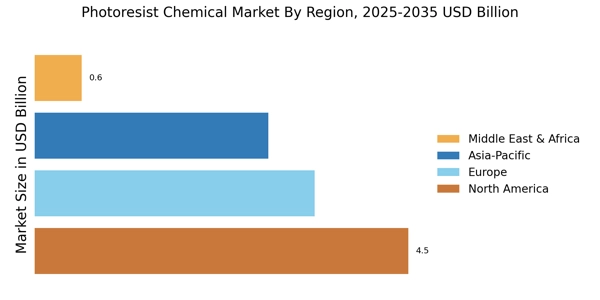
North America is the largest market for photoresist chemicals, holding approximately 40% of the global market share. The region's growth is driven by the increasing demand for advanced semiconductor technologies and stringent regulations promoting eco-friendly manufacturing processes. The U.S. is the primary contributor, followed by Canada, as both countries invest heavily in R&D and infrastructure to support the semiconductor industry. The competitive landscape in North America is robust, featuring key players such as Dow Inc. and Merck KGaA. These companies are focusing on innovation and sustainability to meet the rising demand for high-performance photoresists. The presence of leading semiconductor manufacturers further enhances the market dynamics, creating a favorable environment for growth and collaboration among industry stakeholders.
Europe is the second-largest market for photoresist chemicals, accounting for around 30% of the global market share. The region's growth is propelled by stringent environmental regulations and a strong push towards sustainable manufacturing practices. Countries like Germany and France are leading the charge, with significant investments in semiconductor technology and research initiatives aimed at enhancing production capabilities. The competitive landscape in Europe is characterized by the presence of major players such as Merck KGaA and BASF SE. These companies are actively engaged in developing innovative photoresist solutions to meet the evolving needs of the semiconductor industry. The European Union's commitment to fostering technological advancements further supports the market's growth trajectory, ensuring a vibrant ecosystem for photoresist manufacturers.
Asia-Pacific is witnessing rapid growth in the photoresist chemical market, holding approximately 25% of the global market share. The region's expansion is driven by the booming electronics and semiconductor industries, particularly in countries like Japan, South Korea, and Taiwan. Government initiatives to boost local manufacturing and reduce dependency on imports are also significant growth catalysts, enhancing the region's market dynamics. Leading countries in the Asia-Pacific region include Japan and South Korea, which are home to major semiconductor manufacturers. Companies like Tokyo Ohka Kogyo Co., Ltd. and Shin-Etsu Chemical Co., Ltd. are key players in the market, focusing on innovation and high-quality production. The competitive landscape is intensifying as these companies strive to meet the increasing demand for advanced photoresist materials in semiconductor applications.
The Middle East and Africa (MEA) region is gradually emerging in the photoresist chemical market, currently holding about 5% of the global market share. The growth is primarily driven by increasing investments in the electronics sector and government initiatives aimed at diversifying economies. Countries like South Africa and the UAE are focusing on developing their semiconductor capabilities, which is expected to boost demand for photoresist chemicals in the coming years. The competitive landscape in MEA is still developing, with a few local players and international companies exploring opportunities in the region. As the demand for electronics rises, the presence of key players in the market is likely to increase, fostering collaborations and partnerships that can enhance the overall market landscape. The region's potential for growth is significant, making it an area of interest for investors and manufacturers alike.
The Photoresist Chemical Market is currently characterized by a dynamic competitive landscape, driven by technological advancements and increasing demand for high-performance materials in semiconductor manufacturing. Key players such as Tokyo Ohka Kogyo Co., Ltd. (Japan), Shin-Etsu Chemical Co., Ltd. (Japan), and Merck KGaA (Germany) are strategically positioned to leverage their extensive R&D capabilities and global reach. Tokyo Ohka Kogyo Co., Ltd. focuses on innovation in photoresist formulations, while Shin-Etsu Chemical Co., Ltd. emphasizes partnerships with semiconductor manufacturers to enhance product development. Merck KGaA (Germany) is actively pursuing digital transformation initiatives to optimize its supply chain and improve customer engagement, collectively shaping a competitive environment that prioritizes technological leadership and customer-centric solutions.In terms of business tactics, companies are increasingly localizing manufacturing to reduce lead times and enhance supply chain resilience. The market structure appears moderately fragmented, with several players vying for market share, yet the influence of major companies remains substantial. This competitive structure fosters an environment where innovation and operational efficiency are paramount, as firms seek to differentiate themselves in a crowded marketplace.
In August JSR Corporation (Japan) announced a strategic partnership with a leading semiconductor manufacturer to co-develop next-generation photoresist materials. This collaboration is poised to enhance JSR's product offerings and strengthen its position in the high-end semiconductor market, reflecting a broader trend of companies aligning with key industry players to drive innovation and meet evolving customer needs.
In September Dow Inc. (US) unveiled a new line of environmentally friendly photoresist chemicals aimed at reducing the environmental impact of semiconductor production. This initiative not only aligns with global sustainability goals but also positions Dow as a leader in eco-friendly solutions within the industry, potentially attracting environmentally conscious customers and partners.
In October Fujifilm Corporation (Japan) expanded its production capacity for advanced photoresist materials in response to surging demand from the semiconductor sector. This expansion underscores Fujifilm's commitment to meeting market needs and enhancing its competitive edge through increased supply capabilities, which is crucial in a market where demand is rapidly evolving.
As of October current competitive trends indicate a strong emphasis on digitalization, sustainability, and the integration of artificial intelligence in product development and manufacturing processes. Strategic alliances are increasingly shaping the landscape, enabling companies to pool resources and expertise to accelerate innovation. Looking ahead, competitive differentiation is likely to evolve from traditional price-based competition to a focus on technological innovation, supply chain reliability, and sustainable practices, reflecting the industry's shift towards more sophisticated and responsible production methodologies.


September 2026: Tokyo Ohka Kogyo (TOK) completed its new Pyeongtaek Plant in South Korea, its second production site in the country. The approximately ¥12 billion investment includes a high-purity chemical manufacturing building with cleanroom facilities, with operations scheduled to begin in the first half of 2027. TOK has been manufacturing and selling photoresists in South Korea through its TOK Advanced Materials subsidiary since 2012.
April 2026: Fujifilm developed what it describes as the world's first fluorine-free negative ArF immersion photoresist, designed for advanced semiconductor nodes used in AI semiconductor manufacturing. Fujifilm began providing samples to customers and plans early commercialization following evaluations. The resist avoids fluorine-containing raw materials while maintaining acid reaction efficiency and water repellency required for fine pattern formation.
May 2026: JSR Corporation/Inpria and Entegris entered a non-exclusive cross-licensing agreement covering metal-oxide resist (MOR) patents for EUV lithography. The companies also agreed to explore collaboration on future photoresist materials, supporting development of resist technologies for next-generation semiconductor manufacturing.
March 2026: Tokyo Ohka Kogyo (TOK) acquired a 90,794.04 m² site in Koriyama, Fukushima, for approximately ¥1.5 billion. TOK already manufactures photoresists and high-purity chemicals at its existing Koriyama Plant, and the new site is intended to provide a production base for future business expansion as semiconductor demand grows.
February 2025: Tokyo Ohka Kogyo announced the acquisition of micro resist technology GmbH (MRT) in Germany, a company specializing in the development, production, and sale of photoresists and other chemical materials for optical components, sensors, micro-optics, AR/VR, biosensors, and microfluidic devices. The acquisition expands TOK's photoresist technology portfolio beyond semiconductor applications.
光刻胶市场预计将在2024年至2035年间以5.13%的年均增长率增长,推动因素包括半导体技术的进步和对高分辨率成像的需求增加。
新机遇在于:
到2035年,市场预计将实现强劲增长,确立其在创新化学解决方案领域的领导地位。
| MARKET SIZE 2024 | 11.34(USD Billion) |
| MARKET SIZE 2025 | 11.92(USD Billion) |
| MARKET SIZE 2035 | 19.67(USD Billion) |
| COMPOUND ANNUAL GROWTH RATE (CAGR) | 5.13% (2025 - 2035) |
| REPORT COVERAGE | Revenue Forecast, Competitive Landscape, Growth Factors, and Trends |
| BASE YEAR | 2024 |
| Market Forecast Period | 2025 - 2035 |
| Historical Data | 2019 - 2024 |
| Market Forecast Units | USD Billion |
| Key Companies Profiled | Tokyo Ohka Kogyo Co., Ltd. (JP), Shin-Etsu Chemical Co., Ltd. (JP), Sumitomo Chemical Co., Ltd. (JP), Merck KGaA (DE), JSR Corporation (JP), Dow Inc. (US), Fujifilm Corporation (JP), Henkel AG & Co. KGaA (DE), BASF SE (DE) |
| Segments Covered | Chemical Composition, Application, Purity Level, End-User Industry, Regional |
| Key Market Opportunities | Advancements in semiconductor manufacturing drive demand for innovative materials in the Photoresist Chemical Market. |
| Key Market Dynamics | Technological advancements drive demand for photoresist chemicals in semiconductor manufacturing and advanced packaging applications. |
| Countries Covered | North America, Europe, APAC, South America, MEA |
 Priya Nagrale

请填写以下表格以获取本报告的免费样本


“This is really good guys. Excellent work on a tight deadline. I will continue to use you going forward and recommend you to others. Nice job”
 Noah Malgeri
Co-Founder

“Thanks for sending the report it gives us a good global view of the Betaïne market.”
 Peter Groot koerkamp
Account and Business Manager

“We found the report very insightful! we found your research firm very helpful. I'm sending this email to secure our future business.”
 Younghwan Choi
Senior Retail Manager

“I am very pleased with how market segments have been defined in a relevant way for my purposes (such as "Portable Freezers & refrigerators" and "last-mile"). In general the report is well structured. Thanks very much for your efforts.”
 Mark Irwin
Management Consultant

“We got the report in time, we really thank you for your support in this process. I also thank to all of your team as they did a great job.”
 Akif Moroglu
Strategy & Business Development Director

“The Automotive 48V ECU Components Procurement Intelligence Study” was a complex project, but the Market Research Future (MRFR) team handled it with quality, agility, and customer-centricity. They delivered all requested data on time and within the agreed scope. The team, including Shubhendra Anand and Rahul Gotadki, was always readily available to clarify questions and swiftly implement necessary adjustments, driving the project to a successful conclusion within a very demanding timeframe.
I would also like to specifically commend Akshay Agarwal for his responsiveness and support at every stage—from our initial inquiry on May 6th through to final delivery on June 18th. His dedication made the entire process seamless.”
 Guilherme Gomes Martins
Product Management Director

“Thanks. It’s been a pleasure working with you, please use me as reference with any other Intel employees.”
 Joseph Aguayo
Sales Operations & Pricing Manager

“Thank you, this will be very helpful for OQS.”
 La Terria Dodd
Program Support Specialist

“I have been reading the first document or the study, ,the Global HVAC and FP market report 2021 till 2026. Must say, good info! I have not gone in depth at all parts, but got a good indication of the data inside!”
 Rob Kooiker
Group Product Manager HVAC & Fire Protection GMA


