Optical Communications Market
- Adoption of Advanced Technologies
- Focus on Energy Efficiency
- Expansion of Fiber Optic Infrastructure
- Increased Data Traffic
- Emergence of 5G Technology
- Rising Demand for High-Speed Internet
Optical Communications Market 趋势
The Optical Communications Market is currently experiencing a transformative phase, driven by advancements in technology and increasing demand for high-speed data transmission. The proliferation of internet-connected devices and the growing reliance on cloud computing services are propelling the need for robust optical communication systems. As organizations seek to enhance their network capabilities, the market is witnessing a shift towards more efficient and reliable optical solutions. This evolution is characterized by the integration of innovative technologies such as wavelength division multiplexing and optical fiber advancements, which are enhancing data transfer rates and overall network performance. Moreover, the emphasis on sustainability and energy efficiency is influencing the Optical Communications Market. Companies are increasingly prioritizing eco-friendly practices, leading to the development of greener optical technologies. This trend not only addresses environmental concerns but also aligns with regulatory requirements aimed at reducing carbon footprints. As the market continues to evolve, it appears poised for substantial growth, with potential opportunities emerging in various sectors, including telecommunications, data centers, and smart cities. The future landscape of the Optical Communications Market seems promising, as it adapts to the ever-changing demands of a digital world.
Adoption of Advanced Technologies
The Optical Communications Market is witnessing a notable shift towards the adoption of advanced technologies. Innovations such as wavelength division multiplexing and coherent optical technology are enhancing data transmission capabilities. These advancements enable higher bandwidth and improved signal integrity, which are crucial for meeting the demands of modern communication networks.
Focus on Energy Efficiency
There is a growing emphasis on energy efficiency within the Optical Communications Market. Companies are increasingly developing solutions that minimize energy consumption while maximizing performance. This trend aligns with global sustainability goals and regulatory pressures, prompting organizations to invest in greener optical technologies.
Expansion of Fiber Optic Infrastructure
The expansion of fiber optic infrastructure is a prominent trend in the Optical Communications Market. As demand for high-speed internet and reliable connectivity rises, investments in fiber optic networks are increasing. This expansion not only enhances communication capabilities but also supports the development of smart cities and advanced telecommunications.
Optical Communications Market Drivers
Increased Data Traffic
The exponential growth of data traffic is a significant driver of the Optical Communications Market Industry. With the advent of big data, cloud computing, and the Internet of Things, the volume of data transmitted over networks has skyrocketed. Reports indicate that global IP traffic is expected to reach 4.8 zettabytes per year by 2022, necessitating robust optical communication solutions to handle this surge. Optical fibers offer higher bandwidth and greater transmission distances compared to traditional copper cables, making them essential for modern data centers and telecommunications networks. As organizations strive to optimize their data handling capabilities, the Optical Communications Market Industry is likely to experience sustained growth.
Emergence of 5G Technology
Rising Demand for High-Speed Internet
Government Initiatives and Investments
Government initiatives aimed at enhancing digital infrastructure are driving the Optical Communications Market Industry. Many governments are recognizing the importance of high-speed internet access as a critical component of economic development and social equity. As a result, substantial investments are being made in optical communication technologies to expand fiber optic networks, particularly in underserved areas. For instance, various countries have launched programs to subsidize the deployment of fiber optics, which is expected to increase connectivity and stimulate local economies. These initiatives not only support the growth of the Optical Communications Market Industry but also promote innovation and competition among service providers.
Technological Advancements in Optical Components
市场细分洞察
In the Optical Communications Market, Wavelength Division Multiplexing (WDM) holds the largest market share, driven by its efficiency in maximizing bandwidth. Synchronous Optical Networking (SONET), while not the largest, is gaining traction due to growing demand for high-speed communication and reliable data transfer in telecommunication networks. Fiber Channel and Other technologies also contribute to the landscape, albeit with a smaller share, catering to specialized applications that require high-speed data transfers yet facing pressure from robust growth in WDM and SONET.
区域洞察
North America : Innovation and Leadership Hub
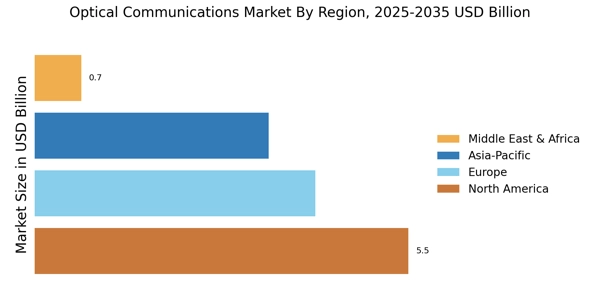
North America is the largest market for optical communications, holding approximately 40% of the global share. The region's growth is driven by increasing demand for high-speed internet, advancements in 5G technology, and significant investments in infrastructure. Regulatory support, such as the Federal Communications Commission's initiatives to expand broadband access, further catalyzes market expansion. The United States leads the market, with major players like Cisco Systems, Ciena Corporation, and Corning Incorporated driving innovation. Canada also contributes significantly, focusing on enhancing its telecommunications infrastructure. The competitive landscape is characterized by rapid technological advancements and strategic partnerships among key players, ensuring a robust market presence.
Europe : Emerging Market with Potential
Europe is witnessing a significant transformation in the optical communications market, holding around 30% of the global share. The region's growth is propelled by the European Union's Digital Single Market strategy, which aims to enhance connectivity and digital infrastructure. Regulatory frameworks promoting fiber optic deployment and 5G rollout are key drivers of this growth, fostering a competitive environment. Leading countries include Germany, France, and the UK, where companies like Nokia and ADVA Optical Networking are prominent. The competitive landscape is marked by collaborations between telecom operators and technology providers, enhancing service delivery. The region's focus on sustainability and innovation positions it as a vital player in The Optical Communications.
Asia-Pacific : Rapid Growth and Expansion
Asia-Pacific is rapidly emerging as a powerhouse in the optical communications market, accounting for approximately 25% of the global share. The region's growth is driven by increasing internet penetration, urbanization, and government initiatives to enhance digital infrastructure. Countries like China and India are at the forefront, with substantial investments in telecommunications and broadband expansion, supported by favorable regulatory environments. China, led by Huawei Technologies and ZTE Corporation, dominates the market, while Japan and India are also significant players. The competitive landscape is characterized by aggressive pricing strategies and technological advancements, with companies focusing on next-generation optical networks. This dynamic environment positions Asia-Pacific as a critical region for future growth in optical communications.
Middle East and Africa : Emerging Market with Challenges
The Middle East and Africa region is gradually developing its optical communications market, holding about 5% of the global share. Growth is driven by increasing demand for connectivity, particularly in urban areas, and government initiatives aimed at improving telecommunications infrastructure. However, challenges such as regulatory hurdles and varying levels of investment across countries impact market development. Leading countries include South Africa and the UAE, where investments in fiber optic networks are gaining momentum. The competitive landscape is evolving, with local and international players vying for market share. Companies are focusing on innovative solutions to address infrastructure gaps, making the region a potential growth area for optical communications in the coming years.
主要参与者和竞争洞察
The Optical Communications Market is currently characterized by a dynamic competitive landscape, driven by rapid technological advancements and increasing demand for high-speed data transmission. Key players such as Cisco Systems (US), Huawei Technologies (CN), and Nokia (FI) are strategically positioned to leverage their extensive research and development capabilities, focusing on innovation and digital transformation. Cisco Systems (US) emphasizes its commitment to enhancing network performance through cutting-edge optical technologies, while Huawei Technologies (CN) continues to expand its global footprint, particularly in emerging markets. Nokia (FI) is also actively pursuing partnerships to bolster its optical networking solutions, thereby shaping a competitive environment that is increasingly collaborative yet fiercely competitive.
In terms of business tactics, companies are localizing manufacturing and optimizing supply chains to enhance operational efficiency and reduce costs. The market structure appears moderately fragmented, with a mix of established players and emerging companies vying for market share. This fragmentation allows for diverse offerings and innovation, as key players like Ciena Corporation (US) and Corning Incorporated (US) adapt their strategies to meet the evolving demands of the market.
In August 2025, Ciena Corporation (US) announced a strategic partnership with a leading telecommunications provider to deploy its latest optical networking solutions across multiple regions. This collaboration is poised to enhance network capacity and reliability, reflecting Ciena's focus on addressing the growing demand for bandwidth. Such partnerships not only strengthen Ciena's market position but also signify a broader trend towards collaborative innovation in the optical communications sector.
In September 2025, Corning Incorporated (US) unveiled a new line of advanced optical fibers designed to support next-generation data centers. This launch underscores Corning's commitment to innovation and its strategic focus on high-performance solutions that cater to the increasing data traffic demands. By investing in research and development, Corning aims to maintain its competitive edge and respond effectively to market needs.
In October 2025, Huawei Technologies (CN) revealed its plans to invest heavily in sustainable optical communication technologies, aiming to reduce the environmental impact of its operations. This initiative aligns with global trends towards sustainability and positions Huawei as a forward-thinking leader in the market. Such strategic moves not only enhance Huawei's brand reputation but also reflect a growing emphasis on environmentally responsible practices within the industry.
As of October 2025, the Optical Communications Market is witnessing significant trends such as digitalization, sustainability, and the integration of artificial intelligence. Strategic alliances among key players are increasingly shaping the competitive landscape, fostering innovation and collaboration. Looking ahead, it appears that competitive differentiation will evolve from traditional price-based competition to a focus on technological innovation, supply chain reliability, and sustainable practices, indicating a transformative shift in how companies position themselves in the market.
Optical Communications Market市场的主要公司包括
Recent Industry Developments
- Q2 2025: Nokia has agreed to buy optical networking equipment vendor Infinera in a deal worth $2.3 billion Nokia announced it will acquire Infinera, a major optical networking equipment provider, for $2.3 billion, with 70% of the sum paid in cash and the remainder in stock. The acquisition is aimed at strengthening Nokia's position in the optical communications market.
未来展望
Optical Communications Market 未来展望
光通信市场预计在2024年至2035年期间以7.83%的年均增长率增长,推动因素包括数据流量增加、技术进步和对高速连接的需求。
到2035年,光通信市场预计将保持强劲,受创新和全球连接性增加的推动。
市场细分
光通信市场类型展望
- 光开关
- 光收发器
- 光放大器
- 光分路器
- 光环
- 光纤
光通信市场最终用户展望
- 政府
- 医疗保健
- 云
- 能源和公用事业
- 银行、金融服务和保险
- 信息技术和电信
- 国防
- 航空航天
光通信市场技术展望
- 同步光网络
- 光纤通道
- 波长分复用
- 其他
光通信市场应用展望
- 数据中心
- 电信
- 企业
- 其他
报告范围
| MARKET SIZE 2024 | 13.62(USD Billion) |
| MARKET SIZE 2025 | 14.69(USD Billion) |
| MARKET SIZE 2035 | 31.22(USD Billion) |
| COMPOUND ANNUAL GROWTH RATE (CAGR) | 7.83% (2024 - 2035) |
| REPORT COVERAGE | Revenue Forecast, Competitive Landscape, Growth Factors, and Trends |
| BASE YEAR | 2024 |
| Market Forecast Period | 2025 - 2035 |
| Historical Data | 2019 - 2024 |
| Market Forecast Units | USD Billion |
| Key Companies Profiled | Market analysis in progress |
| Segments Covered | Market segmentation analysis in progress |
| Key Market Opportunities | Integration of advanced photonic technologies enhances data transmission efficiency in the Optical Communications Market. |
| Key Market Dynamics | Rising demand for high-speed internet drives innovation and competition in the Optical Communications Market. |
| Countries Covered | North America, Europe, APAC, South America, MEA |
市场亮点
Frequently Asked Questions
到2035年,光通信市场的预计市场估值是多少?
光通信市场预计到2035年将达到312.2亿美元的估值。
2024年光通信市场的市场估值是多少?
在2024年,光通信市场的估值为136.2亿美元。
在2025年至2035年的预测期内,光通信市场的预期年均增长率是多少?
在2025年至2035年的预测期内,光通信市场的预期年均增长率为7.83%。
哪些公司被认为是光通信市场的关键参与者?
光通信市场的关键参与者包括思科系统、华为技术、诺基亚和赛灵思公司。
光通信市场的主要细分市场是什么?
光通信市场的主要细分市场包括类型、技术、应用和最终用户。
到2035年,光收发器细分市场预计将增长多少?
光收发器细分市场预计将从2024年的40亿美元增长到2035年的90亿美元。
到2035年,电信应用细分市场的预计增长是多少?
电信应用细分市场预计将从2024年的50亿美元增长到2035年的120亿美元。
到2035年,光纤细分市场的预计估值是多少?
光纤细分市场预计将从2024年的36.2亿美元增长到2035年的97.2亿美元。
到2035年,哪个最终用户细分市场预计将有最高的增长?
IT和电信最终用户细分市场预计将从2024年的30亿美元增长到2035年的70亿美元。
到2035年,哪个技术细分市场预计将看到最显著的增长?
波长分复用技术细分市场预计将从2024年的50亿美元增长到2035年的120亿美元。
请填写以下表格以获取本报告的免费样本
Customer Stories
“This is really good guys. Excellent work on a tight deadline. I will continue to use you going forward and recommend you to others. Nice job”
“Thanks for sending the report it gives us a good global view of the Betaïne market.”
“We found the report very insightful! we found your research firm very helpful. I'm sending this email to secure our future business.”
“I am very pleased with how market segments have been defined in a relevant way for my purposes (such as "Portable Freezers & refrigerators" and "last-mile"). In general the report is well structured. Thanks very much for your efforts.”
“We got the report in time, we really thank you for your support in this process. I also thank to all of your team as they did a great job.”
“The Automotive 48V ECU Components Procurement Intelligence Study” was a complex project, but the Market Research Future (MRFR) team handled it with quality, agility, and customer-centricity. They delivered all requested data on time and within the agreed scope. The team, including Shubhendra Anand and Rahul Gotadki, was always readily available to clarify questions and swiftly implement necessary adjustments, driving the project to a successful conclusion within a very demanding timeframe.
I would also like to specifically commend Akshay Agarwal for his responsiveness and support at every stage—from our initial inquiry on May 6th through to final delivery on June 18th. His dedication made the entire process seamless.”
“Thanks. It’s been a pleasure working with you, please use me as reference with any other Intel employees.”
“Thank you, this will be very helpful for OQS.”
“I have been reading the first document or the study, ,the Global HVAC and FP market report 2021 till 2026. Must say, good info! I have not gone in depth at all parts, but got a good indication of the data inside!”