Kids Smartwatch Market 摘要
主要市场趋势和亮点
市场规模与预测
| CAGR (2025 - 2035) | 11.42% |
主要参与者
Garmin(US), Fitbit (US), Apple (US), Samsung (KR), VTech (HK), Xplora (NO), TickTalk (US), Huawei (CN), Lego (DK)
| CAGR (2025 - 2035) | 11.42% |
儿童智能手表市场目前正在经历动态演变,受到技术进步和消费者偏好变化的推动。随着父母越来越寻求提供安全功能、教育内容和娱乐的设备,针对儿童的智能手表的需求似乎在上升。这些设备不仅提供通信功能,还结合健康监测功能,可能吸引关注健康的家庭。此外,将游戏化元素整合到教育应用中似乎增强了参与感,使这些智能手表对儿童及其监护人更具吸引力。除了安全和教育功能外,儿童智能手表市场还越来越强调定制和个性化。制造商可能会提供多种设计、颜色和功能,以迎合年轻用户的多样化口味和偏好。这一趋势表明,品牌正在认识到吸引儿童个性的重要性,同时也关注父母对可用性和耐用性的担忧。随着市场的不断演变,竞争可能会变得越来越激烈,各公司努力通过创新功能和独特的销售主张来区分其产品。
安全功能的加入,例如GPS追踪和紧急联系人选项,正成为儿童智能手表市场的焦点。父母越来越重视能够监控孩子行踪并确保其安全的设备。此外,强大的家长控制功能使监护人能够管理使用和应用访问,从而增强安全感。
为儿童设计的智能手表越来越多地整合教育内容和互动应用。这一趋势反映了对技术在吸引人方式中促进学习潜力的日益认可。通过将娱乐与教育价值结合,这些设备可能在保持儿童娱乐的同时增强其认知发展。
儿童智能手表市场对可定制选项的需求正在上升。制造商可能会提供多种设计、颜色和功能,让儿童表达他们的个性。这一趋势表明,正在朝着创造与年轻用户产生共鸣的产品转变,使其更具吸引力并培养归属感。
儿童智能手表市场受到家长和孩子们对健康和健身日益关注的影响。随着对儿童肥胖和久坐生活方式的担忧加剧,促进身体活动和健康习惯的智能手表正在获得关注。步数追踪、锻炼提醒和心率监测等功能正成为重要的卖点。市场数据显示,健康导向的智能手表需求可能会增加,因为家长优先考虑鼓励孩子积极生活方式的设备。这一趋势可能导致智能手表作为儿童健康管理工具的更广泛接受。
儿童智能手表市场受到家庭可支配收入增加的积极影响。随着经济条件的改善,家长更愿意投资于提升孩子安全和学习体验的技术。智能手表的可负担性有所提高,使其对更广泛的受众可及。市场数据显示,随着可支配收入的增加,儿童智能手表市场对高端功能和品牌的需求可能会增加。这一趋势表明,提供各种价格产品的制造商可能会受益于更大的客户群,以满足多样化的消费者需求。
儿童智能手表市场正在经历技术进步的激增,这增强了智能手表对儿童的功能性和吸引力。GPS追踪、健康监测和通信功能等创新正成为标准。根据最近的数据,先进传感器和连接选项的整合预计将显著推动市场增长。随着家长越来越寻求提供安全性和参与感的设备,配备尖端技术的智能手表的需求可能会增加。这一趋势表明,投资于研发的制造商可能会在儿童智能手表市场中占据更大的份额,吸引技术敏感的家庭。
儿童智能手表市场受益于电子商务平台的扩展,这使得更容易获取各种产品。在线购物在家长中变得越来越受欢迎,他们欣赏数字市场提供的便利和多样性。这一趋势可能会推动销售增长,因为消费者可以轻松比较功能、价格和评价。市场数据显示,儿童智能手表市场的电子商务销售预计将上升,因为越来越多的家庭转向在线平台满足他们的购买需求。这一转变可能会鼓励制造商增强其在线存在和营销策略,以捕捉不断增长的在线购物者群体。
儿童智能手表市场正在见证对提供增强家长控制功能的设备需求的上升。家长对孩子的安全和数字暴露越来越关注,导致他们偏好能够监控和控制通信和位置的智能手表。地理围栏、SOS警报和限制联系人列表等功能正成为标准。市场分析表明,具有强大家长控制功能的智能手表可能会吸引更多买家,因为它们为家长提供了安心。这种对安全和控制的日益重视正在塑造儿童智能手表市场,推动制造商之间的创新和竞争。
儿童智能手表市场目前由集成儿童智能手表主导,这些手表将多种功能无缝集成到一个设备中。这些智能手表因其多功能性而受到家长的青睐,涵盖从GPS追踪和通信到健康监测的所有内容。尽管独立儿童智能手表的市场份额较小,但由于其简单的功能和较低的价格,正迅速吸引关注,成为预算有限家庭的可选方案。
智能手表:集成(主导)与独立(新兴)
集成儿童智能手表提供全面的功能,包括实时追踪、通信能力和教育工具,使其成为优先考虑多功能性的家长的首选。这些设备通常配备内置安全功能,如SOS警报和地理围栏,这些功能促进了它们的受欢迎程度。另一方面,独立儿童智能手表在市场上迅速崛起,吸引了那些偏好易用性和经济实惠的消费者。它们通常专注于基本功能,如计时和健身追踪,吸引那些寻找基本功能而不想增加额外开支的家庭。这种对简单性的日益需求正在推动它们在市场上的日益存在。
儿童智能手表市场展示了三个主要应用细分:个人使用、学校和儿童培训组织。在这些细分中,个人使用占据最大份额,因为许多家长优先考虑为孩子购买智能手表以确保个人安全和娱乐。相反,学校应用细分正在迅速获得关注,因为教育机构越来越多地采用技术来增强学生的学习体验并监测他们的健康。
个人使用(主导)与学校(新兴)
在儿童智能手表市场应用领域,个人使用作为主导细分出现,受到家长对提供安全、追踪功能和多媒体能力的设备需求增长的推动。个人使用的智能手表配备GPS追踪、通信工具和互动游戏,满足儿童和家长的需求。另一方面,学校细分是一个新兴应用,受到教育中技术整合的推动。学校利用智能手表促进教师与学生之间的沟通,监测活动,并在年轻学习者中培养数字公民意识。这种向技术驱动的教育工具的转变使学校细分成为儿童智能手表市场的关键增长驱动力。
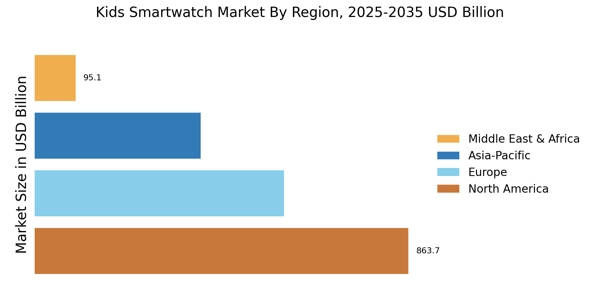
北美是儿童智能手表最大的市场,占全球市场份额的约45%。该地区的增长受到父母对儿童安全日益关注和对教育技术需求上升的推动。对可穿戴技术在学校的监管支持进一步促进了这一趋势,使其成为创新和投资的关键领域。美国在市场中处于领先地位,主要参与者如Garmin、Fitbit和Apple主导着市场。竞争环境的特点是持续的产品创新和针对技术精明父母的营销策略。加拿大也在其中扮演重要角色,专注于儿童智能手表中的健康和安全功能,促进整体增长。
欧洲儿童智能手表市场正在显著上升,目前占全球市场份额的约30%。增长受到父母对健康和安全意识提高的推动,同时监管倡议促进儿童数字素养。德国和英国等国家处于前沿,需求日益增长的多功能智能手表结合了安全功能和教育工具。德国是欧洲最大的市场,其次是英国。竞争格局包括VTech和Lego等主要参与者,他们专注于将教育内容整合到其设备中。创新初创企业的存在也很显著,为市场环境增添了活力。随着法规的演变,市场预计将进一步扩展,以满足技术精明家庭的需求。
亚太地区正在成为儿童智能手表市场的强国,占全球市场份额的约20%。该地区的增长受到可支配收入上升、智能手机普及率提高和对儿童安全关注增加的推动。中国和韩国等国在这一领域处于领先地位,对提供GPS追踪和健康监测功能的技术先进智能手表的需求强劲。中国是该地区最大的市场,韩国和日本也做出了重要贡献。竞争格局的特点是华为和三星等主要参与者的存在,他们在研发方面投入巨资,以增强产品供应。该地区传统价值观与现代技术的独特结合为创新儿童智能手表解决方案创造了肥沃的土壤,满足安全和教育需求。
中东和非洲地区在儿童智能手表市场逐渐崭露头角,目前占全球市场份额的约5%。增长受到城市化加速、可支配收入上升和对儿童安全意识提高的推动。阿联酋和南非等国在市场中处于领先地位,对提供安全功能和教育内容的智能手表有显著需求。阿联酋是该地区最大的市场,南非紧随其后。竞争格局的特点是本地和国际参与者的混合,包括TickTalk和Xplora等品牌。随着该地区的持续发展,对创新和多功能儿童智能手表的需求预计将上升,得到政府倡导教育技术的支持。
儿童智能手表市场目前的特点是动态竞争格局,受到技术进步和对儿童安全及参与度日益增长的需求的推动。主要参与者如Apple(美国)、Garmin (美国)和VTech (香港)战略性地定位以利用创新和消费者洞察。Apple (美国)专注于整合先进的健康监测功能,而Garmin (美国)则强调户外活动追踪,吸引关注健康的父母。VTech (香港)则以教育内容为目标,针对年轻人群体,从而多样化其市场覆盖。总体而言,这些策略促进了一个优先考虑创新和用户参与的竞争环境,塑造了消费者偏好和市场动态。儿童智能手表市场的关键商业策略包括本地化制造和优化供应链,以增强对消费者需求的响应。市场结构似乎适度分散,几家主要参与者通过差异化的产品提供影响市场。这种分散性使得小众参与者能够与知名品牌共同繁荣,为消费者创造多样化的选择。这些主要参与者的集体影响推动了竞争,因为他们不断寻求提升产品功能和市场存在感。
在九月,Apple (美国)宣布推出其最新的儿童智能手表市场型号,该型号整合了先进的AI驱动安全功能,包括实时位置追踪和紧急警报。这一战略举措不仅强化了Apple对儿童安全的承诺,还将公司定位为在儿童可穿戴设备中整合尖端技术的领导者。这些功能的引入可能会引起寻求增强儿童安全的父母的共鸣,从而加强Apple的市场地位。
在八月,Garmin (美国)通过推出专为户外活动设计的智能手表扩展了其产品线,该手表具有GPS导航和冒险追踪功能。这一战略行动与Garmin作为户外技术领导者的品牌形象相一致,吸引了重视户外体验的活跃家庭。通过迎合这一小众市场,Garmin增强了其竞争优势并多样化了其产品,可能吸引更广泛的客户群。
在七月,VTech (香港)与教育内容提供商建立了合作关系,以增强其智能手表产品的互动学习应用。这一合作旨在丰富VTech产品的教育价值,吸引重视儿童玩耍时间学习的父母。这种战略联盟不仅增强了VTech产品的吸引力,还使公司在日益关注教育技术的市场中处于有利地位。
截至十月,儿童智能手表市场当前的竞争趋势受到数字化、可持续性和AI技术整合的强烈影响。主要参与者之间的战略联盟正在塑造市场格局,促进创新并增强产品供应。展望未来,竞争差异化可能会从传统的基于价格的竞争演变为关注技术创新、用户体验和供应链可靠性。这一转变强调了在快速发展的市场中保持竞争优势的适应性和前瞻性战略的重要性。






Q2 2026: Garmin (US): Garmin released software version 16.38 for its LTE-enabled Bounce 2 kids smartwatch, delivering targeted bug fixes and system optimizations to enhance two-way voice messaging and location tracking reliability.
Q3 2026: Apple (US): Apple introduced expanded "Apple Watch For Your Kids" management tools in watchOS 27, enabling independent device configuration without requiring a paired iPhone while introducing advanced parental controls and tailored communication safeguards.
Q3 2026: TickTalk (US): TickTalk launched the TickTalk 6 kids smartwatch featuring upgraded FaceTalk video calling, built-in eSIM technology for international travel across over 160 countries, and more than 50 enhanced parental control settings.
According to Xplora Technologies, the number of subscribers increased significantly from 281,000 in June 2024 to 393,000 by June 30 of 2025, demonstrating robust growth in both the European and American sectors.
The X5 Play smartwatch, developed on Snapdragon Wear for users aged 4 to 11, was introduced by Xplora in the United States in May 2025. It has gamified step tracking, secure texting, GPS location, and video chatting.
The KidiZoom Smartwatch DX4, a splash-proof wearable with two cameras, a high-resolution screen, games, and creative capabilities, was unveiled by VTech in May 2024 and was named the best holiday item of the year.
The Bounce kids wristwatch, which Garmin debuted in August 2024, received positive reviews from parents for its location and messaging capabilities. It offers LTE-based voice/text, GPS boundary alarms, activity tracking, and swim-friendly durability.
Using humorous suggestions to encourage health and engagement, LeapFrog revamped its LeapBand tracker with an emphasis on active activities and pet challenges for younger children. In 2024, Apple witnessed an increase in the use of the Apple Watch SE by older kids, who valued its location sharing, family setup features, and health tracking without requiring full smartphone access.
儿童智能手表市场预计在2025年至2035年间以11.42%的年均增长率增长,推动因素包括技术进步、家长对安全的关注增加以及对教育功能的需求。
到2035年,儿童智能手表市场预计将强劲,反映出显著的增长和创新。
| 市场规模 2024 | 1919.4(亿美元) |
| 市场规模 2025 | 2138.6(亿美元) |
| 市场规模 2035 | 6306.24(亿美元) |
| 年均复合增长率 (CAGR) | 11.42% (2025 - 2035) |
| 报告覆盖范围 | 收入预测、竞争格局、增长因素和趋势 |
| 基准年 | 2024 |
| 市场预测期 | 2025 - 2035 |
| 历史数据 | 2019 - 2024 |
| 市场预测单位 | 亿美元 |
| 关键公司简介 | Garmin (美国)、Fitbit (美国)、Apple (美国)、Samsung (韩国)、VTech (香港)、Xplora (挪威)、TickTalk (美国)、Huawei (中国)、Lego (丹麦) |
| 覆盖的细分市场 | 类型、应用、地区 |
| 关键市场机会 | 在儿童智能手表市场中整合先进的安全功能和教育内容推动消费者需求。 |
| 关键市场动态 | 对安全功能的消费者需求上升推动儿童智能手表市场的创新和竞争。 |
| 覆盖的国家 | 北美、欧洲、亚太地区、南美、中东和非洲 |
儿童智能手表市场在2024年的估值为1919.4亿美元。
预计到2035年,市场将达到6306.24亿美元。
在2025年至2035年的预测期内,儿童智能手表市场的预期年均增长率为11.42%。
市场的关键参与者包括Garmin、Fitbit、Apple、Samsung、VTech、Xplora、TickTalk、Huawei和Lego。
在2024年,集成型儿童智能手表的估值为767.76亿美元,而独立型儿童智能手表的估值达到了1151.64亿美元。
主要应用包括个人使用、学校和儿童培训组织,其中个人使用在2024年的估值为800.0亿美元。
用于学校的儿童智能手表市场在2024年的估值为600.0亿美元。
独立型儿童智能手表细分市场在2024年的估值最高,达到了1151.64亿美元。
儿童智能手表在培训组织的市场在2024年的估值为519.4亿美元,表明这一细分市场相较于个人使用和学校应用较小。
影响增长的趋势包括对安全功能的需求增加、教育应用以及技术在儿童日常活动中的整合。
 Kiran Jinkalwad

 Aarti Dhapte
The secondary research process involved comprehensive analysis of regulatory databases, telecommunications authority filings, consumer electronics standards, child safety publications, and authoritative technology organizations. Key sources included the US Federal Communications Commission (FCC), US Consumer Product Safety Commission (CPSC), European Telecommunications Standards Institute (ETSI), European Committee for Electrotechnical Standardization (CENELEC), International Telecommunication Union (ITU-R & ITU-T standards), Institute of Electrical and Electronics Engineers (IEEE) wearable device standards, Bluetooth Special Interest Group (SIG) certification databases, GSMA Intelligence, Consumer Technology Association (CTA), Japanese Ministry of Internal Affairs and Communications (MIC), National Institute of Standards and Technology (NIST) cybersecurity frameworks, American Academy of Pediatrics (AAP) digital media guidelines, UNICEF Child Protection Statistics, World Health Organization (WHO) childhood obesity and activity tracking data, MRFR Worldwide Quarterly Wearable Device Tracker, MRFR Global Smartwatch Market Monitor, and national statistics offices from key markets for youth digital adoption rates.
Data on device certification, safety compliance requirements, assessments of parental control protocols, pricing trends, and demographic adoption patterns for standalone devices, integrated smartwatches, and educational/training applications were gathered from these sources.
To gather both qualitative and quantitative insights, supply-side and demand-side stakeholders were interviewed during the primary research process. Regulatory affairs heads, supply chain directors, CEOs, CTOs, VPs of Product Development, and carrier partnership managers from kids smartwatch manufacturers (Garmin, VTech, Xplora, TickTalk, Huawei), component OEMs (chipset, display, GPS module suppliers), and mobile network operators with connected wearables plans were among the supply-side sources. Parents/guardians, principals and IT administrators of school districts, physicians, educational technologists, procurement leaders from children's training groups, and retail category managers from consumer electronics chains were all considered demand-side sources. Primary research confirmed product pipeline timelines for integrating educational content, validated market segmentation between standalone and integrated devices, and collected information on pricing sensitivity across institutional and consumer channels, school adoption policies, parental purchasing decisions, and safety feature prioritization.
Primary Respondent Breakdown:
• By Designation: C-level Primaries (28%), Director Level (35%), Others (37%)
• By Region: North America (40%), Europe (25%), Asia-Pacific (28%), Rest of World (7%)
Unit shipment analysis and revenue mapping across institutional and consumer channels were used to determine the global market valuation. The following were part of the methodology:
• The discovery of more than 35 major producers of children's wearable technology in North America, Europe, Asia-Pacific, and Latin America
• Product mapping between the GPS-enabled, cellular-connected, and Bluetooth-tethered versions of the Integrated Kids' Smartwatch and Standalone Kids' Smartwatch categories
• Evaluation of reported and estimated yearly sales and unit shipments for children's smartwatch portfolios, encompassing both direct-to-consumer and institutional sales channels in education
• Manufacturers that will account for 75–80% of the worldwide market in 2024
• To determine segment-specific valuations and installation base estimates, extrapolation is done using top-down (manufacturer revenue validation and mobile carrier subscription data) and bottom-up (unit shipment volume × ASP by country/region) approaches across Individual Use, School, and Kids Training Organization segments.
请填写以下表格以获取本报告的免费样本


“This is really good guys. Excellent work on a tight deadline. I will continue to use you going forward and recommend you to others. Nice job”
 Noah Malgeri
Co-Founder

“Thanks for sending the report it gives us a good global view of the Betaïne market.”
 Peter Groot koerkamp
Account and Business Manager

“We found the report very insightful! we found your research firm very helpful. I'm sending this email to secure our future business.”
 Younghwan Choi
Senior Retail Manager

“I am very pleased with how market segments have been defined in a relevant way for my purposes (such as "Portable Freezers & refrigerators" and "last-mile"). In general the report is well structured. Thanks very much for your efforts.”
 Mark Irwin
Management Consultant

“We got the report in time, we really thank you for your support in this process. I also thank to all of your team as they did a great job.”
 Akif Moroglu
Strategy & Business Development Director

“The Automotive 48V ECU Components Procurement Intelligence Study” was a complex project, but the Market Research Future (MRFR) team handled it with quality, agility, and customer-centricity. They delivered all requested data on time and within the agreed scope. The team, including Shubhendra Anand and Rahul Gotadki, was always readily available to clarify questions and swiftly implement necessary adjustments, driving the project to a successful conclusion within a very demanding timeframe.
I would also like to specifically commend Akshay Agarwal for his responsiveness and support at every stage—from our initial inquiry on May 6th through to final delivery on June 18th. His dedication made the entire process seamless.”
 Guilherme Gomes Martins
Product Management Director

“Thanks. It’s been a pleasure working with you, please use me as reference with any other Intel employees.”
 Joseph Aguayo
Sales Operations & Pricing Manager

“Thank you, this will be very helpful for OQS.”
 La Terria Dodd
Program Support Specialist

“I have been reading the first document or the study, ,the Global HVAC and FP market report 2021 till 2026. Must say, good info! I have not gone in depth at all parts, but got a good indication of the data inside!”
 Rob Kooiker
Group Product Manager HVAC & Fire Protection GMA



