Ethernet PHY Chip Market

以太网PHY芯片市场规模、份额和研究报告(按数据速率(10-100Mbps、100-1000Mbps和大于100 Gaps)、按应用(电信、消费电子、汽车、企业网络和工业自动化)以及按地区(北美、欧洲、亚太和其他地区) – 产业预测至2035年
ID: MRFR/SEM/5960-CR 142 Pages Nirmit Biswas, Aarti Dhapte Last Updated: September 19, 2026
Ethernet PHY Chip Market
Market Size
Forecast Period2025 - 2035
CAGR (2025 - 2035)8.8%
2024 Market Size$ 11.25 Billion
2025 Market Size$ 12.24 Billion
2035 Market Size$ 28.46 Billion
Key Players
Broadcom
Intel
Texas Instruments
NXP Semiconductors
Marvell Technology
Microchip Technology
Opportunities
  • Expansion of Data Centers
  • Emergence of Edge Computing
  • Growth of Industrial Automation

Ethernet PHY Chip Market 摘要

根据市场研究未来的分析,以太网PHY芯片市场规模预计在2024年为112.5亿美元。预计以太网PHY芯片行业将从2025年的122.4亿美元增长到2035年的284.6亿美元,在2025年至2035年的预测期内,年均增长率(CAGR)为8.8%。

主要市场趋势和亮点

以太网PHY芯片市场因技术进步和日益增长的连接需求而准备实现显著增长。

  • 市场对高速连接的需求正在上升,特别是在北美地区。
  • 与物联网设备的集成变得越来越普遍,尤其是在亚太地区。
  • 在各类应用中,能源效率受到显著关注,影响设计和生产。
  • 数据中心的扩展和5G技术的日益普及是推动电信领域增长的关键因素。

市场规模与预测

2024市场规模 112.5(十亿美元)
2035市场规模 284.6(十亿美元)
年均增长率(2025 - 2035) 8.8%

主要参与者

博通(美国)、英特尔(美国)、德州仪器(美国)、NXP半导体(荷兰)、美满科技(美国)、微芯科技(美国)、瑞昱半导体(台湾)、高通(美国)、模拟设备(美国)

Ethernet PHY Chip Market Drivers

数据中心的扩展

数据中心的扩展是以太网物理芯片市场的关键驱动因素。随着组织越来越多地迁移到基于云的解决方案,对高效数据处理和存储解决方案的需求日益增强。以太网物理芯片在确保数据中心内的高速连接方面发挥着至关重要的作用,促进无缝的数据传输和通信。根据行业报告,数据中心市场预计在未来几年将以超过10%的复合年增长率增长。这一增长与对以太网物理芯片日益增长的需求直接相关,因为数据中心需要先进的网络解决方案来处理不断增加的数据流量。

边缘计算的出现

边缘计算的出现正在重塑以太网物理芯片市场。随着组织寻求在数据源附近处理数据,对高效网络解决方案的需求变得至关重要。以太网物理芯片对于在边缘计算环境中实现高速数据传输至关重要,在这些环境中,低延迟和可靠性是最重要的。边缘计算市场预计将显著增长,推动这一增长的是对实时数据处理和分析的需求增加。这一增长表明,随着企业投资于边缘计算技术以增强其运营能力,以太网物理芯片市场将经历更高的需求。

工业自动化的增长

工业自动化的增长是以太网物理芯片市场的关键驱动因素。随着各行业采用自动化技术以提高生产力和效率,对可靠网络解决方案的需求增加。以太网物理芯片是工业自动化系统的核心,为设备和机械提供必要的连接。预计工业自动化市场将见证显著增长,这一增长是由于对提高运营效率和降低成本的需求。这一趋势表明,随着制造商和工业运营商寻求实施先进的网络解决方案以支持其自动化计划,以太网物理芯片市场可能会看到需求增加。

智能家居技术的激增

智能家居技术的激增正在显著影响以太网物理芯片市场。随着消费者越来越多地采用智能设备,对可靠和高速连接的需求变得至关重要。以太网物理芯片对于确保智能家居设备有效且高效地通信至关重要。预计到2025年,智能家居设备市场将达到数千亿美元,表明对基础网络技术的强劲需求。这一趋势表明,随着制造商寻求将先进的连接解决方案集成到其产品中,以太网物理芯片市场将受益于智能家居技术的普及。

5G技术的日益普及

5G技术的日益普及正在推动以太网物理芯片市场,因为它需要高速数据传输和低延迟。5G网络需要强大的基础设施,其中包括先进的以太网物理芯片,以支持增强的带宽和连接需求。随着电信公司在5G推广上进行大量投资,对以太网物理芯片的需求预计将显著上升。这一趋势进一步得到了预计到2025年移动数据流量将达到数个泽字节的支持。因此,以太网物理芯片市场可能会经历显著增长,因为它与下一代移动网络的要求相一致。

市场细分洞察

获取关于Ethernet PHY Chip Market的更多详细见解

区域洞察

北美:技术创新领导者

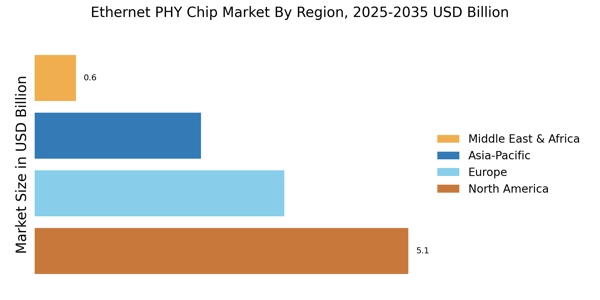
北美是以太网PHY芯片最大的市场,约占全球市场份额的45%。该地区的增长受到技术快速进步、高速互联网需求增加以及对数据中心和云计算的重大投资的推动。对宽带扩展的监管支持进一步促进了市场增长,使其成为全球市场的重要参与者。加拿大以太网PHY芯片市场的增长得益于对数据中心基础设施、工业自动化和智能制造计划的投资。美国在市场中处于领先地位,博通、英特尔和德州仪器等主要公司推动创新和竞争。这些关键参与者的存在促进了一个强大的生态系统,确保了先进以太网PHY技术的持续发展。竞争格局以战略合作伙伴关系和并购为特征,增强了产品供应和市场覆盖。

欧洲:新兴市场动态

欧洲的以太网PHY芯片市场正在显著上升,约占全球市场份额的30%。欧洲以太网PHY芯片市场因工业网络和汽车电子中以太网通信的日益采用而持续扩展。该地区的增长受到数字化加速、5G网络的推广以及促进能源效率和可持续性的严格法规的推动。德国和英国等国处于前沿,推动对高性能网络解决方案的需求,这对智能城市和物联网应用至关重要。德国是欧洲最大的市场,拥有NXP半导体和美满科技等关键参与者。竞争格局以本地和国际公司之间的创新与合作为特征。法国以太网PHY芯片市场的扩展受到工业自动化、运输和数字基础设施现代化项目的需求推动。德国以太网PHY芯片市场在汽车制造、工厂自动化和工业4.0部署中表现出强劲的采用。欧洲市场还受到鼓励技术进步和环境可持续性的监管框架的影响,确保了平衡的增长轨迹。

亚太地区:快速增长区域

亚太地区正在成为以太网PHY芯片市场的强国,约占全球市场份额的20%。该地区的增长受到快速城市化、互联网普及率提高和智能技术扩展的推动。中国和印度等国在这一激增中处于领先地位,政府倡导增强数字基础设施和连接性,进一步推动市场需求。印度以太网PHY芯片市场的增长得益于数字基础设施的扩展、电子制造的增加和连接设备的日益采用。中国是该地区最大的市场,拥有瑞昱半导体等本地制造商的强大存在。日本以太网PHY芯片市场受益于先进的电子制造能力和对高可靠性网络解决方案的日益需求。竞争格局以成熟参与者和新进入者的混合为特征,促进了创新和具有成本效益的解决方案。该地区对技术进步和基础设施发展的关注使其成为以太网PHY芯片市场的重要参与者。

中东和非洲:新兴技术中心

中东和非洲(MEA)地区正在逐步发展其以太网PHY芯片市场,目前约占全球市场份额的5%。增长主要受到对数字基础设施、智能城市项目和物联网技术采用的投资增加的推动。阿联酋和南非等国正在引领这一潮流,政府倡导增强连接性和技术能力。MEA的竞争格局正在演变,本地和国际参与者争夺市场份额。全球公司的存在促进了创新,而区域公司则专注于满足当地需求的定制解决方案。随着该地区继续投资于技术,以太网PHY芯片市场预计在未来几年将显著增长。

Ethernet PHY Chip Market Regional Image

主要参与者和竞争洞察

以太网PHY芯片市场目前的特点是动态的竞争格局,受到快速技术进步和对高速连接需求增加的推动。博通(美国)、英特尔(美国)和美满科技(美国)等主要参与者处于前沿,各自采用不同的策略来增强市场定位。博通(美国)专注于高性能网络解决方案的创新,而英特尔(美国)则强调其整合先进半导体技术的承诺。美满科技(美国)通过有针对性的收购战略性地扩大其产品组合,从而增强其在数据基础设施方面的能力。这些策略共同促成了一个日益受到技术创新和战略合作伙伴关系影响的竞争环境。在商业策略方面,公司越来越多地本地化制造并优化供应链,以提高运营效率。以太网PHY芯片市场似乎适度分散,既有成熟的参与者,也有新兴公司争夺市场份额。主要参与者的集体影响力显著,因为他们利用自己的技术专长和市场覆盖面来建立竞争优势。这种竞争结构促进了一个创新和战略合作至关重要的环境。
在八月,博通(美国)宣布推出其最新的以太网PHY芯片,旨在5G应用,预计将显著提高数据传输速度。这一战略举措强调了博通在高速网络解决方案中保持领导地位的承诺,特别是在对5G技术需求持续激增的情况下。该芯片的推出不仅增强了博通的产品组合,还使公司在快速发展的电信行业中处于有利地位。
在九月,英特尔(美国)透露其计划在美国投资新制造设施,旨在增加以太网PHY芯片的生产能力。这项投资反映了英特尔在增强国内制造能力方面的战略重点,这可能会提高供应链的可靠性并减少对海外生产的依赖。通过扩大其制造足迹,英特尔旨在满足对高性能网络解决方案日益增长的需求,同时也应对潜在的供应链脆弱性。
在七月,美满科技(美国)完成了对一家领先的软件定义网络公司的收购,预计将增强其以太网PHY芯片产品。这项收购在战略上具有重要意义,因为它使美满能够将先进的软件能力集成到其硬件解决方案中,从而为客户提供更全面的网络解决方案。这一举措表明,硬件和软件的融合在以太网PHY芯片市场中变得越来越重要。
截至十月,当前的竞争趋势受到数字化、可持续性和人工智能在网络解决方案中集成的重大影响。主要参与者之间的战略联盟正在塑造市场格局,促进创新并增强产品供应。展望未来,竞争差异化可能会从传统的基于价格的竞争转向关注技术创新、供应链可靠性和可持续性倡议。能够有效应对这些趋势的公司可能会在以太网PHY芯片市场中获得竞争优势。

Ethernet PHY Chip Market市场的主要公司包括

Recent Industry Developments

Q3 2026: Realtek Semiconductor (TW): Realtek showcased mass-produced 100GbE solutions using 25GbE lanes for Edge AI and enterprise servers and previewed an ultra-low-power 10GbE solution, expanding its high-speed Ethernet physical-layer portfolio for infrastructure applications.

Q3 2026: NXP Semiconductors (NL): NXP introduced its MCX A5 MCU family with an integrated 10BASE-T1S Ethernet digital PHY, enabling industrial and IoT endpoints to connect more sensors, actuators and controllers while reducing connectivity complexity

Q2 2026: Microchip Technology (US): Microchip introduced LAN878x and LAN888x 100BASE-T1 and 1000BASE-T1 PHY families with integrated MACsec, Time Sensitive Networking and functional-safety capabilities for automotive and industrial Ethernet architectures.

February 2024: Announcing the industry's first comprehensive 1.6T Ethernet IP solution in February 2024, Synopsys, Inc. significantly increased bandwidth and throughput for data-intensive AI workloads. In order to efficiently process petabytes of data, hyperscale data centers, which are fundamental in the era of pervasive intelligence, necessitate high-bandwidth, low-latency processors and interfaces. The new 1.6T Ethernet IP solution from Synopsys enables design teams to produce the fastest processors in the industry for applications involving AI and data center networking.

Synopsys' silicon roadmap equips hyperscale data center providers and the ecosystem that supports them with the most comprehensive, interoperable, and proved IP portfolio in the industry, thereby enabling them to future-proof their infrastructure. Customers require the IxVerify pre-silicon test solution from Keysight and the new 1.6T Ethernet controllers and robust 224G Ethernet PHY IP from Synopsys in order to design system on a chip devices that are the quickest and most reliable in the world.

July 2023: Microchip introduced its initial automotive Ethernet short range 10Base-T1S physical layer devices with support for time-sensitive networking (TSN) and functional safety in July 2023. For use in ISO 26262 applications, the LAN8670/1/2 10BASE-T1S Ethernet PHYs connect low-speed devices that previously needed their own communication systems to a standard Ethernet network with 10Mbit/s links. Specifications include a half-duplex mode, a speed of 10 Mbps, a flexible topology featuring a point-to-point and multidrop bus line, and the utilization of a single balanced pair of conductors. Additionally, the electromagnetic compatibility and interference with electromagnetic interference (EMC/EMI) of the devices are improved.

Support for Time-Synchronized Networks (TSN) enables synchronized timing across Ethernet networks and deterministic operation, which is crucial for numerous automotive zonal architecture applications.

November 2022: Two new 5-port Multi-Gigabit Unmanaged Switches, MS105, and MS305, were, launched by Netgear to help enterprises to expand their networks in cost-effective manner and with multi-gigabit speeds. MS105 and MS305, Multi-Gigabit Ethernet switches in a metal enclosure, have five 2.5G ports that can be mounted on a wall or desk. These switches are energy efficient and largely tested to make sure the reliability required by enterprises.

June 2022: The release of a new 10BASE-T1S Ethernet controller was announced by Onsemi, designed to provide dependable multi-point connectivity in industrial environments. More than forty nodes on a single twisted pair are supported by NCN26010, which is more than five times the number of nodes needed by the IEEE 802.3cg standard and minimizes the cost and complexity of installation.

未来展望

Ethernet PHY Chip Market 未来展望

预计以太网PHY芯片市场将在2025年至2035年期间以8.8%的年均增长率增长,推动因素是对高速连接和物联网应用的需求增加。

到2035年,以太网PHY芯片市场预计将保持强劲,受技术进步和多样化应用的推动。

市场细分

以太网PHY芯片市场数据速率展望

  • 10-100Mbps
  • 100-1000Mbps
  • 大于100 Gbps

以太网PHY芯片市场应用展望

  • 电信
  • 消费电子
  • 汽车
  • 企业网络
  • 工业自动化

报告范围

市场规模 2024 112.5(亿美元)
市场规模 2025 122.4(亿美元)
市场规模 2035 284.6(亿美元)
年均增长率(CAGR) 8.8%(2025 - 2035)
报告覆盖范围 收入预测、竞争格局、增长因素和趋势
基准年 2024
市场预测期 2025 - 2035
历史数据 2019 - 2024
市场预测单位 亿美元
关键公司简介 博通(美国)、英特尔(美国)、德州仪器(美国)、NXP半导体(荷兰)、美满科技(美国)、微芯科技(美国)、瑞昱半导体(台湾)、高通(美国)、模拟设备(美国)
覆盖的细分市场 数据速率、应用、地区
关键市场机会 下一代5G和物联网应用中集成先进以太网PHY芯片具有巨大的增长潜力。
关键市场动态 对高速连接的需求上升推动了以太网PHY芯片市场的创新和竞争。
覆盖的国家 北美、欧洲、亚太地区、南美、中东和非洲

Frequently Asked Questions

到2025年以太网物理芯片市场的当前估值是多少?

以太网物理芯片市场的估值在2024年约为65亿美元。

到2035年以太网物理芯片市场的预计市场规模是多少?

预计到2035年市场将达到约90亿美元。

在预测期内,以太网物理芯片市场的预期年均增长率是多少?

2025年至2035年期间,以太网物理芯片市场的预期年均增长率为3.0%。

哪些公司被认为是以太网物理芯片市场的关键参与者?

关键参与者包括博通、德州仪器、Marvell科技、NXP半导体等。

推动以太网物理芯片市场的主要应用是什么?

主要应用包括数据中心、电信、工业自动化、消费电子和汽车。

在以太网物理芯片市场中,网络设备细分市场的表现如何?

网络设备细分市场在2024年的估值约为25亿美元,预计将增长到35亿美元。

2025年汽车系统细分市场的市场表现如何?

汽车系统细分市场预计将在预测期内从15亿美元增长到20亿美元。

以太网物理芯片市场中有哪些不同的技术细分?

技术细分包括10/100/1000BASE-T、2.5GBASE-T、5GBASE-T和10GBASE-T。

集成电路形态在市场中的预期增长是多少?

集成电路形态预计将在2035年前从26亿美元增长到35亿美元。

数据速率细分如何影响整体市场估值?

数据速率细分,特别是千兆以太网,预计将从20亿美元增长到25亿美元,从而影响整体市场估值。

作者
Author Author Profile Nirmit Biswas LinkedIn Senior Research Analyst
With 5+ years of expertise in Market Intelligence and Strategic Research, Nirmit Biswas specializes in ICT, Semiconductors, and BFSI. Backed by an MBA in Financial Services and a Computer Science foundation, Nirmit blends technical depth with business acumen. He has successfully led 100+ projects for global enterprises and startups, including Amazon, Cisco, L&T and Huawei, delivering market estimations, competitive benchmarking, and GTM strategies. His focus lies in transforming complex data into clear, actionable insights that drive growth, innovation, and investment decisions. Recognized for bridging engineering innovation with executive strategy, Nirmit helps businesses navigate dynamic markets with confidence.
Co-Author Co-Author Profile Aarti Dhapte LinkedIn AVP - Research
A consulting professional focused on helping businesses navigate complex markets through structured research and strategic insights. I partner with clients to solve high-impact business problems across market entry strategy, competitive intelligence, and opportunity assessment. Over the course of my experience, I have led and contributed to 100+ market research and consulting engagements, delivering insights across multiple industries and geographies, and supporting strategic decisions linked to $500M+ market opportunities. My core expertise lies in building robust market sizing, forecasting, and commercial models (top-down and bottom-up), alongside deep-dive competitive and industry analysis. I have played a key role in shaping go-to-market strategies, investment cases, and growth roadmaps, enabling clients to make confident, data-backed decisions in dynamic markets.

Research Approach


Secondary Research

The secondary research process involved comprehensive analysis of semiconductor industry databases, technical standards publications, patent repositories, and authoritative electronics industry organizations. Key sources included the Semiconductor Industry Association (SIA), World Semiconductor Trade Statistics (WSTS), European Semiconductor Industry Association (ESIA), Institute of Electrical and Electronics Engineers (IEEE) Standards Association, Ethernet Alliance, USB Implementers Forum (USB-IF), U.S. Census Bureau ( semiconductor trade data), International Trade Administration (ITA), Japan Electronics and Information Technology Industries Association (JEITA), China Semiconductor Industry Association (CSIA), Taiwan Semiconductor Industry Association (TSIA), IPC Association Connecting Electronics Industries, IEEE Xplore Digital Library, ScienceDirect, Springer Nature, and company statutory filings (10-K, 10-Q, annual reports). These sources were used to collect shipment statistics, IEEE 802.3 standard adoption rates, R&D expenditure data, foundry capacity utilization, and market landscape analysis for 10/100/1000BASE-T, 2.5GBASE-T/5GBASE-T, 10GBASE-T, and automotive/industrial Ethernet PHY technologies.


Primary Research

During the primary research process, both supply-side and demand-side stakeholders were interviewed to gather qualitative and quantitative data. The supply-side sources were CEOs, VPs of Engineering, CTOs, product line managers, and fab operations directors from fabless semiconductor businesses, integrated device makers (IDMs), and foundry service providers that specialize in making mixed-signal and analog semiconductors. Demand-side sources included chief hardware architects, system design engineers, procurement VPs from network equipment manufacturers (NEMs), automotive Tier-1 suppliers, data center infrastructure providers, and IoT device OEMs. Primary study confirmed the use of automotive Ethernet (100BASE-T1/1000BASE-T1) and validated interface protocol segmentation (MII/RMII/RGMII/SGMII). It also gathered information on design-win patterns, silicon pricing trends, and the dynamics of supply chain certification.

Primary Respondent Breakdown:

By Designation: C-level Primaries (25%), Director Level (35%), Others (40%)

By Region: North America (40%), Europe (25%), Asia-Pacific (25%), Rest of World (10%)


Market Size Estimation

Global market valuation was derived through revenue mapping and unit shipment analysis. The methodology included:

Identification of 35+ key semiconductor manufacturers and fabless vendors across North America, Europe, Asia-Pacific, and Greater China

Product mapping across Fast Ethernet (10/100 Mbps), Gigabit Ethernet (1 Gbps), Multi-Gigabit (2.5/5/10 Gbps), and Automotive Ethernet (100BASE-T1/1000BASE-T1) PHY categories

Analysis of reported and modeled annual revenues specific to Ethernet PHY product portfolios, including discrete PHY and integrated switch-PHY solutions

Coverage of manufacturers representing 75-80% of global market share in 2024

Extrapolation using bottom-up (unit shipment × ASP by end-use application and port speed) and top-down (foundry wafer allocation validation) approaches to derive segment-specific valuations across consumer electronics, enterprise networking, automotive, and industrial automation verticals

下载免费样本

请填写以下表格以获取本报告的免费样本

Download PDF ×

We do not share your information with anyone. However, we may send you emails based on your report interest from time to time. You may contact us at any time to opt-out.