Electronic Waste Recycling Market

电子废物回收市场规模、份额和研究报告(按材料(金属和化学品、塑料、玻璃和其他)、按来源(家用电器、娱乐和消费电子、信息技术和电信、医疗设备和其他)以及按地区(北美、欧洲、亚太、中东和非洲以及南美) - 行业预测至2035年
ID: MRFR/SEM/1913-CR 199 Pages Ankit Gupta Last Updated: September 21, 2026
Electronic Waste Recycling Market
Market Size
Forecast Period2025 - 2035
CAGR (2025 - 2035)13.4%
2024 Market Size$ 34.5 Billion
2025 Market Size$ 39.12 Billion
2035 Market Size$ 137.61 Billion
Key Players
Sims Limited
Umicore
Electronic Recyclers International
Veolia
Stena Recycling
Enviro-Hub Holdings
Opportunities
  • Rising Consumer Awareness
  • Regulatory Compliance Pressure
  • Growth of the Electronics Market

Electronic Waste Recycling Market 摘要

主要市场趋势和亮点

市场规模与预测

CAGR (2025 - 2035) 13.4%

主要参与者

Sims Limited (AU), Umicore (BE), Electronic Recyclers International (US), Veolia (FR), Stena Recycling (SE), Enviro-Hub Holdings (SG), E-Waste Systems (US), GEEP (CA), AER Worldwide (US)

Electronic Waste Recycling Market Drivers

消费者意识的提升

消费者对电子废物环境影响的意识正在上升,显著影响电子废物回收市场。随着个人对不当处置的有害影响了解得越来越多,他们越来越寻求负责任的回收选项。调查显示,许多消费者更倾向于选择那些展示可持续性承诺的品牌。这种消费者行为的转变促使制造商将回收计划纳入其商业模式。因此,电子废物回收服务的需求预计将激增,因为消费者积极参与回收倡议,从而推动电子废物回收市场的发展。

合规压力

电子废物回收市场正面临来自合规的加大压力。各国政府越来越多地实施严格的法规,以有效管理电子废物。例如,欧盟的废弃电气和电子设备指令规定生产商对其产品的处置负责。这一监管框架迫使制造商采用可持续的做法,从而推动回收服务的需求。因此,未能遵守的公司可能面临巨额罚款,这进一步激励参与电子废物回收市场。随着更多国家采用类似法规,市场预计将增长,为回收倡议创造一个强大的环境。

电子市场的增长

电子市场的快速增长是电子废物回收市场的一个关键驱动因素。随着智能手机、笔记本电脑和其他电子设备的普及,产生的电子废物数量以惊人的速度增加。根据估计,全球电子废物的产生预计到2030年将达到7400万吨。这一电子消费的激增需要有效的回收解决方案来管理日益增加的废物。随着制造商和消费者都认识到回收的重要性,电子废物回收市场有望实现显著增长,以应对日益严重的电子废物挑战。

企业可持续发展倡议

企业可持续发展倡议正日益影响电子废物回收市场。许多公司正在采用包括负责任的电子废物管理在内的全面可持续发展战略。这一趋势受到监管要求和消费者对环保做法的期望的推动。企业现在正在投资回收计划,并与认证的电子废物回收商建立合作关系,以确保合规并提升品牌形象。因此,电子废物回收服务的需求可能会增加,因为企业寻求减少其环境足迹。这种向可持续发展的转变预计将推动电子废物回收市场的发展,创造新的增长机会。

回收技术的进步

技术进步在塑造电子废物回收市场中发挥着关键作用。回收技术的创新,如自动化分拣系统和先进的粉碎技术,提高了电子废物处理的效率。这些技术不仅提高了有价值材料的回收率,还减少了与传统回收方法相关的环境影响。例如,水冶金工艺的引入使得在最小废物的情况下提取贵金属成为可能。随着这些技术变得更加可及,它们可能会吸引投资,从而扩大电子废物回收市场并提高整体回收能力。

市场细分洞察

获取关于Electronic Waste Recycling Market的更多详细见解

区域洞察

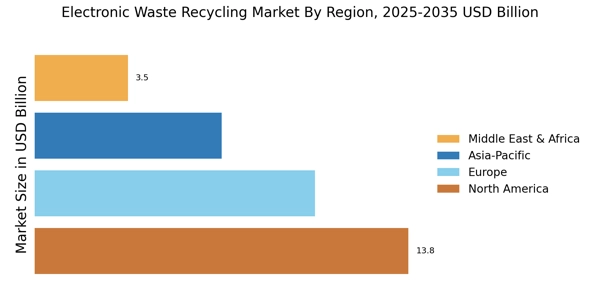
北美:引领创新与监管

北美是电子废物回收的最大市场,占全球市场份额的约40%。该地区的增长受到严格法规、消费者意识提高和强大的电子废物收集和处理基础设施的推动。对可持续回收解决方案的需求进一步受到政府旨在减少垃圾填埋废物和促进循环经济实践的倡议的推动。美国和加拿大是该地区的领先国家,主要参与者如电子回收国际和Sims Limited推动创新。竞争格局的特点是成熟企业和新兴初创企业的混合,所有企业都专注于提升回收技术和扩展服务。先进回收设施的存在和强有力的监管框架支持该地区在电子废物管理中的领导地位。

欧洲:可持续性与合规性关注

欧洲是电子废物回收的第二大市场,占全球市场份额的约30%。该地区的增长受到严格的欧盟法规和领先的全球电子回收商的推动。废弃电气和电子设备指令(WEEE)要求对电子废物进行适当处置和回收。公众意识的提高和可持续实践的倡议进一步推动了成员国对回收服务的需求。德国、法国和英国是该市场的领先国家,竞争格局中有Veolia和Umicore等主要参与者。先进回收技术的存在和对遵守环境法规的强烈重视增强了该地区的市场地位。政府、非政府组织和私营部门之间的合作努力在促进有效的电子废物回收解决方案中也至关重要。

亚太地区:新兴市场潜力

亚太地区的电子废物回收市场正在迅速增长,占全球市场份额的约20%。亚太地区的扩展受到城市化和环境问题意识提高的推动,Enviro-Hub Holdings和E-Waste Systems等公司为电子回收市场做出了贡献。该地区的扩展受到城市化、可支配收入增加和环境问题意识提高的推动。中国和印度等国正在实施更严格的法规来管理电子废物,这催生了对回收服务和技术的需求。中国和印度是该地区的领先国家,竞争格局包括本地和国际参与者。Enviro-Hub Holdings和E-Waste Systems等公司处于前沿,专注于创新回收方法和可持续实践。该地区的市场特点是挑战与机遇并存,政府努力改善基础设施和监管框架,以实现有效的电子废物管理。

中东和非洲:资源丰富但发展不足

中东和非洲地区在电子废物回收市场中逐渐崭露头角,占全球市场份额的约10%。增长主要受到电子消费增加和环境可持续意识提高的推动。然而,市场面临基础设施不足和监管框架不完善等挑战,这阻碍了有效的电子废物管理和回收实践。该地区的领先国家包括南非和阿联酋,正在推出改善回收率的倡议。竞争格局仍在发展中,本地参与者和国际公司正在探索机会。GEEP和AER Worldwide等公司开始建立存在,专注于提升能力和增强回收技术,以满足不断增长的需求。

Electronic Waste Recycling Market Regional Image

主要参与者和竞争洞察

The market for electronic waste recycling has been witnessing significant growth over the forecast period owing to the growing adoption of electronic waste recycling in various sectors. The e-waste recycling industry is rapidly expanding as the demand for improved technologies and critical equipment grows. The tremendous expansion and popularity of home electronics, ranging from laptops to smartphones to flat-screen televisions, has transformed this area into a multibillion-dollar worldwide market with a quick turnaround.

The advent of a flourishing e-waste recycling business has emerged as a potential answer.It was created in response to the rising popularity of consumer electronics as well as the growing disfavor of these items in landfills.The electronic waste recycling market is characterized by several companies operating globally. The growth of these vendors depends upon the market conditions, the impact of macroeconomic factors on the market competition, government support, and industry development. The industry is expected to remain competitive with frequent acquisitions and strategic alliances adopted by the key players as a part of their business strategy to increase the industry presence.

During the study, MRFR has analyzed some of the major players in the Electronic Waste Recycling Market who have contributed to the market growth.These include Umicore SA (Belgium), Quantum Lifecycle Partners (Geep Inc.) (Canada), Enviro-Hub Holdings Ltd (Singapore), Stena Technoworld AB (Sweden), Tetronics International Limited (UK), Electronics Recyclers International Inc. (US), Sims Limited (US), Aurubis AG (Germany), Boliden AB (Sweden), Attero Recycling Pvt. Ltd (India), Great Lakes Electronics Corporation (US), E-Parisaraa Private Limited (India), Greentec (Canada), Cleanaway (Australia), and Veolia Environment SA (France).

Electronic Waste Recycling Market市场的主要公司包括

Recent Industry Developments

  • Q3 2026: Sims Limited (AU): Sims Lifecycle Services announced its recognition as a 2026 SERI Champion of Electronics Sustainability, highlighting collaboration, circular electronics practices, component recovery, and reuse initiatives directly supporting responsible e-waste management.
  • Q3 2026: Stena Recycling (SE): Stena Recycling’s WEEELABEX certification for its Wschowa electronics recycling center confirmed compliance with European standards for processing and recycling waste electrical and electronic equipment, strengthening certified e-waste treatment capabilities.
  • Q2 2026: Umicore (BE): Umicore highlighted its Hoboken, Belgium recycling operations recovering copper from electronic-waste streams, linking e-scrap processing with secondary metal supply for electronics and semiconductor applications.

March 2023: State-owned Bharat Petroleum Corporation Limited (BPCL) announced over the weekend it launched Sound Management of Waste Disposal (SMW), an initiative designed as part of a sustainable development program aimed at reducing e-waste through proper handling, such as recycling. “The company has issued a directive on e-waste management across the organization for effective management, including timely disposal in line with the statutory requirement,” said BPCL spokespeople.

In addition, they are committed to circularity resources by diverting non-hazardous scrap materials like E-waste, which should be sent only via registered recyclers where then those items can either be recycled again or refurbished accordingly depending upon their condition so far during FY2021-22 we have disposed of around 2.57 tonnes.

September 2022: Samsung Electronics today unveiled its new environmental strategy, a comprehensive plan to align with global efforts in addressing climate change. Among the goals are to achieve net zero carbon emissions across its entire business operation, to use more renewable energy, and to invest in researching technologies that will enable the development of energy-saving products while increasing water recycling capacity and carbon capture capabilities.

Central to these commitments is also an aim at achieving net zero carbon emissions (Scope 1 & Scope 2) from all Device eXperience (DX) Division sites by 2030 before making this applicable worldwide within the company, including those under Device Solutions (DS) Division, come the year 2050.

As part of its commitment to sustainability within its operations, Getnet Brazil, a subsidiary of PagoNxt specializing in payment technology and solutions, just launched a card machine made from recycled parts that were sourced out of waste electrical equipment commonly referred to as e-scrap, thereby becoming first ever company globally who managed to achieve this milestone achievement together with others namely Newland; Paytec; Brasil Reverso etcetera henceforth every single one any model POS delivered by Newland shall have been built incorporating reused components but not limited thereto.

October 2021 Umicore has joined the Global Alliance for Trade Facilitation in Geneva, including some of the world's biggest manufacturers, merchants, and logistics companies. Umicore joins Alliance in supporting the World Trade Organization's Trade Facilitation Agreement, which aims to make cross-border trade easier, faster, and less expensive.

October 2021  Umicore has inked a long-term lithium supply agreement with Ganfeng Lithium Co. Ltd, China and Vulcan Energy Resources, Australia, bolstering its lithium supply capabilities as demand for electric vehicle batteries grows. These long-term agreements will provide Umicore with a more sustainable and regional supply of this critical raw material to address the growing demand for cathode materials from its global automotive customers as the transition to electromobility accelerates in key regions. The long-term agreement is signed for five years, with the option of an extension if both parties agreed.

The arrangement with Vulcan, a German-Australian lithium producer, will go into force in 2025. It will cover a portion of Umicore's lithium hydroxide requirements in Europe, allowing the company to purchase between 28,000 and 42,000 tonnes over the contract's duration.

July 2021  Umicore and ENGIE, France, have inked a long-term corporate power purchase agreement (PPA) to deliver renewable electricity to Umicore's greenfield project in Nysa, Poland. It will be Europe's first plant to create cathode materials and essential components of rechargeable Li-ion batteries used in electric vehicles. ENGIE will generate green electricity at its 100 percent-owned wind farm near Pgów, Poland's Opole district. The PPA will allow ENGIE to ensure the wind park's economic viability after the existing subsidy arrangement expires.

At the same time, the PPA will help Umicore achieve its goal of carbon neutrality by 2035 by ensuring a long-term renewable energy supply for the Nysa plant.
未来展望

Electronic Waste Recycling Market 未来展望

预计电子废物回收市场将在2025年至2035年期间以13.4%的年均增长率增长,推动因素包括日益严格的监管压力、技术进步和消费者意识的提高。

到2035年,市场预计将强劲增长,受创新和战略合作伙伴关系的推动。

市场细分

电子废物回收市场来源展望

  • 家用电器
  • 娱乐和消费电子
  • 信息技术和电信
  • 医疗设备
  • 其他

电子废物回收市场材料展望

  • 金属和化学品
  • 塑料
  • 玻璃
  • 其他

报告范围

MARKET SIZE 2024 34.5(USD Billion)
MARKET SIZE 2025 39.12(USD Billion)
MARKET SIZE 2035 137.61(USD Billion)
COMPOUND ANNUAL GROWTH RATE (CAGR) 13.4% (2025 - 2035)
REPORT COVERAGE Revenue Forecast, Competitive Landscape, Growth Factors, and Trends
BASE YEAR 2024
Market Forecast Period 2025 - 2035
Historical Data 2019 - 2024
Market Forecast Units USD Billion
Key Companies Profiled Sims Limited (AU), Umicore (BE), Electronic Recyclers International (US), Veolia (FR), Stena Recycling (SE), Enviro-Hub Holdings (SG), E-Waste Systems (US), GEEP (CA), AER Worldwide (US)
Segments Covered Material, Source, Region
Key Market Opportunities Integration of advanced recycling technologies enhances efficiency in the Electronic Waste Recycling Market.
Key Market Dynamics Rising regulatory pressures and technological advancements drive innovation and competition in the electronic waste recycling sector.
Countries Covered North America, Europe, APAC, South America, MEA

Frequently Asked Questions

到2035年,电子废物回收市场的预计市场估值是多少?

电子废物回收市场预计到2035年将达到1376.1亿美元的估值。

2024年电子废物回收市场的市场估值是多少?

在2024年,电子废物回收市场的市场估值为345亿美元。

在2025年至2035年的预测期内,电子废物回收市场的预期年均增长率是多少?

在2025年至2035年的预测期内,电子废物回收市场的预期年均增长率为13.4%。

电子废物回收市场中最大的材料细分是什么?

电子废物回收市场中最大的细分包括金属和化学品,预计到2035年价值为550亿美元。

市场中电子废物的主要来源是什么?

电子废物的主要来源包括信息技术和电信,预计到2035年将达到415亿美元。

电子废物回收市场的主要参与者是谁?
电子废物回收市场的主要参与者包括Sims Limited、Umicore和Veolia。
电子废物回收市场中塑料细分的预计增长是多少?
塑料细分预计到2035年将增长到320亿美元。
家用电器市场与其他细分市场相比如何?
家用电器市场预计到2035年将达到275亿美元,显示出显著的增长。
像电子回收国际公司在市场中扮演什么角色?
像电子回收国际公司这样的公司在推动电子废物回收的创新和效率方面发挥着关键作用。
电子废物回收市场的未来前景如何?
电子废物回收市场的未来前景看起来强劲,预计到2035年将实现显著增长。
作者
Author Author Profile Ankit Gupta LinkedIn Team Lead - Research
Ankit Gupta is a seasoned market intelligence and strategic research professional with over six plus years of experience in the ICT and Semiconductor industries. With academic roots in Telecom, Marketing, and Electronics, he blends technical insight with business strategy. Ankit has led 200+ projects, including work for Fortune 500 clients like Microsoft and Rio Tinto, covering market sizing, tech forecasting, and go-to-market strategies. Known for bridging engineering and enterprise decision-making, his insights support growth, innovation, and investment planning across diverse technology markets.

Research Approach


Secondary Research

The secondary research process involved comprehensive analysis of regulatory databases, environmental protection agency reports, peer-reviewed environmental journals, circular economy publications, and authoritative waste management organizations. Key sources included the United Nations Environment Programme (UNEP), United Nations University - SCYCLE Programme, International Labour Organization (ILO), Environmental Protection Agency (EPA), European Environment Agency (EEA), Basel Convention Regional Centres for Training and Technology Transfer, Organisation for Economic Co-operation and Development (OECD) Environment Directorate, World Economic Forum (WEF) Global Battery Alliance, International Renewable Energy Agency (IRENA) End-of-Life Management reports, International Solid Waste Association (ISWA), Global E-waste Statistics Partnership (GESP), Step Initiative, Electronics TakeBack Coalition, Basel Action Network (BAN), Solving the E-waste Problem (StEP) Initiative, and national environmental ministry reports from key markets (Ministry of Environment and Forests India, Ministry of Ecology and Environment China, Environment and Climate Change Canada). These sources were used to collect e-waste generation statistics, regulatory compliance data, material recovery rates, technological advancements, and market landscape analysis for metals and chemicals recovery, plastics recycling, glass processing, and other material streams.


Primary Research

Qualitative and quantitative insights were obtained by interviewing supply-side and demand-side stakeholders during the primary research process. The supply-side sources consisted of CEOs, VPs of Sustainability Operations, regulatory compliance leaders, and commercial directors from e-waste recycling companies, electronic waste management service providers, smelting facilities, and OEMs. Procurement managers from electronics manufacturers, sustainability officers from consumer electronics brands, waste management coordinators from municipalities, facility managers from IT and telecommunication enterprises, and compliance leads from healthcare institutions that manage medical equipment disposal were the demand-side sources. The market segmentation was validated across household appliances, entertainment & consumer electronics, IT & telecommunication, and medical equipment sources through primary research. The technology deployment timelines for automated sorting and hydrometallurgical processes were confirmed, and insights were gathered on the adoption of collection programs, material pricing volatility, and extended producer responsibility (EPR) dynamics.

Primary Respondent Breakdown:

• By Designation: C-level Primaries (42%), Director Level (24%), Others (34%)

• By Region: North America (32%), Europe (35%), Asia-Pacific (25%), Rest of World (8%)


Market Size Estimation

Global market valuation was derived through revenue mapping and e-waste volume analysis across the identified material segments. The methodology included:

• Identification of 50+ key recyclers and waste management companies across North America, Europe, Asia-Pacific, Latin America, and Middle East & Africa

• Product mapping across metals and chemicals recovery, plastics recycling, glass processing, and other material categories

• Analysis of reported and modeled annual revenues specific to e-waste recycling portfolios

• Coverage of recyclers and processors representing 75-80% of global market share in 2024

• Extrapolation using bottom-up (e-waste volume × recovery rate × material ASP by country) and top-down (recycler revenue validation) approaches to derive segment-specific valuations for household appliances, entertainment & consumer electronics, IT & telecommunication, and medical equipment source categories

下载免费样本

请填写以下表格以获取本报告的免费样本

Download PDF ×

We do not share your information with anyone. However, we may send you emails based on your report interest from time to time. You may contact us at any time to opt-out.