Cold Chain Monitoring Market

冷链监测市场规模、份额和研究报告:按应用(制药、食品和饮料、化学品、医疗保健、农业)、按产品类型(硬件、软件、服务)、按技术(温度监测、湿度监测、位置跟踪、数据记录器)、按最终用途(零售、运输、仓储、分销)和按地区(北美、欧洲、南美、亚太、中东和非洲) - 行业预测至2035年
ID: MRFR/SEM/1351-CR 110 Pages Nirmit Biswas, Aarti Dhapte Last Updated: September 28, 2026
Cold Chain Monitoring Market
Market Size
Forecast Period2025 - 2035
CAGR (2025 - 2035)9.01%
2024 Market Size$ 8.32 Billion
2025 Market Size$ 9.07 Billion
2035 Market Size$ 21.48 Billion
Key Players
Thermo Fisher Scientific
Sensitech
Zebra Technologies
Monnit Corporation
Berlinger & Co. AG
Emerson Electric Co.
Opportunities
  • Increasing Demand for Perishable Goods
  • Regulatory Pressures and Compliance Requirements
  • Technological Advancements in Monitoring Solutions

Cold Chain Monitoring Market 摘要

主要市场趋势和亮点

市场规模与预测

CAGR (2025 - 2035) 9.01%

主要参与者

Thermo Fisher Scientific (US), Sensitech (US), Zebra Technologies (US), Monnit Corporation (US), Berlinger & Co. AG (CH), Emerson Electric Co. (US), DHL Supply Chain (DE), Controlant (IS), ORBCOMM (US), LogTag Recorders (NZ)

Cold Chain Monitoring Market Drivers

对易腐商品需求的增加

冷链监测市场正在经历对易腐商品需求的激增,这一趋势受到消费者偏好和饮食习惯变化的推动。随着消费者越来越倾向于选择新鲜和有机产品,对有效冷链解决方案的需求变得至关重要。根据行业估计,易腐商品细分市场预计在未来五年内将以约8%的复合年增长率增长。这一增长需要强大的冷链监测系统,以确保产品在整个供应链中的完整性和质量。零售商和分销商正在投资先进的监测技术,以维持最佳的温度条件,从而减少变质和浪费。因此,冷链监测市场有望从这一趋势中受益,因为利益相关者优先实施可靠的监测解决方案以满足消费者期望。

监管压力和合规要求

冷链监测市场受到各类机构施加的严格监管压力和合规要求的影响。各国政府和监管机构越来越多地要求实施强大的冷链监测系统,以确保食品和药品的安全和质量。例如,关于运输和储存过程中的温度控制的法规变得更加严格,迫使公司采用全面的监测解决方案。这一趋势在制药行业尤为明显,在该行业中,遵循良好分销规范(GDP)的需求至关重要。因此,冷链监测市场可能会经历增长,因为企业投资于促进合规和增强可追溯性的技术。对监管遵从的日益关注不仅保护了消费者,还推动了市场内的创新,因为公司寻求开发符合不断变化标准的解决方案。

监测解决方案的技术进步

冷链监测市场受到监测解决方案快速技术进步的显著影响。物联网(IoT)传感器、实时跟踪系统和数据分析等创新正在改变温度敏感产品的管理方式。这些技术促进了温度和湿度水平的持续监测,为利益相关者提供可操作的见解,以提高运营效率。人工智能和机器学习的整合进一步优化了供应链流程,通过预测潜在的中断并采取主动措施。因此,冷链监测市场可能会见证这些先进解决方案的增加采用,这可以提高对安全法规的合规性并降低运营成本。随着公司认识到投资于尖端监测技术以保护其易腐库存的价值,市场预计将扩展。

电子商务和在线杂货服务的扩展

冷链监测市场正在受益于电子商务和在线杂货服务的扩展,这些服务近年来获得了越来越多的关注。随着消费者越来越多地转向在线平台满足他们的杂货需求,对高效冷链解决方案的需求也在加剧。电子商务公司需要确保易腐物品在最佳条件下交付,这就需要实施先进的监测系统。根据市场分析,在线杂货细分市场预计将以超过15%的年增长率增长,进一步推动对有效冷链监测的需求。这一趋势为冷链监测市场提供了重要机会,因为企业寻求增强其物流能力并在运输过程中保持产品质量。实时跟踪和监测技术的整合可能会成为电子商务行业的标准做法。

消费者意识和对质量保证需求的上升

冷链监测市场越来越受到消费者对食品安全和质量保证意识上升的影响。随着消费者对易腐商品的正确处理和储存重要性了解得越来越多,他们对供应商的透明度要求也在增加。这种消费者行为的转变促使公司投资于提供产品条件实时数据的冷链监测解决方案。对质量保证的重视在食品和制药行业尤为明显,在这些行业中,冷链的任何失误都可能导致重大健康风险。因此,冷链监测市场可能会看到对确保符合安全标准并增强消费者信任的监测技术的需求激增。这一趋势强调了有效冷链管理在满足消费者期望和保护公共健康方面的关键作用。

市场细分洞察

The Pharmaceuticals segment in the Cold Chain Monitoring Market is characterized by its reliance on precise temperature management to preserve the efficacy of drugs, vaccines, and other medical products. This segment has established itself as the dominant force due to strict regulatory standards and the critical nature of medical supplies. Conversely, the Food and Beverages segment is emerging as a key player, propelled by trends in consumer health and safety. It emphasizes the need for integrated monitoring systems to ensure freshness, quality, and compliance with food safety regulations, reflecting a growing market demand for advanced cold chain logistics.

In the Cold Chain Monitoring Market, Temperature Monitoring occupies the largest share, demonstrating its fundamental role in ensuring product integrity during transportation. This segment effectively captures the majority of market demand, driven by stringent regulations across various industries such as pharmaceuticals and food & beverages. In contrast, Data Loggers, while currently smaller in terms of market share, are rapidly gaining traction due to advancements in technology and a growing emphasis on real-time data collection and analysis. Growth within the Cold Chain Monitoring Technology segment is largely propelled by the increasing demand for efficient logistics and enhanced supply chain visibility. The implementation of advanced technologies such as IoT and wireless communication has further facilitated this growth, allowing for precise tracking of temperature-sensitive products. Additionally, rising consumer expectations for quality assurance in perishables is driving the need for robust temperature monitoring solutions. This evolving landscape underscores the importance of both Temperature Monitoring and Data Loggers in securing the cold chain process.

获取关于Cold Chain Monitoring Market的更多详细见解

区域洞察

北美:创新市场领导者

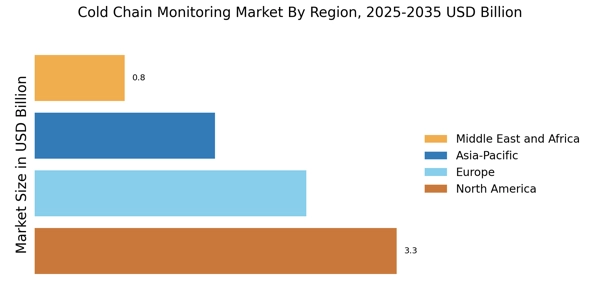
北美是冷链监测的最大市场,约占全球市场份额的40%。该地区的增长受到食品安全和制药分销的严格法规推动,同时对温度敏感产品的需求不断增加。物联网技术和实时监测解决方案的采用进一步促进了市场扩展,公共和私营部门的重大投资也在其中。美国在市场中处于领先地位,其次是加拿大,主要参与者如赛默飞世尔科技、Sensitech和Zebra Technologies主导着市场。竞争环境的特点是持续的创新和旨在提高供应链效率的合作。先进的物流基础设施的存在支持了冷链解决方案的增长,确保遵守监管标准。

欧洲:受法规驱动的市场增长

欧洲是冷链监测的第二大市场,约占全球市场份额的30%。该地区的增长受到欧盟对食品安全和药品的严格法规推动,这些法规要求在整个供应链中进行精确的温度控制。对新鲜农产品和药品的需求增加也是一个重要驱动因素,导致监测解决方案和技术的增强。德国和英国是该市场的领先国家,DHL供应链和Berlinger & Co. AG等主要参与者在此市场中占有强大地位。竞争环境的特点是公司之间的创新和合作,以满足监管要求。欧洲市场也在见证对智能技术投资的增加,进一步提高冷链运营的效率。

亚太地区:新兴市场潜力

亚太地区在冷链监测市场中是一个新兴的强国,约占全球市场份额的20%。该地区的增长受到城市化加速、可支配收入增加和对易腐商品需求增长的推动。此外,政府旨在改善食品安全和减少浪费的举措正在催化对冷链基础设施和技术的投资,使其成为未来增长的关键领域。中国和印度是该市场的领先国家,地方参与者和国际公司的贡献显著。竞争环境正在演变,既有成熟公司也有初创企业专注于创新解决方案。像ORBCOMM和Controlant这样的关键参与者正在积极扩大其市场影响力,利用技术增强监测能力并确保遵守当地法规。

中东和非洲:未开发的市场机会

中东和非洲代表了冷链监测市场的资源丰富的前沿,约占全球市场份额的10%。该地区的增长受到基础设施投资增加和对温度敏感产品需求上升的推动,特别是在食品和制药行业。政府旨在提高供应链效率和食品安全标准的举措也是市场发展的重要催化剂。南非和阿联酋是该地区的领先国家,越来越多的本地和国际参与者进入市场。竞争环境的特点是旨在增强冷链能力的合作与合作。公司越来越多地采用先进技术来改善监测和合规性,为在这一新兴市场中的未来增长做好准备。

Cold Chain Monitoring Market Regional Image

主要参与者和竞争洞察

冷链监测市场目前的特点是动态竞争环境,受到各个行业对温度敏感产品需求增加的推动,包括制药、食品和饮料以及生物技术。关键参与者积极参与强调创新、数字化转型和战略合作伙伴关系的策略,以增强其市场定位。例如,赛默飞世尔科技(美国)一直专注于扩大其数字解决方案组合,这似乎是对冷链物流中对实时监测和数据分析日益增长需求的回应。同样,Sensitech(美国)通过战略合作增强其服务产品,这可能旨在改善供应链的可见性和运营效率。这些公司的商业策略通常包括本地化制造和优化供应链,以更好地服务于区域市场。冷链监测市场适度分散,多个参与者争夺市场份额。然而,像Zebra Technologies(美国)和艾默生电气公司(美国)等主要公司的集体影响显著,因为它们利用其技术专长设定行业标准并推动竞争差异化。在2025年8月,Zebra Technologies(美国)宣布推出其最新的物联网启用的冷链监测解决方案,该方案集成了先进的分析和机器学习能力。这一战略举措具有重要意义,因为它将Zebra置于技术创新的前沿,可能通过为客户提供更强大的数据驱动洞察来增强其竞争优势,以管理其冷链运营。在2025年9月,艾默生电气公司(美国)宣布与一家领先的物流提供商建立新伙伴关系,以增强其冷链监测服务。这一合作可能会扩大艾默生在市场上的影响力,使其能够提供综合解决方案,将监测技术与物流专业知识相结合,从而满足对无缝冷链管理日益增长的需求。在2025年10月,Controlant(冰岛)宣布在北美扩大其运营能力的重大投资。这一战略扩张表明Controlant致力于在需求激增的地区获取更大的市场份额。通过增强其存在,Controlant可能改善其服务交付和对客户需求的响应。截至2025年10月,冷链监测市场正在见证强调数字化、可持续性和人工智能整合的趋势。这些趋势正在重塑竞争环境,因为公司越来越多地形成战略联盟,以增强其技术能力和服务产品。从基于价格的竞争转向关注创新和供应链可靠性变得显而易见,这表明未来的竞争差异化将取决于提供先进、可靠和可持续的冷链解决方案的能力。

Cold Chain Monitoring Market市场的主要公司包括

Recent Industry Developments

  • Q3 2026: Sensitech (US): Sensitech launched TempTale GEO APX Global for real-time monitoring of temperature, humidity, light, and location across ocean, road, and rail shipments, strengthening continuous cold-chain visibility for fresh, frozen, and other temperature-sensitive food products.
  • Q3 2026: Monnit Corporation (US): Monnit introduced NIST-standard detachable temperature and humidity leads for its ALTA sensor bases, enabling calibration replacement without removing installed sensors and supporting uninterrupted monitoring in regulated cold-chain environments.
  • Q2 2024: WHO released directives for makers of temperature monitoring devices under the PQS system sanctioning presentation, standard, and security for cold chain equipment In September 2024, the World Health Organization issued new regulatory directives for manufacturers of temperature monitoring devices, setting standards for performance, safety, and compliance in cold chain equipment used for vaccines and other temperature-sensitive products.

未来展望

Cold Chain Monitoring Market 未来展望

冷链监测市场预计将在2025年至2035年间以9.01%的年均增长率增长,推动因素包括技术进步、法规要求和对易腐商品的需求增加。

到2035年,冷链监测市场预计将保持强劲,推动因素包括创新和需求增加。

市场细分

冷链监测市场最终用途展望

  • 零售
  • 运输
  • 仓储
  • 分销

冷链监测市场技术展望

  • 温度监测
  • 湿度监测
  • 位置追踪
  • 数据记录仪

冷链监测市场应用展望

  • 制药
  • 食品和饮料
  • 化学品
  • 医疗保健
  • 农业

冷链监测市场产品类型展望

  • 硬件
  • 软件
  • 服务

报告范围

2024年市场规模 83.17(亿美元)
2025年市场规模 90.67(亿美元)
2035年市场规模 214.8(亿美元)
年均复合增长率(CAGR) 9.01%(2025 - 2035)
报告覆盖范围 收入预测、竞争格局、增长因素和趋势
基准年 2024
市场预测期 2025 - 2035
历史数据 2019 - 2024
市场预测单位 亿美元
关键公司简介 赛默飞世尔科技(美国)、Sensitech(美国)、Zebra Technologies(美国)、Monnit Corporation(美国)、Berlinger & Co. AG(瑞士)、艾默生电气公司(美国)、DHL供应链(德国)、Controlant(冰岛)、ORBCOMM(美国)、LogTag记录器(新西兰)
覆盖的细分市场 应用、产品类型、技术、最终用途、区域
关键市场机会 物联网和区块链技术的整合提高了冷链监测市场的透明度和效率。
关键市场动态 对温度敏感产品的需求上升推动了冷链监测技术和法规合规性的创新。
覆盖的国家 北美、欧洲、亚太、南美、中东和非洲

Frequently Asked Questions

到2035年,冷链监测市场的预计市场估值是多少?

冷链监测市场预计到2035年将达到214.8亿美元的估值。

2024年冷链监测市场的市场估值是多少?

在2024年,冷链监测市场的估值为83.17亿美元。

在2025年至2035年的预测期内,冷链监测市场的预期年均增长率是多少?

在2025年至2035年的预测期内,冷链监测市场的预期年均增长率为9.01%。

在冷链监测市场中,哪个应用细分市场预计增长最多?

食品和饮料细分市场预计将从30亿美元增长到80亿美元,到2035年。

冷链监测市场的主要产品类型有哪些?

主要产品类型包括硬件、软件和服务,其中服务预计将从38.17亿美元增长到99.8亿美元。

冷链监测市场的主要参与者有哪些?

冷链监测市场的主要参与者包括赛默飞世尔科技、Sensitech和斑马技术。

冷链监测市场包含哪些技术细分市场?

技术细分市场包括温度监测、湿度监测、位置追踪和数据记录仪,其中数据记录仪预计将显著增长。

冷链监测市场如何支持制药行业?

冷链监测市场通过确保温度敏感产品保持有效性来支持制药行业,预计将从15亿美元增长到40亿美元。

哪些最终用途细分市场推动了冷链监测市场的增长?

推动增长的最终用途细分市场包括运输和仓储,其中运输预计将从25亿美元增长到60亿美元。

位置追踪技术在冷链监测市场中的重要性是什么?

位置追踪技术对于实时监测至关重要,预计到2035年将从10亿美元增长到25亿美元。

作者
Author Author Profile Nirmit Biswas LinkedIn Senior Research Analyst
With 5+ years of expertise in Market Intelligence and Strategic Research, Nirmit Biswas specializes in ICT, Semiconductors, and BFSI. Backed by an MBA in Financial Services and a Computer Science foundation, Nirmit blends technical depth with business acumen. He has successfully led 100+ projects for global enterprises and startups, including Amazon, Cisco, L&T and Huawei, delivering market estimations, competitive benchmarking, and GTM strategies. His focus lies in transforming complex data into clear, actionable insights that drive growth, innovation, and investment decisions. Recognized for bridging engineering innovation with executive strategy, Nirmit helps businesses navigate dynamic markets with confidence.
Co-Author Co-Author Profile Aarti Dhapte LinkedIn AVP - Research
A consulting professional focused on helping businesses navigate complex markets through structured research and strategic insights. I partner with clients to solve high-impact business problems across market entry strategy, competitive intelligence, and opportunity assessment. Over the course of my experience, I have led and contributed to 100+ market research and consulting engagements, delivering insights across multiple industries and geographies, and supporting strategic decisions linked to $500M+ market opportunities. My core expertise lies in building robust market sizing, forecasting, and commercial models (top-down and bottom-up), alongside deep-dive competitive and industry analysis. I have played a key role in shaping go-to-market strategies, investment cases, and growth roadmaps, enabling clients to make confident, data-backed decisions in dynamic markets.

Research Approach


Secondary Research

The secondary research process involved comprehensive analysis of regulatory databases, peer-reviewed journals, industry publications, and authoritative health and logistics organizations. Key sources included the US Food & Drug Administration (FDA), US Department of Agriculture (USDA), European Medicines Agency (EMA), World Health Organization (WHO), International Institute of Refrigeration (IIR), International Society for Pharmaceutical Engineering (ISPE), Parenteral Drug Association (PDA), International Air Transport Association (IATA), Global Cold Chain Alliance (GCCA), Global Cold Chain Foundation (GCCF/WFLO), United Nations Food and Agriculture Organization (FAO), US Pharmacopeia (USP), International Organization for Standardization (ISO), European Food Safety Authority (EFSA), Pan American Health Organization (PAHO), National Institutes of Health (NIH), National Center for Biotechnology Information (NCBI/PubMed), US Centers for Disease Control and Prevention (CDC), World Trade Organization (WTO) Trade Statistics, and national health ministry reports from key markets. These sources were used to collect regulatory approval data, cold chain infrastructure statistics, pharmaceutical GDP compliance guidelines, food safety protocols, temperature monitoring standards, and market landscape analysis for hardware, software, and services across food and beverages, pharmaceuticals, chemicals, healthcare, and agriculture applications.


Primary Research

To gather both qualitative and quantitative insights, supply-side and demand-side stakeholders were interviewed during the primary research phase. CEOs, CTOs, VPs of Product Development, heads of regulatory affairs, and commercial directors from firms that make cold chain monitoring technologies, IoT sensors, data loggers, and refrigerated logistics services were among the supply-side sources. Demand-side sources included procurement leads from food processing companies, pharmaceutical manufacturers, third-party logistics (3PL) providers, refrigerated warehousing operators, retail distribution centers, and supply chain directors, quality assurance managers, logistics managers, cold storage facility managers, and pharmaceutical distribution heads. In addition to confirming product pipeline deadlines and validating market segmentation, primary research also provided information on pricing strategies, technology adoption trends, regulatory compliance costs, and integration problems.

Primary Respondent Breakdown:

By Designation: C-level Primaries (32%), Director Level (31%), Others (37%)

By Region: North America (32%), Europe (30%), Asia-Pacific (28%), Rest of World (10%)


Market Size Estimation

Global market valuation was derived through revenue mapping and solution deployment analysis. The methodology included:

Identification of 50+ key technology providers and system integrators across North America, Europe, Asia-Pacific, and Latin America

Product mapping across hardware (sensors, data loggers, RFID devices, telemetry systems), software (cloud platforms, analytics, inventory management), and services (installation, calibration, maintenance, consulting) categories

Analysis of reported and modeled annual revenues specific to cold chain monitoring portfolios

Coverage of manufacturers and service providers representing 72-78% of global market share in 2024

Extrapolation using bottom-up (deployment volume × ASP by country/region) and top-down (manufacturer revenue validation) approaches to derive segment-specific valuations

Specific Sources by Segment:

Regulatory & Standards:

FDA 21 CFR Part 211 (Current Good Manufacturing Practice)

USDA Food Safety and Inspection Service (FSIS) guidelines

EMA Guidelines on Good Distribution Practice (GDP)

WHO Vaccine Management Handbook and Cold Chain Guidelines

IATA CEIV Pharma Certification standards

ISPE Good Practice Guide: Cold Chain Management

Industry Associations:

International Institute of Refrigeration (IIR) – global refrigeration statistics

Global Cold Chain Alliance (GCCA) – warehousing and logistics data

Global Cold Chain Foundation (GCCF) – research and training metrics

Parenteral Drug Association (PDA) – pharmaceutical distribution standards

Government & International:

FAO State of Food and Agriculture reports

WHO Immunization Supply Chain data

CDC Vaccine Storage and Handling Toolkit

National health ministries (India, China, Brazil, EU member states)

Market Data:

Company annual reports and 10-K filings

Industry trade publications (Cold Storage, Food Logistics)

Patent databases for IoT and sensor technologies

Venture capital and M&A transaction databases

This methodology ensured comprehensive coverage of the cold chain monitoring ecosystem while maintaining data integrity through triangulation of secondary sources and primary intelligence.

下载免费样本

请填写以下表格以获取本报告的免费样本

Download PDF ×

We do not share your information with anyone. However, we may send you emails based on your report interest from time to time. You may contact us at any time to opt-out.