砖石外墙系统市场 摘要
主要市场趋势和亮点
市场规模与预测
| CAGR (2025 - 2035) | 6.99% |
| CAGR (2025 - 2035) | 6.99% |
The Brick Cladding System Market is currently experiencing a notable transformation, driven by a combination of aesthetic preferences and functional requirements. As urbanization continues to rise, there is an increasing demand for materials that not only enhance the visual appeal of buildings but also provide durability and energy efficiency. This market appears to be influenced by a growing awareness of sustainable construction practices, prompting architects and builders to seek out innovative cladding solutions that align with environmental standards. Furthermore, advancements in manufacturing technologies are likely to expand the range of available designs and finishes, catering to diverse consumer tastes. In addition, the Brick Cladding System Market seems to be benefiting from a shift towards modular construction techniques. This approach allows for quicker installation and reduced labor costs, making brick cladding an attractive option for developers. The integration of smart technologies into building materials may also play a role in shaping future trends, as consumers increasingly prioritize smart home features. Overall, the Brick Cladding System Market is poised for growth, with evolving consumer preferences and technological advancements driving its development.
There is a growing emphasis on sustainable building materials within the Brick Cladding System Market. This trend reflects a broader commitment to environmentally friendly practices, as consumers and builders alike seek options that minimize ecological impact. Manufacturers are responding by developing products that utilize recycled materials and promote energy efficiency.
The adoption of modular construction techniques is reshaping the Brick Cladding System Market. This method allows for faster assembly and reduced labor costs, making brick cladding a more appealing choice for modern construction projects. As this trend continues, it may lead to increased demand for prefabricated cladding solutions.
The integration of advanced technologies into brick cladding systems is emerging as a significant trend. Innovations such as smart materials and automated installation processes are likely to enhance the functionality and appeal of brick cladding. This trend suggests a future where building materials not only serve aesthetic purposes but also contribute to smart building solutions.
Rapid urbanization is a significant driver for the Brick Cladding System Market. As populations in urban areas continue to swell, the demand for residential and commercial buildings is escalating. Brick cladding systems, with their aesthetic appeal and durability, are increasingly favored in urban construction projects. Data suggests that urban areas are expected to account for over 70% of the global population by 2050, leading to a surge in construction activities. This trend indicates that the Brick Cladding System Market could see substantial growth as developers seek to meet the rising demand for attractive and long-lasting building facades in densely populated regions.
In the Brick Cladding System Market, material segmentation plays a crucial role in defining preferences among consumers. Currently, Fiber Cement leads this category, characterized by its versatility and durability, followed closely by Clay Brick. Natural Stone and Brick Veneer maintain significant market shares, while Metal is emerging, appealing to niche markets. The distribution reflects the historical preference for traditional materials alongside the rising popularity of innovative options. The growth trajectory within the material segment is shaped by evolving architectural trends and consumer demands for sustainability. Fiber Cement continues to dominate due to its lightweight and weather-resistant properties, whereas Clay Brick is gaining attention as a fast-growing choice due to its aesthetic appeal and natural insulation features. Factors such as energy efficiency, cost-effectiveness, and ease of installation are propelling their respective market positions.
In the Brick Cladding System Market, 'Standard Bricks' hold the largest market share, providing robust durability and aesthetic appeal that appeals to traditional building methods. On the other hand, 'Thin Bricks' have emerged as a popular choice due to their lightweight nature and versatility, catering to modern construction requirements. This segment showcases a clear preference among consumers for both traditional and contemporary styles, with 'Thin Bricks' rapidly capturing market attention due to their innovative installation methods.
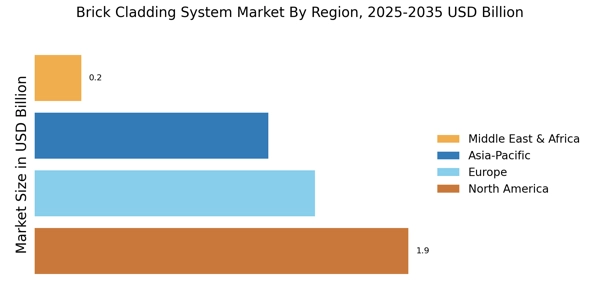
North America is the largest market for brick cladding systems, holding approximately 40% of the global market share. The growth is driven by increasing construction activities, urbanization, and a rising demand for sustainable building materials. Regulatory support for energy-efficient construction practices further catalyzes market expansion. The U.S. and Canada are the primary contributors, with significant investments in infrastructure and residential projects fueling demand. The competitive landscape in North America is robust, featuring key players such as Forterra, Inc., Glen-Gery Corporation, and Acme Brick Company. These companies are focusing on innovation and sustainability to meet the evolving needs of the market. The presence of established manufacturers and a growing trend towards eco-friendly materials are expected to enhance market dynamics in the region.
Europe is witnessing significant growth in the brick cladding system market, accounting for approximately 30% of the global share. The region's focus on sustainability and energy efficiency in construction is a key driver. Stringent regulations and incentives for green building practices are propelling demand for brick cladding systems. Countries like Germany and France are leading the market, supported by government initiatives aimed at reducing carbon footprints in the construction sector. Leading players in Europe include Saint-Gobain and Etex Group, who are investing in innovative solutions to meet regulatory standards. The competitive landscape is characterized by a mix of established companies and emerging players, all striving to enhance product offerings. The emphasis on sustainable materials and compliance with EU regulations is shaping the market, making it a dynamic environment for growth.
Asia-Pacific is an emerging powerhouse in the brick cladding system market, holding around 25% of the global market share. The rapid urbanization and increasing population in countries like China and India are significant growth drivers. The demand for modern infrastructure and residential buildings is rising, supported by government initiatives to enhance urban development. Regulatory frameworks promoting sustainable construction are also contributing to market growth in the region. China is the largest market in Asia-Pacific, with substantial investments in construction and infrastructure projects. Key players like Nichiha Corporation and Boral Limited are expanding their presence to capitalize on the growing demand. The competitive landscape is evolving, with both local and international companies vying for market share, driven by innovation and sustainability in product offerings.
The Middle East and Africa region is witnessing a gradual increase in the brick cladding system market, accounting for approximately 5% of the global share. The growth is primarily driven by large-scale infrastructure projects and urban development initiatives in countries like the UAE and South Africa. Government investments in housing and commercial projects are creating a favorable environment for market expansion. Regulatory frameworks are also evolving to support sustainable building practices in the region. In the Middle East, the UAE is leading the market, with significant investments in construction and real estate. Key players such as Cemex S.A.B. de C.V. are actively participating in the region, focusing on innovative solutions to meet local demands. The competitive landscape is characterized by a mix of international and regional players, all aiming to leverage the growing opportunities in infrastructure and urban development.
The Brick Cladding System Market is currently characterized by a dynamic competitive landscape, driven by increasing demand for aesthetic and durable building materials. Key players such as Boral Limited (AU), Saint-Gobain (FR), and Kingspan Group (IE) are strategically positioning themselves through innovation and regional expansion. Boral Limited (AU) focuses on enhancing its product offerings with sustainable materials, while Saint-Gobain (FR) emphasizes digital transformation to streamline operations and improve customer engagement. Kingspan Group (IE) is actively pursuing mergers and acquisitions to bolster its market presence, indicating a trend towards consolidation in the industry. Collectively, these strategies contribute to a competitive environment that is increasingly focused on sustainability and technological advancement.In terms of business tactics, companies are localizing manufacturing to reduce lead times and optimize supply chains. The Brick Cladding System Market appears moderately fragmented, with several key players exerting influence over regional markets. This fragmentation allows for niche players to thrive, yet the collective strength of major companies like Cemex S.A.B. de C.V. (MX) and Etex Group (BE) shapes market dynamics significantly. Their ability to adapt to local market needs while maintaining global standards is crucial for competitive success.
In August Cemex S.A.B. de C.V. (MX) announced a partnership with a leading technology firm to develop smart brick cladding solutions that integrate IoT capabilities. This strategic move not only enhances their product portfolio but also positions Cemex as a pioneer in the integration of technology within traditional building materials. Such innovations are likely to attract environmentally conscious consumers and builders looking for advanced solutions.
In September Etex Group (BE) launched a new line of eco-friendly brick cladding products, which are designed to meet stringent sustainability standards. This initiative reflects a growing trend towards environmentally responsible construction materials, aligning with global efforts to reduce carbon footprints. Etex's commitment to sustainability may enhance its competitive edge, appealing to a market increasingly focused on green building practices.
In October Kingspan Group (IE) completed the acquisition of a regional brick manufacturer, significantly expanding its market share in Europe. This acquisition is indicative of Kingspan's strategy to consolidate its position in the market while diversifying its product offerings. By integrating local expertise and resources, Kingspan is likely to enhance its operational efficiency and responsiveness to market demands.
As of October the Brick Cladding System Market is witnessing trends such as digitalization, sustainability, and the integration of artificial intelligence in production processes. Strategic alliances among key players are shaping the competitive landscape, fostering innovation and collaboration. The shift from price-based competition to a focus on technological advancement and supply chain reliability is becoming increasingly evident. Companies that prioritize innovation and sustainability are likely to differentiate themselves in this evolving market.



June 2026: Forterra launched the Omnia Mechanical Brick Slip System, a UK-manufactured system combining brick slips, steel rails and fixings from a single supplier. The system is A1-rated non-combustible and designed as a lightweight rainscreen façade for residential, mixed-use, high-rise and retrofit projects.
September 2026: Shackerley highlighted the growing use of its BrickClad mechanically fixed brick façade system for lightweight structures, modern methods of construction and ventilated façades. The system retains the durability and non-combustibility of brick while supporting applications including higher-risk buildings.
March 2026: Eurobrick Systems promoted its A-Clad brick slip rainscreen system, which was launched as a fully fire-tested, A1-rated non-combustible cladding solution. The system combines brick-slip aesthetics with a rainscreen construction approach for projects requiring improved fire-performance credentials.
December 2025: Vivalda Group launched VBrick, a mechanical brick and stone façade system offering handmade, waterstruck and extruded brick slips as well as natural-stone slips. The system was developed as a fully tested mechanical façade solution intended to provide faster and more cost-effective installation.
March 2025: Sotech launched the Optima BrickTech System, a non-combustible brick rainscreen cladding system designed for new-build and refurbishment projects. The system underwent CWCT Sequence B testing and combines real-brick appearance with a modern rainscreen construction system.
砖石外墙系统市场预计将在2024年至2035年间以6.99%的年均增长率增长,推动因素包括城市化、可持续发展趋势和技术进步。
新机遇在于:
到2035年,市场预计将实现强劲增长,反映出不断变化的建筑需求。
| MARKET SIZE 2024 | 4.801(USD Billion) |
| MARKET SIZE 2025 | 5.137(USD Billion) |
| MARKET SIZE 2035 | 10.1(USD Billion) |
| COMPOUND ANNUAL GROWTH RATE (CAGR) | 6.99% (2025 - 2035) |
| REPORT COVERAGE | Revenue Forecast, Competitive Landscape, Growth Factors, and Trends |
| BASE YEAR | 2024 |
| Market Forecast Period | 2025 - 2035 |
| Historical Data | 2019 - 2024 |
| Market Forecast Units | USD Billion |
| Key Companies Profiled | Boral Limited (AU), Saint-Gobain (FR), Kingspan Group (IE), Cemex S.A.B. de C.V. (MX), Etex Group (BE), Nichiha Corporation (JP), Forterra, Inc. (US), Glen-Gery Corporation (US), Acme Brick Company (US) |
| Segments Covered | Material, Application, Mounting System, Size and Shape, Regional |
| Key Market Opportunities | Growing demand for sustainable building materials drives innovation in the Brick Cladding System Market. |
| Key Market Dynamics | Rising demand for sustainable building materials drives innovation in the Brick Cladding System market. |
| Countries Covered | North America, Europe, APAC, South America, MEA |
 Chitranshi Jaiswal

请填写以下表格以获取本报告的免费样本

“This is really good guys. Excellent work on a tight deadline. I will continue to use you going forward and recommend you to others. Nice job”
 Noah Malgeri
Co-Founder

“Thanks for sending the report it gives us a good global view of the Betaïne market.”
 Peter Groot koerkamp
Account and Business Manager

“We found the report very insightful! we found your research firm very helpful. I'm sending this email to secure our future business.”
 Younghwan Choi
Senior Retail Manager

“I am very pleased with how market segments have been defined in a relevant way for my purposes (such as "Portable Freezers & refrigerators" and "last-mile"). In general the report is well structured. Thanks very much for your efforts.”
 Mark Irwin
Management Consultant

“We got the report in time, we really thank you for your support in this process. I also thank to all of your team as they did a great job.”
 Akif Moroglu
Strategy & Business Development Director

“The Automotive 48V ECU Components Procurement Intelligence Study” was a complex project, but the Market Research Future (MRFR) team handled it with quality, agility, and customer-centricity. They delivered all requested data on time and within the agreed scope. The team, including Shubhendra Anand and Rahul Gotadki, was always readily available to clarify questions and swiftly implement necessary adjustments, driving the project to a successful conclusion within a very demanding timeframe.
I would also like to specifically commend Akshay Agarwal for his responsiveness and support at every stage—from our initial inquiry on May 6th through to final delivery on June 18th. His dedication made the entire process seamless.”
 Guilherme Gomes Martins
Product Management Director

“Thanks. It’s been a pleasure working with you, please use me as reference with any other Intel employees.”
 Joseph Aguayo
Sales Operations & Pricing Manager

“Thank you, this will be very helpful for OQS.”
 La Terria Dodd
Program Support Specialist

“I have been reading the first document or the study, ,the Global HVAC and FP market report 2021 till 2026. Must say, good info! I have not gone in depth at all parts, but got a good indication of the data inside!”
 Rob Kooiker
Group Product Manager HVAC & Fire Protection GMA



