饮料纸箱包装机械市场 摘要
主要市场趋势和亮点
市场规模与预测
| CAGR (2025 - 2035) | 6.52% |
| CAGR (2025 - 2035) | 6.52% |
The Beverage Carton Packaging Machinery Market is currently experiencing a transformative phase, driven by evolving consumer preferences and technological advancements. As sustainability becomes a focal point for manufacturers, there is a noticeable shift towards eco-friendly materials and processes. This trend is not merely a response to regulatory pressures but reflects a broader societal demand for responsible production practices. Consequently, companies are investing in innovative machinery that minimizes waste and enhances recyclability, thereby aligning with global sustainability goals. Moreover, the integration of automation and smart technologies is reshaping operational efficiencies within the Beverage Carton Packaging Machinery Market. Manufacturers are increasingly adopting advanced robotics and artificial intelligence to streamline production lines, reduce labor costs, and improve precision. This technological evolution appears to enhance productivity while also addressing the challenges of labor shortages in various regions. As the market continues to evolve, it is likely that these trends will further influence the competitive landscape, compelling businesses to adapt and innovate in order to maintain relevance and meet consumer expectations.
The emphasis on sustainable practices is becoming increasingly prominent within the Beverage Carton Packaging Machinery Market. Companies are prioritizing eco-friendly materials and processes to meet consumer demand for environmentally responsible products. This trend is likely to drive innovation in machinery that supports recycling and reduces waste.
The integration of automation and smart technologies is significantly impacting the Beverage Carton Packaging Machinery Market. Manufacturers are adopting advanced robotics and artificial intelligence to enhance production efficiency, reduce labor costs, and improve accuracy. This shift may lead to greater productivity and operational effectiveness.
There is a growing demand for customization and flexibility in packaging solutions within the Beverage Carton Packaging Machinery Market. As consumer preferences shift towards personalized products, manufacturers are likely to invest in machinery that allows for quick adjustments and varied designs, catering to diverse market needs.
饮料纸箱包装机械市场对定制化的需求是一个显著的驱动因素。随着消费者偏好向个性化产品转变,制造商越来越寻求能够提供设计和生产灵活性的机械。这一趋势反映在定制包装解决方案日益增长的市场中,预计到2025年将达到3000亿美元。公司正在投资能够适应各种尺寸、形状和设计的机械,从而提供满足特定消费者需求的定制包装解决方案。这种适应性不仅增强了产品的吸引力,还促进了品牌忠诚度。因此,饮料纸箱包装机械市场正在见证对能够高效生产定制包装的多功能机械的需求激增。
技术进步在塑造饮料纸箱包装机械市场中发挥着关键作用。自动化和智能技术的整合提高了生产效率,降低了运营成本。到2025年,自动化包装机械市场预计将显著增长,推动因素是对更快生产速度和更高准确性的需求。物联网(IoT)启用的机械创新允许实时监控和预测性维护,这可以减少停机时间。此外,机器人技术和人工智能的进步正在简化包装过程,使制造商能够迅速响应市场需求。因此,饮料纸箱包装机械市场正在迅速发展,各公司正在投资尖端技术以保持竞争优势。
电子商务的快速增长是饮料纸箱包装机械市场的重要驱动力。随着在线购物的持续升温,对高效和安全包装解决方案的需求正在上升。到2025年,电子商务包装市场预计将达到约2000亿美元,这突显了生产适合运输和处理的包装的机械需求。公司正专注于开发不仅能在运输过程中保护产品,还能提升消费者开箱体验的包装。这一趋势促使对能够满足电子商务独特需求的创新包装机械的投资。因此,饮料纸箱包装机械市场正在不断发展,以应对日益增长的电子商务行业带来的挑战。
健康和安全法规对饮料纸箱包装机械市场产生了重大影响。关于食品安全和卫生的严格规定促使制造商投资于先进的包装解决方案,以确保产品的完整性。到2025年,符合这些法规的机械市场预计将扩大,因为公司优先考虑消费者安全。遵守健康标准需要使用高质量的材料和创新的包装技术,以防止污染。这种对安全的关注不仅保护了消费者,还增强了品牌信任。因此,饮料纸箱包装机械市场正在适应这些监管要求,导致对符合健康和安全标准的机械的投资增加。
饮料纸箱包装机械市场正受到可持续发展倡议的日益影响。随着消费者对环境的关注度提高,制造商被迫采用环保实践。这一转变在对可回收和生物降解材料的包装需求上表现得尤为明显。到2025年,可持续包装市场预计将达到约4000亿美元,显示出强劲的增长轨迹。公司正在投资于减少废物和能源消耗的机械,以符合全球可持续发展目标。这一趋势不仅提升了品牌声誉,还满足了旨在减少环境影响的监管要求。因此,饮料纸箱包装机械市场正在见证优先考虑可持续性的创新,推动对支持这些倡议的先进机械的需求。
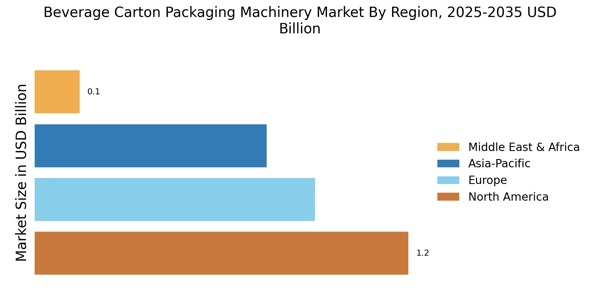
North America is the largest market for beverage carton packaging machinery, holding approximately 40% of the global market share. The region's growth is driven by increasing consumer demand for sustainable packaging solutions and stringent regulations promoting eco-friendly practices. The rise in health-conscious consumers is also pushing beverage manufacturers to adopt innovative packaging technologies that enhance product shelf life and reduce waste. The United States and Canada are the leading countries in this market, with major players like Tetra Pak and SIG Combibloc establishing strong footholds. The competitive landscape is characterized by continuous innovation and investment in R&D, with companies focusing on advanced automation and smart packaging solutions to meet evolving consumer preferences. The presence of key players ensures a robust supply chain and technological advancements in the region.
Europe is the second-largest market for beverage carton packaging machinery, accounting for around 30% of the global market share. The region is witnessing significant growth due to increasing regulations aimed at reducing plastic waste and promoting sustainable packaging. The European Union's directives on packaging waste are driving manufacturers to innovate and adopt eco-friendly materials and processes, enhancing the demand for carton packaging solutions. Germany, France, and the UK are the leading countries in this market, with a strong presence of key players like Elopak and Stora Enso. The competitive landscape is marked by collaborations and partnerships among manufacturers to develop advanced packaging technologies. The focus on sustainability and circular economy principles is reshaping the market, encouraging companies to invest in research and development for innovative packaging solutions.
Asia-Pacific is rapidly emerging as a significant market for beverage carton packaging machinery, holding approximately 25% of the global market share. The region's growth is fueled by urbanization, rising disposable incomes, and changing consumer lifestyles that favor convenient and ready-to-drink beverages. Additionally, government initiatives promoting sustainable packaging are catalyzing the demand for carton solutions in the beverage sector. China and India are the leading countries in this market, with a growing number of local and international players investing in advanced packaging technologies. The competitive landscape is evolving, with companies like Krones AG and Bühler Group expanding their operations to cater to the increasing demand. The focus on innovation and sustainability is driving the market forward, as manufacturers seek to meet the diverse needs of consumers in this dynamic region.
The Middle East and Africa region is witnessing a gradual increase in demand for beverage carton packaging machinery, holding about 5% of the global market share. The growth is primarily driven by the rising population, urbanization, and an increase in the consumption of packaged beverages. Additionally, government initiatives aimed at improving food safety and packaging standards are contributing to market expansion in this region. Countries like South Africa and the UAE are leading the market, with a growing number of local manufacturers and international players entering the scene. The competitive landscape is characterized by a mix of established companies and new entrants, focusing on innovative packaging solutions to cater to the evolving consumer preferences. The region's potential for growth is significant, as more businesses recognize the importance of sustainable and efficient packaging solutions.
The Beverage Carton Packaging Machinery Market is currently characterized by a dynamic competitive landscape, driven by increasing demand for sustainable packaging solutions and technological advancements. Key players such as Tetra Pak (SE), SIG Combibloc (DE), and Elopak (NO) are at the forefront, each adopting distinct strategies to enhance their market positioning. Tetra Pak (SE) emphasizes innovation in sustainable materials, while SIG Combibloc (DE) focuses on digital transformation to optimize production efficiency. Elopak (NO) is actively pursuing partnerships to expand its global footprint, indicating a trend towards collaborative growth in the sector. Collectively, these strategies not only enhance individual company profiles but also contribute to a more competitive environment, where innovation and sustainability are paramount.In terms of business tactics, companies are increasingly localizing manufacturing to reduce lead times and enhance supply chain resilience. This approach appears to be a response to the growing need for agility in production processes. The market structure is moderately fragmented, with several key players exerting influence over their respective segments. The collective actions of these companies suggest a trend towards consolidation, as they seek to leverage economies of scale and enhance their competitive edge.
In August Tetra Pak (SE) announced the launch of a new line of carton packaging that utilizes plant-based materials, reinforcing its commitment to sustainability. This strategic move not only aligns with global trends towards eco-friendly packaging but also positions Tetra Pak (SE) as a leader in innovation within the beverage carton sector. The introduction of this product line is likely to attract environmentally conscious consumers and strengthen the company's market share.Similarly, in July 2025, SIG Combibloc (DE) unveiled a digital platform designed to enhance operational efficiency through real-time data analytics. This initiative is indicative of the company's focus on digital transformation, which is essential for maintaining competitiveness in an increasingly data-driven market. By leveraging technology, SIG Combibloc (DE) aims to optimize production processes and reduce operational costs, thereby enhancing its overall value proposition.
In September Elopak (NO) entered into a strategic partnership with a leading beverage manufacturer to co-develop innovative packaging solutions tailored to specific market needs. This collaboration underscores Elopak's strategy of leveraging partnerships to drive growth and innovation. By aligning with key industry players, Elopak (NO) is likely to enhance its product offerings and expand its market reach, further solidifying its position in the competitive landscape.
As of October the Beverage Carton Packaging Machinery Market is witnessing significant trends such as digitalization, sustainability, and the integration of artificial intelligence. These trends are reshaping competitive dynamics, with companies increasingly forming strategic alliances to enhance their capabilities. The shift from price-based competition to a focus on innovation and technology is evident, as firms prioritize supply chain reliability and sustainable practices. Looking ahead, it appears that competitive differentiation will increasingly hinge on the ability to innovate and adapt to evolving consumer preferences, suggesting a promising future for those who can effectively navigate these trends.

October 2026: SIG introduced two new high-speed aseptic carton filling machines, SIG Neo XSlim 32 Aseptic and SIG Neo Midi 15 Aseptic, designed for single-serve and multi-serve beverage cartons. The XSlim model can fill up to 32,000 cartons per hour, while the Midi model can fill up to 15,000 cartons per hour. Both machines support multiple pack sizes and rapid format changes, with changeovers possible in less than 15 minutes. SIG reports that the machines increase output per square metre by one-third, helping beverage manufacturers expand production without requiring larger factory buildings.
August 2026: SIG and Euromilk, one of Slovakia’s leading dairy producers, advanced plans to install a SIG Slimline 12 Aseptic filling machine. The equipment is intended to improve operational efficiency and provide flexibility for packaging white milk, flavoured milk, cream and plant-based beverages. The installation supports growing demand for aseptic carton packaging and enables dairy manufacturers to respond to changing product and pack-size requirements.
December 2025: SIG announced that its first aseptic carton manufacturing plant in India, located in Ahmedabad, Gujarat, had become fully operational. Completed in approximately 20 months, the facility strengthens the supply of carton packaging materials for SIG’s growing installed base of filling machines serving Indian dairy and non-carbonated beverage producers. The plant also has the potential to serve neighbouring Asian markets, supporting the expansion of aseptic carton packaging infrastructure in the region.
November 2025: Tetra Pak showcased its beverage-processing and carton-packaging technologies at Drinktec India 2025. Featured equipment included the Tetra Pak E3/Speed Hyper, an aseptic carton filling machine capable of producing up to 40,000 packs per hour using eBeam sterilisation technology. The company also highlighted solutions designed to reduce water and energy consumption and improve production efficiency, reflecting the industry's focus on high-throughput, resource-efficient beverage packaging machinery
饮料纸箱包装机械市场预计将在2024年至2035年间以6.52%的年均增长率增长,推动因素包括可持续发展趋势、技术进步以及对包装饮料的需求增加。
新机遇在于:
到2035年,市场预计将实现强劲增长,反映出不断变化的消费者偏好和技术创新。
| MARKET SIZE 2024 | 3.094(USD Billion) |
| MARKET SIZE 2025 | 3.296(USD Billion) |
| MARKET SIZE 2035 | 6.2(USD Billion) |
| COMPOUND ANNUAL GROWTH RATE (CAGR) | 6.52% (2025 - 2035) |
| REPORT COVERAGE | Revenue Forecast, Competitive Landscape, Growth Factors, and Trends |
| BASE YEAR | 2024 |
| Market Forecast Period | 2025 - 2035 |
| Historical Data | 2019 - 2024 |
| Market Forecast Units | USD Billion |
| Key Companies Profiled | Tetra Pak (SE), SIG Combibloc (DE), Elopak (NO), Stora Enso (FI), Mondi Group (GB), Krones AG (DE), Sidel (FR), GEA Group (DE), Bühler Group (CH) |
| Segments Covered | Machine Type, Capacity, Carton Material, End-use Application, Level of Automation, Regional |
| Key Market Opportunities | Integration of sustainable materials and automation technologies in the Beverage Carton Packaging Machinery Market. |
| Key Market Dynamics | Technological advancements drive efficiency and sustainability in the Beverage Carton Packaging Machinery market, reshaping competitive dynamics. |
| Countries Covered | North America, Europe, APAC, South America, MEA |
 Priya Nagrale

请填写以下表格以获取本报告的免费样本


“This is really good guys. Excellent work on a tight deadline. I will continue to use you going forward and recommend you to others. Nice job”
 Noah Malgeri
Co-Founder

“Thanks for sending the report it gives us a good global view of the Betaïne market.”
 Peter Groot koerkamp
Account and Business Manager

“We found the report very insightful! we found your research firm very helpful. I'm sending this email to secure our future business.”
 Younghwan Choi
Senior Retail Manager

“I am very pleased with how market segments have been defined in a relevant way for my purposes (such as "Portable Freezers & refrigerators" and "last-mile"). In general the report is well structured. Thanks very much for your efforts.”
 Mark Irwin
Management Consultant

“We got the report in time, we really thank you for your support in this process. I also thank to all of your team as they did a great job.”
 Akif Moroglu
Strategy & Business Development Director

“The Automotive 48V ECU Components Procurement Intelligence Study” was a complex project, but the Market Research Future (MRFR) team handled it with quality, agility, and customer-centricity. They delivered all requested data on time and within the agreed scope. The team, including Shubhendra Anand and Rahul Gotadki, was always readily available to clarify questions and swiftly implement necessary adjustments, driving the project to a successful conclusion within a very demanding timeframe.
I would also like to specifically commend Akshay Agarwal for his responsiveness and support at every stage—from our initial inquiry on May 6th through to final delivery on June 18th. His dedication made the entire process seamless.”
 Guilherme Gomes Martins
Product Management Director

“Thanks. It’s been a pleasure working with you, please use me as reference with any other Intel employees.”
 Joseph Aguayo
Sales Operations & Pricing Manager

“Thank you, this will be very helpful for OQS.”
 La Terria Dodd
Program Support Specialist

“I have been reading the first document or the study, ,the Global HVAC and FP market report 2021 till 2026. Must say, good info! I have not gone in depth at all parts, but got a good indication of the data inside!”
 Rob Kooiker
Group Product Manager HVAC & Fire Protection GMA



