North America : Innovation and Sustainability Focus
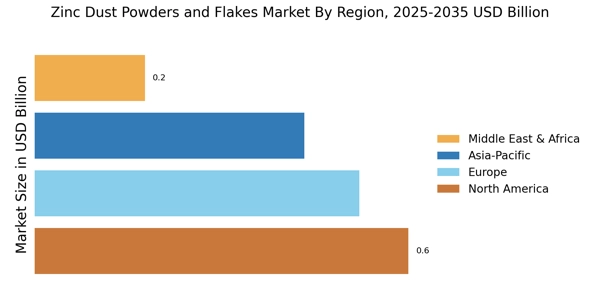
North America is witnessing significant growth in the Zinc Dust Powders and Flakes market, driven by increasing demand in the automotive and construction sectors. The region holds approximately 35% of the global market share, making it the largest market. Regulatory support for sustainable practices and the push for eco-friendly materials are further catalyzing this growth. The U.S. and Canada are the primary contributors to this demand, with a focus on innovation in production processes.
The competitive landscape in North America is robust, featuring key players such as American Zinc Recycling and Zinc Oxide LLC. These companies are investing in advanced technologies to enhance production efficiency and reduce environmental impact. The presence of established firms and a growing number of startups focused on sustainable practices are shaping the market dynamics. The region's regulatory framework encourages the adoption of zinc-based products, further solidifying its market position.
Europe : Regulatory Support and Innovation
Europe is emerging as a significant player in the Zinc Dust Powders and Flakes market, driven by stringent environmental regulations and a shift towards sustainable materials. The region accounts for approximately 30% of the global market share, making it the second-largest market. The European Union's commitment to reducing carbon emissions and promoting circular economy practices is fostering demand for zinc products in various applications, including construction and automotive sectors.
Leading countries in Europe include Germany, Belgium, and the Netherlands, where companies like Nyrstar and Zincor are prominent. The competitive landscape is characterized by a mix of established firms and innovative startups focusing on eco-friendly solutions. The presence of strong regulatory frameworks encourages investment in research and development, further enhancing the region's market potential. The European market is poised for growth as it aligns with global sustainability goals.
Asia-Pacific : Emerging Markets and Growth Potential
The Asia-Pacific region is rapidly becoming a powerhouse in the Zinc Dust Powders and Flakes market, driven by industrialization and urbanization. This region holds approximately 25% of the global market share, with countries like India and China leading the charge. The increasing demand for zinc in construction, automotive, and electronics sectors is propelling market growth. Government initiatives to boost infrastructure development are also significant growth drivers in this region.
China is the largest market in Asia-Pacific, followed by India, where companies like Hindustan Zinc Limited and Korea Zinc Co Ltd are key players. The competitive landscape is evolving, with both domestic and international firms vying for market share. The presence of major players and a growing focus on sustainable practices are shaping the market dynamics. As the region continues to industrialize, the demand for zinc products is expected to rise significantly, presenting lucrative opportunities for stakeholders.
Middle East and Africa : Resource-Rich and Growing Demand
The Middle East and Africa (MEA) region is witnessing a gradual increase in the Zinc Dust Powders and Flakes market, driven by resource availability and growing industrial activities. The region holds approximately 10% of the global market share, with countries like South Africa and the UAE showing promising growth. The demand for zinc in construction and manufacturing is on the rise, supported by government initiatives to enhance infrastructure and industrial capabilities.
South Africa is the leading market in the MEA region, with companies like Zincor playing a crucial role. The competitive landscape is characterized by a mix of local and international players, focusing on expanding production capacities and improving supply chain efficiencies. As the region continues to develop, the demand for zinc products is expected to grow, providing opportunities for investment and collaboration among key stakeholders.




 Noah Malgeri
Co-Founder

 Peter Groot koerkamp
Account and Business Manager

 Younghwan Choi
Senior Retail Manager

 Mark Irwin
Management Consultant

 Akif Moroglu
Strategy & Business Development Director

 Guilherme Gomes Martins
Product Management Director

 Joseph Aguayo
Sales Operations & Pricing Manager

 La Terria Dodd
Program Support Specialist

 Rob Kooiker
Group Product Manager HVAC & Fire Protection GMA