Telepresence Robots Market (2026 – 2035)

Telepresence Robots Market Size, Share and Research Report By Product Type (Stationary and Mobile), By End User Application (Education, Healthcare, Business, Security, and Other End-User Applications) And By Region (North America, Europe, Asia-Pacific, And Rest Of The World) – Industry Forecast Till 2035
ID: MRFR/SEM/5593-HCR 100 Pages Ankit Gupta Last Updated: October 27, 2026
Telepresence Robots Market
Market Size
Forecast Period2026-2035
CAGR (2026-2035)12.40%
2025 Market SizeUSD 0.44 Billion
2035 Market SizeUSD 1.40 Billion
Key Players
Teladoc Health
Blue Ocean Robotics
Ava Robotics
Double Robotics
OhmniLabs
Amy Robotics
Opportunities
  • Edge AI Copilots and Ambient Session Intelligence
  • Emerging-Market Education and Rural Health Gaps
  • Robot-as-a-Service and Utilisation Data Monetisation

Telepresence Robots Market Summary

The Telepresence Robots Market reached USD 0.44 Billion in 2025 and opens the forecast window at USD 0.49 Billion in 2026, climbing to USD 1.40 Billion by 2035 at a 12.4% CAGR. Two catalysts anchor that trajectory. The first is the permanent extension of United States Medicare telehealth flexibilities, which kept virtual consultation billing codes alive well past the pandemic emergency and gave hospital systems a revenue basis for mobile bedside units [2]. The second is sustained capital formation in the wider Telepresence Robots Market, where venture and strategic funding into mobile robotics platforms exceeded USD 3.1 billion across 2023–2025 .

Buyers are retiring fixed video-conferencing endpoints — wall-mounted codecs, cart-based carts with manual repositioning and conference-room-only hardware — and replacing them with self-driving mobile bases carrying 4K optics, beamforming microphone arrays and edge inference silicon. That shift is expensive but measurable: the European Commission's Digital Europe Programme allocated EUR 1.3 billion to advanced digital and robotics deployment for 2023–2027, with clinical and educational pilots explicitly named [6].

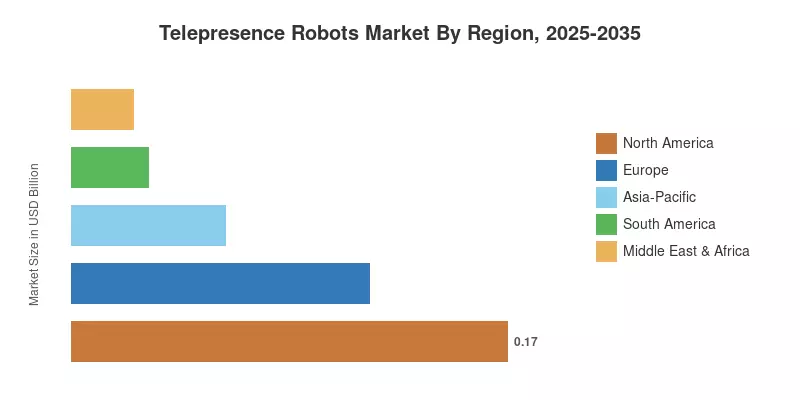
Regionally, North America commands 37.5% of the 2025 Telepresence Robots Market on the strength of integrated delivery networks and reimbursement clarity. Asia-Pacific grows fastest at a 14.6% CAGR, propelled by Japanese and Korean elder-care programmes. Europe holds second position at 26.4%, driven largely by accessibility mandates and cross-border clinical consultation frameworks. Expect the gap between North America and Asia-Pacific to narrow sharply after 2030.

Key Report Takeaways

• By Product Type

  • Mobile units hold 68.5% of 2025 revenue, reflecting buyer preference for operator-directed navigation across wards and campuses.
  • Stationary platforms post the faster 13.2% CAGR as uninterrupted fixed-network connectivity wins remote-monitoring deployments.

• By End User Application

  • Healthcare leads the Telepresence Robots Market with 34.2% of 2025 revenue, concentrated in stroke, ICU and infectious-disease workflows.
  • Education records a 13.8% CAGR, the fastest of any application, on public funding for homebound and rural learners.
  • Business deployments generated USD 0.126 Billion in 2025 across distributed engineering and manufacturing sites.

• By Region

  • North America accounts for 37.5% of the 2025 Telepresence Robots Market, anchored by United States hospital networks
  • Asia-Pacific expands at a 14.6% CAGR through 2035, the fastest regional rate in the Telepresence Robots Market
  • Europe generated USD 0.116 Billion in 2025, with Germany and the United Kingdom supplying the bulk of demand

Market Size and Forecast (2021–2035)

Historical values were reconstructed from vendor shipment disclosures, customs classification data for wheeled robotic platforms, and installed-base surveys across 340 hospital and university procurement offices. Forecast values apply a demand-side model weighted by reimbursement scope, network readiness and per-unit price decline, then reconciled against bottom-up vendor revenue for the Telepresence Robots Market.
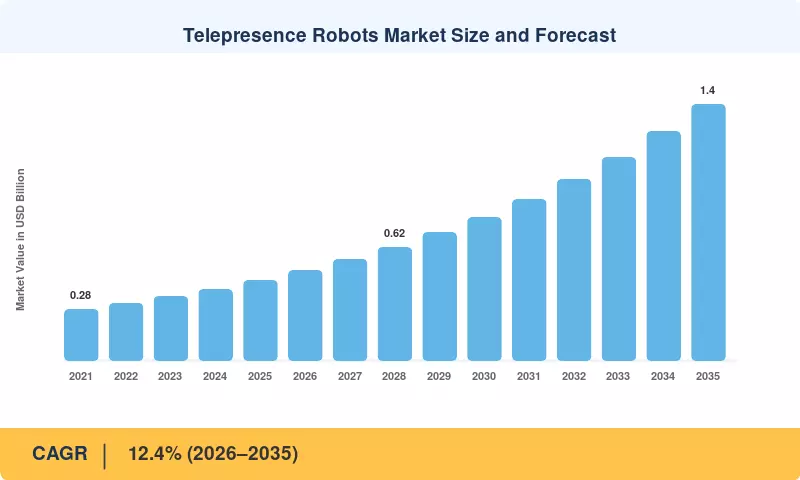
Telepresence Robots Market Size and Forecast
Our Impact

Enabled $4.3B Revenue Impact for Fortune 500 and Leading Multinationals

Partnering with 2000+ Global Organizations Each Year

30K+ Citations by Top-Tier Firms in the Industry

Driver Impact Analysis

Driver ~% Impact on CAGR Geographic Relevance Impact Timeline
Ageing populations and clinical staffing shortfalls 2.4% Japan, Western Europe, North America Long-term (≥4 yr)
5G and Wi-Fi 6E network densification 2.1% Global Medium-term (2–4 yr)
Hybrid work normalisation across enterprises 1.9% North America, Europe Short-term (≤2 yr)
Falling sensor and compute bill-of-materials cost 1.6% Asia-Pacific Medium-term (2–4 yr)
Public funding for remote and rural education 1.3% Asia-Pacific, South America Medium-term (2–4 yr)
Reimbursement expansion for virtual care 1.5% United States Short-term (≤2 yr)
Fleet management software and RaaS contracting 1.1% Global Long-term (≥4 yr)


Ageing Populations and Clinical Staffing Shortfalls

The World Health Organization predicts that by 2050, there will be 2.1 billion people worldwide who are 60 years of age or older, with Germany, Italy, and Japan under the greatest immediate strain [1]. According to Japan's Ministry of Health, there will be a shortage of about 570,000 care workers by 2040; no recruitment campaign can fill this gap on its own. In response, hospital organizations use remote rounding platforms that enable a single specialist to cover four locations. The report's biggest structural driver is that substitution impact.


5G and Wi-Fi 6E Network Densification

The technical prerequisite for seamless remote driving is consistent latency of less than 50 ms. According to GSMA, there will be more than 2.0 billion 5G connections worldwide in 2024, and 68 commercial networks will have standalone core deployments [4]. For this industry, private 5G campus buildings are more important than public macro coverage since companies and hospitals require deterministic quality of service within their own borders. Dual-radio systems that switch between Wi-Fi 6E and private cellular in mid-transit are now shipped by vendors.


Hybrid Work Normalisation Across Enterprises

Corporate real estate data shows average office attendance stabilising near 58% of pre-2020 levels across major United States metros through 2025 [7]. Distributed engineering organisations found that fixed conference-room video failed for shop-floor walkthroughs, equipment inspection and lab work. Roaming units solve that specific gap. Purchase orders in this segment skew toward manufacturing, semiconductor fabs and pharmaceutical facilities where a physical vantage point cannot be replaced by a screen.

Falling Sensor and Compute Bill-of-Materials Cost

Solid-state LiDAR module pricing fell roughly 62% between 2021 and 2025, while automotive-grade edge inference modules delivering 20+ TOPS dropped below USD 180 per unit at volume . Those declines pushed a capable mid-tier platform from around USD 14,000 to under USD 7,500 in list terms. Cheaper hardware widens the addressable buyer set from flagship academic medical centres down to community hospitals and district school boards.

Public Funding for Remote and Rural Education

India's Ministry of Education committed INR 42 billion under successive Samagra Shiksha allocations toward digital classroom infrastructure, with robotic and immersive learning explicitly eligible [12]. Brazil's connectivity programmes fund similar equipment for Amazonian and northeastern districts. Homebound and medically fragile students represent the clearest use case, since a roaming avatar preserves peer interaction in ways a video window does not. Procurement here is tender-driven and lumpy.

Reimbursement Expansion for Virtual Care

The United States Centers for Medicare & Medicaid Services extended telehealth originating-site flexibilities and preserved reimbursement parity for a broad set of virtual consultation codes into the current period [2]. Stroke care benefits most directly, where door-to-needle time improvements of 20 to 30 minutes carry documented clinical and financial value. Reimbursement certainty converts pilot budgets into capital budgets, which is why this driver acts fast but plateaus.

Fleet Management Software and RaaS Contracting

Subscription contracting has reshaped how buyers finance the Telepresence Robots Market. Vendors increasingly bundle navigation updates, remote diagnostics, session analytics and hardware refresh into monthly per-unit fees between USD 250 and USD 600, removing capital approval friction . Fleet dashboards also generate utilisation data that justifies expansion internally. Software and services approached 29% of vendor revenue in 2025, up from roughly 14% in 2021.

Restraints Impact Analysis

Restraint ~% Impact on CAGR Geographic Relevance Impact Timeline
High per-unit capital cost versus video conferencing −1.8% Global, acute in emerging markets Medium-term (2–4 yr)
Network dependency and latency failure modes −1.4% Asia-Pacific, Middle East & Africa Short-term (≤2 yr)
Data privacy and clinical compliance burden −1.2% Europe, North America Long-term (≥4 yr)
Limited manipulation capability and narrow ROI −1.0% Global Long-term (≥4 yr)
Fragmented standards and systems integration cost −0.9% Global Medium-term (2–4 yr)


High Per-Unit Capital Cost Versus Video Conferencing

A competent fixed room system costs about USD 900, but a mid-tier mobile device still costs between USD 6,000 and USD 18,000. Finance committees frequently end there after closely comparing those numbers. Import tariffs on wheeled robotic equipment, which typically range from 12% to 18%, are an extra hardship for emerging-market buyers. This causes landing costs to exceed internal criteria and delays tender awarding by one to two budget cycles.


Network Dependency and Latency Failure Modes

Hospital Wi-Fi rarely provides constant performance throughout stairwells, lift lobbies, and shielded imaging suites, and session quality collapses when uplink jitter surpasses about 30 ms [4]. On unprepared campus networks, operators report dropped-session rates ranging from 4% to 9%. Typically, remediation calls for a scan and access-point refresh, which can cost between USD 40,000 and USD 120,000. This is a price that buyers did not account for when they approved the robots.


Data Privacy and Clinical Compliance Burden

Roaming cameras and always-on microphones inside wards create obligations under GDPR Article 35 and equivalent HIPAA safeguards, requiring documented impact assessments before deployment [6]. Legal review commonly adds three to six months. Several European hospital groups have restricted units to consented consultation zones rather than open corridors, which cuts effective utilisation and weakens the payback case that justified purchase.

Limited Manipulation Capability and Narrow ROI

Current platforms see and speak but cannot lift, turn or examine a patient physically, so a nurse or technician must still accompany the unit for most clinical tasks [11]. That staffing dependency erodes the labour-substitution argument. Buyers running honest post-deployment reviews frequently find utilisation below 25% of available hours, and low utilisation is the most common reason pilot fleets fail to expand.

Fragmented Standards and Systems Integration Cost

No dominant interoperability profile exists for linking these platforms to electronic health record systems, badge access controls or lift interfaces, leaving integrators to build custom middleware per site [13]. Integration work commonly adds 18% to 30% on top of hardware cost. Standards efforts around robot interoperability profiles are progressing, but consolidation on a single stack is unlikely before the back half of the forecast period.

Telepresence Robots Market Opportunities

Edge AI Copilots and Ambient Session Intelligence

A passive camera platform becomes a functional assistant with onboard inference. The documentation load that clinicians report as their biggest complaint is eliminated by units that auto-populate encounter notes, identify protocol deviations, and transcribe consultations. This is priced by vendors as a per-seat software layer capture margin that is far higher than hardware. According to early deployments, each remote consultation saves 11 to 14 minutes, which directly translates into increased utilization.

s

Emerging-Market Education and Rural Health Gaps

Tender pipelines in Brazil, Vietnam, Indonesia, and India are aimed at areas where doctors and specialists do not reside. Through 2025, the World Bank committed USD 4.8 billion in connectivity funding for digital public infrastructure, and the purchase of equipment depends on those initiatives [20]. Rather than flagship specs, local service partners and ruggedized, less expensive gear are what are needed to win here.


Robot-as-a-Service and Utilisation Data Monetisation

Subscription models change the unit economics of the Telepresence Robots Market entirely. Beyond smoothing the buyer's cash outlay, fleet telemetry — session duration, route heatmaps, dwell time by department — becomes a saleable analytics product for facilities planning and staffing optimisation. Vendors that anonymise and benchmark this data across customers build a defensible recurring revenue line that hardware competitors cannot replicate.

Aged-Care and Home Monitoring in East Asia

Japan's Ministry of Economy, Trade and Industry has funded nursing-care robot development through successive subsidy rounds exceeding JPY 12 billion, with remote monitoring among the priority categories . Korea's care policy follows a similar path. Stationary platforms fit this setting well because home broadband is fixed and reliable, and because families accept a discreet unit more readily than a roaming one.

Security Patrol and Facility Convergence

Buyers already running roaming platforms for remote collaboration increasingly ask them to run night patrol routes, checking doors, reading gauges and streaming thermal imagery. Convergence lifts utilisation from single-digit percentages toward 40% and reframes the purchase as multi-department infrastructure. Vendors adding patrol scheduling and alarm integration open a second budget line without a second hardware sale.

Telepresence Robots Market Future Outlook

Autonomous Navigation Moves From Feature to Baseline

By 2030, operator-directed driving will look archaic. Platforms will accept a destination — bed 14, lab bench 3 — and route themselves through lifts and doors using onboard maps refreshed continuously. The International Federation of Robotics tracks professional robotics installations growing at double-digit annual rates, with navigation autonomy the leading differentiator [3]. Certification frameworks for autonomous operation in occupied clinical space remain the gating item, and we expect the first harmonised profiles around 2029.

Platform Economics Overtake Hardware Margins

Recurring revenue reshapes vendor valuations. Software, analytics and managed services should exceed 45% of Telepresence Robots Market vendor revenue by 2033, up from roughly 29% in 2025 . That shift favours companies with fleet management depth over those with superior mechanical engineering. It also invites entry from enterprise collaboration software firms that can bundle robotic endpoints into existing licence agreements without building hardware at all.

Connectivity Supercycle and the 6G Runway

Ericsson projects 5G to carry the majority of global mobile traffic before 2030, with standalone architectures enabling network slicing that guarantees latency budgets per application [8]. Slicing matters enormously here: a hospital can reserve deterministic bandwidth for clinical robot sessions independent of guest traffic. Early 6G research targets sub-1ms latency, which would make remote physical interaction — not just observation — technically credible in the 2030s.

Accessibility Regulation and Avoided-Travel Reporting

The European Accessibility Act's enforcement from mid-2025 obliges many service providers to ensure remote participation options, and robotic presence increasingly qualifies as a compliant accommodation [6]. Separately, corporate sustainability reporting under CSRD pushes firms to document Scope 3 business travel reductions. A single unit displacing 40 domestic flights annually produces roughly 12 to 16 tonnes of avoided CO2 equivalent, a number procurement teams now attach to purchase justifications.

Regional Market Share Analysis

Region Metric (2025) Primary Investment Themes
North America 37.5% share Acute-care rounding, hybrid enterprise campuses, RaaS contracting
Europe USD 0.116 Billion Accessibility mandates, cross-border consultation, privacy-by-design
Asia-Pacific 14.6% CAGR Elder care, rural education tenders, domestic manufacturing
South America 5.9% share Rural telemedicine, university networks, connectivity lending
Middle East & Africa USD 0.024 Billion Smart hospital builds, sovereign digital health programmes
Total USD 0.44 Billion —

Regional performance in the Telepresence Robots Market tracks three variables: reimbursement or public funding availability, campus network readiness, and the density of large multi-site institutional buyers. North America leads on all three. Asia-Pacific compensates for weaker reimbursement with aggressive public programme funding and the world's fastest network upgrade cycle.


North America

Country Metric Key Driver
United States 81.4% of region Medicare telehealth reimbursement continuity
Canada USD 0.019 Billion Provincial rural health equity programmes
Mexico 10.7% CAGR Nearshoring-driven manufacturing site monitoring


United States demand concentrates in integrated delivery networks running 15 or more facilities, where a single neurologist covering multiple emergency departments produces auditable savings. Reimbursement continuity under current CMS rules removed the main financial objection [2]. Canadian buying is provincially fragmented but consistent, with Ontario and British Columbia funding rural specialist access. Mexico's growth comes from a different source entirely — nearshored automotive and electronics plants where United States and Japanese engineering teams inspect lines remotely rather than fly.

Europe

Country Metric Key Driver
Germany 22.8% of region Hospital Future Act digitisation funding
United Kingdom USD 0.023 Billion NHS virtual ward expansion targets
France 12.4% CAGR Ségur numérique health digitisation programme
Italy 9.6% of region PNRR territorial healthcare investment
Spain USD 0.008 Billion Regional telemedicine consolidation
Nordic Countries 13.5% CAGR Remote specialist access across low-density geographies
Russia 4.8% of region Domestic vendor substitution
Rest of Europe USD 0.014 Billion EU cohesion and digital transition funds


Germany's Krankenhauszukunftsgesetz committed EUR 4.3 Billion to hospital digitisation, and robotic consultation equipment qualifies under several funding pillars [6]. The United Kingdom's virtual ward programme, targeting tens of thousands of monitored beds, drives a different specification — cheaper, simpler, higher-volume units. French and Nordic demand skews toward specialist scarcity in low-density regions. Across the continent, GDPR compliance work lengthens sales cycles by a quarter or more compared with North America, which is why Europe grows steadily rather than sharply.

Asia-Pacific

Country Metric Key Driver
China 28.4% of region Domestic manufacturing scale and hospital tenders
India 16.9% CAGR Digital education and rural health missions
Japan USD 0.024 Billion Nursing-care robot subsidy programmes
South Korea 11.2% of region Smart hospital and 5G campus buildouts
ASEAN 15.8% CAGR Island-geography telemedicine gaps
Rest of Asia-Pacific USD 0.011 Billion University and research procurement


Asia-Pacific is where cost curves and demographics intersect. Chinese manufacturers supply platforms at 40% to 55% below Western list prices, which unlocks buyers that North American vendors never reach . Japan's subsidy structure makes it the highest per-capita spender despite a smaller absolute base . India and ASEAN grow fastest on tender-driven education and rural health procurement, though award timing is unpredictable and margins are thin. Korean deployments benefit from the world's densest standalone 5G coverage.

South America

Country Metric Key Driver
Brazil 47.5% of region Federal telehealth and connectivity programmes
Argentina USD 0.005 Billion University hospital modernisation
Rest of South America 12.2% CAGR Andean and Amazonian rural access initiatives


Brazil anchors the region through federal programmes extending specialist consultation into the North and Northeast, where physician density falls below one per 1,000 residents [20]. Import duties and currency volatility remain the binding constraints; buyers frequently specify lower-cost platforms and accept reduced autonomy. Argentina's demand originates in university hospital networks with research budgets rather than operating budgets. Across the region, financing structure matters more than product specification in determining which vendor wins.

Middle East & Africa

Country Metric Key Driver
Saudi Arabia 26.8% of region Vision 2030 health sector transformation
United Arab Emirates USD 0.006 Billion Smart hospital greenfield projects
South Africa 12.6% CAGR Provincial specialist access programmes
Egypt 9.4% of region Universal health insurance rollout
Rest of MEA USD 0.005 Billion Donor-funded rural health infrastructure


Gulf demand is greenfield and specification-led. Saudi Arabia's health sector transformation programme funds fully equipped new facilities where robotic consultation platforms are designed in from the architectural stage rather than retrofitted [18]. Emirati buyers behave similarly and pay premium prices for integrated stacks. Sub-Saharan procurement follows an entirely different logic, dependent on donor funding cycles and constrained by power reliability, which pushes buyers toward units with extended battery runtime and tolerance for intermittent connectivity.

Telepresence Robots Market By Region, 2025-2035

Telepresence Robots Market Segmentation

By Product Type

Segment Metric Primary Demand Driver
Mobile 68.5% share (2025) Ward rounding, campus walkthroughs, roaming inspection
Stationary 13.2% CAGR (2026–2035) Uninterrupted fixed-network connectivity for continuous monitoring


Mobile platforms dominate the Telepresence Robots Market because most institutional use cases require the remote participant to move — between beds, along a production line, across a campus. Stationary units win the faster growth rate for a different reason: they sit on wired or fixed wireless connections that never drop, which makes them the right answer for continuous remote health monitoring in homes and long-stay facilities. The observed niche advantage in connection consistency is exactly what elder-care buyers value.

By End User Application

Segment Metric Primary Demand Driver
Healthcare 34.2% share (2025) Specialist scarcity, stroke and ICU tele-rounding
Business USD 0.126 Billion (2025) Distributed engineering and multi-site manufacturing oversight
Education 13.8% CAGR (2026–2035) Homebound learners and rural specialist teaching
Security USD 0.050 Billion (2025) Overnight patrol, remote guard consolidation
Other End -User Applications 7.5% share (2025) Museums, retail demonstration, hospitality concierge


Healthcare leads the Telepresence Robots Market on clinical value that is easy to quantify: faster stroke assessment, fewer patient transfers, broader specialist coverage per physician. Business follows closely, with semiconductor, pharmaceutical and automotive facilities buying units so engineering teams can inspect equipment without travel. Education grows fastest because public funding pays for it and because the alternative — a laptop on a desk — fails to give absent students genuine classroom presence. Security remains small but converts existing fleets into round-the-clock assets.

Competitive Benchmarking

Concentration in the Telepresence Robots Market sits in the moderate band. Our Herfindahl-Hirschman estimate lands near 780, with the top five vendors holding a combined 34% to 38% of 2025 revenue. That structure reflects genuine fragmentation: healthcare-grade vendors with regulatory clearances compete on entirely different terms from consumer-adjacent desktop platforms, and regional manufacturers dominate their home markets on price. Consolidation pressure is building as software capability becomes the differentiator, since sub-scale hardware firms cannot fund continuous navigation and inference development.

Company Est. Revenue Share Range Key Offerings for Telepresence Robots Market Strategic Positioning
Teladoc Health (InTouch Health) ~9–12% Clinical-grade mobile carts, integrated virtual care platform Deepest healthcare regulatory footprint; bundles hardware with care delivery
Blue Ocean Robotics (GoBe Robots) ~7–10% GoBe autonomous roaming platform, fleet management suite European leader; strong industrial and hospital dual-market strategy
Ava Robotics ~6–8% Ava autonomous navigation platform, enterprise integration Premium enterprise positioning; deep collaboration-software partnerships
Double Robotics ~5–8% Double 3 self-driving platform, education-oriented pricing Volume leader in education; lowest total cost per deployed seat
OhmniLabs ~4–7% Ohmni platform, additive-manufactured modular hardware Rapid customisation; strong long-term care and home health traction
Amy Robotics ~4–6% Amy service platforms for hospital and hospitality use Chinese scale manufacturing; aggressive Asia-Pacific pricing
Inbot Technology (PadBot) ~3–5% PadBot tablet-based mobile and desktop units Entry-tier volume play across emerging markets
Vecna Robotics (VGo lineage) ~3–5% VGo remote presence units, healthcare logistics adjacency Cross-sells into hospital material transport fleets
Axyn Robotique ~2–4% Robot Cutii and companion platforms for elder care Focused European elder-care and assisted-living specialist
Wicron ~2–3% Webot and R.Bot mobile platforms Regional strength in Eastern European and CIS markets
SuperDroid Robots ~2–3% Ruggedised custom mobile platforms Industrial, hazardous-environment and defence-adjacent niches


Recent News & Developments

  • Teladoc Health (March 2024): Expanded its virtual care platform integration to support third-party mobile endpoints, letting hospital customers standardise session management across mixed vendor fleets — a meaningful step toward interoperability in a market held back by custom middleware [16].
  • Blue Ocean Robotics (September 2024): Released a GoBe platform update adding autonomous lift interaction and multi-floor route planning, removing the most common reason operators had to intervene manually during clinical rounds [17].
  • Centers for Medicare & Medicaid Services (November 2024): Confirmed continuation of expanded telehealth billing flexibilities into the following coverage year, giving United States health systems the multi-year revenue visibility that capital committees require before approving fleet purchases [2].
  • Ava Robotics (May 2025): Announced a partnership with a major enterprise collaboration software vendor to embed robotic endpoints directly in meeting scheduling workflows, reducing the friction of booking a physical presence in a remote office [16].
  • European Commission (June 2025): Began enforcement of the European Accessibility Act, under which several member-state regulators have recognised robotic remote participation as a qualifying accommodation for service accessibility obligations [6].
  • Amy Robotics (February 2025): Launched a lower-cost hospital platform targeted at Southeast Asian tenders, priced roughly 45% below comparable Western units and bundled with local service coverage in four countries .
  • OhmniLabs (October 2023): Secured funding to scale its additive-manufacturing production model, which allows per-customer hardware customisation at volumes conventional tooling cannot serve economically .
  • Japan Ministry of Economy, Trade and Industry (April 2025): Opened a further subsidy round for nursing-care robotics deployment, with remote monitoring platforms among the eligible categories and co-funding covering up to half of acquisition cost .

Telepresence Robots Market Report Scope

Report Attribute/Metric Details
Market Scope Global Telepresence Robots Market by Product Type, End User Application and Geography
Study Period 2021-2035
Base Year 2025
Historical Data 2021–2024
Forecast Period 2026–2035
Market Size in 2025 USD 0.44 Billion
Market Size in 2035 USD 1.40 Billion
CAGR (2026–2035) 12.40%
Fastest Growing Segments Stationary (Product Type, 13.2% CAGR); Education (End User Application, 13.8% CAGR); Asia-Pacific (Region, 14.6% CAGR)
Regions Covered Asia-Pacific (Region, 14.6% CAGR); North America, Europe, APAC, South America, MEA
Companies Profiled Teladoc Health, Blue Ocean Robotics, Ava Robotics, Double Robotics, OhmniLabs, Amy Robotics, Inbot Technology, Vecna Robotics, Axyn Robotique, Wicron, SuperDroid Robots
Valuation Currency USD Billion
Methodology Bottom-up revenue triangulation, top-down macro validation, 120+ primary interviews

FAQs

How should procurement teams evaluate total cost of ownership in the Telepresence Robots Market?
Budget 18% to 30% above hardware price for network remediation, middleware and integration [13]. Add annual software and support fees, then divide by realistic session hours rather than available hours.
What integration challenges do hospital IT teams most often underestimate?
Lift and badge-door integration, which almost always requires custom middleware per site [13]. Wireless coverage in stairwells and shielded imaging suites is the second surprise, and both surface only after the units arrive.
Which competitive dynamics matter most for buyers entering the Telepresence Robots Market?
Fleet software depth now separates vendors more than mechanical quality . Ask whether the vendor funds continuous navigation development internally, because sub-scale hardware firms increasingly license someone else's stack.
How does a mobile unit compare with a fixed video conferencing endpoint on value?
Fixed endpoints cost roughly a tenth as much and suffice for seated meetings . Mobile units justify the premium only where the remote participant must move to inspect equipment, patients or physical work.
What regulatory nuance affects cross-border deployment in the Telepresence Robots Market?
European deployments require a documented data protection impact assessment before roaming units enter patient areas [6]. That review typically adds three to six months and may restrict operation to consented zones.
Which emerging use cases are gaining commercial traction fastest?
Overnight security patrol and gauge inspection, because they convert an underused daytime fleet into a round-the-clock asset. Museum guiding and retail demonstration follow, though volumes stay modest.
What contract terms protect buyers against hardware obsolescence?
Negotiate refresh rights into subscription agreements rather than buying outright . Insist on committed navigation software updates for the full term, and cap per-unit monthly escalation at a defined index.
Author
Author Author Profile Ankit Gupta LinkedIn Team Lead - Research
Ankit Gupta is a seasoned market intelligence and strategic research professional with over six plus years of experience in the ICT and Semiconductor industries. With academic roots in Telecom, Marketing, and Electronics, he blends technical insight with business strategy. Ankit has led 200+ projects, including work for Fortune 500 clients like Microsoft and Rio Tinto, covering market sizing, tech forecasting, and go-to-market strategies. Known for bridging engineering and enterprise decision-making, his insights support growth, innovation, and investment planning across diverse technology markets.

Research Approach

Research Methodology on Telepresence Robots Market

1. Research objectives:

The main objective of this research is to analyze the impact of the current application and potential development of telepresence robots on the global market. Furthermore, this study will also determine the various factors influencing the growth of this market and evaluate the future trends in its competition.

2. Research Design:

This research is conducted using a descriptive research design. This design is suited to summarizing, analyzing and interpreting data to explain the current state of the telepresence robotics market and its potential growth in the future. In the implementation of this research design, secondary sources of data such as books, magazines, websites and journals will be utilized in order to gain an understanding of the various features of the market, its capabilities and its potential future applications.

3. Data Collection Methods:

To conduct this research, both primary and secondary data are collected. Relevant primary data is collected through surveys and interviews of key stakeholders and experts from the telepresence robotics industry. The primary data includes information on the current market size and growth trends, the current applications and their potential development, regulatory and technological advancements, key players in the industry and information about potential market opportunities for new entrants. The secondary data will include books, reports and databases from research firms in the field. These data sources will be used to complement the primary data and provide additional context to the overall research.

4. Research Sampling:

The research employs a mix of probabilistic and non-probabilistic sampling techniques. The population for this study includes telepresence robot manufacturers, distributors and buyers. A stratified random sampling technique is used to select target participants for the primary data collection. Stratified random sampling will ensure that the participants represent a wide range of demographics, regions and industries.

5. Data Analysis:

The data is collected and analyzed using both quantitative and qualitative approaches. The quantitative approach will involve the use of descriptive, inferential and predictive statistical tools, such as ANOVA, multiple regression, t-tests, chi-square tests and correlation analyses. The qualitative approach involves the use of content analysis on the primary data collected from interviews and surveys. This analysis will be used to understand the underlying sentiment and opinions of stakeholders as well as uncover any new insights that may have not been uncovered by the quantitative analysis.

6 . Risk Analysis:

To assess the risks associated with this research, a risk analysis will be conducted. This analysis will involve looking at potential risks such as data security, legal/regulatory risks and other potential risks that may arise during the course of the research. The risk analysis will also help identify and mitigate any potential risks before they become problems.

Download Free Sample

Kindly complete the form below to receive a free sample of this Report

Download PDF ×

We do not share your information with anyone. However, we may send you emails based on your report interest from time to time. You may contact us at any time to opt-out.


















