Surrogacy Market (2026 - 2035)

Surrogacy Market Research Report By Intended Parent Type (Infertile Couples, Single Individuals, LGBTQ+ Couples), By Surrogacy Type (Traditional Surrogacy, Gestational Surrogacy), By Compensation Type (Altruistic Surrogacy, Commercial Surrogacy), By Surrogacy Arrangement (Independent Surrogacy, Agency-Assisted Surrogacy), By Legal Framework (Permissive/Legalized Surrogacy, Restrictive/Prohibited Surrogacy) and By Regional (North America, Europe, South America, Asia Pacific, Middle East and Africa) - Growth & Industry Forecast 2025 To 2035
ID: MRFR/HC/21153-HCR 128 Pages Satyendra Maurya, Rahul Gotadki Last Updated: September 17, 2026
Surrogacy Market
Market Size
Forecast Period2026-2035
CAGR (2026-2035)20.2%
2025 Market SizeUSD 25.30 Billion
2035 Market SizeUSD 159.27 Billion
Key Players
Growing Generations
Circle Surrogacy
ConceiveAbilities
Extraordinary Conceptions
Simple Surrogacy
West Coast Surrogacy
Opportunities
  • Employer-Sponsored Fertility Benefits
  • Digital Matching Platforms and Marketplace Models
  • Emerging Markets in Southeast Asia and Latin America

Surrogacy Market Summary

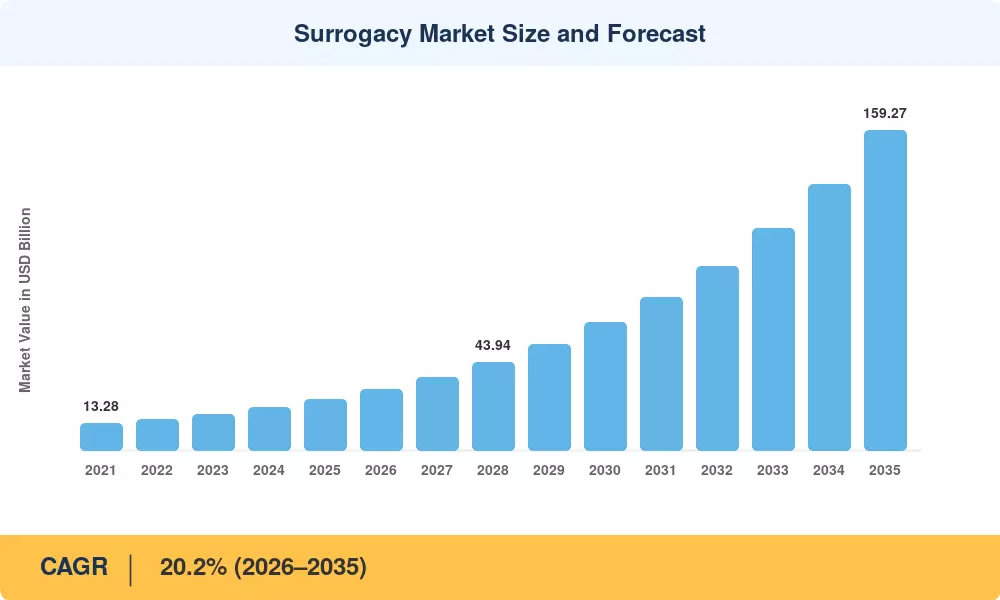
The global Surrogacy Market reached USD 25.30 Billion in 2025 and is projected to climb from USD 30.41 Billion in 2026 to USD 159.27 Billion by 2035, expanding at a 20.2% CAGR across the forecast window. Delayed parenthood among millennials, legislative liberalization in key jurisdictions such as Thailand's 2023 Commercial Surrogacy Amendment and multiple U.S. state-level parentage acts, and rising infertility prevalence—now affecting roughly one in six couples globally according to WHO data—are converging to drive double-digit growth [1]. Private equity commitments to reproductive health exceeded USD 4.8 billion in 2024 alone, signaling sustained investor appetite .

Surrogacy Market Technology is changing the way Surrogacy Market is operated. AI-based morphokinetic embryo selection platforms are replacing traditional manual embryo grading, pushing implantation success rates beyond 65%. Preimplantation genetic testing panels have evolved from single-gene screening to polygenic risk scores. The American Society for Reproductive Medicine found that IVF live-birth rates per transfer climbed 11% from 2020 to 2024, shortening treatment schedules and cutting per-cycle expenses [3]. These developments immediately assist intended parents seeking surrogacy by lowering the number of transfer cycles.

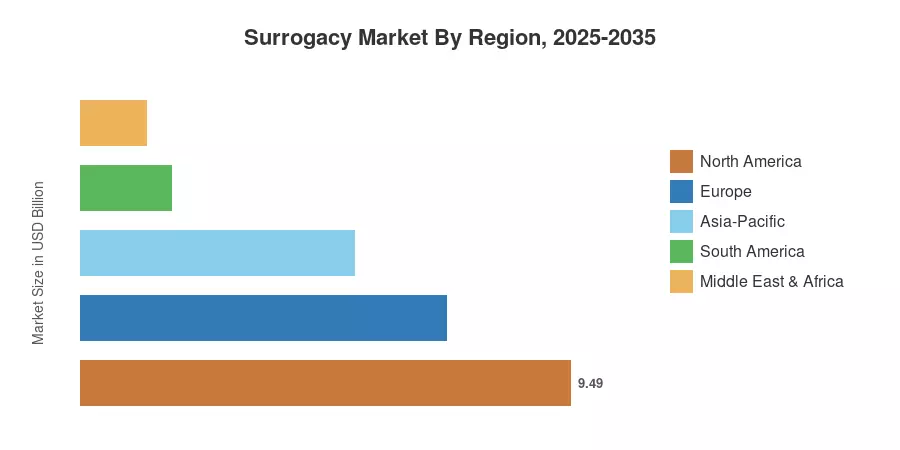
North America’s revenue share of the Surrogacy Market is 37.5%, propelled by the presence of a well-established legal framework in states such as California, Nevada, and Connecticut. Asia-Pacific is the fastest-growing area with a CAGR of 21.0% and is driven by cost-competitive programs in countries such as Georgia and Cambodia (for altruistic arrangements) and India. Europe is the second largest market at 28.0%, with Ukraine, Greece and the United Kingdom driving volumes in the region. With legislative clarity coming into view and public acceptability growing, the Surrogacy Market is poised to move from a specialist service into a mainstream section of global reproductive healthcare.


Key Report Takeaways

• By Type

  • Gestational surrogacy accounted for 85.2% of total Surrogacy Market revenue in 2025, reflecting a strong preference for arrangements where the surrogate has no genetic link to the child.
  • Traditional surrogacy is forecast to record the fastest segment CAGR of 21.5% through 2035, driven by lower procedural costs and growing acceptance in select emerging economies.

• By Technology

  • IVF-based arrangements represented 71.6% of the Surrogacy Market in 2025, a share that continues to grow as success rates improve.


  • Surrogacy agencies are expanding at a 20.7% CAGR as specialized intermediaries streamline matching, legal, and medical coordination for intended parents.

• By Region

  • North America led the Surrogacy Market with a 37.5% share in 2025, anchored by the United States' state-by-state legal protections.
  • Asia-Pacific is projected to grow at a 21.0% CAGR through 2035 as regulatory reforms in Southeast Asia and rising disposable incomes attract cross-border demand.


Surrogacy Market Size and Forecast (2021–2035)

Market Research Future's proprietary estimation framework integrates primary interviews with fertility center operators, surrogacy agency executives, and legal practitioners across 32 countries, cross-validated against reproductive health registry data published by ESHRE, CDC, and ICMART .
Surrogacy Market Size and Forecast
Our Impact

Enabled $4.3B Revenue Impact for Fortune 500 and Leading Multinationals

Partnering with 2000+ Global Organizations Each Year

30K+ Citations by Top-Tier Firms in the Industry

Driver Impact Analysis

Driver ~% Impact on CAGR Geographic Relevance Impact Timeline
Rising infertility prevalence ~18% Global Long-term (≥4 yr)
Delayed parenthood trends ~16% N. America, Europe Medium-term (2–4 yr)
LGBTQ+ family-building acceptance ~14% N. America, Europe, Oceania Medium-term (2–4 yr)
AI-enabled embryo selection ~13% N. America, APAC Short-term (≤2 yr)
Legislative liberalization ~15% APAC, S. America Long-term (≥4 yr)
Cross-border medical tourism ~12% Global Medium-term (2–4 yr)
Insurance coverage expansion ~12% N. America, Europe Long-term (≥4 yr)


Rising Infertility Prevalence

The World Health Organization estimates that around 17.5% of the world’s adult population suffers from infertility. Environmental and lifestyle changes exacerbate this ongoing public health problem. So in places like South Korea, the government has spent a lot of money on fertility support, including free or very cheap IVF therapy, which keeps the surrogacy market going when the first round doesn’t work.


Delayed Parenthood and Changing Demographics

In the OECD countries, the average age of first-time mothers has steadily increased and is now about 30 years in several developed economies. This tendency to become parents later in life is the fundamental reason for assisted reproduction. With the increase in biological age, clinical procedures are more relied upon, eventually growing the pool of candidates for surrogacy.


Legislative Liberalization

Legislative frameworks are increasingly being developed to offer legal clarity for reproductive agreements. For example, Thailand is in the process of revising its Assisted Reproductive Technologies Act to provide access to international couples, perhaps. These changing legislation changes lower the legal risks for intended parents, directly boosting the growth and stability of cross-border surrogacy market activities globally.


AI-Driven Reproductive Technology

Integrating artificial intelligence into fertility care is transforming clinical outcomes. Studies indicate that AI-assisted embryo selection can improve IVF pregnancy rates by up to 20% compared to conventional methods. By enhancing precision in embryo viability assessment, these technologies reduce the number of failed cycles required, improving overall cost-efficiency and increasing accessibility for prospective parents.


Restraints Impact Analysis

As with driver estimates, the restraint impact percentages below are directional indicators rather than precise CAGR offsets.

Restraint ~% Negative Impact on CAGR Geographic Relevance Impact Timeline
Regulatory fragmentation & bans ~–20% Europe, parts of APAC Long-term
Ethical and religious opposition ~–18% MEA, S. America Long-term
High all-in program costs ~–22% N. America Short-term
Legal uncertainty on parentage ~–18% Cross-border Medium-term
Exploitation and safeguarding concerns ~–22% Global Medium-term


Regulatory Fragmentation

European nations exhibit extreme legislative divergence, ranging from total bans—such as Italy’s 2024 classification of surrogacy as a “universal crime”—to restricted altruistic frameworks in countries like the UK. This fragmentation creates significant legal uncertainty for an estimated 450 million residents, forcing intended parents into high-risk cross-border arrangements while impeding regional market harmonization.


High All-In Program Costs

Gestational surrogacy remains a high-capital endeavor, with total costs in the United States currently ranging from USD 150,000 to over USD 220,000 for standard journeys. These financial barriers drive price-sensitive intended parents toward lower-cost international destinations, where programs often range from USD 50,000 to USD 80,000, creating a two-tiered global market defined by economic accessibility.


Ethical and Safeguarding Concerns

Surrogacy faces intense scrutiny regarding human rights, with the UN Special Rapporteur on violence against women and girls calling for international abolition due to exploitation risks. In 2026, the Hague Conference indefinitely suspended its work on a cross-border framework, while a growing coalition of UN states now advocates for a global moratorium on all arrangements.


Surrogacy Market Opportunities

Employer-Sponsored Fertility Benefits

Major global corporations are increasingly integrating comprehensive surrogacy support into their employee benefits packages to foster workplace inclusivity. By 2026, leading firms will have standardized support levels, with some providing upwards of USD 150,000 for surrogacy and related IVF procedures. This corporate trend significantly lowers financial barriers, enabling a wider demographic of employees to pursue family-building journeys.


Digital Matching Platforms and Marketplace Models

Digital fertility health platforms are revolutionizing reproductive care by utilizing data-driven models to streamline the coordination of surrogacy journeys. By integrating telehealth, automated legal document management, and centralized clinical monitoring, these tools reduce administrative timelines from approximately 18 months to under 10. These efficiencies improve accessibility and patient outcomes through enhanced service delivery and transparency.


Emerging Markets in Southeast Asia and Latin America

Nations such as Colombia are refining their legal frameworks to provide structured, transparent environments for assisted reproduction. By mandating insurance protections and clarifying parental rights, these jurisdictions are emerging as key hubs for international intended parents. This shift toward regulated, cost-competitive models is expected to attract significant global patient volume and investment into regional reproductive infrastructure.


Genetic Screening and Personalized Reproductive Medicine

Advancements in next-generation sequencing and expanded carrier screening allow intended parents to identify genetic risks before conception with greater precision. By integrating these screening panels with personalized medication protocols, clinics can optimize embryo selection and pregnancy outcomes. This shift toward highly individualized, evidence-based care increases clinical success rates and provides greater confidence to prospective parents.


Insurance Product Innovation

The development of specialized insurance products is mitigating the financial unpredictability inherent in surrogacy. New policies now cover contingencies such as failed transfers, pregnancy complications, and neonatal intensive care unit stays. By bundling these risks, insurers are providing critical financial security for both surrogates and intended parents, unlocking demand from risk-averse individuals previously deterred by potential costs.


Surrogacy Market Future Outlook

AI and Precision Reproductive Medicine

Machine-learning models are evolving from basic embryo grading to comprehensive, end-to-end journey optimization. AI now assists in predicting hormonal protocols for surrogates and forecasting cycle timing with high accuracy. As the broader global assistive reproductive technology market is projected to reach approximately USD 43 billion by 2030, these intelligent tools are increasingly standardizing clinical workflows.


Platform Economics and Marketplace Consolidation

Digital surrogacy platforms that vertically integrate matching, legal support, and medical coordination are reshaping market structures. By centralizing services, these entities reduce administrative overhead and streamline complex cross-border logistics. As these platforms achieve significant scale, the industry is seeing a transition toward consolidation, with smaller agencies increasingly being integrated into larger, technology-enabled reproductive health networks.


Regulatory Convergence and International Frameworks

Following the March 2026 decision by the Hague Conference to indefinitely suspend work on a cross-border surrogacy convention, international policy has shifted toward regional prohibition. With recent UN-backed declarations calling for a global moratorium, legislative environments are hardening, significantly limiting cross-border patient flows and increasing the legal hurdles for prospective parents seeking arrangements in foreign jurisdictions.


ESG, Ethics, and Responsible Surrogacy Standards

Institutional and political scrutiny regarding the ethical dimensions of surrogacy is at an all-time high. With recent UN special reports characterizing the practice as involving systemic exploitation and calling for its global abolition, the industry faces severe reputational pressure. Future viability now depends on meeting rigorous human rights benchmarks and navigating an increasingly restrictive international legal climate.


Regional Market Share Analysis

Region Metric Primary Investment Themes
North America 37.5% share (2025) State-level parentage reforms; employer benefits expansion
Europe 28.0% share (2025) Ukraine rebuild, Greek regulatory framework, UK reform debates
Asia-Pacific 21.0% CAGR (2026–2035) Cost-competitive hubs; rising middle-class demand
South America USD 1.77 Billion (2025) Draft enabling legislation in Colombia and Argentina
Middle East & Africa USD 1.27 Billion (2025) Medical tourism clusters in the UAE and South Africa
Total USD 25.30 Billion (2025) —


North America

Country Metric Key Driver
United States 82.5% of regional share Most surrogacy-friendly legal environment globally
Canada 12.9% CAGR (2026–2035) Altruistic-only model; growing outbound demand
Mexico USD 0.43 Billion (2025) Tabasco state framework; cross-border demand from the U.S.


The United States remains the anchor of the global Surrogacy Market, with California, Nevada, and Connecticut operating as primary hubs due to pre-birth parentage order availability. The American Bar Association's 2024 Surrogacy Law Survey identified 14 additional states that enacted or amended surrogacy-enabling statutes between 2020 and 2024, gradually expanding the domestic addressable market . Canada's altruistic framework limits domestic growth, but Canadian intended parents increasingly pursue arrangements in the U.S. and abroad.

Europe

Country Metric Key Driver
Germany USD 0.82 Billion (2025) Outbound demand to Ukraine, Greece, and the U.S.
United Kingdom 19.4% CAGR (2026–2035) Law Commission surrogacy reform recommendations
France USD 0.54 Billion (2025) Outbound demand despite the domestic ban
Italy 17.8% CAGR (2026–2035) Cross-border arrangements; recent legal challenges
Spain USD 0.41 Billion (2025) Growing outbound surrogacy to the U.S. and Greece
Nordic Countries 18.2% CAGR (2026–2035) Progressive social attitudes; limited domestic options
Russia USD 0.96 Billion (2025) Active domestic commercial framework
Rest of Europe 21.8% CAGR (2026–2035) Ukraine and Greece as primary hubs


Ukraine and Greece serve as Europe's two principal surrogacy destinations. Despite disruptions from the Russia-Ukraine conflict, Ukrainian clinics have partially relocated to western Ukraine and neighboring countries, maintaining service continuity. The UK Law Commission's 2023 surrogacy reform report recommended a new pathway granting intended parents legal parentage at birth, a change that—if enacted—would transform the UK Surrogacy Market landscape [19].

Asia-Pacific

Country Metric Key Driver
China USD 1.28 Billion (2025) Underground demand despite ban; outbound flows
India 22.4% CAGR (2026–2035) Altruistic framework under the 2021 Surrogacy Act
Japan USD 0.72 Billion (2025) Aging population; outbound demand to the U.S. and Thailand
South Korea 21.9% CAGR (2026–2035) Ultra-low birth rate; government fertility subsidies
ASEAN 23.1% CAGR (2026–2035) Thailand and Cambodia are emerging as regulated hubs
Rest of Asia-Pacific USD 0.48 Billion (2025) Australia and other markets


Asia-Pacific's Surrogacy Market growth is anchored by dual dynamics: high domestic infertility rates and the region's role as a cost-effective destination for international intended parents. India's 2021 Surrogacy (Regulation) Act restricted commercial surrogacy but created a regulated altruistic pathway that still attracts significant volumes [20]. Thailand's revised legislation has made it the fastest-growing ASEAN destination, while South Korea's government allocated KRW 3.6 trillion (USD 2.7 billion) toward fertility support programs through 2027 [11].

South America

Country Metric Key Driver
Brazil 45.2% of regional share Altruistic arrangements under existing guidelines
Argentina 22.6% CAGR (2026–2035) Draft surrogacy bill in Congress
Rest of South America USD 0.47 Billion (2025) Colombia is emerging as a regulated destination


Colombia's constitutional court rulings have created a de facto permissive environment for surrogacy arrangements, and the country's healthcare infrastructure supports high-quality IVF programs at a fraction of U.S. costs. Brazil permits altruistic surrogacy among family members up to the fourth degree of kinship, constraining commercial growth but sustaining steady volumes within the Surrogacy Market.

Middle East & Africa

Country Metric Key Driver
Saudi Arabia USD 0.18 Billion (2025) Restrictive religious frameworks
UAE 24.1% CAGR (2026–2035) Medical tourism infrastructure in Dubai and Abu Dhabi
South Africa 43.7% of regional share Children's Act Chapter 19 provides a legal framework
Egypt 16.8% CAGR (2026–2035) Limited but growing awareness
Rest of MEA USD 0.22 Billion (2025) Kenya and Nigeria are emerging quietly


South Africa stands out in this region with a structured legal framework under the Children's Act that permits surrogacy with prior High Court confirmation. The UAE, while not permitting surrogacy domestically, serves as a coordination hub where agencies connect Gulf-based intended parents with programs in the U.S., Greece, and Georgia.


Surrogacy Market By Region, 2025-2035

Surrogacy Market Segmentation

By Type

Segment Metric Primary Demand Driver
Gestational Surrogacy 85.2% share (2025) No genetic link to surrogate; legal clarity
Traditional Surrogacy 21.5% CAGR (2026–2035) Lower cost; simpler procedure


Gestational surrogacy dominates the Surrogacy Market because it eliminates the surrogate's genetic relationship with the child, simplifying parental rights adjudication in virtually every jurisdiction that permits surrogacy. Intended parents—and their legal advisors—overwhelmingly prefer this model. Traditional surrogacy, while a smaller segment, is gaining traction in regions where IVF access is limited or cost-prohibitive, offering a lower barrier to entry that appeals to single intended parents and those in emerging markets.

By Compensation Model

Segment Metric Primary Demand Driver
Commercial Surrogacy 77.5% share (2025) Larger surrogate pool; incentive alignment
Altruistic Surrogacy 22.1% CAGR (2026–2035) Regulatory mandates in India, the UK and Canada


Commercial arrangements lead the Surrogacy Market because financial compensation expands the available surrogate pool and reduces wait times. Altruistic surrogacy, mandated in countries such as the United Kingdom, Canada, and India, is growing as these markets formalize their regulatory frameworks and attract domestic demand that was previously served abroad.

By Technology

Segment Metric Primary Demand Driver
IVF 71.6% share (2025) Highest success rates; genetic screening compatibility
IUI 17.3% CAGR (2026–2035) Lower cost alternative to traditional surrogacy
Other Technologies USD 1.14 Billion (2025) Natural cycle and minimal stimulation protocols


IVF remains the cornerstone technology for the Surrogacy Market, as it allows genetic contribution from both intended parents (or selected donors) and supports preimplantation genetic testing. Rising success rates—now exceeding 55% per transfer in leading clinics—continue to reinforce IVF's dominance.

By Intended Parent Type

Segment Metric Primary Demand Driver
Heterosexual Couples 81.0% share (2025) Largest addressable population with fertility challenges
Same-Sex Couples 20.8% CAGR (2026–2035) Marriage equality expansion; social acceptance
Single Intended Parents USD 1.52 Billion (2025) Rising single-parent-by-choice movement


The segment of heterosexual couples is dominating the market, and the segment of same-sex couples is accelerating at the fastest rate, growing at a 20.8% CAGR (2026–2035).


By Service Provider

Segment Metric Primary Demand Driver
Fertility Centers 67.5% share (2025) Integrated medical and coordination services
Surrogacy Agencies 20.7% CAGR (2026–2035) Specialized matching, legal, and support services
Hospitals USD 2.66 Billion (2025) Prenatal and delivery services for surrogates


The surrogacy service providers categorize the market. Fertility Centers dominate the landscape, holding a 67.5% market share as of 2025. Meanwhile, Surrogacy Agencies represent the fastest-growing segment, projected to experience a 20.7% CAGR between 2026 and 2035, driven by their specialized coordination services.


By Arrangement Geography

Segment Metric Primary Demand Driver
Domestic Surrogacy 55.9% share (2025) Legal simplicity; proximity to surrogate
Cross-Border Surrogacy 21.8% CAGR (2026–2035) Cost arbitrage; regulatory access


Cross-border surrogacy is the fastest-growing arrangement category within the Surrogacy Market, as intended parents in countries that ban or restrict surrogacy seek legal and affordable programs elsewhere. Eastern Europe, the Caucasus, and Southeast Asia are the primary receiving regions, while intended parents from Western Europe, East Asia, and the Middle East constitute the dominant outbound flows.


Competitive Benchmarking

The Surrogacy Market is highly fragmented, with an estimated HHI below 400 and no single player commanding more than 8% of global revenue. The top five players collectively account for roughly 18–24% of the market, reflecting the localized nature of surrogacy services and the influence of jurisdiction-specific legal requirements. Competition centers on program success rates, surrogate welfare standards, legal expertise, and geographic reach.

Company Est. Revenue Share Range Key Offerings for the Surrogacy Market Strategic Positioning
Growing Generations ~4–7% Full-service gestational surrogacy, egg donation U.S.-focused LGBTQ+ pioneer; 30+ years of operation
Circle Surrogacy ~3–6% Domestic and international surrogacy programs Boston-based; strong legal and psychological support
ConceiveAbilities ~2–5% Gestational surrogacy, egg donation, embryo donation Chicago headquarters; data-driven matching platform
Extraordinary Conceptions ~2–4% Surrogacy and egg donor agency Southern California hub; diverse donor pool
Simple Surrogacy ~2–4% Affordable gestational surrogacy programs Texas-based; cost-competitive U.S. positioning
West Coast Surrogacy ~2–4% Full-service surrogacy coordination California-focused; pre-birth order expertise
Tammuz Family ~2–5% International surrogacy across multiple destinations Israel-headquartered, multi-country program options
BioTexCom ~3–5% Surrogacy and reproductive medicine Ukraine-based, high-volume European destination clinic
Creative Family Connections ~1–3% Legal consulting and surrogacy program management Washington D.C.; legal-first advisory model
Sensible Surrogacy ~1–3% Cross-border surrogacy consulting International consulting; multi-destination advisory


Recent News & Developments

Kindbody- (March 2026)-- Kindbody acquired the Chicago-based surrogacy agency Alternative Reproductive Resources (ARR), integrating their gestational surrogacy services into its existing KindEOS care platform.


Kindbody & Future Family- (March 2026)-- Kindbody partnered with Future Family to provide patients nationwide with flexible financing solutions, financial specialists, and dedicated nursing support for fertility treatments.

IVIRMA Global- (July 2025)-- IVIRMA Global acquired the Middle East operations of ART Fertility Clinics in the UAE and Saudi Arabia to expand its regional footprint.


Surrogacy Market Report Scope

Parameter Detail
Market Scope Global Surrogacy Market covering Type, Compensation Model, Technology, Intended Parent Type, Service Provider, Arrangement Geography, and Regional segmentation
Study Period 2021–2035
CAGR 20.2% (2026–2035)
Market Size (2025) USD 25.30 Billion
Market Size (2035) USD 159.27 Billion
Fastest Growing Segments Traditional surrogacy (by type); Cross-border surrogacy (by arrangement); Asia-Pacific (by region)
Companies Profiled 10+, including Growing Generations, Circle Surrogacy, ConceiveAbilities, Tammuz Family, BioTexCom
Valuation Currency USD Billion

FAQs

What legal protections should intended parents verify before starting a surrogacy journey?
Confirm that the chosen jurisdiction allows pre-birth or at-birth parentage orders in favor of intended parents. Verify that the surrogacy agreement is judicially enforceable and that citizenship/passport issuance procedures are established for children born via surrogacy .
How do surrogacy success rates compare between first-time and experienced surrogates?
Experienced surrogates demonstrate 10–15% higher live-birth rates per embryo transfer than first-time surrogates, primarily due to proven uterine receptivity. Most agencies require at least one prior successful pregnancy [3].
What insurance considerations apply to surrogacy arrangements?
Standard health insurance policies frequently exclude surrogacy-related maternity care. Intended parents should secure a surrogate-specific policy covering prenatal care, delivery, and neonatal complications before embryo transfer [15].
How are cross-border surrogacy disputes typically resolved?
Disputes generally fall under the family law of the jurisdiction where the child is born. The Hague Conference is developing a convention to standardize cross-border parentage recognition [17].
What role does psychological screening play in the surrogacy process?
ASRM guidelines and most agency protocols mandate psychological evaluations of surrogates and intended parents. Screening assesses emotional readiness, motivation, and the surrogate's support system [3].
How does surrogacy pricing vary between domestic and international programs?
U.S. programs typically range from USD 120,000 to USD 200,000, while Eastern European and Latin American programs cost USD 30,000–60,000. Price differences reflect surrogate compensation levels, legal complexity, and clinical fees [15].
What emerging technologies could disrupt the Surrogacy Market over the next decade?
Artificial-womb (ectogenesis) research, still in early animal-trial stages, could eventually reduce reliance on gestational carriers. Nearer-term, non-invasive prenatal monitoring wearables are improving surrogate safety and care [3].    
Author
Author Author Profile Satyendra Maurya LinkedIn Research Analyst
An accomplished research analyst with high proficiency in market forecasting, data visualization, competitive benchmarking, and others. He holds a pronounced track record in research and consulting projects for sectors such as life sciences, medical devices, and healthcare IT. His capabilities in qualitative and quantitative analysis have resulted in positive client outcomes. Working on niche market trends, opportunities, sales, and forecasted value is part of his skill set.
Co-Author Co-Author Profile Rahul Gotadki LinkedIn Research Manager
He holds an experience of about 9+ years in Market Research and Business Consulting, working under the spectrum of Life Sciences and Healthcare domains. Rahul conceptualizes and implements a scalable business strategy and provides strategic leadership to the clients. His expertise lies in market estimation, competitive intelligence, pipeline analysis, customer assessment, etc.

Research Approach


Secondary Research

The secondary research process involved comprehensive analysis of regulatory databases, peer-reviewed medical journals, clinical publications, reproductive health organization reports, and authoritative fertility industry sources. Key sources included the US Centers for Disease Control and Prevention (CDC) - Division of Reproductive Health, US Department of Health and Human Services (HHS), European Society of Human Reproduction and Embryology (ESHRE), American Society for Reproductive Medicine (ASRM), Society for Assisted Reproductive Technology (SART), International Federation of Fertility Societies (IFFS), Human Fertilisation and Embryology Authority (HFEA - UK), National Institutes of Health (NIH) - Eunice Kennedy Shriver National Institute of Child Health and Human Development (NICHD), National Center for Biotechnology Information (NCBI/PubMed), World Health Organization (WHO) - Reproductive Health and Research, United Nations Population Fund (UNFPA), national health ministry reports from key markets (Ukraine Ministry of Health, Health Canada, Australian Department of Health), and legal regulatory frameworks from permissive surrogacy jurisdictions. These sources were used to collect surrogacy procedure statistics, regulatory approval data, clinical success rates, legal framework analysis, demographic trends, and market landscape analysis for gestational surrogacy, traditional surrogacy, altruistic surrogacy, and commercial surrogacy arrangements.


Primary Research

In order to gather both qualitative and quantitative insights, supply-side and demand-side stakeholders were interviewed during the primary research process. CEOs, VPs of operations, heads of legal affairs, and clinical directors from fertility clinics, surrogacy agencies, and reproductive healthcare providers were examples of supply-side suppliers. Board-certified reproductive endocrinologists, fertility experts, surrogacy lawyers, intended parents, and program coordinators from surrogacy firms, family-building organizations, and fertility institutions were examples of demand-side sources. In addition to gathering information on legal adoption patterns, pricing tactics, insurance dynamics, and cross-border surrogacy trends, primary research verified service pipeline timings and validated market segmentation.

Primary Respondent Breakdown:

By Designation: C-level Primaries (32%), Director Level (31%), Others (37%)

By Region: North America (38%), Europe (25%), Asia-Pacific (28%), Rest of World (9%)


Market Size Estimation

Global market valuation was derived through revenue mapping and procedure volume analysis. The methodology included:

Identification of 40+ key surrogacy agencies and fertility service providers across North America, Europe, Asia-Pacific, Latin America, and Middle East & Africa

Service mapping across gestational surrogacy, traditional surrogacy, altruistic surrogacy, and commercial surrogacy categories

Analysis of reported and modeled annual revenues specific to surrogacy service portfolios

Coverage of service providers representing 65-70% of global market share in 2024

Extrapolation using bottom-up (surrogacy cycle volume × average service package value by country) and top-down (agency/fertility clinic revenue validation) approaches to derive segment-specific valuations

Download Free Sample

Kindly complete the form below to receive a free sample of this Report

Download PDF ×

We do not share your information with anyone. However, we may send you emails based on your report interest from time to time. You may contact us at any time to opt-out.

















