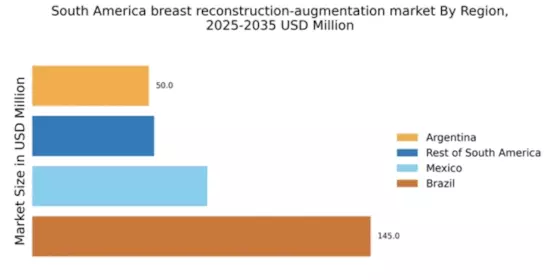
The breast reconstruction-augmentation market in South America is characterized by a dynamic competitive landscape, driven by increasing consumer demand for aesthetic procedures and advancements in surgical technologies. Key players such as Allergan (US), Mentor Worldwide (US), and Sientra (US) are strategically positioned to leverage their innovative product offerings and robust distribution networks. Allergan (US) focuses on enhancing its product portfolio through continuous innovation, while Mentor Worldwide (US) emphasizes strategic partnerships to expand its market reach. Sientra (US) appears to be concentrating on regional expansion, particularly in Brazil, which is a significant market for aesthetic procedures. Collectively, these strategies contribute to a competitive environment that is increasingly focused on innovation and customer-centric solutions.In terms of business tactics, companies are localizing manufacturing to reduce costs and improve supply chain efficiency. The market structure is moderately fragmented, with several players vying for market share. This fragmentation allows for a diverse range of products and services, but also intensifies competition among key players. The collective influence of these companies shapes market dynamics, as they continuously adapt to consumer preferences and regulatory changes.
In October Allergan (US) announced the launch of a new line of breast implants designed with enhanced safety features, which is expected to address growing consumer concerns regarding implant safety. This strategic move not only reinforces Allergan's commitment to innovation but also positions the company favorably against competitors who may not have similar advancements. The introduction of these implants could potentially capture a larger market share by appealing to safety-conscious consumers.
In September Mentor Worldwide (US) entered into a partnership with a leading Brazilian aesthetic clinic to offer specialized training for surgeons on the latest breast augmentation techniques. This collaboration is significant as it not only enhances the skill set of local practitioners but also strengthens Mentor's brand presence in a key market. By investing in education and training, Mentor is likely to foster loyalty among healthcare professionals, which could translate into increased sales.
In August Sientra (US) expanded its distribution network in South America by partnering with local distributors in Argentina and Chile. This strategic expansion is crucial for Sientra as it seeks to penetrate markets with high growth potential. By establishing local partnerships, Sientra may enhance its operational efficiency and responsiveness to market demands, thereby improving its competitive positioning.
As of November current trends in the breast reconstruction-augmentation market include a strong emphasis on digitalization, sustainability, and the integration of artificial intelligence (AI) in product development and marketing strategies. Strategic alliances are increasingly shaping the competitive landscape, allowing companies to pool resources and expertise. Looking ahead, competitive differentiation is likely to evolve from traditional price-based competition to a focus on innovation, technological advancements, and supply chain reliability. This shift suggests that companies that prioritize these areas may gain a competitive edge in an increasingly crowded market.







 Noah Malgeri
Co-Founder

 Peter Groot koerkamp
Account and Business Manager

 Younghwan Choi
Senior Retail Manager

 Mark Irwin
Management Consultant

 Akif Moroglu
Strategy & Business Development Director

 Guilherme Gomes Martins
Product Management Director

 Joseph Aguayo
Sales Operations & Pricing Manager

 La Terria Dodd
Program Support Specialist

 Rob Kooiker
Group Product Manager HVAC & Fire Protection GMA



