Sequencing Reagents Market

Sequencing Reagents Market Research Report: By Sequencing Technology (Next-Generation Sequencing (NGS), Sanger Sequencing), By Application (Genomics, Transcriptomics, Epigenomics, Single-Cell Sequencing), By Sample Type (DNA, RNA, Targeted Panel), By Read Length (Short-Read Sequencing, Long-Read Sequencing), By End User (Academic and Research Institutions, Clinical Laboratories, Pharmaceutical and Biotechnology Companies) and By Regional (North America, Europe, South America, Asia-Pacific, Middle East and Africa) - Growth & Industry Forecast 2025 To 2035.
ID: MRFR/HC/39176-HCR
128 Pages
Rahul Gotadki
Last Updated: May 15, 2026
Sequencing Reagents Market

Market Size

Forecast Period2025 - 2035
CAGR (2025 - 2035)10.25%
2024 Market Size$ 10.26 Billion
2025 Market Size$ 11.32 Billion
2035 Market Size$ 30.03 Billion

Key Players

Illumina
Thermo Fisher Scientific
Roche
Qiagen
Agilent Technologies
Bio-Rad Laboratories
Opportunities
  • Government Initiatives and Funding
  • Increasing Demand for Genomic Research
  • Rising Prevalence of Genetic Disorders

Sequencing Reagents Market Summary

As per Market Research Future analysis, the Sequencing Reagents Market Size was estimated at 10.26 USD Billion in 2024. The Sequencing Reagents industry is projected to grow from 11.32 USD Billion in 2025 to 30.03 USD Billion by 2035, exhibiting a compound annual growth rate (CAGR) of 10.25% during the forecast period 2025 - 2035

Key Market Trends & Highlights

The Sequencing Reagents Market is experiencing robust growth driven by technological advancements and increasing applications in personalized medicine.

  • The rise of personalized medicine is significantly shaping the demand for sequencing reagents, particularly in North America.
  • Advancements in automation are enhancing the efficiency of sequencing processes, thereby attracting investments in the Asia-Pacific region.
  • Collaborative research initiatives are fostering innovation and expanding the market for next-generation sequencing, which remains the largest segment.
  • The increasing demand for genomic research and rising prevalence of genetic disorders are key drivers propelling market growth.

Market Size & Forecast

2024 Market Size 10.26 (USD Billion)
2035 Market Size 30.03 (USD Billion)
CAGR (2025 - 2035) 10.25%

Major Players

Illumina (US), Thermo Fisher Scientific (US), Roche (CH), Qiagen (DE), Agilent Technologies (US), Bio-Rad Laboratories (US), New England Biolabs (US), PerkinElmer (US), Takara Bio (JP)

Our Impact
Enabled $4.3B Revenue Impact for Fortune 500 and Leading Multinationals
Partnering with 2000+ Global Organizations Each Year
30K+ Citations by Top-Tier Firms in the Industry

Sequencing Reagents Market Drivers

Government Initiatives and Funding

Government initiatives and funding programs are playing a pivotal role in the expansion of the Sequencing Reagents Market. Various governments are investing in genomic research and biotechnology, recognizing the potential benefits of sequencing technologies in healthcare and agriculture. For instance, funding for research projects that utilize sequencing reagents is on the rise, which is likely to stimulate demand for these products. As of October 2025, several countries have launched national genomics initiatives aimed at enhancing their research capabilities, thereby increasing the need for high-quality sequencing reagents. This supportive environment is expected to drive innovation and growth within the Sequencing Reagents Market, as researchers gain access to the necessary resources to advance their studies.

Increasing Demand for Genomic Research

The Sequencing Reagents Market is experiencing a notable surge in demand driven by the increasing focus on genomic research. As researchers and institutions strive to understand genetic variations and their implications on health, the need for high-quality sequencing reagents has escalated. The market is projected to grow at a compound annual growth rate of approximately 12% over the next five years, reflecting the urgency in genomic studies. This growth is further fueled by advancements in sequencing technologies, which require sophisticated reagents to ensure accuracy and reliability. Consequently, the Sequencing Reagents Market is positioned to benefit from the expanding research initiatives aimed at unraveling the complexities of the human genome.

Rising Prevalence of Genetic Disorders

The growing incidence of genetic disorders is a critical driver for the Sequencing Reagents Market. As healthcare providers and researchers seek to diagnose and treat these conditions more effectively, the demand for sequencing reagents has intensified. The market is witnessing a shift towards precision medicine, where genetic information is utilized to tailor treatments to individual patients. This trend is expected to contribute to a market growth rate of around 10% annually. Furthermore, initiatives aimed at early detection and prevention of genetic disorders are likely to bolster the need for advanced sequencing technologies and reagents. Thus, the Sequencing Reagents Market is poised for substantial growth as it aligns with the healthcare sector's focus on personalized treatment strategies.

Growing Applications in Clinical Diagnostics

The application of sequencing technologies in clinical diagnostics is significantly influencing the Sequencing Reagents Market. As healthcare systems increasingly adopt genomic sequencing for disease diagnosis and treatment planning, the demand for sequencing reagents is expected to rise. The integration of sequencing into routine clinical practice is projected to enhance diagnostic accuracy and patient outcomes. By 2026, the market for clinical sequencing is anticipated to exceed 3 billion USD, reflecting the growing reliance on these technologies in healthcare. This trend underscores the importance of high-quality reagents that can support various diagnostic applications, thereby propelling the Sequencing Reagents Market into a new era of clinical utility.

Technological Advancements in Sequencing Techniques

Technological innovations are reshaping the Sequencing Reagents Market, as new sequencing techniques emerge that enhance speed and accuracy. The introduction of next-generation sequencing (NGS) has revolutionized the field, allowing for rapid sequencing of entire genomes at a fraction of the cost of traditional methods. This shift has led to an increased demand for specialized reagents tailored to these advanced techniques. As of October 2025, the market for sequencing reagents is expected to reach a valuation of over 5 billion USD, driven by the adoption of these cutting-edge technologies. The continuous evolution of sequencing methods necessitates ongoing development and supply of reagents, thereby propelling the Sequencing Reagents Market forward.
Market Segment Insights

By Sequencing Technology: Next-Generation Sequencing (Largest) vs. Sanger Sequencing (Fastest-Growing)

The Sequencing Technology segment within the Sequencing Reagents Market showcases a clear dominance of Next-Generation Sequencing (NGS) technologies, capturing the majority of the market share due to their high throughput and cost-effective solutions. NGS is increasingly preferred for various applications, ranging from genomic research to clinical diagnostics, enabling comprehensive sequencing of entire genomes and transcriptomes. In contrast, Sanger Sequencing, though smaller in market share, is gaining traction for targeted sequencing applications, particularly in specific clinical settings and research endeavors where precision is paramount.

Technology: NGS (Dominant) vs. Sanger (Emerging)

Next-Generation Sequencing (NGS) technologies are recognized as the dominant force in the sequencing reagents market due to their ability to rapidly sequence vast amounts of DNA, catering to a wide array of applications including personalized medicine and large-scale genomic studies. This high-throughput technology significantly reduces time and costs associated with sequencing projects, positioning it at the forefront of advancements in genomics. Conversely, Sanger Sequencing, while emerging, remains a critical player for its accuracy and reliability in sequencing smaller regions of genomic DNA. It is particularly favored in clinical applications where precision is crucial, thus securing its vital role despite lagging behind in overall market share.

By Application: Genomics (Largest) vs. Transcriptomics (Fastest-Growing)

In the Sequencing Reagents Market, the application segment is primarily driven by genomics, which holds the largest share due to its critical role in various fields including personalized medicine, agriculture, and evolutionary biology. On the other hand, transcriptomics is rapidly gaining ground, marking itself as the fastest-growing segment as researchers increasingly leverage RNA sequencing to understand gene expression patterns and regulatory mechanisms. The demand for advanced tools and technologies in both categories continues to rise, propelling innovation and improvements in sequencing accuracy and efficiency. Moreover, epigenomics and single-cell sequencing are emerging segments that are gaining traction as scientific interest in epigenetic modifications and cellular heterogeneity grows. While they currently contribute less to the overall market share compared to genomics and transcriptomics, their potential applications in disease research and diagnosis are vast. The increasing availability of funding for genomics research and the expansion of applications into clinical and agricultural sectors are key drivers of growth across these segments.

Genomics (Dominant) vs. Single-Cell Sequencing (Emerging)

Genomics remains the dominant application in the Sequencing Reagents Market, harnessing the power of DNA sequencing to unlock biological insights that are pivotal for personalized medicine, genetic research, and evolving agricultural practices. It enables comprehensive analysis of genetic variations, paving the way for targeted therapies and improved crop strains. Conversely, single-cell sequencing is viewed as an emerging frontier, giving researchers a granular look at cellular diversity within complex tissues, which is essential for understanding conditions like cancer and developmental biology. As technologies in single-cell sequencing improve, the boundaries of its applications are expanding, suggesting a transformative impact on future research in genomics and beyond.

By Sample Type: DNA (Largest) vs. RNA (Fastest-Growing)

The Sequencing Reagents Market is characterized by a diverse range of sample types, with DNA sequencing dominating the landscape. DNA holds a significant market share due to its extensive applications in genomics and diagnostics. RNA sequencing, on the other hand, is rapidly gaining traction, driven by advancements in transcriptomics and personalized medicine. This increasing demand for RNA analysis highlights the transformative potential of RNA technologies in research and clinical applications. Growth trends indicate that while DNA continues to be the backbone of sequencing efforts, the RNA segment is witnessing the fastest growth. Factors such as the rise of RNA-based therapies, including mRNA vaccines, and increased research funding in RNA-related projects are propelling this segment forward. The recognition of RNA's pivotal role in gene expression and regulation is also fostering investments, leading to a dynamic and evolving Sequencing Reagents Market.

DNA (Dominant) vs. RNA (Emerging)

The DNA segment is the dominant force within the Sequencing Reagents Market, primarily due to its longstanding applications in various fields, including clinical diagnostics and research. DNA sequencing technologies are well-established, with a wide array of reagents available that cater to different needs. In contrast, the RNA segment is an emerging powerhouse, largely influenced by breakthroughs in RNA sequencing technologies and their implications in areas such as cancer research and therapeutic development. RNA-based approaches are becoming increasingly important, with researchers investing in innovative reagents that enhance the efficiency and accuracy of RNA sequencing. This dual dynamic between the dominant DNA market and the burgeoning RNA segment creates a competitive landscape that encourages innovation and growth.

By Read Length: Short-Read Sequencing (Largest) vs. Long-Read Sequencing (Fastest-Growing)

The Sequencing Reagents Market exhibits a significant preference for Short-Read Sequencing, which commands the largest market share. This technology is widely adopted due to its cost-effectiveness and ability to generate large volumes of data quickly. As a result, various research institutions and clinical applications favor this method for its efficiency in handling high-throughput sequencing tasks. Conversely, Long-Read Sequencing, while still emerging, is gaining traction for its unique capabilities in resolving complex genomic regions and structural variations, thus appealing to niche markets in genomics and disease research.

Sequencing Type: Short-Read (Dominant) vs. Long-Read (Emerging)

Short-Read Sequencing is the dominant force in the Sequencing Reagents Market, known for its high throughput and affordability. This technology can produce massive amounts of data, making it essential for projects involving whole-genome sequencing and RNA sequencing. On the other hand, Long-Read Sequencing is considered an emerging method, noted for its ability to accurately capture long stretches of DNA, which aids in better understanding complex genomic structures and mutations. Although its adoption is slower compared to short-read methods, advancements in technology are driving its growth. Long-Read Sequencing is particularly beneficial in applications like metagenomics and the study of genetic disorders, indicating its potential to carve out a significant niche in the market.

By End User: Academic and Research Institutions (Largest) vs. Clinical Laboratories (Fastest-Growing)

The Sequencing Reagents Market is predominantly driven by Academic and Research Institutions, which hold the largest share in the end-user segment. These institutions invest significantly in genomics research, leading to a high demand for advanced sequencing technologies. Clinical Laboratories follow, capitalizing on the growing need for genetic testing in personalized medicine. Pharmaceutical and Biotechnology Companies also contribute, although to a lesser extent, primarily focusing on drug development and genetic research.

Academic and Research Institutions (Dominant) vs. Clinical Laboratories (Emerging)

Academic and Research Institutions are the dominant players in the Sequencing Reagents Market, leveraging their extensive funding and focus on innovative research. They frequently utilize sequencing reagents for a wide array of applications, such as disease genomics and evolutionary studies. On the other hand, Clinical Laboratories are emerging as a vital end user, fueled by the increasing demand for genetic testing and diagnostics. Their adoption of sequencing technologies is expanding rapidly as they aim to provide more precise and personalized healthcare solutions, marking significant growth potential in this sector.

Get more detailed insights about Sequencing Reagents Market

Regional Insights

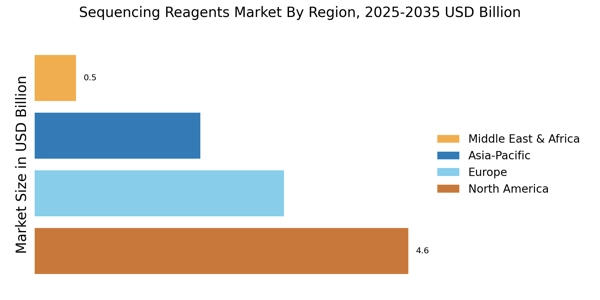
The Sequencing Reagents Market is segmented into North America, Europe, APAC, South America, and MEA. North America held the largest market share in 2023 and is expected to continue its dominance throughout the forecast period. The growth in this region can be attributed to the increasing adoption of next-generation sequencing (NGS) technologies in research and clinical applications. Europe is the second-largest market for sequencing reagents, followed by APAC.

The APAC region is expected to witness the highest growth rate during the forecast period due to the rising prevalence of chronic diseases and increasing healthcare expenditure.South America and MEA are expected to contribute a smaller share of the market but are expected to grow at a steady pace over the next ten years.

Source Primary Research, Secondary Research, Market Research Future Database and Analyst Review

Sequencing Reagents Market Regional Image

Key Players and Competitive Insights

Developing innovative sequencing technologies and reagents has been a key focus for leading players within the Sequencing Reagents Market. The Sequencing Reagents Market industry is characterized by cutthroat competition, with companies developing and launching new products, entering into partnerships, and expanding their product portfolios to stay ahead of competitors. Moreover, companies are targeting different market segments and customers by adopting various strategies, including product differentiation, strategic marketing tactics, and aggressive pricing approaches.The competitive nature of the market is expected to continue as the industry is rapidly evolving with advancements in new technologies and an increase in the adoption of genomic sequencing across different applications.Illumina is one of the prominent players in the Sequencing Reagents Market, as it has managed to establish a strong foothold in the market with innovative sequencing platforms and reagents.The company's NextSeq and MiSeq systems are used across various research and clinical applications, offering high-throughput and accurate sequencing data. Furthermore, the company's efforts in research and development have resulted in the development of new products and technologies. For instance, Illumina's latest sequencing platform, NovaSeq, offers even higher throughput and improved data quality. The MiSeqDx system is another product that was recently developed by Illumina and is a sample-to-answer sequencing system designed for the clinical market.Thermo Fisher Scientific is another key player operating in the Sequencing Reagents Market and offers a wide range of sequencing reagents, as well as instruments, through its subsidiary, Ion Torrent. The products have achieved success across both research and clinical markets, with Thermo Fisher Scientific maintaining its strong market presence.The Ion Torrent has become popular due to its high-quality data, simplicity of use, and cost-effectiveness. Moreover, the company's efforts in research and development led to the development of the Ion Torrent Genexus System, which is an automated and simplified sequencing system.

Key Companies in the Sequencing Reagents Market include

Industry Developments

The sequencing reagents market is projected to register a CAGR of 10.25% from 2024 to 2032, reaching a value of USD 22.4 billion by 2032. This growth is attributed to the increasing demand for genetic testing, the rising prevalence of chronic diseases, and advances in sequencing technologies.

The market is expected to be driven by the increasing demand for next-generation sequencing (NGS) and the growing adoption of personalized medicine. Major players in the market include Illumina, Thermo Fisher Scientific, and Pacific Biosciences. The market is expected to witness several key trends in the coming years, including the development of new sequencing technologies, the increasing use of artificial intelligence (AI) in data analysis, and the growing adoption of cloud-based sequencing solutions.

The market is also expected to be impacted by the ongoing COVID-19 pandemic, which has led to an increase in demand for genetic testing and the development of new sequencing technologies for the diagnosis and surveillance of the virus.

Future Outlook

Sequencing Reagents Market Future Outlook

The Sequencing Reagents Market is projected to grow at a 10.25% CAGR from 2025 to 2035, driven by advancements in genomics, personalized medicine, and increasing research funding.

New opportunities lie in:

  • Development of next-generation sequencing kits for rare disease diagnostics.
  • Expansion of reagent distribution networks in emerging markets.
  • Partnerships with biotech firms for custom reagent solutions.

By 2035, the market is expected to be robust, driven by innovation and strategic partnerships.

Market Segmentation

Sequencing Reagents Market End User Outlook

  • Academic and Research Institutions
  • Clinical Laboratories
  • Pharmaceutical and Biotechnology Companies

Sequencing Reagents Market Application Outlook

  • Genomics
  • Transcriptomics
  • Epigenomics
  • Single-Cell Sequencing

Sequencing Reagents Market Read Length Outlook

  • Short-Read Sequencing
  • Long-Read Sequencing

Sequencing Reagents Market Sample Type Outlook

  • DNA
  • RNA
  • Targeted Panels

Sequencing Reagents Market Sequencing Technology Outlook

  • Next-Generation Sequencing
  • Sanger Sequencing

Report Scope

MARKET SIZE 2024 10.26(USD Billion)
MARKET SIZE 2025 11.32(USD Billion)
MARKET SIZE 2035 30.03(USD Billion)
COMPOUND ANNUAL GROWTH RATE (CAGR) 10.25% (2025 - 2035)
REPORT COVERAGE Revenue Forecast, Competitive Landscape, Growth Factors, and Trends
BASE YEAR 2024
Market Forecast Period 2025 - 2035
Historical Data 2019 - 2023
Market Forecast Units USD Billion
Key Companies Profiled Illumina (US), Thermo Fisher Scientific (US), Roche (CH), Qiagen (DE), Agilent Technologies (US), Bio-Rad Laboratories (US), New England Biolabs (US), PerkinElmer (US), Takara Bio (JP)
Segments Covered Sequencing Technology, Application, Sample Type, Read Length, End User, Regional
Key Market Opportunities Advancements in personalized medicine drive demand for innovative solutions in the Sequencing Reagents Market.
Key Market Dynamics Technological advancements and regulatory changes drive innovation and competition in the Sequencing Reagents Market.
Countries Covered North America, Europe, APAC, South America, MEA

FAQs

What is the projected market valuation of the Sequencing Reagents Market by 2035?

The Sequencing Reagents Market is projected to reach a valuation of 30.03 USD Billion by 2035.

What was the market valuation of the Sequencing Reagents Market in 2024?

In 2024, the Sequencing Reagents Market was valued at 10.26 USD Billion.

What is the expected CAGR for the Sequencing Reagents Market during the forecast period 2025 - 2035?

The expected CAGR for the Sequencing Reagents Market during the forecast period 2025 - 2035 is 10.25%.

Which companies are considered key players in the Sequencing Reagents Market?

Key players in the Sequencing Reagents Market include Illumina, Thermo Fisher Scientific, Roche, Qiagen, and Agilent Technologies.

What are the main segments of the Sequencing Reagents Market?

The main segments of the Sequencing Reagents Market include Sequencing Technology, Application, Sample Type, Read Length, and End User.

How much is the Next-Generation Sequencing segment projected to be worth by 2035?

The Next-Generation Sequencing segment is projected to be worth 20.0 USD Billion by 2035.

What is the projected value of the Clinical Laboratories segment by 2035?

The Clinical Laboratories segment is projected to reach a value of 7.25 USD Billion by 2035.

What is the expected growth for the Single-Cell Sequencing application by 2035?

The Single-Cell Sequencing application is expected to grow to 8.03 USD Billion by 2035.

What is the projected market size for RNA sample types by 2035?

The projected market size for RNA sample types is expected to reach 8.0 USD Billion by 2035.

How does the market for Targeted Panels compare to other sample types by 2035?

The market for Targeted Panels is projected to be 12.03 USD Billion by 2035, indicating strong growth compared to other sample types.

Author
Author
Author Profile
Rahul Gotadki LinkedIn
Research Manager
He holds an experience of about 9+ years in Market Research and Business Consulting, working under the spectrum of Life Sciences and Healthcare domains. Rahul conceptualizes and implements a scalable business strategy and provides strategic leadership to the clients. His expertise lies in market estimation, competitive intelligence, pipeline analysis, customer assessment, etc.
Leave a Comment

Research Approach

Secondary Research

The secondary research process involved comprehensive analysis of regulatory databases, peer-reviewed scientific journals, genomic research publications, and authoritative biotechnology organizations. Key sources included the US Food & Drug Administration (FDA), European Medicines Agency (EMA), National Institutes of Health (NIH), National Center for Biotechnology Information (NCBI/PubMed), National Human Genome Research Institute (NHGRI), Centers for Disease Control and Prevention (CDC), World Health Organization (WHO) Genomic Surveillance Network, European Molecular Biology Laboratory (EMBL), Human Genome Organisation (HUGO), International Nucleotide Sequence Database Collaboration (INSDC), European Bioinformatics Institute (EBI), National Center for Health Statistics (NCHS), Organisation for Economic Co-operation and Development (OECD) Health Statistics, and national genomics initiative reports from key markets including the UK Genomics England, US All of Us Research Program, and China National GeneBank. These sources were used to collect sequencing technology adoption statistics, regulatory approval data for sequencing platforms, clinical genomics studies, research funding trends, and market landscape analysis for Next-Generation Sequencing (NGS), Sanger sequencing, and emerging long-read sequencing technologies.

Primary Research

Qualitative and quantitative insights were obtained by interviewing supply-side and demand-side stakeholders during the primary research process. The supply-side sources consisted of CEOs, VPs of Research & Development, regulatory affairs chiefs, and commercial directors from sequencing reagent manufacturers, sequencing platform OEMs, and molecular diagnostics companies. Principal investigators, core facility directors, laboratory managers, and procurement leads from academic research institutions, clinical diagnostic laboratories, pharmaceutical companies, and biotechnology firms constituted demand-side sources. Primary research has confirmed the timelines of product pipelines, gathered insights on technology adoption patterns, pricing strategies, and reimbursement dynamics for clinical sequencing applications, and validated market segmentation across sequencing technologies (NGS, Sanger), applications (genomics, transcriptomics, epigenomics, single-cell sequencing), sample types (DNA, RNA, targeted panels), read lengths (short-read, long-read), and end users (academic institutions, clinical labs, pharma/biotech).

Primary Respondent Breakdown:

By Designation: C-level Primaries (32%), Director Level (30%), Others (38%)

By Region: North America (38%), Europe (30%), Asia-Pacific (25%), Rest of World (7%)

Market Size Estimation

Global market valuation was derived through revenue mapping and sequencing run volume analysis. The methodology included:

Identification of 50+ key manufacturers across North America, Europe, Asia-Pacific, and Latin America including Illumina, Thermo Fisher Scientific, Roche, Qiagen, Agilent Technologies, Bio-Rad Laboratories, New England Biolabs, PerkinElmer, Takara Bio, Pacific Biosciences, and Oxford Nanopore Technologies

Product mapping across NGS reagents (library preparation kits, sequencing kits, cluster generation reagents), Sanger sequencing reagents (BigDye terminators, capillary electrophoresis reagents), and specialized reagents for long-read and single-cell sequencing platforms

Analysis of reported and modeled annual revenues specific to sequencing reagent portfolios

Coverage of manufacturers representing 75-80% of global market share in 2024

Extrapolation using bottom-up (sequencing run volume × reagent consumption per run × ASP by technology and region) and top-down (manufacturer revenue validation) approaches to derive segment-specific valuations across sequencing technologies, applications, sample types, read lengths, and end-user categories

Download Free Sample

Kindly complete the form below to receive a free sample of this Report

Download PDF ×

We do not share your information with anyone. However, we may send you emails based on your report interest from time to time. You may contact us at any time to opt-out.