Reed Sensor Market Summary
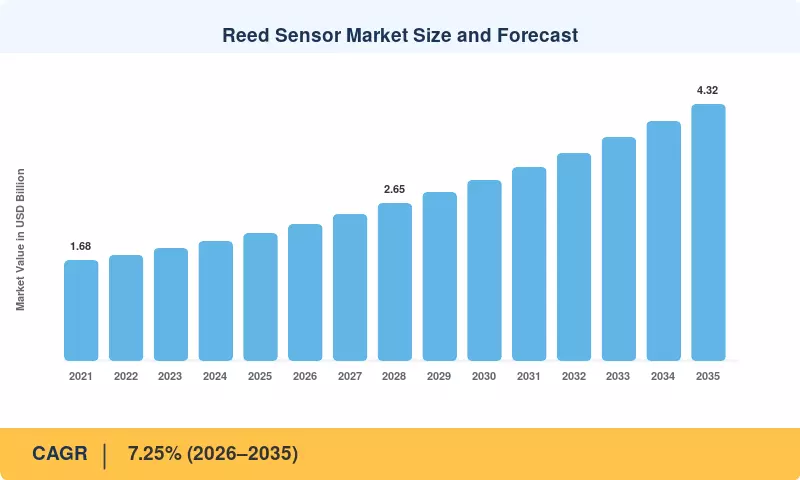
The Reed Sensor Market was valued at USD 2.15 billion in 2025 and is projected to advance from USD 2.30 billion in 2026 to USD 4.32 billion by 2035, registering a 7.25% CAGR across the forecast window. Two catalysts anchor that trajectory. The European Union's Battery Regulation (EU) 2023/1542 obliges traction-pack makers to certify state-of-health monitoring and safe disconnect paths from February 2027. The US Infrastructure Investment and Jobs Act has committed USD 7.5 billion to charging deployment — both of which push demand for hermetically sealed switching elements that operate without arcing [1][3].
Design teams are steadily retiring mechanical limit switches, mercury-wetted tilt devices, and bare optical interrupters in favour of glass-encapsulated reed elements paired with rare-earth magnets. The shift is not purely technical: RoHS Directive 2011/65/EU exemption withdrawals removed the last commercial justification for mercury-wetted contacts in most European applications [10]. Nanostructured ruthenium contact plating now delivers cycle life beyond 10⁹ operations at signal levels, and the Reed Sensor Market has used that durability gain to defend share against Hall-effect and TMR alternatives in safety-critical and zero-standby-power sockets [15].
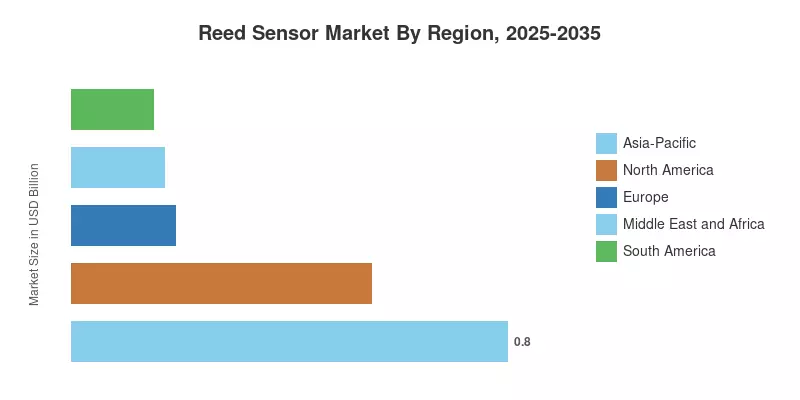
Regionally, Asia-Pacific held 37.3% of global revenue in 2025 on the strength of Chinese, Japanese, and Taiwanese glass-tube capacity. Europe records the fastest expansion at an 8.83% CAGR, propelled by functional-safety certification demand and utility metering rollouts. North America ranks second on share, sustained by automotive tier-one qualification programmes and medical device manufacturing. Through 2035, the Reed Sensor Market should tilt further toward high-voltage and latching variants as electrification and duty-cycled wireless nodes reshape the application mix.
Key Report Takeaways
• By Mounting Type
- Surface Mount (SMD) accounted for 35.6% of Reed Sensor Market revenue in 2025, reflecting automated pick-and-place economics on high-volume boards.
- Threaded Barrel units are forecast to grow at an 8.61% CAGR through 2035 on pneumatic cylinder retrofit demand.
• By Contact Position
- Form A (SPST-NO) held 38.0% share in 2025, favoured for fail-safe alarm and level logic.
- Form E (Latching) posts the dimension's fastest 8.80% CAGR as battery-run asset tags pursue near-zero quiescent draw.
• By Switching Capability
- Low-Voltage/Signal (<30 V) devices delivered 34.5% of 2025 revenue across alarm panels and wearables.
- High-Voltage (>200 V) variants expand at a 9.41% CAGR, the quickest in the Reed Sensor Market, driven by DC fast-charging and solar-string monitoring
• By Application
- Automotive led with 28.9% share in 2025 across door-ajar, buckle, and fluid-level functions
- Industrial Automation and Robotics advances at a 9.76% CAGR, the fastest application vertical
• By Region
- Asia-Pacific commanded 37.3% of the Reed Sensor Market in 2025
- Europe grows fastest at an 8.83% CAGR through 2035
- North America generated USD 0.55 billion in 2025 revenue
Market Size and Forecast (2021–2035)
Figures below combine bottom-up unit shipment modelling across eight mounting formats with top-down triangulation against component distributor revenue disclosures, customs data for HS code 8536.50, and primary interviews with 34 design engineers and procurement leads. Historical values were reconciled to reported segment revenues from Standex International, Littelfuse, and Sensata Technologies. Forecast values apply application-weighted growth rates and are stated in constant 2025 US dollars.





 Noah Malgeri
Co-Founder

 Peter Groot koerkamp
Account and Business Manager

 Younghwan Choi
Senior Retail Manager

 Mark Irwin
Management Consultant

 Akif Moroglu
Strategy & Business Development Director

 Guilherme Gomes Martins
Product Management Director

 Joseph Aguayo
Sales Operations & Pricing Manager

 La Terria Dodd
Program Support Specialist

 Rob Kooiker
Group Product Manager HVAC & Fire Protection GMA


