Precision Resistor Market (2026 - 2035)

Precision Resistor Market Size, Share and Research Report By Technology (Thin-Film, Thick-Film, Wire-Wound, Metal-Foil, and Others), By Mounting Configuration (Surface-Mount Chip 0201-2512, Through-Hole Axial/Radial, Resistor Networks and Arrays, and Kelvin-Sense Shunt Packages), By Resistance Range (Below 0.1Ω, 0.1-1Ω, 1-100Ω, 100Ω-10kΩ, and Above 10kΩ), By End-Use Industry (Consumer Electronics, Automotive/XEV, Industrial, T&M, Medical, Aerospace and Defense, Telecommunications, and Others), And By Application (Current-Sensing, Precision Measurement) – Industry Forecast Till 2035
ID: MRFR/SEM/38827-HCR 128 Pages Aarti Dhapte, Aarti Dhapte Last Updated: October 15, 2026
Precision Resistor Market
Market Size
Forecast Period2026-2035
CAGR (2026-2035)6.22%
2025 Market SizeUSD 5.88 Billion
2035 Market SizeUSD 10.75 Billion
Key Players
Vishay Intertechnology, Inc.
Yageo Corporation
KOA Corporation
Panasonic Industry Co., Ltd.
ROHM Co., Ltd.
Susumu Co., Ltd.
Opportunities
  • Emerging-Market Electronics Manufacturing
  • Data Monetization and Calibration-as-a-Service Models
  • Quantum Computing and Metrology Instrumentation

Precision Resistor Market Summary

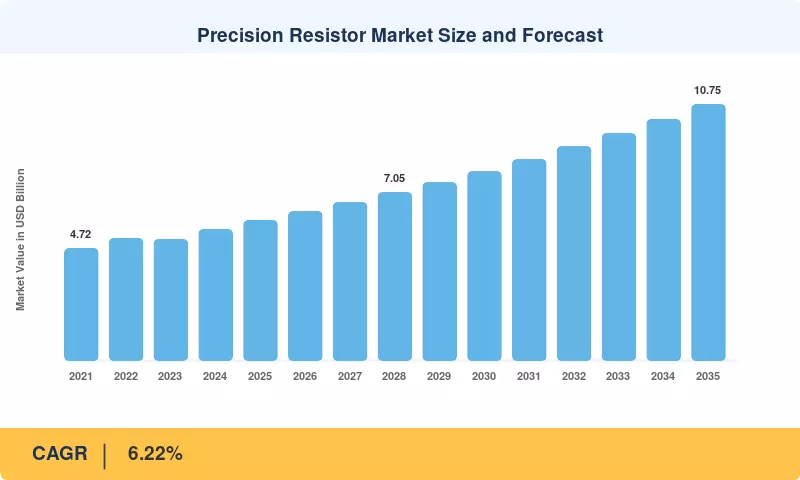
The Precision Resistor Market reached USD 5.88 Billion in 2025 and is forecast to open the projection window at USD 6.25 Billion in 2026, climbing to USD 10.75 Billion by 2035 at a CAGR of 6.22% over 2026–2035. Two catalysts anchor that trajectory. Global electric car sales passed 17 million units in 2024, more than one in five new cars sold, and every battery pack, inverter and onboard charger relies on low-ohm shunts and matched divider networks [1]. The European Chips Act, which has been in place since September 2023, seeks to mobilize more than €43 billion of public and private semiconductor investment, bringing analog, power and manufacturing capabilities and the passive content around it closer to European customers [3].

The design practice is changing rapidly. Signal chains are abandoning carbon-composition parts and general-purpose ±1% thick-film chips for ±0.05% tolerance, ±5 ppm/°C drift nickel-chromium and tantalum-nitride films, while power stages are dropping wire-wound current sensors in favor of bulk metal-foil and copper-manganin strip shunts. The US CHIPS and Science Act committed $39 billion in manufacturing incentives, and the analog, mixed-signal and power fabs it funds list tighter-tolerance passives as standard [4]. Policy drives capacity.

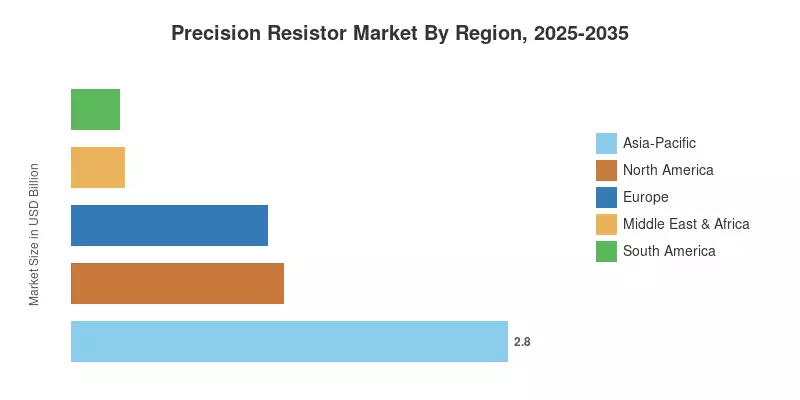
The Asia-Pacific region leads the Precision Resistor Market with a 47.6% share in 2025. It is the fastest-moving region, driven by Chinese EV output, Japanese and Taiwanese component capacity and India’s fab buildout. North America is second, with premium demand supported by AI server power delivery and defense electronics. Over the coming decade, the gap between commodity chips and finely defined parts will expand, and providers that can guarantee long-term stability at scale will acquire an increasing share of value.

Key Report Takeaways

• By Technology

  • Thin-Film accounted for a 35.8% share of the Precision Resistor Market in 2025, backed by tight temperature stability and scalable chip geometries.
  • Metal-Foil is the fastest-growing technology at a 6.9% CAGR through 2035, pulled by metrology, aerospace and quantum instrumentation.

• By Mounting Configuration

  • Surface-Mount Chip 0201-2512 parts held a 48.4% share as board densities keep rising.
  • Kelvin-Sense Shunt Packages are projected to expand at a 7.4% CAGR on battery-management demand.

• By Resistance Range

  • The 1-100Ω band captured a 40.1% share, the core window for DC-link and motor-drive current sensing.
  • Below 0.1Ω devices lead growth at a 7.2% CAGR as 800 V vehicle platforms scale

• By End-Use Industry

  • Consumer Electronics represented 30.6% of the Precision Resistor Market in 2025
  • Automotive/XEV is the fastest-growing end use at a 6.8% CAGR

• By Application

  • Current-Sensing commanded a 36.3% share, led by battery-management and smart-meter designs.
  • Precision Measurement is set to grow at a 6.9% CAGR on test-equipment upgrades.

• By Region

  • Asia-Pacific held a 47.6% share of the Precision Resistor Market and remains the fastest-growing region
  • North America generated USD 1.36 billion in 2025
  • Europe accounted for a 21.4% share

Market Size and Forecast (2021–2035)

Historical values for the Precision Resistor Market combine company-reported passive-component revenue from leading suppliers [11][12][13], distributor shipment surveys [18] and semiconductor demand indicators [6], reconciled through bottom-up unit-and-price modelling and top-down validation against end-market production. Forecast values follow a calibrated growth path anchored on 2025 actuals. The year 2023 marks the only contraction in the series, reflecting a distribution-channel inventory correction after the 2021–2022 shortage cycle.
Precision Resistor Market Size and Forecast
Our Impact

Enabled $4.3B Revenue Impact for Fortune 500 and Leading Multinationals

Partnering with 2000+ Global Organizations Each Year

30K+ Citations by Top-Tier Firms in the Industry

Driver Impact Analysis

Driver ~% Impact on CAGR Geographic Relevance Impact Timeline
Vehicle electrification and battery-management current sensing ~+1.4% Asia-Pacific, Europe, North America Medium-term (2–4 yr)
AI data-centre power delivery ~+1.0% North America, Asia-Pacific Short-term (≤2 yr)
Semiconductor fab localization incentives ~+0.8% North America, Europe, India, Japan Long-term (≥4 yr)
Industrial automation and robotics ~+0.7% Asia-Pacific, Europe Medium-term (2–4 yr)
Miniaturization and rising semiconductor content ~+0.6% Global Short-term (≤2 yr)
Aerospace, defense and high-reliability demand ~+0.5% North America, Europe, Middle East Long-term (≥4 yr)

Vehicle Electrification and Battery-Management Current Sensing

Electric car sales exceeded 17 million units in 2024, and the IEA expects the electric share of new sales to keep rising through the decade [1]. Each battery electric vehicle carries dozens of current-sense and voltage-divider positions across the battery-management system, traction inverter, DC-DC converter and onboard charger, many specified at ±0.1% or better with AEC-Q200 qualification. BloombergNEF projects sustained growth in the global passenger EV fleet [15], and migration to 800 V architectures adds isolation-divider strings that multiply precision content per vehicle.

AI Data-Centre Power Delivery

Data-centre electricity consumption reached roughly 415 TWh in 2024 and is projected to more than double to around 945 TWh by 2030, according to the IEA [2]. Accelerator servers draw several kilowatts per board, and 48 V intermediate bus converters, multiphase voltage regulators and hot-swap controllers depend on milliohm shunts and matched feedback dividers to hold rail accuracy. Hyperscale operators now qualify these parts against telemetry error budgets of 1% or less, turning power monitoring into a premium design socket.

Semiconductor Fab Localization Incentives

Public funding is redrawing the electronics supply map. The US CHIPS program allocates USD 39 billion to manufacturing incentives [4], the European Chips Act targets more than €43 billion in combined investment [3], and the India Semiconductor Mission carries a ₹76,000 crore outlay [5]. New analog, power and assembly-and-test sites create local demand for qualified precision parts and encourage component makers to add regional capacity, shortening lead times for customers that previously sourced exclusively from East Asia.

Industrial Automation and Robotics

Factories installed 541,302 industrial robots in 2023, the second-highest annual total on record, according to the International Federation of Robotics [23]. Servo drives, encoder interfaces and programmable logic controller I/O cards use precision dividers and current shunts to close control loops at high resolution. Upgrades of legacy cards to meet IEC 60115 reliability requirements [8] are prompting OEMs to replace general-purpose parts with tighter-tolerance, lower-drift alternatives across motion-control platforms.

Miniaturization and Rising Semiconductor Content

WSTS expects the global semiconductor market to approach USD 700 billion in 2025 [6], and every analog front end, sensor hub and power-management IC sold needs surrounding resistive networks. Smartphones and wearables are moving from 0402 to 0201 and smaller footprints, shrinking board area while tightening quiescent-current budgets. That combination raises demand for small-case parts with ±0.1% tolerance and low noise, a clear step up from the ±1% commodity chips used in earlier device generations.

Aerospace, Defense and High-Reliability Demand

NATO allies agreed at the June 2025 Hague summit to raise defense and security spending toward 5% of GDP by 2035, including 3.5% for core defense [24]. Radar, electronic warfare, satellite payloads and guided munitions specify parts qualified to MIL-PRF-55342, which defines established failure-rate levels down to 0.001% per 1,000 hours . Medical imaging systems apply comparable reliability expectations, giving suppliers with military-grade lines a durable, price-insensitive revenue base.

Restraints Impact Analysis

Restraint ~% Impact on CAGR Geographic Relevance Impact Timeline
Raw material price volatility ~-0.6% Global Short-term (≤2 yr)
Price erosion in commodity thick-film chips ~-0.5% Asia-Pacific Medium-term (2–4 yr)
Long qualification and design-in cycles ~-0.4% North America, Europe Medium-term (2–4 yr)
Functional integration into ICs ~-0.4% Global Long-term (≥4 yr)
Trade restrictions and tariff exposure ~-0.3% North America, Asia-Pacific Short-term (≤2 yr)

Raw Material Price Volatility

Precision parts consume ruthenium, palladium, silver, and nickel-chromium alloys. The USGS reports platinum-group metal net import reliance exceeded 70% in 2024, exposing manufacturers to market shocks. Concurrently, the World Bank commodity database recorded a 5.3% single-month drop in nickel prices in mid-2024 as Indonesian supply grew, squeezing component margins on unindexed low-ohm shunt contracts

Price Erosion in Commodity Thick-Film Chips

Thick-film chip capacity in China and Taiwan has grown faster than demand, and distributor surveys recorded weakening lead-time and pricing indicators through the 2023 correction [18]. Spillover pressure reaches precision tiers when buyers benchmark ±0.5% thick-film parts against ±1% commodity pricing. Smaller vendors without film or foil lines struggle to defend margins, which slows reinvestment in tighter-tolerance capacity.

Long Qualification and Design-In Cycles

Automotive platforms enforce strict reliability through the AEC-Q200 standard, requiring 1,000-hour operational life testing at rated temperatures up to 125°C. Additionally, AIAG frameworks require the standard 5-level Production Part Approval Process (PPAP). Consequently, component makers face 18 to 36 months from initial sampling to volume shipment, slowing technology adoption and delaying return on investment.

Functional Integration into ICs

Analog chipmakers increasingly integrate internal sense elements and matched resistor networks directly into power management ICs. According to WIPO's World Intellectual Property Indicators, global semiconductor patent filings surged past 70,000 annually, driven largely by integrated power circuits. Integrated shunts replace discrete parts up to 20 A, capping discrete component volume growth in space-constrained consumer electronics devices.

Trade Restrictions and Tariff Exposure

Under US Section 301 actions, tariffs on Chinese semiconductors doubled to 50% as of January 2025, while related passive resistors face layered import duties under Executive Orders. Because precision parts undergo cross-border wafer processing, trimming, and testing, these trade barriers elevate landed costs, force expensive dual-source qualifications, and lengthen customer program lead times

.

Precision Resistor Market Opportunities

Emerging-Market Electronics Manufacturing

India and Southeast Asia offer the largest greenfield opening. The India Semiconductor Mission's ₹76,000 crore program [5], combined with production-linked incentives for mobile phones and IT hardware, is drawing assembly, test and EMS capacity to Gujarat, Tamil Nadu and Uttar Pradesh. Vietnam, Malaysia and Thailand are absorbing similar relocation flows. Local stocking and application-engineering centers would let suppliers win sockets early, ahead of competitors shipping from distant hubs.

Data Monetization and Calibration-as-a-Service Models

Precision buyers pay for confidence, not just components. Suppliers in the Precision Resistor Market can monetize lot-level parametric data, including measured TCR, load-life drift and noise index, through subscription portals that feed customers' digital twins and reliability models. Paired with calibration services for instrument OEMs and long-term stability guarantees, these models convert one-time sales into recurring revenue and raise switching costs, especially in aerospace and medical programs that demand traceability .

Quantum Computing and Metrology Instrumentation

National metrology institutes are disseminating quantum-based resistance standards, and NIST's graphene quantum Hall work aims to bring primary-level accuracy closer to industrial calibration labs [22]. Quantum computers and cryogenic instruments need parts with sub-ppm drift and stable behavior at very low temperatures. Foil and specialty-film suppliers that characterize parts for cryogenic use can address a small but high-margin niche.

800 V Vehicles and Charging Infrastructure

Fast chargers above 350 kW and 800 V vehicle platforms require high-voltage divider strings and pulse-rated shunts. The IEA tracks rapid growth in public fast-charging points [1], while grid upgrades for charging hubs add metering and protection relays [20]. Suppliers combining surge-rated metal-strip shunts with high-voltage film dividers can sell complete sensing sets to charger and inverter OEMs.

AI Server Power Telemetry

Hyperscale operators are moving to 48 V and higher-voltage rack architectures to cut conversion losses as data-centre demand climbs toward 945 TWh by 2030 [2]. Each rack adds hundreds of telemetry points. Vendors offering low-inductance, four-terminal shunts with documented thermal EMF performance can secure multi-year frame agreements with power-module makers.

Precision Resistor Market Future Outlook

Electrification Supercycle

Electrification will remain the main growth engine for the Precision Resistor Market through 2035. The IEA projects global electricity demand growing close to 4% a year through 2027 [20], with EVs, heat pumps and grid storage all adding power-conversion stages. Each stage needs current-sense and voltage-feedback parts that tolerate high temperatures and surge loads, keeping low-ohm and high-voltage categories ahead of the overall market.

AI-Driven Power Density

Accelerator boards will continue pushing power density upward as data-centre consumption heads toward 945 TWh by 2030 [2]. Tighter voltage margins on sub-1 V processor rails leave little room for measurement error, which lifts demand for high-accuracy resistors in voltage-regulator feedback and telemetry loops. Thermal performance, low inductance and documented drift under continuous load will define winning designs.

Supply Chain Regionalization

Supply networks will become more regional. Incentives under the CHIPS program [4], the European Chips Act [3] and India's semiconductor program [5] encourage customers to qualify second sources outside a single country. Suppliers with balanced footprints across Japan, Southeast Asia, Europe and North America will gain allocation preference, while single-region producers face tariff and continuity scrutiny [25].

Sustainability and Materials Compliance

Materials regulation will shape the Precision Resistor Market as much as demand. Lead in glass and ceramic layers of thick-film elements depends on RoHS Annex III exemption 7(c)-I [17], and any narrowing would force paste reformulation. Customers are also requesting product carbon footprints and conflict-mineral disclosures, rewarding suppliers that can document metal sourcing and energy use per part.

Regional Market Share Analysis

Region Key Metric (2025) Primary Investment Themes
North America USD 1.36 Billion AI data-centre power, defense electronics, CHIPS-funded fabs
Europe 21.4% share Automotive electrification, industrial automation, Chips Act capacity
Asia-Pacific 47.6% share EV production, consumer electronics assembly, fab expansion in China, Japan and India
South America 5.3% CAGR Automotive assembly, smart metering
Middle East & Africa 5.8% CAGR Grid upgrades, defense localization, industrial diversification
Total USD 5.88 Billion Global electrification and digital infrastructure

Regional demand in the Precision Resistor Market mirrors where electronics are designed, assembled and qualified. Asia-Pacific dominates volume, North America and Europe skew toward high-reliability and automotive-grade value, and South America and the Middle East & Africa remain smaller but are building industrial and grid-related demand.

North America

Country Key Metric Key Driver
US 81.5% of regional share AI servers, defense programs, CHIPS-funded analog fabs
Canada 5.6% CAGR EV battery plants in Ontario and Quebec
Mexico USD 0.12 Billion Automotive electronics and EMS nearshoring

North America generated USD 1.36 Billion in 2025, with the US holding most design-in authority. CHIPS-funded projects by analog and power semiconductor makers [4], rising defense budgets and hyperscale data-centre construction keep demand concentrated in high-specification parts. Canada's battery supply chain and Mexico's automotive nearshoring add volume, although qualification decisions largely remain with US engineering teams.

Europe

Country Key Metric Key Driver
Germany 31.2% of regional share Tier-one automotive suppliers and machine builders
UK USD 0.14 Billion Defense electronics and test instrumentation
France 13.6% of regional share Aerospace and nuclear instrumentation
Italy 4.9% CAGR Industrial drives and power semiconductors
Spain USD 0.07 Billion Automotive assembly and renewables
Nordic Countries 5.7% CAGR Grid equipment and EV charging
Russia USD 0.05 Billion Domestic substitution under sanctions
Rest of Europe 14.8% of regional share Central European EMS clusters

Europe's 21.4% share rests on automotive, industrial and medical engineering. Germany anchors demand through tier-one suppliers and machine builders, while the European Chips Act [3] backs power-semiconductor and analog investments in Germany, Italy and France. Ongoing RoHS exemption reviews [17] influence paste chemistry and requalification plans, and sanctions continue to isolate Russian demand from Western supply.

Asia-Pacific

Country Key Metric Key Driver
China 52.4% of regional share EV, smartphone and inverter production
India 8.6% CAGR Semiconductor Mission and handset PLI scheme
Japan USD 0.53 Billion Domestic component makers and automotive OEMs
South Korea 10.2% of regional share Battery cells, memory and display supply chains
ASEAN 7.9% CAGR EMS relocation to Vietnam, Malaysia and Thailand
Rest of Asia-Pacific USD 0.09 Billion Australian defense and mining electronics

Asia-Pacific held a 47.6% share in 2025 and is growing faster than any other region. China produces most of the world's EVs and smartphones, Japan's semiconductor and digital strategy subsidizes domestic capacity at home to several leading suppliers [21], and South Korea's battery makers drive shunt demand. India and ASEAN post the strongest country-level momentum as assembly relocates [5].

South America

Country Key Metric Key Driver
Brazil 58.0% of regional share Vehicle assembly and Manaus electronics cluster
Argentina 4.6% CAGR Agricultural machinery and energy projects
Rest of South America USD 0.04 Billion Mining automation in Chile and Peru

South America is projected to expand at a 5.3% CAGR, led by Brazil's vehicle assembly base and the Manaus Free Trade Zone, which hosts consumer electronics production. Utility smart-meter rollouts add steady current-sensing volume. Currency volatility and import duties keep most precision content sourced through distributors rather than direct supplier contracts.

Middle East & Africa

Country Key Metric Key Driver
Saudi Arabia 6.9% CAGR Vision 2030 defense and industrial localization
UAE 24.5% of regional share Data centres and aerospace MRO
South Africa USD 0.04 Billion Mining equipment and grid metering
Egypt 6.2% CAGR Electronics assembly incentives
Rest of MEA 21.0% of regional share Telecom and utility projects

The Middle East & Africa is forecast to grow at a 5.8% CAGR. Saudi Arabia's target of localizing half of military spending by 2030 is driving domestic electronics assembly, while the UAE's data-centre and aerospace maintenance hubs import high-reliability parts. South African and Egyptian demand centers on metering, mining and assembly incentives.

Precision Resistor Market By Region, 2025-2035

Precision Resistor Market Segmentation

By Technology

Segment Key Metric (2025) Primary Demand Driver
Thin-Film 35.8% share Tight TCR and tolerance in signal chains
Thick-Film USD 1.71 Billion Cost-optimized consumer and IoT boards
Wire-Wound 16.4% share Surge handling in power stages of 5 W and above
Metal-Foil 6.9% CAGR Sub-2 ppm/year drift for metrology and aerospace
Others USD 0.48 Billion Metal-strip shunts and IC-processed arrays

Within the Precision Resistor Market, Thin-Film leads with a 35.8% share because nickel-chromium and tantalum-nitride films deliver roughly ±10 ppm/°C stability in compact chip formats suited to converter front ends. Metal-Foil grows fastest at a 6.9% CAGR, specified wherever long-term drift must stay below 2 ppm per year. Thick-Film retains cost-sensitive consumer sockets, while Wire-Wound remains essential in power stages that must absorb surge energy. Hybrid boards increasingly pair film arrays with bulk-metal shunts.

By Mounting Configuration

Segment Key Metric (2025) Primary Demand Driver
Surface-Mount Chip 0201-2512 48.4% share Board miniaturization and automated assembly
Through-Hole Axial/Radial USD 1.12 Billion Rail, defense and heavy-machinery retrofits
Resistor Networks and Arrays 17.5% share Ratiometric gain-setting in op-amp circuits
Kelvin-Sense Shunt Packages 7.4% CAGR Four-terminal current sensing in battery management

Mounting choices in the Precision Resistor Market track board density and current levels. Surface-Mount Chip 0201-2512 parts hold a 48.4% share as handset, wearable and automotive ECU designs migrate toward smaller cases and tighter placement windows. Kelvin-Sense Shunt Packages grow fastest at a 7.4% CAGR, since four-terminal layouts remove lead resistance from battery and inverter measurements. Through-Hole Axial/Radial parts persist in vibration-prone legacy equipment, and Resistor Networks and Arrays serve matched-ratio amplifier stages.

By Resistance Range

Segment Key Metric (2025) Primary Demand Driver
Below 0.1Ω 7.2% CAGR Metal-strip shunts in 800 V traction systems
0.1-1Ω USD 0.94 Billion Power-conversion feedback loops
1-100Ω 40.1% share DC-link monitoring in motor drives and EV packs
100Ω-10kΩ 18.6% share Voltage-divider ladders and sensor bias
Above 10kΩ USD 0.41 Billion High-voltage dividers and metrology

By resistance value, the Precision Resistor Market concentrates in the 1-100Ω band, which holds a 40.1% share because it matches the current-sense range used in motor drives and battery packs. Below 0.1Ω devices grow fastest at a 7.2% CAGR as copper-manganin shunts rated from 1 W to 15 W prevent hot spots in 800 V platforms. Mid-range networks populate divider ladders, while values above 10kΩ serve high-voltage sensing and laboratory standards, with alloy selection shifting across each band.

By End-Use Industry

Segment Key Metric (2025) Primary Demand Driver
Consumer Electronics 30.6% share Low quiescent-current smartphones and wearables
Automotive/XEV 6.8% CAGR Electrification and driver-assistance diagnostics
Industrial 16.2% share PLC upgrades and servo drives
T&M USD 0.71 Billion 5G and semiconductor test equipment
Medical 6.1% CAGR Imaging and patient-monitoring accuracy
Aerospace and Defense USD 0.42 Billion MIL-qualified high-reliability programs
Telecommunications 7.8% share Base-station and optical network power
Others USD 0.31 Billion Grid-edge and energy metering devices

End-use demand in the Precision Resistor Market remains led by Consumer Electronics, with a 30.6% share as smartphones, tablets and wearables tighten power budgets. Automotive/XEV expands fastest at a 6.8% CAGR, driven by electrification mandates and driver-assistance systems that require accurate current diagnostics. T&M, meaning test and measurement equipment, buys premium sub-ppm parts for 5G and chip testing, while Aerospace and Defense and Medical buyers pay for qualified, traceable reliability.

By Application

Segment Key Metric (2025) Primary Demand Driver
Current-Sensing 36.3% share Battery management, DC-link and smart meters
Precision Measurement 6.9% CAGR Instrument and calibration upgrades
Voltage Division and Feedback 20.8% share Regulator feedback and ADC references
Signal Conditioning and Gain Setting USD 0.82 Billion Amplifier front ends and sensor interfaces
Others 9.2% share Termination, pull-up and timing circuits

Application patterns in the Precision Resistor Market favor Current-Sensing, which holds a 36.3% share thanks to battery-management systems, DC-link monitors and smart-meter installations. Precision Measurement grows fastest at a 6.9% CAGR as instrument makers refresh platforms for higher-resolution converters and tighter calibration intervals. Voltage Division and Feedback sustains broad volume across power supplies, while Signal Conditioning and Gain Setting depends on matched-ratio networks in sensor front ends.

Competitive Benchmarking

The Precision Resistor Market shows medium concentration. The top five suppliers together hold an estimated 40–45% of revenue, and the Herfindahl-Hirschman Index sits around 500–650, indicating a moderately fragmented field beneath a well-capitalized top tier. Competition hinges on TCR and drift guarantees, breadth of AEC-Q200 and MIL qualifications, and capacity in resistor manufacturing across multiple regions. Japanese specialists dominate thin-film and shunt niches, Taiwanese producers lead commodity volume, and US and German firms command foil and high-reliability segments.

Company Est. Revenue Share Range Key Offerings for Precision Resistor Market Strategic Positioning
Vishay Intertechnology, Inc. ~11–14% Thin-film chips, power metal strip shunts, wire-wound and networks Broadest catalog; strong automotive and industrial qualification
Yageo Corporation ~9–12% Thick-film and thin-film chips, current-sense parts Scale leader in Asia; acquisition-led portfolio expansion
KOA Corporation ~7–9% Thin-film, metal-plate shunts, automotive chips Japanese quality reputation in automotive sockets
Panasonic Industry Co., Ltd. ~5–7% Thin-film chips, low-ohm current sensing Integration with automotive and industrial systems
ROHM Co., Ltd. ~4–6% Low-ohm shunts, chip resistors Pairs passives with power semiconductors
Susumu Co., Ltd. ~3–5% High-precision thin-film chips and networks Specialist in ultra-low TCR film parts
Vishay Precision Group, Inc. ~3–4% Bulk metal foil resistors and networks Leader in metrology-grade foil technology
TE Connectivity Ltd. ~2–4% Thin-film, wire-wound and high-power resistors Aerospace, defense and industrial channel reach
Bourns, Inc. ~2–4% Current-sense shunts, chip resistors and networks Strong in battery-management and EV designs
Isabellenhütte Heusler GmbH & Co. KG ~2–3% Manganin shunts and precision alloys Vertically integrated alloy-to-shunt producer

Recent News & Developments

The following developments shaped the Precision Resistor Market between 2023 and 2025.

  • European Commission (September 2023): The European Chips Act entered into force, targeting more than €43 billion in semiconductor investment and creating local demand for qualified passive content around new European fabs [3]
  • Government of India (February 2024): The Union Cabinet approved three semiconductor units under the India Semiconductor Mission, including a fab in Dholera, Gujarat, broadening the domestic customer base for precision parts [5]
  • Vishay Intertechnology (March 2024): Completed its purchase of the Newport Wafer Fab in Wales for USD 177 million, adding European manufacturing capacity alongside its resistor portfolio [11]
  • Office of the US Trade Representative (May 2024): Concluded the Section 301 four-year review, raising tariffs on Chinese semiconductors to 50% by 2025 and prompting dual-sourcing reviews by component buyers [25]
  • Yageo Corporation (February 2025): Launched a tender offer for Japan's Shibaura Electronics, signaling continued consolidation among passive and sensing component makers [12]
  • International Energy Agency (April 2025): Published Energy and AI, projecting data-centre electricity use to more than double by 2030 and underlining power-telemetry demand [2]
  • NATO (June 2025): Allies committed at the Hague summit to raise defense and security spending toward 5% of GDP by 2035, supporting long-term MIL-qualified demand [24]

Precision Resistor Market Report Scope

Parameter Details
Market Scope Covers thin-film, thick-film, wire-wound, metal-foil and other precision resistors in surface-mount, through-hole, network and shunt formats, sold through direct and distribution channels to consumer, automotive, industrial, test, medical, aerospace and telecom end uses.
Study Period 2021–2035
Base Year 2025
Historical Data 2021–2024
Forecast Period 2026–2035
Market Size in 2025 USD 5.88 Billion
Market Size in 2035 USD 10.75 Billion
CAGR (2026–2035) 6.22%
Fastest Growing Segments Kelvin-Sense Shunt Packages (7.4% CAGR); Below 0.1Ω (7.2% CAGR); Metal-Foil (6.9% CAGR); Automotive/XEV (6.8% CAGR)
Regions Covered North America, Europe, South America, Asia Pacific, Middle East and Africa and ROW
Companies Profiled Vishay Intertechnology, Yageo Corporation, KOA Corporation, Panasonic Industry, ROHM, Susumu, Vishay Precision Group, TE Connectivity, Bourns, Isabellenhütte Heusler
Valuation Currency USD Billion
Methodology 350+ primary expert interviews; bottom-up market sizing; top-down validation; data triangulation; scenario-based forecasting; real-time project tracking

FAQs

Which specification matters most when sourcing parts from the Precision Resistor Market?
Temperature coefficient often matters more than initial tolerance, because drift across operating temperature erodes accuracy that trimming cannot recover. Buyers should also request load-life drift data at rated power [8].
When does metal-foil justify its premium over thin-film parts?
Metal-foil pays off when an instrument needs sub-ppm stability over years, such as reference standards or flight hardware. For most converter front ends, ±0.05% film parts deliver adequate accuracy at a fraction of the cost [22].
How could RoHS exemption decisions affect suppliers in the Precision Resistor Market?
Lead in glass and ceramic layers of thick-film elements relies on RoHS Annex III exemption 7(c)-I. A non-renewal would force paste reformulation and requalification, favoring suppliers with lead-free chemistries already approved [17].
What counterfeit risks should procurement teams manage?
Remarked or recycled parts surface mainly through brokers during shortages. Buying through franchised distributors with traceable lot codes and certificates of conformance sharply reduces exposure for defense and medical programs .
Which emerging use case could open new demand in the Precision Resistor Market?
Solid-state transformers and DC microgrids need high-voltage dividers and isolated current sensing at medium voltage. Utility and data-centre pilots could create a specialty niche after 2028 [20].
How long are typical lead times for precision parts?
Standard film chips usually ship in 8–14 weeks, while custom foil networks or MIL-qualified lots can exceed 20 weeks. Frame agreements with buffer stock reduce allocation risk [18].
What should investors watch when evaluating suppliers?
Revenue from automotive and industrial qualifications locks in multi-year sockets across the Precision Resistor Market. Capacity additions outside China and pricing discipline in commodity lines are useful leading indicators [11][12].
Author
Author Author Profile Aarti Dhapte LinkedIn AVP - Research
A consulting professional focused on helping businesses navigate complex markets through structured research and strategic insights. I partner with clients to solve high-impact business problems across market entry strategy, competitive intelligence, and opportunity assessment. Over the course of my experience, I have led and contributed to 100+ market research and consulting engagements, delivering insights across multiple industries and geographies, and supporting strategic decisions linked to $500M+ market opportunities. My core expertise lies in building robust market sizing, forecasting, and commercial models (top-down and bottom-up), alongside deep-dive competitive and industry analysis. I have played a key role in shaping go-to-market strategies, investment cases, and growth roadmaps, enabling clients to make confident, data-backed decisions in dynamic markets.
Co-Author Co-Author Profile Aarti Dhapte LinkedIn AVP - Research
A consulting professional focused on helping businesses navigate complex markets through structured research and strategic insights. I partner with clients to solve high-impact business problems across market entry strategy, competitive intelligence, and opportunity assessment. Over the course of my experience, I have led and contributed to 100+ market research and consulting engagements, delivering insights across multiple industries and geographies, and supporting strategic decisions linked to $500M+ market opportunities. My core expertise lies in building robust market sizing, forecasting, and commercial models (top-down and bottom-up), alongside deep-dive competitive and industry analysis. I have played a key role in shaping go-to-market strategies, investment cases, and growth roadmaps, enabling clients to make confident, data-backed decisions in dynamic markets.
Download Free Sample

Kindly complete the form below to receive a free sample of this Report

Download PDF ×

We do not share your information with anyone. However, we may send you emails based on your report interest from time to time. You may contact us at any time to opt-out.