Pad-Mounted Switchgear Market (2026 - 2035)

Pad-Mounted Switchgear Market Research Report By Insulating Medium (Air, Gas, Fluids, Solid Materials), By Application (Industrial, Commercial, Residential) - Forecast to 2035
ID: MRFR/EnP/6383-HCR 111 Pages Priya Nagrale Last Updated: September 15, 2026
Pad-Mounted Switchgear Market
Market Size
Forecast Period2026-2035
CAGR (2026-2035)6.05%
2025 Market SizeUSD 7.59 Billion
2035 Market SizeUSD 13.66 Billion
Key Players
Eaton
Schneider Electric
ABB
Siemens Energy
G&W Electric
Hubbell Power Systems
Opportunities
  • SF₆-Free Retrofit Programs at Scale
  • Data-Center Skid Integration and Pre-Assembly
  • Emerging-Market Urban Distribution Build-Outs

Pad-Mounted Switchgear Market Summary

The Pad-Mounted Switchgear Market reached USD 7.59 billion in 2025 and opens the forecast window at USD 8.05 billion in 2026, advancing to USD 13.66 billion by 2035 at a 6.05% CAGR. Utility grid-hardening budgets are the proximate catalyst: the U.S. Infrastructure Investment and Jobs Act allocated USD 10.5 billion through the Grid Resilience and Innovation Partnerships program, and a large share of those awards fund undergrounding of overhead feeders in wildfire and storm corridors [1][3]. Insurance-driven undergrounding in California and Australia adds a second, non-discretionary demand layer.

The installed base is being transformed by technology substitution. As the EU F-Gas Regulation (EU) 2024/573 phases down fluorinated gasses in new medium-voltage equipment from 2026, legacy SF₆-filled units, which were previously the default for compact medium-voltage switching, are being replaced by solid-dielectric and vacuum-interrupter designs. Parallel restrictions are also being implemented under U.S. state rules in California and Massachusetts [4][6]. Additionally, utilities have reported that dead-front, submersible enclosures significantly reduce restoration times in comparison to overhead reclosers. This reinforces the case for replacement, regardless of environmental policy.

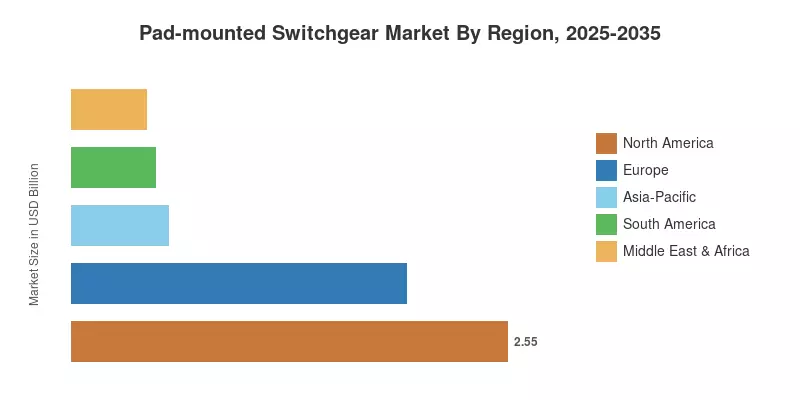
In 2025, North America is expected to account for 33.6% of the Pad-Mounted Switchgear Market as a result of federal resilience funding and hyperscale data-center interconnection. China's State Grid and India's Revamped Distribution Sector Scheme are funding subterranean urban feeders, resulting in the Asia-Pacific region compounding at the fastest rate of 7.55% through 2035 [7][9]. F-Gas compliance retrofits are the driving force behind Europe's second-place ranking at 25.8%. The velocity of growth will be determined by procurement cycles rather than demand through 2035.


Key Report Takeaways

• By Insulating Medium

  • Air-insulated designs led the Pad-Mounted Switchgear Market with a 38.7% revenue share in 2025, anchored by mature supply chains and the lowest installed cost per way.
  • Solid materials record the fastest expansion at an 8.20% CAGR through 2035 as fluorinated-gas phase-downs force technology conversions.
  • Gas-insulated units retain relevance where footprint constraints dominate, though environmental scrutiny caps their long-term trajectory.

• By Application

  • Industrial sites accounted for 43.0% of the Pad-Mounted Switchgear Market in 2025, driven by petrochemical, mining, and heavy-manufacturing switching duty.
  • Commercial installations grow fastest at a 7.90% CAGR, tracking hyperscale campus build-outs and dual-feeder redundancy architectures.
  • Residential deployments represent USD 1.70 billion of 2025 revenue as electrification loads push distribution operators toward underground residential networks.

• By Region

  • North America commanded a 33.6% share in 2025, supported by federal resilience awards and state undergrounding mandates.
  • Asia-Pacific advances at a 7.55% CAGR, the fastest of any region across the forecast period.
  • Middle East & Africa contributed USD 0.44 billion in 2025, concentrated in Gulf giga-project distribution networks.

Market Size and Forecast (2021–2035)

Estimates combine bottom-up shipment tracking across roughly 140 manufacturing and assembly facilities with top-down reconciliation against utility capital-expenditure disclosures, regulatory rate-case filings, and customs trade data for HS 8537 medium-voltage assemblies. Historical years are anchored to audited segment revenues where publicly reported; forecast years apply demand-side modelling of underground circuit-mile additions, feeder replacement cycles, and interconnection queue volumes. Currency effects are normalised to constant 2025 U.S. dollars, and the Pad-Mounted Switchgear Market is measured at manufacturer selling price excluding installation labour.
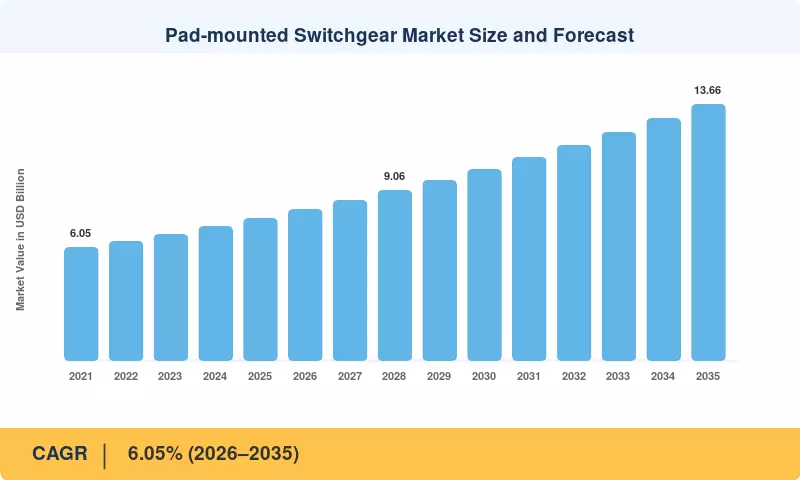
Pad-mounted Switchgear Market Size and Forecast
Our Impact

Enabled $4.3B Revenue Impact for Fortune 500 and Leading Multinationals

Partnering with 2000+ Global Organizations Each Year

30K+ Citations by Top-Tier Firms in the Industry

Driver Impact Analysis

Driver ~% Impact on CAGR Geographic Relevance Impact Timeline
Grid resilience and undergrounding mandates ~1.4% North America, Australia, Southern Europe Medium-term (2–4 yr)
Fluorinated-gas phase-down regulation ~1.1% Europe, North America Short-term (≤2 yr)
Data-center load growth ~1.2% North America, Nordics, Singapore Medium-term (2–4 yr)
Renewable interconnection queues ~0.8% Global Long-term (≥4 yr)
Urban densification and space constraints ~0.6% Asia-Pacific, Europe Long-term (≥4 yr)
Transportation electrification ~0.7% North America, Europe, China Long-term (≥4 yr)
Distribution automation retrofits ~0.5% North America, Japan, Korea Medium-term (2–4 yr)


Grid Resilience and Undergrounding Mandates

Wildfire liability has converted undergrounding from a cost-benefit debate into a regulatory obligation. Pacific Gas & Electric's approved 2023–2026 plan covers roughly 1,230 miles of underground conversion, and each mile displaces overhead reclosers with pad-mounted assemblies [3]. The U.S. Department of Energy's Grid Resilience and Innovation Partnerships program obligated USD 10.5 billion across three funding rounds, with distribution hardening a named eligible use [1]. Australia's Queensland network operators run parallel programs funded through regulated revenue determinations.

Fluorinated-Gas Phase-Down Regulation

Regulation (EU) 2024/573 bars new medium-voltage primary switchgear using fluorinated gases with global warming potential above 1,000 from January 2026, and extends the prohibition to all F-gas medium-voltage equipment by 2030 [4]. California Air Resources Board rules impose declining GWP limits on new gas-insulated equipment starting in 2025, with a 2033 endpoint [6]. Compliance forces specification rewrites at hundreds of utilities, and each rewrite opens a competitive re-bid.

Data-Center Load Growth

Hyperscale campuses consume pad-mounted line-ups at a rate no other commercial segment matches. The International Energy Agency projects global data-center electricity demand roughly doubling to about 945 TWh by 2030, with U.S. facilities the largest single national block [11]. Each 100 MW campus typically integrates dozens of switching units to deliver dual-feeder redundancy and sectionalise between power halls. Pre-integrated skid deliveries, in which switchgear ships mated to transformers, now shorten site schedules by several months.

Renewable Interconnection Queues

Distributed solar and storage projects require medium-voltage switching at the point of common coupling, and queue volumes have become the binding constraint. Lawrence Berkeley National Laboratory reported roughly 2.6 TW of generation and storage capacity awaiting U.S. interconnection studies at the end of 2024 [5]. Even partial queue clearance implies tens of thousands of new switching positions. Europe's grid connection backlog, quantified at over 1,700 GW by ENTSO-E members, generates comparable equipment pull [8].

Urban Densification and Space Constraints

Compact footprints command a premium where land costs dominate project economics. Pad-mounted enclosures occupy a fraction of the area an equivalent air-insulated indoor switchroom requires, which matters acutely in Chinese tier-one cities and Japanese redevelopment districts. China's National Energy Administration directed distribution operators toward underground configurations in high-density zones under its 2024 distribution network modernisation guidance [9]. Site-area savings of roughly 70% against walk-in alternatives justify the higher unit price.

Transportation Electrification

Charging depots concentrate load in ways legacy residential feeders were never designed to carry. The U.S. National Electric Vehicle Infrastructure program committed USD 5 billion in formula funding for corridor charging, and each high-power site typically requires a dedicated medium-voltage service with sectionalising capability [13]. Fleet electrification at transit agencies and parcel depots compounds the effect, since a single bus garage can draw more than a small industrial park.

Distribution Automation Retrofits

Automation upgrades increasingly bundle sensing and switching into a single procurement. Utilities deploying fault location, isolation, and service restoration schemes need remotely operable switching nodes with integrated current and voltage sensing, which favours modern pad-mounted units over passive legacy enclosures. The Electric Power Research Institute documented outage-duration reductions in the range of 30–50% at utilities implementing full automation schemes [14]. That measurable reliability benefit supports rate-base recovery arguments before commissions.

Restraints Impact Analysis

Restraint ~% Impact on CAGR Geographic Relevance Impact Timeline
Component and casting lead times ~-0.9% Global Short-term (≤2 yr)
High installed capital cost versus overhead ~-0.7% South America, Africa, rural markets Long-term (≥4 yr)
Skilled cable-splicing labour shortage ~-0.5% North America, Europe Medium-term (2–4 yr)
Grain-oriented steel and copper price volatility ~-0.4% Global Short-term (≤2 yr)
Regulatory approval and permitting delays ~-0.3% Europe, India Medium-term (2–4 yr)


Component and Casting Lead Times

Vacuum interrupters, epoxy castings, and bushing assemblies remain the chokepoint. Tracked medium-voltage switchgear lead times stretched to 80–110 weeks during 2024, against a pre-2021 norm nearer 30 weeks . Utilities respond by ordering against forecast rather than confirmed projects, which distorts backlog visibility and occasionally produces cancellation waves that suppress reported revenue in later quarters.

High Installed Capital Cost Versus Overhead

Skilled Cable-Splicing Labour Shortage

Installation, not manufacturing, increasingly gates deployment. The Center for Energy Workforce Development estimated that roughly 40% of the U.S. utility line workforce would be eligible to retire or leave within five years [15]. Elbow terminations and medium-voltage splicing require certified crews, and apprenticeship pipelines have not scaled with undergrounding budgets. Contractors report bidding only a fraction of available work.

Grain-Oriented Steel and Copper Price Volatility

Raw material exposure sits at roughly a third of manufacturing cost. Copper traded across a range exceeding 35% during 2024–2025, and grain-oriented electrical steel remains subject to trade remedies in multiple jurisdictions . Fixed-price framework agreements have consequently shortened from three years to twelve or eighteen months, transferring risk onto buyers and slowing contract closure.

Regulatory Approval and Permitting Delays

Street-opening consents, easement negotiations, and environmental review routinely add quarters to underground projects. ENTSO-E members flagged permitting as the leading cause of connection delay in their 2024 assessment [8]. India's state discoms face comparable municipal coordination friction, which pushes equipment deliveries into storage and defers revenue recognition for suppliers.

Pad-Mounted Switchgear Market Opportunities

SF₆-Free Retrofit Programs at Scale

Compliance mandates under EU Regulation 2024/573 establish an addressable compliance pool, as European utilities operate over 400,000 legacy gas-insulated medium-voltage units installed before 2015. Because the regulatory framework completely prohibits new medium-voltage primary switchgear utilizing fluorinated gases up to 24 kV starting January 1, 2026, and extends restrictions through 2030, vendors supplying drop-in solid-dielectric alternatives capture immediate retrofit market share without civil engineering redesign


Data-Center Skid Integration and Pre-Assembly

Modular delivery is becoming a distinct commercial model rather than a service add-on. Suppliers that ship switchgear, transformer, and protection pre-wired on a common skid compress hyperscale site schedules substantially, and buyers pay premiums for schedule certainty. Multi-year capacity reservation agreements, in which operators pre-purchase manufacturing slots, transfer demand risk to the customer and improve supplier working capital [11].

Emerging-Market Urban Distribution Build-Outs

India, Indonesia, Vietnam, and Saudi Arabia are building underground urban networks from a low base, which avoids the retrofit constraints that slow mature markets. India's Revamped Distribution Sector Scheme carries an outlay near INR 3.03 trillion with explicit loss-reduction and metering targets that favour sectionalised underground feeders [7]. Local content requirements shape entry strategy, so joint ventures and licensed manufacturing typically outperform pure export models.

Condition-Monitoring and Asset-Data Services

Embedded digital sensing hardware transforms traditional capital sales into recurring software revenue streams. Units equipped with continuous partial-discharge, thermal, and load-monitoring sensors interface directly with utility asset management platforms. Research documentation published by the Electric Power Research Institute confirms that utilizing live intelligence successfully avoids millions in operational costs, driving multi-million-dollar program savings that help utilities transition away from standard time-based maintenance cycles efficiently.


Wildfire and Flood-Resilient Product Lines

Increasing climate volatility fractures the electrical specification landscape, directly rewarding specialized equipment engineering. Submersible dead-front pad-mounted switchgear configurations engineered for prolonged flood immersion protect coastal zones, while certified arc-resistant enclosures mitigate risks in ignition-sensitive corridors. United Nations Office for Disaster Risk Reduction (UNDRR) frameworks emphasize that scaling such hardened infrastructure is vital, given that direct disaster losses have grown to approximately $202 billion annually, with total economic and cascading impacts exceeding $2.3 trillion.


Pad-Mounted Switchgear Market Future Outlook

Autonomous Fault Management

Self-healing distribution schemes shift switching decisions from central control rooms to edge devices. Units equipped with local processing isolate faults and reconfigure feeders within a few line cycles, avoiding SCADA round trips. Utilities piloting these architectures report substantial reductions in customer-minutes lost. Digital distribution solutions can defer an estimated USD 1.8 trillion in cumulative global infrastructure investments through 2050 by optimizing operational efficiencies and asset life cycles.


Electrification Supercycle Economics

Load growth has resumed in mature markets, altering the replacement calculus. The International Energy Agency (IEA) projects that global grid investment must nearly double to approach USD 600 billion annually by 2030 to keep pace with rapid electrification and renewable integration. Distribution grids absorb approximately 75% of this total expenditure, as legacy feeders cannot safely carry modern heat pump loads and rooftop solar backfeeds simultaneously.


Supply-Chain Regionalisation

Manufacturing footprints are shifting toward end markets under trade policy and lead-time pressures. Domestic content provisions attached to public infrastructure funding, alongside stringent regional net-zero industry rules, favor localized assembly and regional component sourcing. Suppliers are redirecting capital investments into domestic manufacturing hubs to counter logistical bottlenecks, with official trade indices reflecting significant structural shifts across major international supply corridors.


Sustainability Disclosure and Lifecycle Accounting

Reporting obligations are pulling embodied carbon into procurement scoring. The EU Corporate Sustainability Reporting Directive requires Scope 3 disclosure from large utilities, which makes supplier environmental product declarations a bid requirement rather than a differentiator [4]. Fluorinated-gas leakage, historically under-measured, now appears explicitly in utility emissions inventories. Within the Pad-Mounted Switchgear Market, this reporting pressure reinforces the technology shift already underway and disadvantages suppliers without verified lifecycle data.

Regional Market Share Analysis

Region Metric (2025) Primary Investment Themes
North America 33.6% share Wildfire undergrounding, data-center interconnection, IIJA resilience awards.
Europe 25.8% share F-Gas compliance retrofits, offshore wind onshore connection, urban renewal
Asia-Pacific 7.55% CAGR (2026–2035) Distribution modernisation, urban densification, rural electrification upgrades
South America USD 0.49 Billion Mining electrification, metropolitan network reinforcement
Middle East & Africa USD 0.44 Billion Giga-project distribution, desalination and industrial city loads
Total USD 7.59 Billion —

Regional demand within the Pad-Mounted Switchgear Market tracks two variables above all others: the pace of underground circuit-mile additions and the stringency of local fluorinated-gas rules. North America leads on both counts today, while Asia-Pacific converts sheer distribution capex volume into the steepest growth trajectory.


North America

Country Metric Key Driver
US 84.1% share of region GRIP awards and state wildfire mitigation plans
Canada USD 0.28 Billion Provincial storm-hardening and mining loads
Mexico 5.9% CAGR Nearshoring industrial park construction


Utility capital plans, not federal grants, ultimately set North American volume, though grants accelerate approvals. Southern California Edison, San Diego Gas & Electric, and PG&E have collectively committed to thousands of undergrounding miles under wildfire mitigation plans reviewed by the California Office of Energy Infrastructure Safety [3]. Data-center clusters in Northern Virginia, central Ohio, and Georgia generate a second demand stream with far shorter procurement cycles than regulated utility work [11]. Mexican demand is thinner but growing quickly as automotive and electronics investment fills industrial parks along the Bajío corridor.

Europe

Country Metric Key Driver
Germany 22.4% share of region Grid expansion plan and F-Gas replacement
UK USD 0.31 Billion RIIO-ED2 distribution investment allowance
France 6.1% CAGR Enedis underground programme continuation
Italy 11.2% share of region Resilience plan following storm events
Spain USD 0.17 Billion Solar interconnection at distribution level
Nordic Countries 6.4% CAGR Data-center siting and weather hardening
Russia 4.8% share of region Domestic manufacturing substitution
Rest of Europe USD 0.19 Billion EU cohesion-funded network upgrades


Compliance timing dominates European purchasing behaviour more than in any other region. Regulation (EU) 2024/573 removes high-GWP options from new medium-voltage installations from 2026, so distribution system operators are re-qualifying supplier panels now rather than at the deadline [4]. Germany's Bundesnetzagentur-approved network expansion budgets and the UK's RIIO-ED2 settlement, which permits roughly GBP 22 billion of distribution investment across the price control period, provide the funding certainty that converts specification changes into orders [8]—southern European utilities layer storm-resilience spending on top after repeated Mediterranean windstorm damage.

Asia-Pacific

Country Metric Key Driver
China 46.8% share of region State Grid distribution modernisation guidance
India 8.9% CAGR Revamped Distribution Sector Scheme rollout
Japan USD 0.24 Billion Urban redevelopment and disaster hardening
South Korea 7.1% share of region Industrial complex and semiconductor fab loads
ASEAN 8.2% CAGR Urban electrification and industrial estates
Rest of Asia-Pacific USD 0.11 Billion Australian bushfire undergrounding


Scale rather than regulation explains Asia-Pacific's trajectory. State Grid Corporation of China has run annual grid investment above CNY 500 billion, with distribution taking a rising share under 2024 modernisation guidance that favours underground configurations in dense districts [9]. India's Revamped Distribution Sector Scheme ties central funding to aggregate technical and commercial loss reduction, which pushes discoms toward sectionalised underground feeders in high-loss urban pockets [7]. Australian networks, though small in absolute terms, buy at premium specifications following successive bushfire liability rulings.

South America

Country Metric Key Driver
Brazil 61.3% share of region ANEEL distribution quality targets
Argentina USD 0.08 Billion Buenos Aires network reinforcement
Rest of South America 6.6% CAGR Chilean and Peruvian mining electrification


Regulatory quality metrics do more to move South American demand than any environmental rule. Brazil's ANEEL enforces SAIDI and SAIFI targets with financial penalties, which gives distributors a direct commercial reason to sectionalise urban feeders underground. Chilean and Peruvian copper mines electrifying haulage fleets require robust medium-voltage switching at remote sites, and those projects buy to international specification rather than local minimums. Currency volatility remains the principal brake on order conversion across the region.

Middle East & Africa

Country Metric Key Driver
Saudi Arabia 34.7% share of region NEOM and giga-project distribution networks
UAE USD 0.11 Billion DEWA and Abu Dhabi network expansion
South Africa 7.3% CAGR Eskom distribution refurbishment backlog
Egypt 9.8% share of region New administrative capital build-out
Rest of MEA USD 0.05 Billion North African industrial zone development


Gulf demand concentrates in a small number of very large programmes, which makes the region lumpy but lucrative. Saudi Electricity Company and the NEOM developments specify fully underground distribution across new urban districts, and procurement runs through multi-year framework agreements rather than annual tenders. Egypt's new administrative capital follows a comparable model. South African volume, by contrast, is refurbishment-led: Eskom and metropolitan distributors face a documented maintenance backlog that periodically converts into equipment orders when funding is released.

Pad-mounted Switchgear Market By Region, 2025-2035

Pad-Mounted Switchgear Market Segmentation

By Insulating Medium

Insulating medium is the most consequential specification decision in the Pad-Mounted Switchgear Market, because it determines maintenance regime, environmental compliance exposure, and enclosure footprint simultaneously.

Segment Metric Primary Demand Driver
Air 38.7% share (2025) Lowest installed cost and mature supply base
Gas 27.5% share (2025) Compact footprint in space-constrained sites
Fluids USD 0.94 Billion (2025) Fire-safe ester fills for dense urban vaults
Solid Materials 8.20% CAGR (2026–2035) Fluorinated-gas phase-down compliance


Air-insulated designs still ship in the greatest volume because utilities know their failure modes and stock spares for them. Solid-materials units nonetheless take share every year: they eliminate gas-leakage reporting, reduce routine maintenance intervals, and clear faults without the environmental liability attached to fluorinated fills. Gas-insulated equipment holds a defensible niche where site area is genuinely scarce. At the same time, fluid-insulated variants using synthetic esters serve fire-code-driven urban vault applications that neither alternative addresses well.

By Application

Application segmentation in the Pad-Mounted Switchgear Market separates rugged high-ampacity industrial duty from the redundancy-driven architectures now dominating commercial construction.

Segment Metric Primary Demand Driver
Industrial 43.0% share (2025) Petrochemical, mining, and heavy-manufacturing switching duty
Commercial 7.90% CAGR (2026–2035) Hyperscale data centers and dual-feeder redundancy
Residential USD 1.70 Billion (2025) Underground residential distribution and electrification loads


Industrial sites remain the revenue anchor because their loads are large, continuous, and intolerant of unplanned interruption, which justifies premium switching hardware. Commercial demand grows faster on data-center economics alone. Each hyperscale campus integrates dozens of line-ups for sectionalising between power halls, and pre-integrated skid delivery has made switchgear a schedule-critical item. Residential volume rises more slowly but broadens, as EV chargers and heat pumps force distribution operators to reinforce street-level feeders with compact pad enclosures.

Competitive Benchmarking

Concentration in the Pad-Mounted Switchgear Market is moderate. The top five suppliers together account for roughly 44–50% of global revenue, and the estimated Herfindahl-Hirschman Index sits in the 700–900 range — below the threshold most competition authorities treat as concentrated. Regional specialists retain durable positions because utility approval panels are slow to change and often require multi-year field history. Competitive strategy currently centres on three moves: securing solid-dielectric manufacturing capacity ahead of phase-down deadlines, vertically integrating vacuum-interrupter and casting supply, and acquiring regional assemblers to shorten delivery distance to end markets.

Company Est. Revenue Share Range Key Offerings for Pad-Mounted Switchgear Market Strategic Positioning
Eaton ~12–15% Air- and solid-dielectric pad-mounted units, integrated automation Broad utility panel presence; strong North American channel
Schneider Electric ~10–13% SF₆-free medium-voltage switching, digital monitoring Early SF₆-free commitment; EcoStruxure integration
ABB ~8–11% Solid-insulated switching, ring main and pad configurations Technology depth in vacuum interrupters and eco-efficient designs
Siemens Energy ~7–10% Clean-air medium-voltage assemblies, data-center skids Modular pre-integration agreements with hyperscale operators
G&W Electric ~6–9% Solid-dielectric switching, submersible enclosures Specialist reputation in dead-front and submersible designs
S&C Electric Company ~5–8% Automated switching, sectionalising controls Distribution automation leadership; strong utility engineering ties
Hubbell Power Systems ~4–6% Enclosed switching, connectors and terminations Component breadth enabling bundled feeder solutions
Hitachi Energy ~4–6% Eco-efficient medium-voltage switching platforms Global service network; renewable interconnection focus
Powell Industries ~2–4% Custom-engineered medium-voltage assemblies Project-engineered focus on oil, gas, and industrial sites
Trayer Engineering ~2–3% Submersible and pad-mounted switch assemblies Niche depth in flood-resilient and municipal specifications
Ormazabal ~2–3% Compact secondary distribution switching European utility framework agreements
Federal Pacific ~1–3% Pad-mounted switchgear and transformer packages Made-to-order North American manufacturing


Recent News & Developments

  • European Commission (February 2024): Regulation (EU) 2024/573 entered into force, setting fluorinated-gas prohibitions for new medium-voltage switchgear from 2026 and effectively resetting supplier qualification across European distribution operators [4].
  • Siemens Energy and Compass Datacenters (June 2024): The parties expanded a modular power-skid agreement under which switchgear and transformers arrive pre-integrated, cutting hyperscale site electrical works from months to weeks and signalling a shift toward factory-assembled delivery [11].
  • U.S. Department of Energy (October 2024): A third round of Grid Resilience and Innovation Partnerships selections was announced, directing further funding toward distribution hardening and undergrounding projects across more than 20 states [1].
  • Eaton (March 2024): The company announced expanded North American medium-voltage manufacturing capacity, citing lead times and domestic content provisions attached to federal infrastructure funding as the investment rationale .
  • California Air Resources Board (January 2025): Declining global warming potential limits for new gas-insulated electrical equipment took effect, obliging investor-owned utilities to file transition plans for legacy fleets [6].
  • G&W Electric (September 2024): A new solid-dielectric product family was introduced with footprint parity to legacy gas-insulated units, targeting drop-in replacement where civil rework is uneconomic.
  • State Grid Corporation of China (May 2024): Distribution network modernisation guidance directed operators toward underground configurations in high-density urban districts, expanding the addressable base within the Pad-Mounted Switchgear Market across tier-one cities [9].
  • Schneider Electric (November 2023): The company committed to eliminating fluorinated gases across its medium-voltage portfolio, pairing the announcement with pure-air switching launches aimed at European distribution operators [4].

Pad-Mounted Switchgear Market Report Scope

Parameter Detail
Market Scope Global manufacture and sale of pad-mounted medium-voltage switching assemblies, segmented by insulating medium and application, measured at manufacturer selling price.
Study Period 2021–2035 (Historical 2021–2024; Base Year 2025; Forecast 2026–2035)
CAGR 6.05% (2026–2035)
Market Size Checkpoints USD 7.59 Billion (2025); USD 8.05 Billion (2026); USD 13.66 Billion (2035)
Fastest Growing Segments Solid Materials (8.20% CAGR); Commercial (7.90% CAGR); Asia-Pacific (7.55% CAGR)
Companies Profiled Eaton, Schneider Electric, ABB, Siemens Energy, G&W Electric, S&C Electric Company, Hubbell Power Systems, Hitachi Energy, Powell Industries, Trayer Engineering, Ormazabal, Federal Pacific
Valuation Currency USD Billion, constant 2025 dollars

FAQs

What certification standards should buyers require when qualifying products in the Pad-Mounted Switchgear Market?
IEEE C37.74 governs subsurface, vault, and pad-mounted load interrupter switchgear in North America, covering ratings, design tests, and enclosure integrity [23]. European buyers add IEC 62271-200 compliance and a verified environmental product declaration.
How do solid-dielectric and gas-insulated units differ on maintenance obligations?
Solid-dielectric units carry no gas-density monitoring, leak reporting, or refill obligations, which removes an annual inspection line item entirely. Gas-insulated equipment requires density verification and emissions accounting under fluorinated-gas rules [4].
What procurement lead times should planners assume in the Pad-Mounted Switchgear Market today?
Assume 70–100 weeks for standard configurations and longer for custom-engineered assemblies, against a historical norm near 30 weeks . Reserve manufacturing slots before project financing closes rather than after.
Which cybersecurity requirements apply to automated switching units?
Remotely operable units fall within NERC CIP scope when they affect bulk electric system reliability, and IEC 62443 increasingly appears in utility specifications. Require signed firmware and documented vulnerability disclosure from suppliers.
How does flood exposure change enclosure specification?
Submersible designs rated for prolonged immersion use sealed dead-front bushings and stainless enclosures, commanding roughly 20–30% price premiums over standard units. Gulf Coast and monsoon-zone utilities increasingly mandate them for low-lying vault locations.
What contracting models are displacing traditional purchase orders in the Pad-Mounted Switchgear Market?
Multi-year capacity reservation agreements and framework contracts with indexed pricing now dominate large utility and hyperscale buying [11]. Both trade price flexibility for delivery certainty in a constrained supply environment.
Can existing overhead circuits be converted without full feeder redesign?
Rarely. Conversion requires a new duct bank, cable sizing for thermal derating, and revised protection coordination, so utilities treat it as feeder replacement rather than equipment swap [3]. Costs run roughly four times equivalent overhead rebuilds.
Author
Author Author Profile Priya Nagrale LinkedIn Senior Research Analyst
With an experience of over five years in market research industry (Chemicals & Materials domain), I gather and analyze market data from diverse sources to produce results, which are then presented back to a client. Also, provide recommendations based on the findings. As a Senior Research Analyst, I perform quality checks (QC) for market estimations, QC for reports, and handle queries and work extensively on client customizations. Also, handle the responsibilities of client proposals, report planning, report finalization, and execution

Research Approach


Secondary Research

The secondary research process involved comprehensive analysis of regulatory databases, technical standards repositories, peer-reviewed engineering journals, and authoritative energy sector organizations. Key sources included the US Department of Energy (DOE), Energy Information Administration (EIA), Federal Energy Regulatory Commission (FERC), National Electrical Manufacturers Association (NEMA.org), Institute of Electrical and Electronics Engineers (IEEE) Standards Association, International Electrotechnical Commission (IEC) Central Office, American National Standards Institute (ANSI), Occupational Safety and Health Administration (OSHA), US International Trade Commission (USITC), European Committee for Electrotechnical Standardization (CENELEC), EU Eurostat Energy Database, International Energy Agency (IEA) World Energy Investment, World Bank Energy & Extractives Open Data, United Nations Industrial Development Organization (UNIDO), national utility regulatory commissions (PUCs, Ofgem, Bundesnetzagentur), and grid operator annual reports from EEI member utilities. These sources were used to collect infrastructure investment statistics, technical standard adoption rates, grid modernization expenditure data, safety incident reports, and regulatory landscape analysis for air-insulated switchgear (AIS), gas-insulated switchgear (GIS), solid dielectric technologies, and other insulation mediums across industrial, commercial, and residential voltage applications.


Primary Research

To gather both qualitative and quantitative insights, supply-side and demand-side stakeholders were interviewed during the primary research phase. CEOs, VPs of engineering, product line directors, regulatory compliance officers, and grid solutions strategists from switchgear OEMs, electrical equipment manufacturers, and component suppliers were examples of supply-side sources. Chief engineers, T&D planning directors, procurement leads from electric utilities (IOUs, municipalities, cooperatives), industrial facility managers, commercial real estate developers, EPC contractors, and consulting engineers from power sector engineering firms were among the demand-side sources. Market segmentation was validated, product development roadmaps were verified, and information on utility procurement patterns, IEC vs. IEEE standard specification preferences, voltage tier adoption trends, and smart grid integration roadmaps was obtained through primary research.

Primary Respondent Breakdown:

By Designation: C-level Primaries (28%), Director Level (31%), Others (41%)

By Region: North America (31%), Europe (24%), Asia-Pacific (38%), Rest of World (7%)


Market Size Estimation

Global market valuation was derived through revenue mapping, shipment volume analysis, and utility capital expenditure tracking. The methodology included:

Identification of 55+ key manufacturers across North America, Europe, Asia-Pacific, and Latin America

Product mapping across air-insulated, gas-insulated (SF6 and SF6-free), solid dielectric, and hybrid insulation technologies

Analysis of reported and modeled annual revenues specific to pad-mounted switchgear portfolios

Coverage of manufacturers representing 75-80% of global market share in 2024

Extrapolation using bottom-up (utility CAPEX × equipment allocation by voltage class × regional pricing indices) and top-down (manufacturer revenue validation, T&D equipment trade flow analysis) approaches to derive segment-specific valuations

Validation & Triangulation

Data triangulation was performed by cross-referencing secondary research findings with primary interview insights and proprietary databases. Utility interconnection queue data from ISOs/RTOs (CAISO, ERCOT, PJM, NYISO) provided demand-side validation for industrial and commercial segments. Smart Grid Investment Grant program databases and Grid Resilience Innovative Partnership (GRIP) awards offered additional verification for US market size assumptions.

Download Free Sample

Kindly complete the form below to receive a free sample of this Report

Download PDF ×

We do not share your information with anyone. However, we may send you emails based on your report interest from time to time. You may contact us at any time to opt-out.

















