Ota Transmission Platform Market (2026 - 2035)

OTA Transmission Platform Market Research Report By Deployment Type (Cloud-based, On-premises, Hybrid), By Application (Automotive, Industrial, Consumer Electronics, Healthcare), By Protocol (OTA 1.0, OTA 2.0, OTA 3.0), By Connectivity Technology (Cellular (4G/5G), Wi-Fi, Bluetooth) and By Regional (North America, Europe, South America, Asia Pacific, Middle East and Africa) - Forecast to 2035
ID: MRFR/ICT/29493-HCR 128 Pages Nirmit Biswas, Aarti Dhapte Last Updated: October 31, 2026
Ota Transmission Platform Market
Market Size
Forecast Period2026-2035
CAGR (2026-2035)3.52%
2025 Market SizeUSD 112.4 Million
2035 Market SizeUSD 158.9 Million
Key Players
Rohde & Schwarz
GatesAir
Hitachi Kokusai Electric
Harmonic Inc.
Nautel
ENENSYS Technologies
Opportunities
  • Broadcast Datacasting as a Paid Delivery Pipe
  • Digital Terrestrial Completion in Africa and Southeast Asia
  • Managed Transmission and Neutral-Host Leasing

Ota Transmission Platform Market Summary

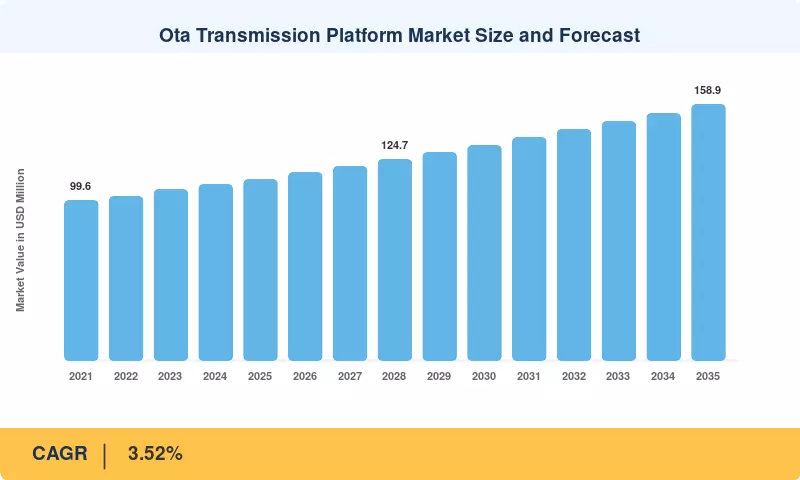
The OTA Transmission Platform Market was valued at USD 112.4 Million in 2025 and is projected to reach USD 116.4 Million in 2026, expanding at a CAGR of 3.52% to USD 158.9 Million by 2035. Regulation is doing much of the heavy lifting. In the United States, broadcasters have asked the Federal Communications Commission to set firm dates for retiring ATSC 1.0, with the top 55 markets targeted for February 2028 [1][2]. In Europe, the Electronic Communications Code requires every new car radio to receive digital terrestrial signals, which steadily widens the audience for DAB+ networks [3].

Underneath those mandates sits a hardware refresh. Tube-based and first-generation analog transmitters are being replaced with solid-state, IP-native platforms that combine exciter, encoder, and telemetry in one chassis and accept new waveforms through software licences. U.S. stations alone drew on an FCC reimbursement fund of roughly USD 2.75 billion during the post-auction spectrum repack [4], and the equipment installed then now forms the upgrade base for next-generation services.

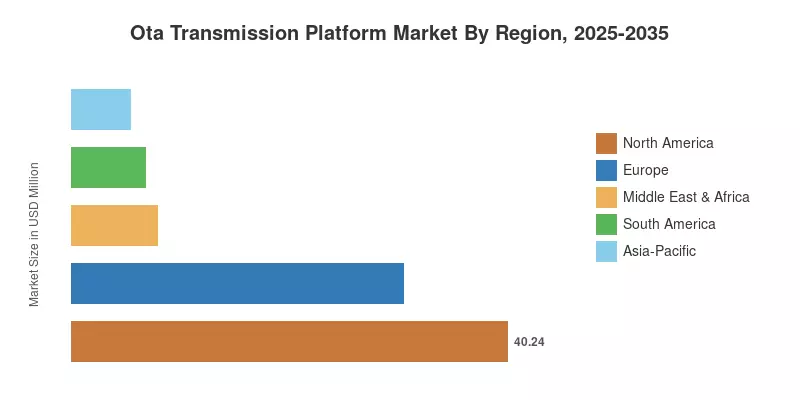
Regionally, North America leads the OTA Transmission Platform Market with a 35.8% share in 2025, supported by NextGen TV signals that reach roughly three-quarters of U.S. television households [5]. Asia-Pacific is the fastest-growing region at a 4.8% CAGR, propelled by digital radio expansion and direct-to-mobile pilots in India and China. Europe ranks second, where FM switch-off programmes and DAB+ densification keep procurement steady. Through 2035, growth will favour vendors that sell software, monitoring, and managed services alongside the transmitter itself.

Key Report Takeaways

• By Component

  • Transmitters held a 43.6% share of the OTA Transmission Platform Market in 2025, reflecting their central role in every digital conversion.
  • Monitoring and Control Systems are forecast to post a 4.9% CAGR as broadcasters centralize network operations.

• By Technology

  • ATSC 3.0 accounted for a 31.9% share, anchored by North American deployments.
  • 5G-Broadcast is the fastest-expanding standard at a 6.2% CAGR.

• By Application

  • Television Broadcasting commanded a 54.8% share of 2025 revenue.
  • Radio/DAB is set to grow at a 4.7% CAGR on the back of in-car digital tuner adoption.

• By End-User

  • Commercial Broadcasters and MSOs represented a 52.9% share of the OTA Transmission Platform Market in 2025.
  • Government and Defense buyers are projected to register a 6.7% CAGR, the highest among end users.

• By Region

  • North America led with a 35.8% share in 2025.
  • Europe generated USD 30.6 million in 2025.
  • Asia-Pacific is the fastest-growing region at a 4.8% CAGR.

Market Size and Forecast (2021–2035)

Market Research Future sized the Ota Transmission Platform Market through a bottom-up count of transmitter, antenna, encoder, and monitoring shipments by power class and broadcast standard, priced against vendor list and contract data. Those totals were reconciled with top-down broadcaster capital expenditure disclosures, vendor filings, and regulatory records [4][17][18]. Historical values reflect shipment records, while forecast values apply standard-specific adoption curves to the installed base.
Ota Transmission Platform Market Size and Forecast
Our Impact

Enabled $4.3B Revenue Impact for Fortune 500 and Leading Multinationals

Partnering with 2000+ Global Organizations Each Year

30K+ Citations by Top-Tier Firms in the Industry

Driver Impact Analysis

Impact percentages below are directional estimates of each driver's contribution to the forecast CAGR. Drivers overlap and reinforce one another, so the figures are not additive and should not be summed to reconcile with the headline growth rate.

Driver ~% Impact on CAGR Geographic Relevance Impact Timeline
ATSC 3.0 / NextGen TV transition mandates +0.9% North America, South Korea, Brazil Medium term (2–4 yr)
FM switch-off and DAB+ network expansion +0.6% Europe, Australia Medium term (2–4 yr)
Energy-efficient solid-state transmitter replacement +0.5% Global Short term (≤2 yr)
5G-Broadcast and direct-to-mobile rollout +0.5% Europe, India, China Long term (≥4 yr)
Public warning and emergency alerting obligations +0.4% EU, North America Medium term (2–4 yr)
Centralized remote monitoring and IP-native networks +0.4% North America, Europe Short term (≤2 yr)
Digital terrestrial completion in emerging markets +0.3% Africa, Southeast Asia, South America Long term (≥4 yr)


ATSC 3.0 / NextGen TV Transition Mandates

The FCC's 2017 order authorized voluntary ATSC 3.0 service on condition that stations keep simulcasting ATSC 1.0 [1]. A 2025 industry petition asks the Commission to end that simulcast in the top 55 markets by February 2028 and nationwide by February 2030 [2]. A firm date would turn discretionary upgrades into compliance purchases across roughly 1,750 full-power U.S. stations. ATSC already reports NextGen TV signals covering about 75% of U.S. households, so the remaining spend shifts toward full conversions [5].

FM Switch-Off and DAB+ Network Expansion

Article 113 and Annex XI of the European Electronic Communications Code have required new car radios sold in the EU to receive digital terrestrial broadcasts since December 2020 [3]. That receiver mandate gives broadcasters a business case for densifying DAB+ coverage. Swiss public broadcaster SRG SSR shut its FM transmitters at the end of 2024 [7], and WorldDAB counts more than 30 countries with regular DAB+ services [6]. Each switch-off concentrates spending on digital radio transmitters, combiners, and SFN timing equipment.

Energy-Efficient Solid-State Transmitter Replacement

Electricity is typically the highest operating cost at a high-power site, and IEA data show European industrial power prices running at roughly twice U.S. levels in 2024 [23]. Liquid-cooled solid-state transmitters now exceed 40% AC-to-RF efficiency, compared with 25–30% for many units installed before 2010. For a 20 kW UHF site, that gap saves several hundred megawatt-hours a year. Payback periods under five years are pulling replacement budgets forward, particularly in Europe.

5G-Broadcast and Direct-to-Mobile Rollout

3GPP Release 16 completed the specifications for LTE-based 5G terrestrial broadcast, allowing high-power, high-tower sites to reach smartphones without a SIM or data plan [8]. European broadcasters have run multiple trials through EBU-coordinated projects [9]. India's Prasar Bharati and IIT Kanpur have tested direct-to-mobile delivery in the 470–582 MHz band [10]. With more than 750 million smartphone users in India, even partial adoption would require new broadcast-grade transmitters and core gateways.

Public Warning and Emergency Alerting Obligations

Article 110 of the European Electronic Communications Code required all 27 EU member states to operate public warning systems by June 2022 [3]. In the United States, FEMA's Integrated Public Alert and Warning System relies on broadcast stations as a primary distribution layer [24]. Broadcast reaches every receiver in range at once and survives cellular congestion, so governments are funding hardened transmitters and backup power. ATSC 3.0's Advanced Emergency Alerting adds geotargeted, rich-media warnings that strengthen the public-safety case.

Centralized Remote Monitoring and IP-Native Networks

Broadcasters running dozens of unattended sites are consolidating control into central network operations centres. SNMP, REST, and cloud APIs let one team track forward power, reflected power, and spectral mask compliance across a whole fleet. Vendor case studies report that remote diagnostics cut unscheduled site visits by 30–40% [17]. Predictive analytics flag failing amplifier modules before outages occur, and automated compliance logs simplify proof-of-performance filings, justifying software subscriptions on installed hardware.

Digital Terrestrial Completion in Emerging Markets

The ITU GE06 agreement set June 2015 as the end of analog protection across most of Region 1, yet several African states have still not completed digital migration . The World Bank's Digital Economy for Africa initiative targets universal digital access by 2030 [21], and terrestrial television remains the cheapest way to reach rural households. Completing DVB-T2 networks in Sub-Saharan Africa and extending ISDB-T in South America sustain long-cycle demand for medium-power transmitters and gap fillers.

Restraints Impact Analysis

Restraint ~% Impact on CAGR Geographic Relevance Impact Timeline
Linear viewing migration to streaming −0.5% North America, Western Europe Long term (≥4 yr)
High replacement capex and constrained broadcaster budgets −0.4% Global Short term (≤2 yr)
UHF spectrum pressure from mobile services −0.3% Europe, Africa, Asia-Pacific Long term (≥4 yr)
Limited ATSC 3.0 receiver penetration and content-protection disputes −0.3% United States Medium term (2–4 yr)
Component supply volatility and trade tariffs −0.2% Global Short term (≤2 yr)


Linear Viewing Migration to Streaming

Nielsen's Gauge showed streaming passing 44% of U.S. television viewing time in 2025, ahead of broadcast and cable combined for the first time [14]. Ofcom reports a similar decline in broadcast viewing among UK adults under 35 [13]. Falling audience share erodes the advertising revenue that funds transmitter replacement at commercial stations and pushes owners to stretch asset life rather than upgrade.

High Replacement Capex and Constrained Broadcaster Budgets

A high-power UHF transmitter with mask filter and installation can exceed USD 1 million, and stations under simulcast obligations must fund parallel ATSC 1.0 and ATSC 3.0 capacity [4]. Equipment vendors disclose lengthening sales cycles as broadcaster customers defer capital commitments [18]. Smaller public and independent stations, which lack fleet purchasing power, are most likely to postpone orders.

UHF Spectrum Pressure from Mobile Services

WRC-23 kept the 470–694 MHz band primarily allocated to broadcasting in ITU Region 1 but added a secondary mobile allocation and scheduled a review at WRC-31 . Current operations are protected, yet long-term spectrum security remains uncertain. Broadcasters weighing 15-year transmitter investments may hesitate where regulators signal interest in clearing further UHF capacity.

Limited ATSC 3.0 Receiver Penetration and Content-Protection Disputes

The majority of American houses may already receive NextGen TV signals, although only a small percentage of installed televisions have appropriate receivers [5]. In 2024, consumer complaints about gateway devices being blocked by encrypted ATSC 3.0 signals reached the FCC, complicating the transition. Many stations will continue to use the shared lighthouse concept rather than completely transition until receiver penetration reaches a critical point.


Component Supply Volatility and Trade Tariffs

Transmitter amplifiers rely on precise filters, FPGAs, and LDMOS transistors from a limited number of suppliers. In their public filings, vendors identify tariff exposure and component lead times as significant risk factors [18]. When tariffs are in effect, price hikes of 5–10% on imported subsystems may cause stations with limited funds to postpone making purchases.


Ota Transmission Platform Market Opportunities

Broadcast Datacasting as a Paid Delivery Pipe

ATSC 3.0 and 5G-Broadcast let stations sell spare capacity as a one-to-many data service. Automakers and device makers are evaluating broadcast as a low-cost channel for over-the-air update technology, because sending one large file to millions of vehicles costs the same as sending it to one. Stations that package capacity for connected device updates, digital signage, and telemetry can earn revenue independent of advertising cycles, raising demand for datacasting-ready exciters and gateways.

Digital Terrestrial Completion in Africa and Southeast Asia

Many Sub-Saharan countries still run partial or analog networks more than a decade after the GE06 deadline . GSMA data show mobile broadband coverage gaps persisting across rural Africa [20], leaving terrestrial broadcast as the most affordable universal medium. Development-finance programmes [21] create a pipeline for turnkey DVB-T2 networks, where vendors offering financing and local service partnerships hold an advantage.

Managed Transmission and Neutral-Host Leasing

Transmission sites are increasingly owned and run by tower companies and neutral hosts, who offer broadcast capacity as a service. The strategy allows hosts to distribute equipment expenditures over multiple tenants and transforms a station's capital outlay into predictable leasing fees. Instead of relying on one-time hardware sales, vendors who offer multi-tenant combiners, virtualized encoding, and service-level monitoring can get recurring revenue.


Direct-to-Mobile Broadcasting in India

A national network that may provide video and emergency content to phones without using up cellular capacity is suggested by India's direct-to-mobile trials [10]. Broadcast-grade transmitters at hundreds of tall towers and receiver chipsets in cell phones would be needed for a commercial launch. In the fastest-growing nation in Asia-Pacific, early adopters that localize production and collaborate with Prasar Bharati stand to gain a first-wave build.


Secure Broadcast and Positioning for Government Users

The FCC's 2025 inquiry into a Broadcast Positioning System explores using ATSC 3.0 signals as a terrestrial backup to GPS timing [16]. Defense and civil agencies also want hardened, cyber-secured links for command and public alerting. Ruggedized, certified transmitters and timing-grade exciters address a buyer group growing faster than any other end user.

Ota Transmission Platform Market Future Outlook

AI-Driven Autonomous Network Operations

Transmitter management will shift from alarm reaction to prediction thanks to machine learning. Repairs can be scheduled during scheduled visits by using models trained on amplifier temperature, reflected power, and module current to predict breakdowns weeks in advance. Analytics software will become a crucial buying criterion as broadcasters anticipate unattended installations to self-optimize production power versus demand and energy tariffs over the next ten years [17].


Software-Defined and Cloud-Native Headends

Only RF stages remain at the tower while encoding, multiplexing, and scheduling move to virtualized and cloud environments. Operators can change standards without upgrading their forklifts thanks to software-licensed waveforms. This change increases recurring license and maintenance revenue for vendors like Harmonic and Ateme while decreasing the hardware portion of each project in the Ota Transmission Platform Market [18].


Energy Efficiency and Sustainability Reporting

The EU Corporate Sustainability Reporting Directive requires large companies, including major broadcasters, to disclose Scope 1 and 2 emissions in audited reports [22]. Transmission networks are a large share of a broadcaster's electricity use, and IEA projections of rising power demand point to continued price pressure [23]. Efficiency ratings and lifecycle carbon data will feature in tender scoring.

Broadcast-Broadband Convergence and Positioning

5G-Broadcast and ATSC 3.0 blur the line between broadcast and mobile networks [8]. Hybrid delivery will let operators offload popular live content from cellular cores onto broadcast towers. If the FCC formalizes the Broadcast Positioning System [16], transmitter sites will also serve national timing resilience, adding a public-infrastructure dimension to investment decisions after 2030.

Regional Market Share Analysis

Region Metric (2025) Primary Investment Themes
North America 35.8% share ATSC 3.0 transition, broadcast positioning, remote monitoring
Europe USD 30.6 Million DAB+ densification, FM switch-off, 5G-Broadcast trials
Asia-Pacific 4.8% CAGR Direct-to-mobile pilots, DTMB and ISDB-T upgrades, digital radio
South America 6.1% share ISDB-T expansion, Brazil TV 3.0
Middle East & Africa USD 7.9 Million DVB-T2 completion, public warning networks
Total USD 112.4 Million —

Regional demand in the OTA Transmission Platform Market follows the timing of standards transitions, radio digitization, and public-safety funding. North America leads on ATSC 3.0, Europe on digital radio, and Asia-Pacific on direct-to-mobile and greenfield builds.


North America

Country Metric (2025) Key Driver
US 81.2% share of region ATSC 3.0 conversions and proposed ATSC 1.0 sunset
Canada USD 4.9 Million Transmitter life-cycle replacement and ATSC 3.0 evaluation
Mexico 3.9% CAGR DTT coverage extension and public broadcaster upgrades


The United States anchors the North American OTA Transmission Platform Market, with the NAB petition proposing 2028 and 2030 sunset dates for ATSC 1.0 [2]. Stations have so far relied on shared lighthouse arrangements, but a firm deadline would trigger full conversions. The FCC's Broadcast Positioning System inquiry adds a resilience angle [16]. Canada is assessing ATSC 3.0 while replacing aging DTV transmitters installed during its 2011 transition, and Mexico continues to extend digital coverage to rural areas.

Europe

Country Metric (2025) Key Driver
Germany 19.4% share of region DAB+ coverage densification
UK USD 5.3 Million DAB+ small-scale multiplexes and DTT site renewal
France 3.6% CAGR National DAB+ rollout
Italy 10.8% share of region DVB-T2 migration
Spain USD 2.7 Million DTT refresh and energy-efficiency upgrades
Nordic Countries 4.1% CAGR Post-FM digital radio networks
Russia 8.2% share of region Domestic network maintenance
Rest of Europe USD 6.0 Million FM switch-off programmes, including Switzerland


Europe's spending centres on digital radio, driven by the EECC in-car receiver mandate [3] and switch-offs such as Switzerland's FM shutdown at the end of 2024 [7]. Germany and the UK continue to add DAB+ sites, while Italy's DVB-T2 migration sustains television transmitter orders. High electricity prices make solid-state efficiency a strong purchasing criterion across the region [23], and EBU members remain the most active 5G-Broadcast testers [9].

Asia-Pacific

Country Metric (2025) Key Driver
China 36.5% share of region DTMB network upgrades and CDR digital radio
India 6.4% CAGR Direct-to-mobile trials and DD network modernization
Japan USD 5.6 Million ISDB-T transmitter replacement cycle
South Korea USD 2.9 Million Terrestrial UHD on ATSC 3.0
ASEAN 5.8% CAGR Post-switchover DTT coverage and DAB+ pilots
Rest of Asia-Pacific 7.2% share of region DAB+ expansion in Australia


Asia-Pacific is the fastest-growing region in the OTA Transmission Platform Market. China is upgrading DTMB networks and promoting its CDR digital radio standard, while India's direct-to-mobile programme could become the largest single broadcast build of the decade [10]. Japan's ISDB-T base, installed around 2011, is entering replacement. South Korea, the first country to launch terrestrial UHD on ATSC 3.0, offers an operational template for other adopters.

South America

Country Metric (2025) Key Driver
Brazil 58.4% share of region TV 3.0 standard adoption
Argentina USD 1.2 Million ISDB-T coverage maintenance
Rest of South America 3.4% CAGR Delayed analog switch-offs in Andean markets


Brazil's 2025 decree establishing TV 3.0, built on the ATSC 3.0 physical layer, sets up the region's largest transmitter replacement cycle [15]. Network planning and pilot stations will precede broad deployment after 2027. Argentina's ISDB-T network requires steady maintenance, while Peru, Colombia, and Chile pursue switch-off timetables that support medium-power transmitter demand.

Middle East & Africa

Country Metric (2025) Key Driver
Saudi Arabia USD 1.9 Million Vision 2030 media infrastructure investment
UAE 5.9% CAGR DAB+ launch and hybrid broadcast services
South Africa 18.6% share of region Completion of analog switch-off
Egypt USD 0.8 Million National broadcaster network upgrades
Rest of MEA 30.4% share of region Donor-funded DVB-T2 builds in Sub-Saharan Africa


Gulf states are funding media infrastructure under national transformation plans, with Saudi Arabia and the UAE investing in digital radio and modern DTT. South Africa's protracted analog switch-off is shifting spend toward DVB-T2 network optimization. Across Sub-Saharan Africa, World Bank and bilateral programmes back universal access [21], and limited mobile broadband in rural areas [20] keeps terrestrial broadcast central to public communication.

Ota Transmission Platform Market By Region, 2025-2035

Ota Transmission Platform Market Segmentation

The Ota Transmission Platform Market is segmented by component, technology, application, and end-user, with regional coverage provided in Section 7.

By Component

Within the Ota Transmission Platform Market, component demand splits between core RF hardware and the software layer that manages it.

Segment Metric (2025) Primary Demand Driver
Transmitters 43.6% share Digital conversion and solid-state replacement
RF Filters and Antennas USD 20.8 Million Mask filter and antenna upgrades tied to transmitter refresh
Multiplexers and Encoders 13.9% share HEVC/VVC compression and channel sharing
Monitoring and Control Systems 4.9% CAGR Centralized network operations and predictive maintenance
Ancillary Infrastructure USD 9.6 Million Backup power, cooling, and site hardening


Transmitters remain the anchor purchase because every standards transition and power increase requires a new exciter and amplifier chain. RF filters and antennas follow the same refresh calendar. Monitoring and Control Systems grow fastest as broadcasters run fleets from central operations centres and add analytics that forecast component wear. Vendors bundling exciter, encoder, and telemetry in one IP-native chassis are winning share from discrete-hardware suppliers.

By Technology

Technology choice in the OTA Transmission Platform Market is set largely by national standards policy.

Segment Metric (2025) Primary Demand Driver
ATSC 3.0 31.9% share U.S. NextGen TV and Brazil TV 3.0
DVB-T/T2 USD 33.5 Million European and African DTT networks
ISDB-T 12.8% share Japan and South American networks
5G-Broadcast 6.2% CAGR Direct-to-mobile and hybrid broadcast-cellular delivery
Others USD 18.2 Million DTMB, ATSC 1.0 maintenance, and analog legacy


ATSC 3.0 leads on the strength of U.S. conversions and Brazil's new standard decision, while DVB-T/T2 remains the workhorse across Europe and Africa. 5G-Broadcast grows fastest as telecom operators and broadcasters test spectrum-efficient delivery to phones. Multistandard exciters that toggle among DVB-T2, ISDB-T, and ATSC 3.0 reduce stock complexity for vendors and protect buyers where policy is unsettled.

By Application

Application demand in the OTA Transmission Platform Market remains television-led, but new uses are diversifying revenue.

Segment Metric (2025) Primary Demand Driver
Television Broadcasting 54.8% share Free-to-air consumption and UHD services
Radio/DAB 4.7% CAGR In-car digital tuners and FM switch-offs
Datacasting and IoT Broadcast USD 11.2 Million One-to-many file and telemetry delivery
Public Warning and Emergency Alerting 7.4% share EU-Alert and IPAWS obligations


Television Broadcasting dominates because must-carry rules and free-to-air audiences sustain investment in higher-order modulation and efficient compression. Radio/DAB grows fastest as automakers fit digital tuners and regulators retire FM. Datacasting is small but strategically important, positioning stations as wholesale distribution pipes, while public warning applications draw stable government funding that does not depend on advertising.

By End-User

End-user purchasing in the Ota Transmission Platform Market varies sharply by procurement model and certification requirement.

Segment Metric (2025) Primary Demand Driver
Commercial Broadcasters and MSOs 52.9% share Fleet-wide upgrades and channel-sharing deals
Public Service Broadcasters USD 29.7 Million Universal-service mandates
Government and Defense 6.7% CAGR Secure command links and public alerting
Tower Companies and Neutral Hosts 8.1% share Managed transmission services


Commercial Broadcasters and MSOs lead because group owners negotiate multi-station contracts and favour opex-light financing. Government and Defense is the fastest-growing buyer, demanding ruggedized, cyber-hardened equipment for alerting and command functions. Public service broadcasters balance fiscal limits with coverage obligations, and tower companies are emerging as neutral hosts that convert station capital costs into leasing fees.

Competitive Benchmarking

Competition in the Ota Transmission Platform Market is moderately concentrated. The top five vendors hold an estimated 45–50% of revenue, and the Herfindahl-Hirschman Index sits near 850, indicating a field led by a few high-power specialists with a long tail of regional suppliers. European and North American firms dominate high-power television, while encoder and monitoring segments are more fragmented.

Company Est. Revenue Share Range Key Offerings for OTA Transmission Platform Market Strategic Positioning
Rohde & Schwarz ~13–16% Liquid-cooled TV and radio transmitters, 5G-Broadcast systems Technology leader in high-power, multi-standard platforms
GatesAir ~10–13% ATSC 3.0 and DAB transmitters, exciters Strong U.S. NextGen TV installed base
Hitachi Kokusai Electric (Comark) ~7–10% UHF transmitters, ISDB-T systems Broad footprint in Japan and the Americas
Harmonic Inc. ~6–9% Encoders, multiplexers, cloud-native headends Software-led video processing
Nautel ~4–6% Solid-state FM, DAB, and digital radio transmitters Radio specialist with efficiency focus
ENENSYS Technologies ~3–5% SFN adapters, ATSC 3.0 gateways, monitoring Network-edge and datacasting tools
Ateme ~3–5% Video compression and ATSC 3.0 encoding Software encoding and cloud delivery
Thomson Broadcast ~3–5% TV and radio transmitters Emerging-market and government projects
Dielectric ~3–5% Broadcast antennas and RF systems Antenna and filter specialist for U.S. stations
Kathrein Broadcast ~2–4% Broadcast antennas and combiners European antenna systems supplier


Recent News & Developments

  • ITU (December 2023): WRC-23 retained primary broadcasting in the 470–694 MHz band in Region 1 with a review at WRC-31, giving broadcasters medium-term spectrum certainty for transmitter investments
  • Prasar Bharati and IIT Kanpur (June 2023): Advanced direct-to-mobile broadcast testing in India, opening a potential national 5G-Broadcast-style build [10]
  • France Télévisions and partners (July 2024): Demonstrated 5G-Broadcast delivery during the Paris Olympics, showcasing live sports to phones without cellular data [9]
  • SRG SSR (December 2024): Switched off FM transmission in Switzerland, shifting radio distribution to DAB+ and validating the switch-off model for other countries [7]
  • National Association of Broadcasters (February 2025): Petitioned the FCC to set ATSC 1.0 sunset dates of 2028 and 2030, a likely trigger for full ATSC 3.0 conversions [2]
  • FCC (March 2025): Opened an inquiry into a Broadcast Positioning System using ATSC 3.0 signals as a GPS backup, adding a critical-infrastructure rationale for upgrades [16]
  • Government of Brazil (August 2025): Issued a decree establishing TV 3.0, based on the ATSC 3.0 physical layer, setting up South America's largest transmitter replacement cycle [15]

Ota Transmission Platform Market Report Scope

Parameter Details
Market Scope Covers transmitters, RF filters and antennas, multiplexers and encoders, monitoring and control systems, and ancillary infrastructure used for terrestrial television, radio, datacasting, and public warning broadcast across commercial, public, government, and neutral-host users
Study Period 2021–2035
Base Year 2025
Historical Data 2021–2024
Forecast Period 2026–2035
Market Size in 2025 USD 112.4 Million
Market Size in 2035 USD 158.9 Million
CAGR (2026–2035) 3.52%
Fastest Growing Segments Government and Defense (6.7% CAGR); 5G-Broadcast (6.2% CAGR); Monitoring and Control Systems (4.9% CAGR); Radio/DAB (4.7% CAGR)
Regions Covered North America, Europe, South America, Asia Pacific, Middle East and Africa and ROW
Companies Profiled Rohde & Schwarz, GatesAir, Hitachi Kokusai Electric, Harmonic Inc., Nautel, ENENSYS Technologies, Ateme, Thomson Broadcast, Dielectric, Kathrein Broadcast
Valuation Currency USD Million
Methodology 350+ primary expert interviews; bottom-up market sizing; top-down validation; data triangulation; scenario-based forecasting; real-time project tracking

FAQs

How should buyers in the Ota Transmission Platform Market evaluate transmitter bids?
Score bids on 15-year total cost of ownership rather than purchase price. Electricity, cooling, and spare modules usually outweigh capital cost, so a few points of extra efficiency can repay a higher bid [23].
What would a Broadcast Positioning System mean for the Ota Transmission Platform Market?
It would use ATSC 3.0 signals to deliver precise timing and location as a GPS backup [16]. A formal federal role would classify transmitter sites as critical infrastructure and open new resilience funding sources.
When does a single-frequency network make financial sense?
SFNs pay off where terrain creates coverage holes or spectrum is scarce. Several synchronized lower-power sites can replace one high-power station, though precise timing and network engineering add upfront cost [9].
Are multistandard exciters worth their price premium?
Yes, in countries where the national standard is still under review. Software-switchable DVB-T2, ISDB-T, and ATSC 3.0 modes protect the investment if policy shifts, as Brazil's TV 3.0 decision showed [15].
Which cybersecurity terms belong in OTA Transmission Platform Market procurement contracts?
Require signed firmware images, role-based access control, encrypted management traffic, and no default credentials. IP-connected transmitters expose web and SNMP interfaces that attackers could use to hijack broadcasts, including emergency alerts [24].
How long do transmitter assets typically stay in service?
Solid-state transmitters usually run 12–15 years, though amplifier modules and power supplies are replaced earlier. Planners should budget a mid-life refurbishment around year seven [17].
Which leading indicators should investors watch?
Track FCC rulings on the ATSC 1.0 sunset, in-car DAB+ fitment rates, and India's direct-to-mobile spectrum decisions. Each signal tends to precede transmitter order cycles by 12–24 months [2][6][10].
Author
Author Author Profile Nirmit Biswas LinkedIn Senior Research Analyst
With 5+ years of expertise in Market Intelligence and Strategic Research, Nirmit Biswas specializes in ICT, Semiconductors, and BFSI. Backed by an MBA in Financial Services and a Computer Science foundation, Nirmit blends technical depth with business acumen. He has successfully led 100+ projects for global enterprises and startups, including Amazon, Cisco, L&T and Huawei, delivering market estimations, competitive benchmarking, and GTM strategies. His focus lies in transforming complex data into clear, actionable insights that drive growth, innovation, and investment decisions. Recognized for bridging engineering innovation with executive strategy, Nirmit helps businesses navigate dynamic markets with confidence.
Co-Author Co-Author Profile Aarti Dhapte LinkedIn AVP - Research
A consulting professional focused on helping businesses navigate complex markets through structured research and strategic insights. I partner with clients to solve high-impact business problems across market entry strategy, competitive intelligence, and opportunity assessment. Over the course of my experience, I have led and contributed to 100+ market research and consulting engagements, delivering insights across multiple industries and geographies, and supporting strategic decisions linked to $500M+ market opportunities. My core expertise lies in building robust market sizing, forecasting, and commercial models (top-down and bottom-up), alongside deep-dive competitive and industry analysis. I have played a key role in shaping go-to-market strategies, investment cases, and growth roadmaps, enabling clients to make confident, data-backed decisions in dynamic markets.
Download Free Sample

Kindly complete the form below to receive a free sample of this Report

Global Diameter Signaling Market
Case Study
Information and Communications Technology
Download PDF ×

We do not share your information with anyone. However, we may send you emails based on your report interest from time to time. You may contact us at any time to opt-out.