Organic Feed Market Summary
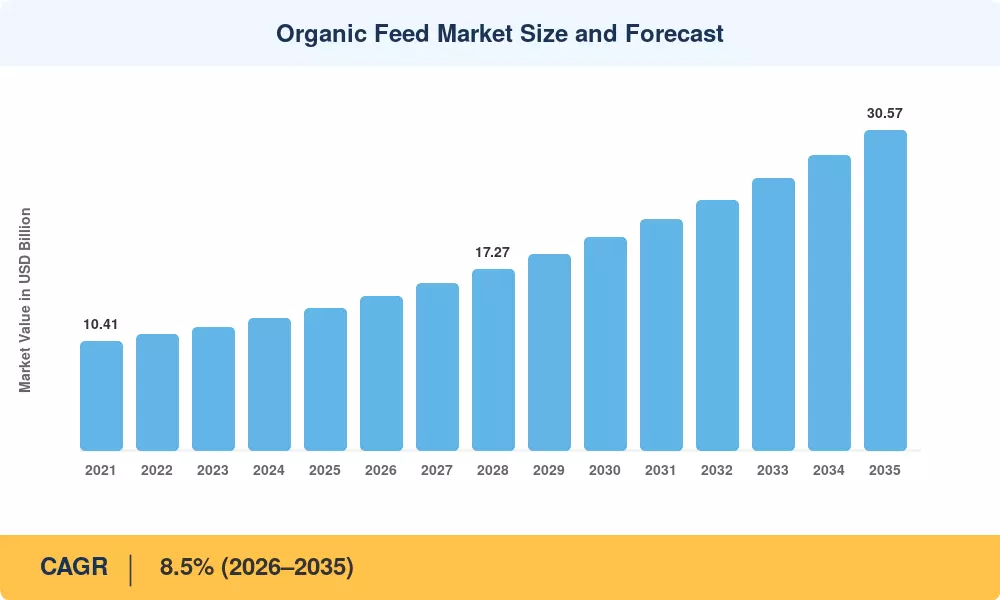
The Organic Feed Market reached a valuation of USD 13.52 Billion in 2025, reflecting sustained global demand for traceable, residue-free livestock nutrition. Starting from an estimated USD 14.67 Billion in 2026, the Organic Feed Market is projected to climb to USD 30.57 Billion by 2035, expanding at an 8.5% CAGR through the forecast period. Regulatory momentum — most notably the EU's Farm to Fork strategy targeting 25% of agricultural land under organic management by 2030 and the USDA's Organic Transition Initiative allocating over USD 300 million in direct producer support — provides a structural demand floor that commodity feed markets simply do not enjoy [1][2].
The production landscape is shifting away from conventional grain-soy rations toward precision-blended formulations that incorporate insect-protein meals, single-cell proteins, and regionally sourced legume concentrates. IFOAM – Organics International estimates that certified organic farmland expanded by 4.5 million hectares between 2020 and 2024, intensifying competition for compliant raw materials and driving vertical integration across the Organic Feed Market value chain . Digital traceability platforms — blockchain-enabled lot tracking, near-infrared feed testing — are becoming table stakes for large-scale buyers seeking to verify non-GMO and pesticide-free claims at every supply node.
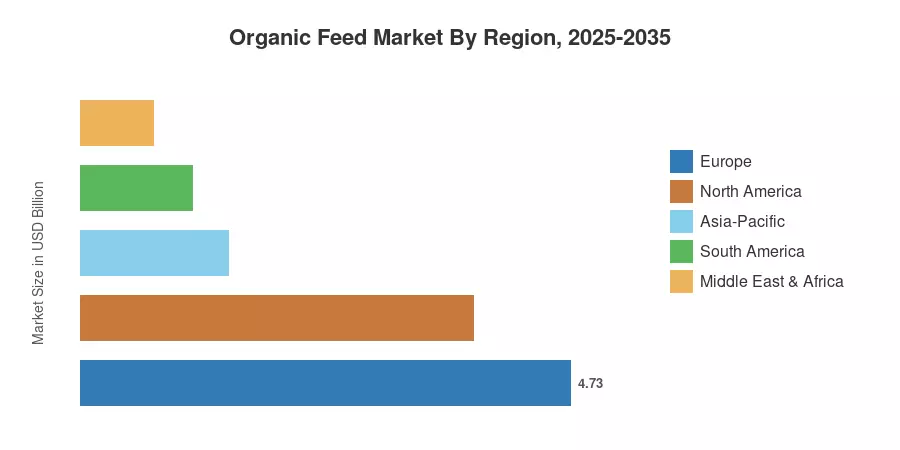
Europe commands roughly 35% of global Organic Feed Market revenue, anchored by Germany, France, and the Nordic nations where organic livestock premiums run 30–50% above conventional equivalents. Asia-Pacific is the fastest-growing region with a projected 10.6% CAGR, powered by rising middle-class protein consumption in China and India and new organic certification frameworks across ASEAN economies. North America holds the second-largest share at 28%, supported by robust consumer demand for organic dairy and eggs. The Organic Feed Market is entering a decade in which supply-chain resilience and ingredient diversification will separate margin leaders from the rest of the field.
Key Report Takeaways
• By Livestock
- Poultry accounted for 41% of the Organic Feed Market consumption in 2025, driven by the category's shorter production cycles and high consumer demand for organic eggs and broilers.
- Aquaculture is forecast to expand at a 10.7% CAGR through 2035, reflecting the rapid adoption of certified organic salmon and shrimp farming practices.
- Ruminants represented USD 3.24 Billion in the Organic Feed Market value in 2025, supported by organic dairy premiums in Europe and North America.
• By Ingredient Type
- Cereals and grains held 49% of the Organic Feed Market in 2025, with corn, wheat, and barley remaining the primary energy sources.
- Oilseeds and meals — including insect-protein meal — are projected to grow at a 13% CAGR as alternative protein approvals accelerate.
• By Form
- Pellets captured 56% of the Organic Feed Market share in 2025, favored for their dosing precision and shelf stability.
- Liquid feed formats are projected to grow at a 10.1% CAGR, gaining traction in large-scale dairy and swine operations.
• By Distribution Channel
- Direct-to-farm channels represented 49% of global sales in 2025, reflecting the preference for long-term supply contracts among large producers.
- E-commerce distribution is forecast to expand at a 12.3% CAGR, driven by smallholder and hobby-farm adoption.
• By Region
- Europe led the Organic Feed Market with a 35% revenue share in 2025, underpinned by stringent organic regulations and high consumer willingness to pay.
- Asia-Pacific is advancing at a 10.6% CAGR, the fastest pace among all regions.
Market Size and Forecast (2021–2035)
Market Research Future's sizing methodology combines bottom-up revenue aggregation across 32 country markets with top-down validation using trade data from FAO, Eurostat, and USDA Foreign Agricultural Service databases. Historical figures (2021–2024) reflect audited company revenues and customs-level import/export flows; the 2025 base year is triangulated against Q1–Q3 actuals and proprietary channel checks. Forecast values (2026–2035) apply an 8.5% CAGR, incorporating macro assumptions on organic acreage expansion, certified-crop yield improvements, and premium-price elasticity.




 Noah Malgeri
Co-Founder

 Peter Groot koerkamp
Account and Business Manager

 Younghwan Choi
Senior Retail Manager

 Mark Irwin
Management Consultant

 Akif Moroglu
Strategy & Business Development Director

 Guilherme Gomes Martins
Product Management Director

 Joseph Aguayo
Sales Operations & Pricing Manager

 La Terria Dodd
Program Support Specialist

 Rob Kooiker
Group Product Manager HVAC & Fire Protection GMA



