Optoelectronics Market Summary
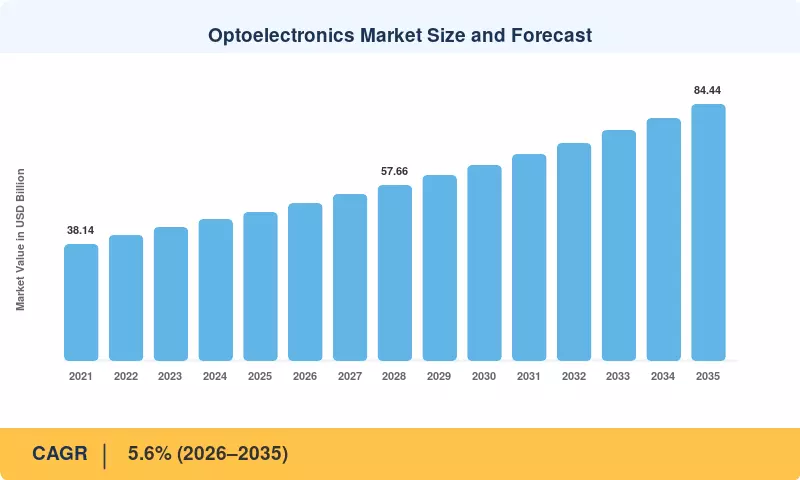
The Optoelectronics Market reached USD 48.96 Billion in 2025 and enters the forecast window at USD 51.70 Billion in 2026, climbing to USD 84.44 Billion by 2035 at a 5.6% CAGR. Two catalysts anchor that trajectory. The U.S. CHIPS and Science Act has committed more than USD 52 billion to domestic semiconductor capacity, with compound-semiconductor pilot lines drawing a growing share of awards [1]. Parallel to that, the European Chips Act mobilised EUR 43 billion in public and private capital through 2030, explicitly naming photonic integration as a strategic priority [2].
Legacy discrete lamps, copper backplanes and mechanical scanning assemblies are giving way to solid-state emitters, co-packaged optical engines and solid-state beam-steering modules. Hyperscale operators moved roughly USD 8.4 billion into optical interconnect procurement during 2024 as AI training clusters outgrew electrical signalling budgets [3]. Wide-bandgap substrates underpin the shift: gallium nitride and silicon carbide devices sustain higher switching frequencies and junction temperatures than silicon, which lets designers cut heat-sink mass and board area simultaneously.
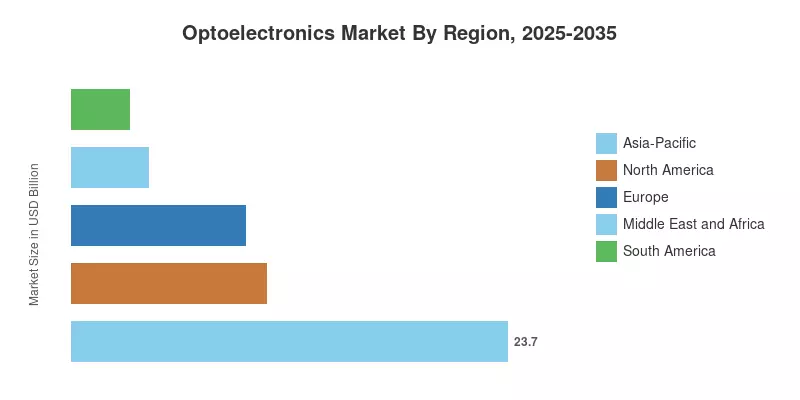
Asia-Pacific dominates with 48.4% of 2025 revenue, supported by concentrated LED, sensor and display fabrication in China, Taiwan, Japan and South Korea. Middle East and Africa is the fastest-growing region at an 8.5% CAGR, driven by border-surveillance imaging programmes and utility-scale solar build-out. North America ranks second on 21.6% share, where defence modernisation and data-centre optics sustain premium pricing. Suppliers that pair traceable material sourcing with export-control compliance will hold the strongest negotiating position through 2035.
Key Report Takeaways
• By Device Type
- LEDs held 31.6% of Optoelectronics Market revenue in 2025 on the strength of horticulture, automotive exterior and commercial display demand.
- Laser diodes are the fastest-expanding device class at a 7.3% CAGR to 2035, lifted by 3D sensing and short-reach interconnect.
• By Device Material
- Gallium Nitride (GaN) commanded a 38.1% share in 2025 on superior electron mobility and 200 mm wafer scaling
- Silicon Carbide (SiC) advances at a 7.9% CAGR as 8-inch substrate qualification unlocks fast-charging and inverter applications.
• By Application
- Lighting and Display accounted for USD 16.84 Billion of 2025 revenue
- Optical Communication and Li-Fi grows fastest at a 6.0% CAGR as hyperscalers retire copper backplanes
• By End-user Industry
- Consumer Electronics retained 42.8% of the Optoelectronics Market in 2025 on rising optical content per device
- Automotive adoption compounds at a 6.5% CAGR through 2035
• By Region
- Asia-Pacific led with 48.4% share in 2025
- Middle East and Africa posts the fastest regional growth at an 8.5% CAGR
- North America contributed USD 10.58 Billion in 2025
Market Size and Forecast (2021–2035)
Historical values were reconstructed from company segment disclosures, customs-level trade flows for optical components and wafer-start data from compound-semiconductor foundries, then reconciled against end-market shipment volumes for handsets, vehicles and data-centre transceivers. Forecast years apply a demand-side build using installed-base turnover rates and announced capacity additions, cross-checked against a top-down revenue model for the Optoelectronics Market.




 Noah Malgeri
Co-Founder

 Peter Groot koerkamp
Account and Business Manager

 Younghwan Choi
Senior Retail Manager

 Mark Irwin
Management Consultant

 Akif Moroglu
Strategy & Business Development Director

 Guilherme Gomes Martins
Product Management Director

 Joseph Aguayo
Sales Operations & Pricing Manager

 La Terria Dodd
Program Support Specialist

 Rob Kooiker
Group Product Manager HVAC & Fire Protection GMA


