Onboard Rail Catering Market (2026 - 2035)

Onboard Rail Catering Market Research Report By Catering Service (Mobile Catering, Static Catering, Other Catering Services), By Mode of Booking (Online, Offline), By Commuting Distance (Metro/Subway, Intercity, Long Range) - Forecast to 2035
ID: MRFR/AT/34921-HCR 128 Pages Shubham Munde, Sejal Akre Last Updated: October 12, 2026
Onboard Rail Catering Market
Market Size
Forecast Period2026-2035
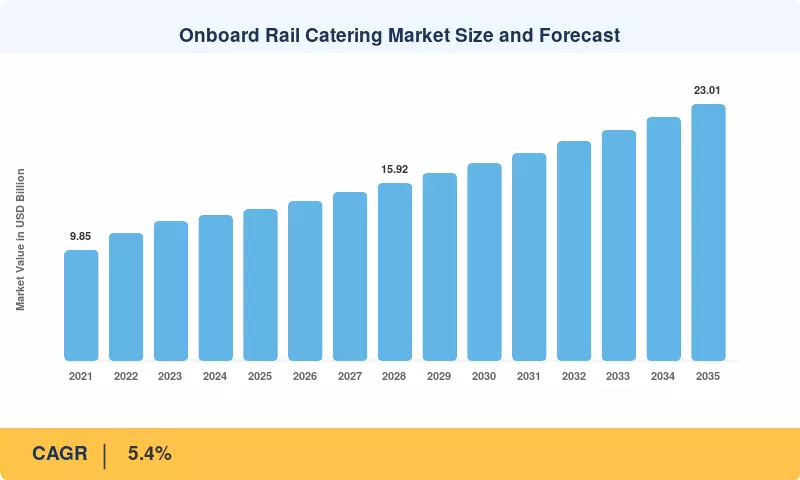
CAGR (2026-2035)5.4%
2025 Market SizeUSD 13.60 Billion
2035 Market SizeUSD 23.01 Billion
Key Players
gategroup
Indian Railway Catering and Tourism Corporation
Newrest Group
Deutsche Bahn
Elior Group
DO & CO
Opportunities
  • Emerging Rail Markets in South Asia, the Gulf and Latin America
  • Passenger Data and Loyalty-Linked Revenue
  • Reusable Packaging and Low-Waste Service Models

Onboard Rail Catering Market Summary

The Onboard Rail Catering Market was valued at USD 13.60 Billion in 2025 and is projected to reach USD 14.33 Billion in 2026, then rise to USD 23.01 Billion by 2035 at a CAGR of 5.4% over 2026–2035. Two large public funding programmes support that path. The U.S. Infrastructure Investment and Jobs Act committed USD 66 billion to passenger and freight rail [3], and India allocated ₹2.52 lakh crore in capital spending to its railways for 2025–26 [6]. More trains, longer routes and higher ridership expand the base of passengers who buy food and drink on board, which makes the Onboard Rail Catering Market a direct beneficiary of rail capital spending.

Service models are changing on the train itself. The legacy trolley cart, a fixture of intercity travel for decades, is being withdrawn on many routes. In its place, operators are adding app-based seat ordering, pre-booked meals and digital payment. Central Japan Railway ended trolley sales on the Tokaido Shinkansen in October 2023 and moved Green Car passengers to mobile ordering [10]. In India, IRCTC has opened its e-catering channel to food delivery aggregators, connecting station kitchens with passengers who order through a phone app [7][8].

North America holds the largest regional position with a 33.8% share, supported by long-distance dining on Amtrak and premium service on private intercity lines [12][13]. Asia-Pacific is the fastest-growing region at a 7.1% CAGR, driven by high-speed rail expansion in China and digital ordering in India. Europe ranks second, helped by the revival of night trains and chef-designed menus on cross-border routes [11][14]. Over the next ten years, growth will depend less on how many passengers travel by rail and more on how much each passenger spends on board.

Key Report Takeaways

• By Catering Service

  • Mobile Catering leads the Onboard Rail Catering Market with a 54.6% share, supported by trolley, at-seat and cart-based formats on intercity and long range routes
  • Static Catering, which covers dining and buffet cars, accounts for USD 5.00 Billion in 2025
  • Other Catering Services, including pre-ordered and station-delivered meals, is growing at a 6.3% CAGR

• By Mode Of Booking

  • Offline purchasing holds a 68.4% share, reflecting continued impulse buying at the café bar and trolley
  • Online booking is the fastest-growing channel in the Onboard Rail Catering Market at an 8.7% CAGR

• By Commuting Distance

  • Long range routes account for a 47.9% share, because longer trips include more meal occasions
  • Intercity services are expanding at a 6.1% CAGR as high-speed corridors open

• By Region

  • North America holds a 33.8% share
  • Asia-Pacific is the fastest-growing region at a 7.1% CAGR
  • Europe accounts for USD 4.11 Billion in 2025

Market Size and Forecast (2021–2035)

Estimates for the Onboard Rail Catering Market combine operator-level catering revenue disclosures, concession contract values, rail ridership statistics from UIC and national rail agencies, and interviews with caterers, rolling stock owners and food-service procurement leads [1][5][7]. Historical values reflect reported recovery from pandemic-era service suspensions. Forecast values apply ridership growth, spend-per-passenger trends and service-mix changes by region.
Onboard Rail Catering Market Size and Forecast
Our Impact

Enabled $4.3B Revenue Impact for Fortune 500 and Leading Multinationals

Partnering with 2000+ Global Organizations Each Year

30K+ Citations by Top-Tier Firms in the Industry

Driver Impact Analysis

The impact percentages below are directional estimates of how much each driver contributes to growth in the Onboard Rail Catering Market. They overlap and should not be added together to reproduce the headline CAGR. Timelines refer to when each driver has its strongest effect: short-term (two years or less), medium-term (two to four years) and long-term (four years or more).

Driver ~% Impact on CAGR Geographic Relevance Impact Timeline
Rising rail passenger volumes +1.2% Global, led by Asia-Pacific Long-term
High-speed and intercity rail build-out +1.0% Asia-Pacific, Europe, North America Medium-term
Digital pre-ordering and e-catering platforms +0.9% India, Japan, Europe Short-term
Premium, chef-led menus +0.6% Europe, North America Medium-term
Night train revival +0.5% Europe Long-term
Food safety certification programmes +0.4% India, Global Medium-term


Rising Rail Passenger Volumes

There are more potential clients for onboard food and drink if there are more rail travelers. In 2024, China's railroads transported a record 4.3 billion passenger journeys [5]. In fiscal 2024, Amtrak reported a record 32.8 million passengers [12]. According to IEA projections, existing policies might cause global rail passenger traffic to nearly treble by 2050 [2]. Even before any shift in the amount spent per trip, each of these numbers indicates an expanding base of purchasers.


High-Speed and Intercity Rail Build-Out

Travel times of two to five hours are produced by faster trains on longer lines, which is ideal for buying a meal or snack. By the end of 2024, China's high-speed network covered over 48,000 kilometers [5]. With a USD 3 billion federal grant, Brightline West began construction in the United States in April 2024 [4]. The expense of launching a culinary service is reduced because new corridors typically include contemporary galleys integrated into the rolling stock.


Digital Pre-Ordering and E-Catering Platforms

Apps let passengers order before boarding or from their seat, which raises conversion and reduces waste. IRCTC's e-catering channel has grown from about 20,000 daily orders a few years ago to a much larger network of partner kitchens [7]. Partnerships with Zomato in 2024 and Swiggy later that year extended delivery to major stations [8][9]. In Japan, JR Central moved Green Car sales to mobile ordering in 2023 [10].

Premium, Chef-Led Menus

Operators use food to justify higher fares in business and premium classes. Eurostar restructured its classes in October 2023, and food service is a clear part of the difference between Standard, Plus and Premier [11]. Brightline includes complimentary food and drinks in its Premium class, which has helped the brand compete with short-haul flights in Florida [13]. Higher-value meals raise average spend per passenger.

Night Train Revival

Overnight trains need dinner and breakfast service, which makes them some of the highest-value catering routes. ÖBB introduced its new-generation Nightjet trains in December 2023 as part of an order for 33 sets [14]. Several European operators have added or restored overnight links since 2021. Every new sleeper service brings a dedicated catering requirement and usually a contract for a specialist caterer.

Food Safety Certification Programmes

Formal hygiene standards build passenger trust and encourage spending. India's FSSAI runs the Eat Right Station certification, which audits food handling at railway stations and base kitchens [15]. Certified kitchens supply both static and e-catering channels. Clear standards also favour established caterers, who can absorb audit and compliance costs more easily than small vendors.

Restraints Impact Analysis

Restraint ~% Impact on CAGR Geographic Relevance Impact Timeline
Labour cost inflation −0.7% Europe, North America Short-term
Service withdrawals on low-margin routes −0.6% Japan, Europe Medium-term
Substitution by station retail and delivery −0.4% Global Short-term
Packaging and waste compliance costs −0.3% Europe Medium-term
Space constraints in new rolling stock −0.3% Global Long-term


Labour Cost Inflation

Wage hikes directly affect margins because onboard catering relies on skilled employees who travel with the train. In April 2024 and April 2025, the UK National Living Wage increased by 9.8% and 6.7%, respectively, to £12.21 per hour [18]. Caterers respond to similar challenges in the U.S. and Western Europe by reducing staffed services on shorter journeys, which restricts revenue growth on such routes.


Service Withdrawals on Low-Margin Routes

When sales levels are insufficient to meet expenses, some operators have ceased onboarding. Tokaido Shinkansen trolley sales were discontinued by JR Central in October 2023 due to staffing constraints and an increase in passengers purchasing meals prior to boarding [10]. Additionally, trolley service has been discontinued on a number of regional routes in Europe. Every withdrawal eliminates a source of income that seldom recovers rapidly.


Substitution by Station Retail and Delivery

Passengers can buy cheaper food at the station before boarding. Large station retail operators, such as SSP Group, continue to expand food outlets at major rail hubs [22]. App-based delivery to the platform also diverts some spending away from traditional onboard sales [8]. Onboard caterers have to compete on convenience and quality rather than on captive demand alone.

Packaging and Waste Compliance Costs

European rules raise the cost of single-use packaging. The Single-Use Plastics Directive restricted several common food-service items from 2021 [17]. The Packaging and Packaging Waste Regulation, in force since February 2025, adds reuse obligations for food-service operators in the coming years [16]. Caterers face spending on reusable containers, washing capacity and return logistics.

Space Constraints in New Rolling Stock

Train designers often favour more seats over large galleys, especially on commuter and regional trains. Smaller kitchens limit hot food options and storage, which caps the range of products that can be sold on board. This constraint shapes demand on metro and short intercity routes for years, because rolling stock stays in service for decades [1].

Onboard Rail Catering Market Opportunities

Emerging Rail Markets in South Asia, the Gulf and Latin America

New passenger lines in fast-growing economies offer greenfield catering contracts. India continues to roll out Vande Bharat services, Mexico opened the Tren Maya in December 2023 with restaurant cars on its long-distance class, and Etihad Rail is preparing passenger services in the UAE [6][24][25]. For caterers, this is a chance to enter the Onboard Rail Catering Market in regions where demand is still forming.

Passenger Data and Loyalty-Linked Revenue

Digital ordering produces data on what passengers buy, when and on which route. Operators can use that data for targeted offers, menu planning and partnerships with food brands. Linking catering to rail loyalty programmes also gives operators a new revenue model, where meal bundles are sold with tickets rather than on board.

Reusable Packaging and Low-Waste Service Models

Regulation creates a market for caterers that can run reuse systems at scale. Operators that invest early in returnable containers and onboard sorting can win contracts from rail companies with public sustainability targets [16][20]. These capabilities can become a selling point in tenders rather than only a cost.

Seat-Delivery Technology and Contactless Retail

QR-code menus, seat-delivery apps and cashless payments reduce the need for staffed trolleys while keeping sales on board. Japan's shift to mobile ordering shows how operators can keep revenue after removing trolleys [10]. Vendors offering integrated ordering, payment and inventory software have an opening with operators across all route types.

Partnerships with Food Delivery Platforms

Aggregators bring brand choice and marketing reach that rail operators lack. India's IRCTC partnerships with Zomato and Swiggy show how a rail operator can earn commission on meals prepared by restaurant partners [8][9]. Similar models could work in Southeast Asia and Latin America, where delivery apps already have wide adoption.

Onboard Rail Catering Market Future Outlook

AI-Based Demand Forecasting and Waste Reduction

Caterers will use booking and sales data to predict how much food each train needs. That matters because waste is costly. Another source estimates that about 1.05 billion tonnes of food were wasted in 2022, with food service accounting for a large share [19]. Better forecasting will cut waste on board and lift margins, giving data-led operators an advantage in the Onboard Rail Catering Market.

Platform Economics and Marketplace Models

More operators will open their catering channels to outside restaurants and delivery apps. The rail operator becomes a marketplace, earning a commission rather than running every kitchen. India already shows this model at scale [8][9]. Through 2035, tenders may increasingly reward platform integration as much as kitchen capacity.

High-Speed Rail Expansion

High-speed and intercity networks will keep growing in Asia, Europe and North America. UIC data show steady growth in high-speed track length worldwide, led by China [1][5]. Each new corridor creates trips of the length most likely to produce food sales, and often comes with modern galleys designed for efficient service.

Sustainability Reporting and Packaging Rules

Large rail operators in Europe now report on sustainability under the Corporate Sustainability Reporting Directive [20]. Catering waste and packaging appear in those reports, so caterers will be asked for data on waste, sourcing and emissions. Those that can supply audited figures and reusable service models will be better placed to keep and win contracts.

Regional Market Share Analysis

Region Metric (2025) Primary Investment Themes
North America 33.8% share Long-distance dining, premium intercity service
Europe USD 4.11 Billion Night trains, cross-border premium classes
Asia-Pacific 7.1% CAGR High-speed rail, app-based e-catering
Latin America 4.9% share New long-distance passenger lines
Middle-East and Africa 5.9% CAGR Greenfield high-speed and intercity rail
Total USD 13.60 Billion —

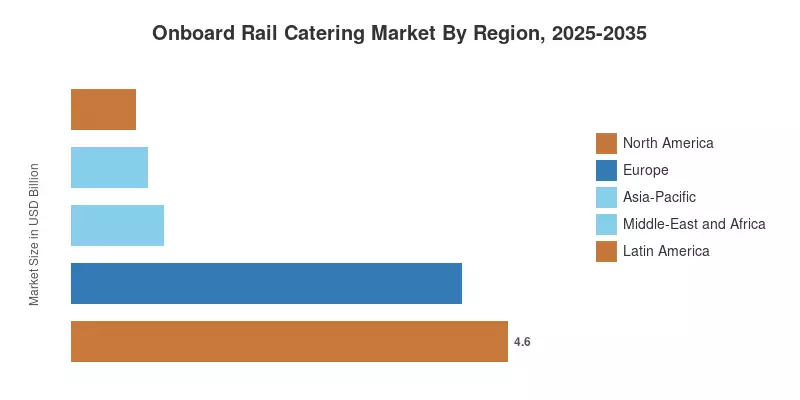
Regional demand in the Onboard Rail Catering Market follows rail network size, trip length and the share of premium-class travel. Mature networks support dining cars and premium service, while fast-growing networks add volume through digital ordering.


North America

Country Metric Key Driver
United States 78.5% share of region Amtrak long-distance dining and private intercity premium service
Canada USD 0.71 Billion VIA Rail long-haul and corridor services
Rest Of North America 4.6% CAGR Limited but growing tourist rail services


Federal funding is the main force behind growth in the U.S. The Infrastructure Investment and Jobs Act provides USD 66 billion for rail, part of which supports Amtrak fleet renewal and new corridors [3]. Amtrak's NextGen Acela trains entered service in August 2025 with a redesigned café, and Brightline's Miami–Orlando extension has added premium-class food service on a three-hour route [12][13]. In Canada, VIA Rail's corridor fleet renewal is creating demand for updated onboard service formats.

Europe

Country Metric Key Driver
Germany 27.6% share of region Deutsche Bahn ICE bistro and restaurant cars
United Kingdom USD 1.02 Billion Intercity premium classes and Eurostar routes
France 5.6% CAGR TGV bar service and night train links
Rest of Europe 34.0% share of region Austrian, Italian and Spanish high-speed and night trains


European demand reflects both scale and service quality. Deutsche Bahn operates one of the largest in-house onboard catering operations, while Eurostar uses food to separate its three travel classes [11]. ÖBB's new Nightjet fleet is driving demand for dinner and breakfast service across Central Europe [14]. New EU packaging rules will push caterers towards reuse systems, which raises costs but rewards operators with strong logistics [16].

Asia-Pacific

Country Metric Key Driver
India 9.3% CAGR IRCTC e-catering and Vande Bharat expansion
China 41.2% share of region High-speed rail volume and onboard meal service
Japan USD 0.79 Billion Shinkansen mobile ordering and station-bought meals
South Korea 6.4% CAGR KTX intercity travel growth
Rest of Asia-Pacific 13.8% share of region New rail lines in Southeast Asia


China's high-speed network gives the region its volume, with about 4.3 billion rail passenger trips in 2024 [5]. India adds the fastest growth through its e-catering platform, which connects certified station kitchens to passengers through IRCTC and its delivery partners [7][8][9]. Japan shows the opposite trend on some routes, where trolley service has given way to mobile ordering and station purchases [10]. Southeast Asian countries are opening new intercity lines that will need catering services.

Latin America

Country Metric Key Driver
Mexico 6.2% CAGR Tren Maya long-distance and restaurant car service
Brazil 44.5% share of region Tourist and regional passenger rail
Argentina USD 0.09 Billion Long-distance state-run passenger services
Rest Of Latin America 4.8% CAGR Tourist rail in Peru and Chile


Passenger rail is a small part of transport in Latin America, but new projects are changing that. Mexico's Tren Maya, opened in December 2023, includes a long-distance class with a restaurant car [25]. Brazil's activity centres on tourist and regional lines. Argentina's long-distance trains continue to operate with basic onboard food service, leaving room for upgrades as fleets are renewed.

Middle-East and Africa

Country Metric Key Driver
United Arab Emirates 6.8% CAGR Etihad Rail passenger service launch
Saudi Arabia 32.6% share of region Haramain High-Speed Railway and pilgrimage travel
Rest Of Middle-East and Africa USD 0.19 Billion Egyptian, Moroccan and South African intercity rail


Gulf governments are building rail as part of wider economic plans. Saudi Arabia's Haramain line carries large volumes during pilgrimage seasons, which creates peak demand for halal meal service. The UAE's Etihad Rail is preparing passenger services that will link major emirates [24]. In North Africa, Morocco's Al Boraq high-speed line and Egypt's planned high-speed network add further catering opportunities.

Onboard Rail Catering Market By Region, 2025-2035

Onboard Rail Catering Market Segmentation

By Catering Service

Segment Metric (2025) Primary Demand Driver
Mobile Catering 54.6% share Trolley and at-seat service on intercity and long range trains
Static Catering USD 5.00 Billion Dining and buffet cars on long-distance routes
Other Catering Services 6.3% CAGR Pre-ordered and station-delivered meals


Within the Onboard Rail Catering Market, Mobile Catering leads because it serves passengers at their seats and works on trains without full dining cars. Static Catering remains central on long-distance and night trains, where passengers expect a sit-down meal or a staffed bar. Other Catering Services, which include pre-ordered meals delivered at stations, grows fastest as digital ordering spreads, especially in India and parts of Europe. Operators increasingly combine all three formats on a single route to reach different passenger groups.

By Mode Of Booking

Segment Metric (2025) Primary Demand Driver
Online 8.7% CAGR Mobile apps, aggregator partnerships and ticket-linked meal bundles
Offline 68.4% share Impulse purchases at café bars and trolleys


Offline buying still dominates the Onboard Rail Catering Market, because many passengers decide to buy food only after boarding. Online booking is growing fastest, helped by app-based seat ordering in Japan and e-catering partnerships in India [8][10]. Online orders allow caterers to plan quantities ahead and reduce waste. The two channels are converging, with QR menus letting passengers order digitally after boarding.

By Commuting Distance

Segment Metric (2025) Primary Demand Driver
Metro/Subway USD 0.68 Billion Station-adjacent kiosks and vending on selected lines
Intercity 6.1% CAGR High-speed corridors with two-to-five-hour trips
Long range 47.9% share Multiple meal occasions on long-distance and night trains


Long range routes generate the largest share of the Onboard Rail Catering Market, because passengers on long journeys often buy more than one meal. Intercity routes grow fastest, supported by new high-speed lines in China, Europe and the U.S. [4][5]. Metro/Subway remains small, since short trips and limited onboard space leave little room for catering. Most metro-related sales come from vending and station-based outlets.

Competitive Benchmarking

Competition in the Onboard Rail Catering Market is fragmented. The top five players hold an estimated 32–38% of global revenue, and the Herfindahl-Hirschman Index is estimated at 650–800, well below the threshold for a concentrated market. National rail operators often run catering in-house or award long-term concessions to specialist caterers, which keeps regional players strong. Large multinational food-service groups compete for major contracts, while local firms win smaller routes and station-linked services.

Company Est. Revenue Share Range Key Offerings for Onboard Rail Catering Market Strategic Positioning
gategroup (Rail Gourmet) ~8–11% Onboard trolley, bar and dining car service Specialist rail caterer with European contracts
Indian Railway Catering and Tourism Corporation (IRCTC) ~7–10% Base kitchens, onboard meals and e-catering platform State-backed operator with digital marketplace model
Newrest Group ~5–8% Onboard bar and catering on high-speed trains Multi-sector caterer with strong French rail presence
Deutsche Bahn (DB Fernverkehr) ~4–7% In-house bistro and restaurant cars on ICE trains Vertically integrated operator-caterer
Elior Group ~3–6% Contract catering for rail operators Food-service group with transport concession experience
DO & CO ~3–5% Premium onboard catering on Austrian services Premium positioning built on airline catering expertise
SSP Group ~2–4% Station food outlets and selected onboard services Station retail leader extending into rail travel
Compass Group ~2–4% Contract food service for transport clients Global scale and procurement strength
Cremonini Group (Chef Express) ~2–4% Onboard catering on Italian high-speed trains Regional leader in Italian rail catering
Sodexo ~1–3% Contract catering and facilities services Diversified food-service provider with transport contracts


Recent News & Developments

  • Brightline (September 2023): Opened its Miami–Orlando extension, adding premium-class food and beverage service on a roughly three-hour intercity route and showing how onboard food can support premium fares [13]
  • Eurostar (October 2023): Launched new travel classes after integrating Thalys, with food service as a defining feature of the Plus and Premier offers [11]
  • Central Japan Railway (October 2023): Ended trolley sales on the Tokaido Shinkansen and moved Green Car passengers to mobile ordering, a clear example of the shift from carts to digital service [10]
  • ÖBB (December 2023): Introduced its new-generation Nightjet trains, expanding demand for overnight dinner and breakfast service in Europe [14]
  • Zomato and IRCTC (February 2024): Began pre-ordered meal delivery to trains at selected stations, extending aggregator reach into rail travel [8]
  • Swiggy and IRCTC (November 2024): Launched pre-ordered meal delivery at railway stations, adding a second major platform to India's e-catering channel [9]
  • European Union (February 2025): The Packaging and Packaging Waste Regulation entered into force, setting future reuse requirements for food-service packaging used on trains [16]
  • Amtrak (August 2025): Put NextGen Acela trains into service with a redesigned café car on the Northeast Corridor, a high-traffic route that remains important for the Onboard Rail Catering Market [12]

Onboard Rail Catering Market Report Scope

Parameter Details
Market Scope Food and beverage services sold or provided on passenger trains through mobile, static and other catering formats, booked online or offline, across metro, intercity and long range routes
Study Period 2021–2035
Base Year 2025
Historical Data 2021–2024
Forecast Period 2026–2035
Market Size in 2025 USD 13.60 Billion
Market Size in 2035 USD 23.01 Billion
CAGR (2026–2035) 5.4%
Fastest Growing Segments Online (8.7% CAGR); Other Catering Services (6.3% CAGR); Intercity (6.1% CAGR)
Regions Covered North America, Europe, South America, Asia Pacific, Middle East and Africa and ROW
Companies Profiled gategroup (Rail Gourmet), Indian Railway Catering and Tourism Corporation (IRCTC), Newrest Group, Deutsche Bahn (DB Fernverkehr), Elior Group, DO & CO, SSP Group, Compass Group, Cremonini Group (Chef Express), Sodexo
Valuation Currency USD Billion
Methodology 350+ primary expert interviews; bottom-up market sizing; top-down validation; data triangulation; scenario-based forecasting; real-time project tracking

FAQs

How are contracts usually structured in the Onboard Rail Catering Market?
Most contracts are concessions, where the caterer pays the rail operator a fee or revenue share and keeps sales income. Some operators prefer management contracts, paying the caterer a fixed fee while keeping commercial risk themselves [21].
What should rail operators check when choosing a caterer in the Onboard Rail Catering Market?
Operators should check food safety certification, base kitchen locations along the route and the caterer's ability to report waste and sales data. Proven experience with rolling stock galleys also reduces start-up risk [15].
Is in-house catering common in the Onboard Rail Catering Market?
Yes, several large operators run catering themselves, with Deutsche Bahn as a leading example. Outsourcing is more common where operators want to share commercial risk or lack food-service expertise.
How do trolley services compare with café cars on cost?
Trolleys reach passengers at their seats but need more staff per sale. Café cars have lower staffing needs per transaction but rely on passengers walking through the train to buy.
Which allergen rules apply to food sold on cross-border European trains?
Food sold in the EU must identify 14 major allergens under Regulation (EU) No 1169/2011. Services entering Great Britain must also follow UK labelling rules, including requirements for prepacked food for direct sale.
Why do galley upgrades matter during fleet refurbishment?
Refurbishment is often the only practical time to change kitchen layout, power supply and storage. A better galley allows hot meals and wider menus, which can raise spend per passenger for the life of the train.
How do caterers meet halal and regional dietary needs on board?
Caterers source certified ingredients and keep separate preparation lines at base kitchens. On Gulf and Indian routes, halal, vegetarian and Jain options are standard expectations rather than special requests.
Author
Author Author Profile Shubham Munde LinkedIn Team Lead - Research
Shubham brings over 7 years of expertise in Market Intelligence and Strategic Consulting, with a strong focus on the Automotive, Aerospace, and Defense sectors. Backed by a solid foundation in semiconductors, electronics, and software, he has successfully delivered high-impact syndicated and custom research on a global scale. His core strengths include market sizing, forecasting, competitive intelligence, consumer insights, and supply chain mapping. Widely recognized for developing scalable growth strategies, Shubham empowers clients to navigate complex markets and achieve a lasting competitive edge. Trusted by start-ups and Fortune 500 companies alike, he consistently converts challenges into strategic opportunities that drive sustainable growth.
Co-Author Co-Author Profile Sejal Akre LinkedIn Senior Research Analyst
She has over 5 years of rich experience, in market research and consulting providing valuable market insights to client. Hands on expertise in management consulting, and extensive knowledge in domain including ICT, Automotive & Transportation and Aerospace & Defense. She is skilled in Go-to market strategy, industry analysis, market sizing, in depth company profiling, competitive intelligence & benchmarking and value chain amongst others.
Download Free Sample

Kindly complete the form below to receive a free sample of this Report

Download PDF ×

We do not share your information with anyone. However, we may send you emails based on your report interest from time to time. You may contact us at any time to opt-out.

















