×
Request Free Sample ×

Kindly complete the form below to receive a free sample of this Report

* Please use a valid business email

Leading companies partner with us for data-driven Insights

clients tt-cursor
Hero Background

Myasthenia Gravis Disease Market

ID: MRFR/Pharma/4387-HCR
200 Pages
Rahul Gotadki
October 2025

Myasthenia Gravis Disease Market Research Report By Treatment Type (Immunosuppressants, Cholinesterase Inhibitors, Monoclonal Antibodies, Plasmapheresis, Intravenous Immunoglobulin), By Diagnosis Method (Electromyography, Blood Tests, CT Scan, MRI, Edrophonium Test), By Patient Demographics (Adults, Children, Elderly), By Distribution Channel (Hospitals, Pharmacies, Online Stores), and By Regional (North America, Europe, South America, Asia Pacific, Middle East and Africa) - Forecast to 2035

Share:
Download PDF ×

We do not share your information with anyone. However, we may send you emails based on your report interest from time to time. You may contact us at any time to opt-out.

Myasthenia Gravis Disease Market Infographic
Purchase Options

Myasthenia Gravis Disease Market Summary

As per MRFR analysis, the Myasthenia Gravis Disease Market Size was estimated at 1327.42 USD Million in 2024. The Myasthenia Gravis industry is projected to grow from 1432.55 in 2025 to 3070.01 by 2035, exhibiting a compound annual growth rate (CAGR) of 7.92 during the forecast period 2025 - 2035.

Key Market Trends & Highlights

The Myasthenia Gravis Disease Market is experiencing a transformative shift towards innovative therapies and increased patient engagement.

  • The emergence of targeted therapies is reshaping treatment paradigms in the Myasthenia Gravis market.
  • North America remains the largest market, while the Asia-Pacific region is identified as the fastest-growing area for Myasthenia Gravis treatments.
  • Anticholinesterase inhibitors dominate the market, yet monoclonal antibodies are rapidly gaining traction as the fastest-growing segment.
  • Rising prevalence of Myasthenia Gravis and advancements in research and development are key drivers propelling market growth.

Market Size & Forecast

2024 Market Size 1327.42 (USD Million)
2035 Market Size 3070.01 (USD Million)
CAGR (2025 - 2035) 7.92%

Major Players

Roche (CH), Bristol-Myers Squibb (US), Sanofi (FR), Novartis (CH), Pfizer (US), Amgen (US), Eisai (JP), Alexion Pharmaceuticals (US), Merck & Co. (US)

Myasthenia Gravis Disease Market Trends

The Myasthenia Gravis Disease Market is currently experiencing notable developments driven by advancements in treatment options and increased awareness of the condition. As healthcare professionals and researchers delve deeper into the complexities of this autoimmune disorder, innovative therapies are emerging, potentially transforming patient outcomes. The market appears to be influenced by a growing emphasis on personalized medicine, which tailors treatments to individual patient profiles, thereby enhancing efficacy and minimizing side effects. Furthermore, the collaboration between pharmaceutical companies and research institutions seems to be fostering a conducive environment for the discovery of novel therapeutic agents. In addition to therapeutic advancements, the Myasthenia Gravis Disease Market is witnessing a rise in patient advocacy and support networks. These organizations play a crucial role in educating the public and healthcare providers about the disease, which may lead to earlier diagnosis and improved management strategies. The increasing prevalence of the condition, coupled with a heightened focus on research funding, suggests that the market is poised for growth. As stakeholders continue to prioritize the needs of patients, the landscape of the Myasthenia Gravis Disease Market is likely to evolve, presenting new opportunities for innovation and collaboration.

Emergence of Targeted Therapies

The Myasthenia Gravis Disease Market is seeing a shift towards targeted therapies that focus on specific pathways involved in the disease. This approach may enhance treatment effectiveness and reduce adverse effects, offering patients more tailored options.

Increased Patient Advocacy

There is a noticeable rise in patient advocacy groups dedicated to Myasthenia Gravis. These organizations are instrumental in raising awareness, promoting research funding, and providing support, which could lead to improved patient outcomes.

Focus on Personalized Medicine

The trend towards personalized medicine is becoming more pronounced within the Myasthenia Gravis Disease Market. By customizing treatment plans based on individual patient characteristics, healthcare providers may achieve better management of the disease.

Myasthenia Gravis Disease Market Drivers

Market Trends and Projections

The Global Myasthenia Gravis Disease Market Industry is characterized by various trends that indicate a positive growth trajectory. Current projections suggest that the market will achieve a value of 2.01 USD Billion in 2024, with an anticipated CAGR of 5.96% from 2025 to 2035. This growth is driven by factors such as increasing prevalence, advancements in treatment options, and supportive government policies. The market's expansion reflects the ongoing commitment to improving patient care and developing innovative therapies. As the industry evolves, it is essential to monitor these trends to understand their implications for future market dynamics.

Supportive Government Policies

Government initiatives aimed at improving healthcare access and funding for rare diseases are positively impacting the Global Myasthenia Gravis Disease Market Industry. Policies that promote research funding and support for clinical trials are essential for advancing treatment options. For example, various countries have established rare disease registries and funding mechanisms to facilitate research. These supportive measures are likely to enhance the development of new therapies, thereby expanding the market. As the industry grows, it is anticipated that the market will reach a valuation of 2.01 USD Billion in 2024, reflecting the positive influence of government involvement in healthcare.

Growing Awareness and Diagnosis

The Global Myasthenia Gravis Disease Market Industry benefits from increasing awareness among healthcare professionals and the general public. Enhanced educational initiatives and advocacy efforts are leading to earlier diagnosis and treatment, which is crucial for managing the disease effectively. As more individuals recognize the symptoms and seek medical advice, the number of diagnosed cases is expected to rise. This trend is likely to contribute to the market's expansion, with projections indicating a compound annual growth rate (CAGR) of 5.96% from 2025 to 2035. The focus on early intervention may also lead to improved patient outcomes and reduced healthcare costs.

Advancements in Treatment Options

Innovations in treatment modalities for Myasthenia Gravis are significantly influencing the Global Myasthenia Gravis Disease Market Industry. The development of monoclonal antibodies and immunotherapies has transformed patient management, offering more effective and targeted approaches. For instance, therapies such as eculizumab have shown promising results in clinical trials, leading to improved patient outcomes. As these advanced treatments gain regulatory approval and enter the market, they are expected to contribute to the market's growth trajectory, potentially reaching a value of 3.8 USD Billion by 2035. The ongoing research and development efforts indicate a robust pipeline of therapies that may enhance patient quality of life.

Emerging Markets and Global Expansion

The Global Myasthenia Gravis Disease Market Industry is experiencing growth in emerging markets, where increased healthcare investments and rising awareness are driving demand for treatment options. Countries in Asia-Pacific and Latin America are witnessing a surge in healthcare infrastructure development, which is likely to enhance access to Myasthenia Gravis therapies. This expansion into new markets presents significant opportunities for pharmaceutical companies. As these regions develop, the market is projected to grow, potentially reaching 3.8 USD Billion by 2035. The increasing focus on healthcare access in these areas may lead to improved patient outcomes and a broader market reach.

Increasing Prevalence of Myasthenia Gravis

The Global Myasthenia Gravis Disease Market Industry is witnessing a notable rise in prevalence rates, which is likely to drive market growth. Current estimates suggest that the incidence of Myasthenia Gravis is approximately 20 per 100,000 individuals globally. This increasing prevalence necessitates enhanced healthcare resources and treatment options, thereby expanding the market. As awareness of the disease grows, more patients are diagnosed, contributing to the projected market value of 2.01 USD Billion in 2024. The rising number of patients emphasizes the need for innovative therapies and management strategies, which could further stimulate market dynamics.

Market Segment Insights

By Treatment Type: Anticholinesterase Inhibitors (Largest) vs. Monoclonal Antibodies (Fastest-Growing)

In the Myasthenia Gravis Disease Market, the Treatment Type segment is characterized by a diverse range of therapeutic options, with Anticholinesterase Inhibitors dominating the market share due to their long-standing presence and effectiveness in symptom management. These agents are crucial for enhancing neuromuscular transmission, making them a cornerstone in treatment regimens. Immunosuppressants, while significant, hold a smaller share compared to Anticholinesterase Inhibitors but play a vital role in reducing autoimmune responses. Monoclonal Antibodies, despite being newer entrants, are rapidly gaining traction, responding to the increasing demand for targeted therapies.

Treatment Type: Anticholinesterase Inhibitors (Dominant) vs. Monoclonal Antibodies (Emerging)

Anticholinesterase Inhibitors are the dominant treatment modality in the Myasthenia Gravis Disease Market, providing established benefits in managing symptoms effectively. Their ability to inhibit acetylcholinesterase allows for improved neuromuscular transmission, thereby alleviating muscle weakness in patients. Conversely, Monoclonal Antibodies represent an emerging treatment avenue, utilizing advanced biotechnology to target specific pathways in the immune response. This tailored approach positions them as a promising future option, especially as clinical evidence supporting their efficacy continues to grow. The increasing adoption of these therapies reflects a broader trend towards personalized medicine, catering to the unique needs of Myasthenia Gravis patients.

By Disease Severity: Moderate (Largest) vs. Severe (Fastest-Growing)

The Myasthenia Gravis Disease market is largely segmented by disease severity, with the Moderate category currently holding the largest share. This prevalence is driven by the growing recognition of symptoms in patients who are experiencing moderate levels of muscle weakness, which comprises a significant segment of those diagnosed. Following closely are the Severe and Crisis segments, which, although smaller in comparison, have also shown considerable numbers amidst patient populations seeking treatment options. The Asymptomatic segment, though not classified under traditional severity scales, indicates a notable presence within the market owing to its crucial role in diagnostics and management of the disease.

Moderate (Dominant) vs. Severe (Emerging)

In the Myasthenia Gravis Disease market, the Moderate segment stands out as the most dominant category, reflecting a broader patient base actively seeking therapeutic options. Characterized by patients experiencing moderate muscle weakness and fatigue, this segment often has a well-defined treatment pathway, allowing for timely intervention. Conversely, the Severe segment, marked by profound weakness that requires acute management, has emerged rapidly in recent years. This rise in severe cases can be attributed to factors such as increased awareness of the disease and advancements in diagnostic techniques. Both segments face unique challenges and opportunities, with the Moderate category benefiting from established treatment protocols, while the Severe segment demands innovative solutions to manage escalating health concerns.

By Patient Demographics: Age Group (Largest) vs. Gender (Fastest-Growing)

In the Myasthenia Gravis Disease Market, age demographics significantly shape treatment dynamics. The largest segment, comprising patients aged 50-70, dominates the patient population, reflecting the typical onset age for the disease. In contrast, younger cohorts, particularly individuals aged 18-35, are emerging as the fastest-growing segment, due to increasing awareness and improved diagnostic practices that facilitate earlier identification of the condition.

Age Group: 50-70 (Dominant) vs. 18-35 (Emerging)

Patients aged 50-70 represent the dominant cohort in the Myasthenia Gravis Disease Market, showcasing a strong need for tailored treatment approaches and support systems. This group tends to experience more severe symptoms and increased comorbidities, necessitating a comprehensive management strategy. Meanwhile, the emerging 18-35 age group is increasingly recognized due to the advancements in awareness and treatments, fostering a shift in disease perception. Their rising visibility may influence market dynamics, prompting the development of targeted therapies and patient-centric services.

By Administration Route: Oral (Largest) vs. Intravenous (Fastest-Growing)

In the Myasthenia Gravis Disease Market, the administration route segment reveals a competitive landscape with varying shares. Oral administration is currently the largest share with a significant portion of patient preference due to its ease of use and convenience. Conversely, Intravenous administration is gaining momentum, rapidly capturing market attention owing to its effectiveness in severe cases. Other routes like Subcutaneous and Intramuscular account for a smaller share, primarily chosen based on patient-specific factors and medical guidelines.

Administration Route: Oral (Dominant) vs. Intravenous (Emerging)

Oral administration remains the dominant route for Myasthenia Gravis treatment, favored for its simplicity and patient compliance. This route typically involves convenient tablets or capsules, making it the preferred choice for long-term management of the disease. On the other hand, Intravenous administration is emerging as a critical alternative, especially in acute situations where rapid therapeutic effects are needed. This method allows for higher drug bioavailability, proving to be indispensable in severe cases. As the market evolves, the growing need for effective treatment solutions is likely to enhance the position of Intravenous administration further.

By Healthcare Setting: Hospital (Largest) vs. Outpatient Clinic (Fastest-Growing)

In the Myasthenia Gravis Disease Market, hospitals stand out as the largest segment, accommodating a majority of patients requiring intensive treatment and monitoring. They provide comprehensive care resources, including specialized neurologists and access to advanced diagnostic tools, ensuring the best outcomes for patients. Meanwhile, outpatient clinics are rapidly gaining prominence, driven by an increasing preference for less invasive treatments and follow-up care. These facilities support a growing number of patients seeking convenience and specialized care without the need for hospitalization.

Hospital (Dominant) vs. Outpatient Clinic (Emerging)

Hospitals play a dominant role in the Myasthenia Gravis Disease Market, primarily due to their capacity to provide specialized care and acute management for complex cases. These settings are resource-rich, offering a full range of diagnostic and therapeutic services, including nerve conduction studies and immunotherapies. In contrast, outpatient clinics are emerging as a significant player, reflecting changing patient preferences towards more accessible care options. They emphasize patient-centered treatment, focusing on routine management and follow-ups, thus catering to the growing population of stable patients. This shift aligns with broader healthcare trends towards outpatient services, allowing patients to receive care in a less stressful environment.

Get more detailed insights about Myasthenia Gravis Disease Market

Regional Insights

North America : Market Leader in Innovation

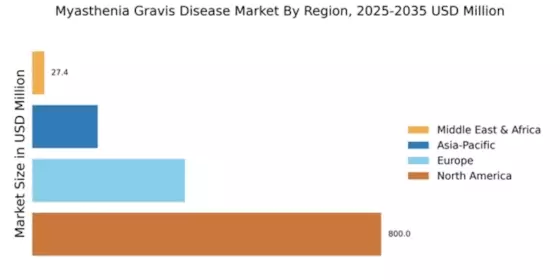
North America is poised to maintain its leadership in the Myasthenia Gravis market, holding a significant share of $800.0M in 2024. The region benefits from advanced healthcare infrastructure, robust research initiatives, and a growing patient population. Regulatory support, including expedited drug approvals, further fuels market growth. The increasing prevalence of autoimmune diseases and rising awareness among healthcare professionals are key demand drivers. The competitive landscape in North America is characterized by the presence of major pharmaceutical companies such as Roche, Bristol-Myers Squibb, and Pfizer. These companies are actively engaged in developing innovative therapies for Myasthenia Gravis. The U.S. leads the market, supported by favorable reimbursement policies and a strong pipeline of new treatments. The collaboration between industry and academia enhances research capabilities, ensuring a steady flow of advancements in treatment options.

Europe : Emerging Market with Potential

Europe's Myasthenia Gravis market is valued at $350.0M, reflecting a growing recognition of the disease and its treatment needs. The region is witnessing increased investment in healthcare and research, driven by supportive regulatory frameworks. Initiatives aimed at improving patient access to therapies and enhancing awareness among healthcare providers are pivotal in driving market growth. The rising incidence of Myasthenia Gravis across European countries is also a significant factor. Leading countries in Europe include Germany, France, and the UK, where key players like Sanofi and Novartis are actively involved. The competitive landscape is evolving, with a focus on innovative therapies and personalized medicine. Regulatory bodies are emphasizing the importance of patient-centric approaches, which is expected to enhance treatment outcomes. "The European Medicines Agency is committed to ensuring that patients have access to effective treatments for rare diseases like Myasthenia Gravis," states a recent report.

Asia-Pacific : Emerging Powerhouse in Healthcare

The Asia-Pacific Myasthenia Gravis market is valued at $150.0M, showcasing significant growth potential driven by increasing healthcare investments and rising awareness of autoimmune diseases. The region is experiencing a surge in demand for effective treatments, supported by government initiatives aimed at improving healthcare access. Regulatory bodies are also working to streamline approval processes for new therapies, which is expected to enhance market dynamics. Countries like Japan and Australia are leading the charge in the Asia-Pacific region, with key players such as Eisai and Amgen making substantial contributions. The competitive landscape is characterized by a mix of local and international companies, all vying for market share. The focus on research and development is intensifying, with collaborations between pharmaceutical firms and research institutions paving the way for innovative treatment options. The region's growing population and increasing prevalence of Myasthenia Gravis further bolster market prospects.

Middle East and Africa : Untapped Market Potential

The Middle East and Africa Myasthenia Gravis market is valued at $27.42M, indicating significant untapped potential. The region is gradually recognizing the importance of addressing autoimmune diseases, with increasing investments in healthcare infrastructure. Regulatory bodies are beginning to implement policies aimed at improving access to treatments, which is expected to drive market growth. The rising prevalence of Myasthenia Gravis is prompting healthcare providers to seek effective solutions. Leading countries in this region include South Africa and the UAE, where there is a growing presence of pharmaceutical companies. The competitive landscape is still developing, with opportunities for both local and international players to enter the market. The focus on awareness campaigns and education among healthcare professionals is crucial for improving diagnosis and treatment rates. "We are committed to enhancing healthcare access and treatment options for patients with rare diseases in the region," states a government health official.

Key Players and Competitive Insights

The Myasthenia Gravis Disease Market is characterized by a competitive landscape that is increasingly shaped by innovation, strategic partnerships, and a focus on patient-centric solutions. Key players such as Roche (CH), Bristol-Myers Squibb (US), and Novartis (CH) are actively engaged in enhancing their market positions through various strategic initiatives. Roche (CH) has been particularly focused on expanding its portfolio of therapies aimed at neuromuscular disorders, indicating a commitment to innovation and research. Meanwhile, Bristol-Myers Squibb (US) has been pursuing strategic collaborations with academic institutions to bolster its research capabilities, thereby enhancing its competitive edge in the market. Novartis (CH) appears to be concentrating on digital transformation initiatives, which may streamline operations and improve patient engagement, collectively shaping a dynamic competitive environment.

In terms of business tactics, companies are increasingly localizing manufacturing and optimizing supply chains to enhance efficiency and responsiveness to market demands. The competitive structure of the Myasthenia Gravis Disease Market is moderately fragmented, with several key players exerting influence over market dynamics. This fragmentation allows for a diverse range of therapeutic options, although it also necessitates that companies remain agile and innovative to maintain their market share.

In November 2025, Roche (CH) announced the initiation of a pivotal clinical trial for a novel monoclonal antibody targeting specific pathways involved in Myasthenia Gravis. This strategic move underscores Roche's commitment to advancing treatment options and potentially addressing unmet medical needs in the patient population. The trial's outcomes could significantly influence the company's market positioning and therapeutic offerings.

In October 2025, Bristol-Myers Squibb (US) entered into a partnership with a leading biotechnology firm to co-develop a new treatment modality for Myasthenia Gravis. This collaboration is expected to leverage both companies' strengths in research and development, potentially accelerating the timeline for bringing innovative therapies to market. Such partnerships may enhance the competitive landscape by fostering rapid advancements in treatment options.

In September 2025, Novartis (CH) launched a digital health platform aimed at improving patient adherence to treatment regimens for Myasthenia Gravis. This initiative reflects a broader trend towards integrating technology into healthcare, which may enhance patient outcomes and satisfaction. By focusing on digital solutions, Novartis is likely positioning itself as a leader in patient engagement and support.

As of December 2025, current competitive trends in the Myasthenia Gravis Disease Market are increasingly defined by digitalization, sustainability, and the integration of artificial intelligence (AI) into therapeutic development. Strategic alliances are playing a crucial role in shaping the landscape, enabling companies to pool resources and expertise. Looking ahead, competitive differentiation is expected to evolve, with a shift from price-based competition towards innovation, technological advancements, and supply chain reliability. This transition may ultimately lead to improved patient outcomes and a more robust market for Myasthenia Gravis therapies.

Key Companies in the Myasthenia Gravis Disease Market market include

Industry Developments

The FDA approved Johnson & Johnson's FcRn-blocking monoclonal antibody, Imaavy (nipocalimab), on April 30, 2025, making it the first to be approved in the United States for the treatment of generalized myasthenia gravis (gMG) in patients 12 years of age and older. This establishes the medication as a crucial therapeutic choice that targets IgG-mediated illness processes.

The FDA authorized Argenx's Vyvgart Hytrulo prefilled syringe on April 10, 2025, allowing adult gMG and CIDP patients to self-administer their efgartigimod/hyaluronidase combo at home. This step is anticipated to increase patient convenience and accessibility.Positive Phase 3 findings from the MINT study, which showed that Uplizna (inebilizumab) significantly improved daily living activities in AChR+ gMG patients during a 52-week period, were announced by Amgen on March 14, 2025.

The FDA authorized the first pediatric treatment for gMG on March 12, 2025, when it extended the use of Soliris (eculizumab) to kids patients six years of age and up. UCB received FDA clearance in October 2023 for Zilbrysq (zilucoplan), a subcutaneous complement C5 inhibitor for adult AChR+ gMG patients.In June 2023, the company introduced Rystiggo (rozanolixizumab), an FcRn modulator for adult gMG that is licensed in the US and the EU. The gMG environment has a strong diversity of treatment approaches, as seen by these recent regulatory accomplishments.

Future Outlook

Myasthenia Gravis Disease Market Future Outlook

The Myasthenia Gravis Disease Market is projected to grow at a 7.92% CAGR from 2024 to 2035, driven by advancements in treatment options and increasing awareness.

New opportunities lie in:

  • Development of targeted biologics for personalized treatment plans.
  • Expansion of telehealth services for remote patient monitoring.
  • Investment in AI-driven diagnostic tools to enhance early detection.

By 2035, the Myasthenia Gravis Disease Market is expected to achieve substantial growth and innovation.

Market Segmentation

Myasthenia Gravis Disease Market Treatment Type Outlook

  • Anticholinesterase Inhibitors
  • Immunosuppressants
  • Monoclonal Antibodies
  • Plasmapheresis
  • Intravenous Immunoglobulin

Myasthenia Gravis Disease Market Disease Severity Outlook

  • Mild
  • Moderate
  • Severe
  • Crisis
  • Asymptomatic

Myasthenia Gravis Disease Market Healthcare Setting Outlook

  • Hospital
  • Outpatient Clinic
  • Home Healthcare
  • Long-term Care Facility
  • Specialized Treatment Center

Myasthenia Gravis Disease Market Administration Route Outlook

  • Oral
  • Intravenous
  • Subcutaneous
  • Intramuscular
  • Topical

Myasthenia Gravis Disease Market Patient Demographics Outlook

  • Age Group
  • Gender
  • Ethnicity
  • Socioeconomic Status
  • Comorbidities

Report Scope

MARKET SIZE 20241327.42(USD Million)
MARKET SIZE 20251432.55(USD Million)
MARKET SIZE 20353070.01(USD Million)
COMPOUND ANNUAL GROWTH RATE (CAGR)7.92% (2024 - 2035)
REPORT COVERAGERevenue Forecast, Competitive Landscape, Growth Factors, and Trends
BASE YEAR2024
Market Forecast Period2025 - 2035
Historical Data2019 - 2024
Market Forecast UnitsUSD Million
Key Companies ProfiledRoche (CH), Bristol-Myers Squibb (US), Sanofi (FR), Novartis (CH), Pfizer (US), Amgen (US), Eisai (JP), Alexion Pharmaceuticals (US), Merck & Co. (US)
Segments CoveredTreatment Type, Disease Severity, Patient Demographics, Administration Route, Healthcare Setting
Key Market OpportunitiesAdvancements in targeted therapies and personalized medicine enhance treatment options in the Myasthenia Gravis Disease Market.
Key Market DynamicsRising demand for innovative therapies drives competitive dynamics in the Myasthenia Gravis Disease market.
Countries CoveredNorth America, Europe, APAC, South America, MEA

Market Highlights

Author
Rahul Gotadki
Assistant Manager

He holds an experience of about 7+ years in Market Research and Business Consulting, working under the spectrum of Life Sciences and Healthcare domains. Rahul conceptualizes and implements a scalable business strategy and provides strategic leadership to the clients. His expertise lies in market estimation, competitive intelligence, pipeline analysis, customer assessment, etc. In addition to the above, his other responsibility includes strategic tracking of high growth markets & advising clients on the potential areas of focus they could direct their business initiatives

Leave a Comment

FAQs

What is the projected growth of the Myasthenia Gravis Disease market?

The Myasthenia Gravis Disease market is the expected increase in total market value of 3.07 USD billion over a defined forecast period 2025–2035. It is driven by factors such as demand trends, technological advances, regulatory changes, and geographic expansion.

What is the size of the Myasthenia Gravis Disease market?

Myasthenia Gravis Disease market size was valued at approximately 1.33 billion USD in 2024. This figure will reach 3.07 billion USD covering all regions (America, Europe, Asia, MEA and ROW), focusing its segments / services / distribution channels till 2035.

What is the CAGR of the Myasthenia Gravis Disease market?

Myasthenia Gravis Disease market is expected to grow at a CAGR of 7.92% between 2025 and 2035.

How much will the Myasthenia Gravis Disease market be worth by 2035?

Myasthenia Gravis Disease market is expected to be worth of 3.07 billion USD, reflecting growth driven by usage, technology and global demands by the end of 2035.

How will the Myasthenia Gravis Disease market perform over the next 10 years?

Over the next 10 years the Myasthenia Gravis Disease market is expected to shift from usd billion 1.33 to 3.07 billion USD, led by adoption of advanced tech, demographic trends, regulatory approvals, with potential headwinds from 2025 to 2035.

What was the market size of the Myasthenia Gravis Disease Market in 2024?

The Myasthenia Gravis Disease Market was valued at 2.01 billion USD in 2024.

What is the projected market valuation for the Myasthenia Gravis Disease Market by 2035?

By 2035, the Myasthenia Gravis Disease Market is projected to reach a valuation of 3.8 billion USD.

Which region held the largest market share in 2024 for the Myasthenia Gravis Disease Market?

North America held the largest market share in 2024, valued at 0.85 billion USD.

What is the expected value of the Myasthenia Gravis Disease Market in Europe by 2035?

By 2035, the Myasthenia Gravis Disease Market in Europe is expected to reach a value of 1.05 billion USD.

Who are the key players in the Myasthenia Gravis Disease Market?

Key players include Pfizer, Mallinckrodt Pharmaceuticals, Bristol-Myers Squibb, Amgen, and UCB.

Download Free Sample

Kindly complete the form below to receive a free sample of this Report

Compare Licence

×
Features License Type
Single User Multiuser License Enterprise User
Price $4,950 $5,950 $7,250
Maximum User Access Limit 1 User Upto 10 Users Unrestricted Access Throughout the Organization
Free Customization
Direct Access to Analyst
Deliverable Format
Platform Access
Discount on Next Purchase 10% 15% 15%
Printable Versions