IGBT and Super Junction MOSFET Market (2026 – 2035)

IGBT and Super Junction MOSFET Market Size, Share and Research Report By Product Type (IGBT Discrete, IGBT Modules, Super-Junction MOSFET Discrete, and Super-Junction MOSFET Modules), By Power Rating (Low ≤600V, Medium 601-1200V, and High >1200V), By End-Use Industry (Automotive, Energy and Power, Industrial Manufacturing, ICT and Data Centers, Consumer Electronics, and Other End-Use Industries) And By Region (North America, Europe, Asia-Pacific, And Rest Of The World) –Industry Forecast Till 2035
ID: MRFR/SEM/31833-HCR 128 Pages Aarti Dhapte, Aarti Dhapte Last Updated: October 10, 2026
IGBT and Super Junction MOSFET Market
Market Size
Forecast Period2026-2035
CAGR (2026-2035)10.25%
2025 Market SizeUSD 12.55 Billion
2035 Market SizeUSD 33.31 Billion
Key Players
Infineon Technologies AG
Mitsubishi Electric Corporation
Fuji Electric Co., Ltd.
onsemi
STMicroelectronics N.V.
Toshiba Electronic Devices & Storage
Opportunities
  • Hybrid Silicon–SiC Modules for 800 V Platforms
  • Localization in India and Southeast Asia
  • Lifetime Data Services and New Business Models

IGBT and Super Junction MOSFET Market Summary

The IGBT and Super Junction MOSFET Market was valued at USD 12.55 Billion in 2025 and is projected to reach USD 13.84 Billion in 2026, rising to USD 33.31 Billion by 2035 at a CAGR of 10.25% over 2026–2035. Two catalysts anchor this trajectory. Global electric car sales passed 17 million units in 2024, and each battery-electric vehicle carries several times the switching silicon of a combustion model [1]. Meanwhile, the U.S. CHIPS and Science Act committed USD 39 billion in manufacturing incentives, part of which is flowing to mature-node power fabs [5].

Underneath the headline numbers, the technology base is shifting. Thyristor bridges, planar MOSFETs, and older punch-through IGBTs are giving way to trench field-stop IGBTs, double-sided-cooled modules, and super-junction MOSFETs that switch at 65 kHz or higher with lower conduction loss. Infineon alone earmarked roughly EUR 5 billion for its Dresden Smart Power Fab, a 300 mm line built largely for this transition [7].

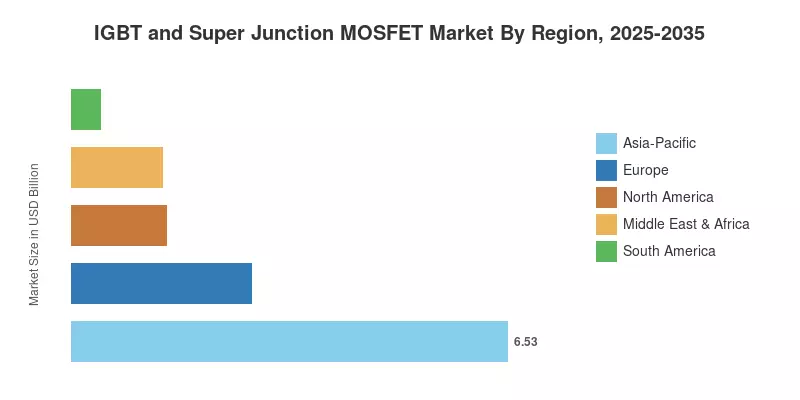
Asia-Pacific leads the IGBT and Super Junction MOSFET Market with a 52.0% revenue share, driven by Chinese EV production and Japanese module expertise. North America is the fastest-growing region at an 11.4% CAGR, supported by reshored fabrication and AI data-center construction. Europe ranks second at USD 2.70 Billion, anchored by German automotive and industrial-drive demand. Over the next decade, the balance between silicon incumbents and wide-bandgap challengers will shape who captures the incremental value.

Key Report Takeaways

• By Product Type

  • IGBT Modules lead the IGBT and Super Junction MOSFET Market with a 51.0% share in 2025, favored for pre-validated thermal performance in traction and drive inverters
  • Super-Junction MOSFET Modules post the fastest product growth at a 12.1% CAGR through 2035
  • IGBT Discrete devices generated USD 2.20 Billion in 2025, concentrated in appliance and small-motor inverters

• By Power Rating

  • Medium 601-1200V devices hold a 38.5% share, matching 800 V traction and three-phase industrial architectures
  • High >1200V devices expand at a 12.4% CAGR on utility-scale storage and wind converter demand

• By End-Use Industry

  • Automotive accounts for 43.6% of the IGBT and Super Junction MOSFET Market, the largest single vertical
  • Energy and Power is the fastest-growing industry at a 13.4% CAGR
  • ICT and Data Centers grow at an 11.9% CAGR as rack power densities climb

• By Region

  • Asia-Pacific commands a 52.0% share of global revenue
  • North America leads regional growth at an 11.4% CAGR
  • Europe contributed USD 2.70 Billion in 2025

Market Size and Forecast (2021–2035)

Estimates combine supplier revenue disclosures from annual reports and SEC filings [7][10][11], end-market unit data for EVs, solar inverters, and server power supplies [1][3][12], and primary interviews with module makers, tier-1 inverter suppliers, and distributors. Historical values reflect reported shipments, while the forecast models device content per end application against projected installation volumes. The IGBT and Super Junction MOSFET Market expanded unevenly between 2021 and 2025, with shortage-driven pricing in 2022–2023 and an inventory correction in 2024.
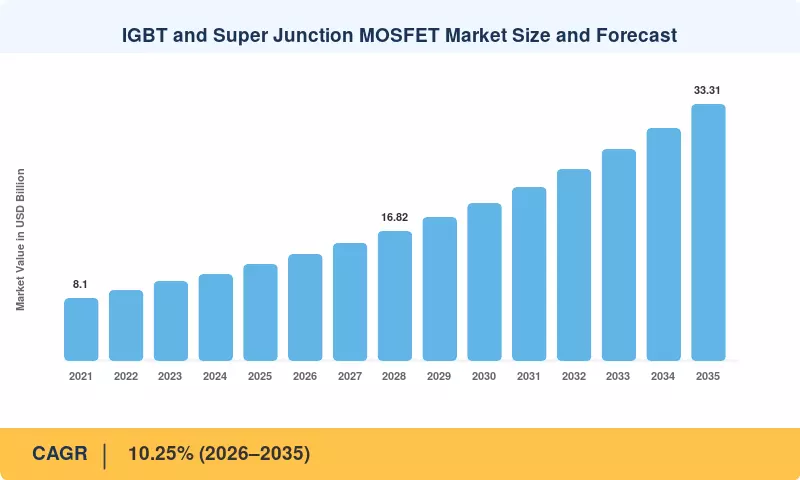
IGBT and Super Junction MOSFET Market Size and Forecast
Our Impact

Enabled $4.3B Revenue Impact for Fortune 500 and Leading Multinationals

Partnering with 2000+ Global Organizations Each Year

30K+ Citations by Top-Tier Firms in the Industry

Driver Impact Analysis

Driver ~% Impact on CAGR Geographic Relevance Impact Timeline
EV traction inverters and onboard chargers +2.6% Global; China, Europe, U.S. Medium-term (2–4 yr)
Renewable and battery storage inverters +1.9% Global; Asia-Pacific, North America Long-term (≥4 yr)
AI data-center power supply upgrades +1.4% North America, Asia-Pacific Short-term (≤2 yr)
Industrial motor efficiency regulations +1.1% Europe, North America Medium-term (2–4 yr)
Government fab incentives +0.8% U.S., EU, Japan, India Long-term (≥4 yr)
Inverter appliance penetration +0.7% China, India, ASEAN Short-term (≤2 yr)


EV Traction Inverters and Onboard Chargers

The China Association of Automobile Manufacturers estimates that 12.9 million new energy vehicles were sold in China in 2024 [20]. The gadget content per battery-electric car is many times more than that of a combustion automobile because each one requires a traction inverter, a DC-DC converter, an onboard charger, and an inverter-driven compressor. 750 V and 1,200 V IGBTs are preferred by automakers switching to 800 V platforms, which maintains silicon's relevance despite silicon carbide's rise in premium trims.


Renewable and Battery Storage Inverters

A record 585 GW of renewable capacity additions, primarily solar, were announced by IRENA in 2024 [3]. IGBT and super-junction switching stages are essential for battery storage converters, string inverters, and central inverters. anticipates that worldwide storage installations will continue to increase over the next ten years, and grid-forming converters need high-voltage components that can manage fault-ride-through and synthetic inertia tasks.


AI Data-Center Power Supply Upgrades

The IEA projects data-center electricity use to roughly double to about 945 TWh by 2030 [2]. Server power supplies must meet the EU's ecodesign efficiency tiers under Regulation (EU) 2019/424 [16], pushing designers toward totem-pole PFC and LLC resonant stages built on 600–650 V super-junction MOSFETs. Higher rack power, now moving past 100 kW, multiplies the number of conversion stages per facility.

Industrial Motor Efficiency Regulations

Regulation (EU) 2019/1781 requires IE3 efficiency for most motors and sets IE4 for the 75–200 kW range from July 2023 [4]. The U.S. Department of Energy's 2023 motor standards rule adds a parallel push [15]. Electric motors draw about half of global electricity, and variable-speed drives built on medium-voltage IGBTs are the main tool for cutting that consumption.

Government Fab Incentives

The U.S. CHIPS program, the EU Chips Act's EUR 43 billion framework, and India's Semiconductor Mission are funding mature-node capacity that suits power discretes [5][6][18]. These incentives lower capital costs for 200 mm and 300 mm power lines, shorten lead times, and give regional OEMs more localized supply. Capacity added under these programs begins contributing meaningful volume after 2027.

Inverter Appliance Penetration

Energy labelling programs in China and India's BEE star rating for room air conditioners reward variable-speed compressors [19]. Each inverter air conditioner, refrigerator, or washing machine uses discrete IGBTs or intelligent power modules. Hundreds of millions of appliances ship annually across Asia, and the share using inverter drives still has room to grow in South and Southeast Asian markets.

Restraints Impact Analysis


Restraint ~% Impact on CAGR Geographic Relevance Impact Timeline
Silicon carbide and GaN substitution −1.3% Global; premium EVs, servers Medium-term (2–4 yr)
Price erosion from Chinese capacity −0.9% Global; China Short-term (≤2 yr)
EV demand volatility and inventory swings −0.8% Europe, North America Short-term (≤2 yr)
Wafer and substrate supply concentration −0.6% Global Medium-term (2–4 yr)
Long automotive qualification cycles −0.5% Global Long-term (≥4 yr)


Silicon Carbide and GaN Substitution

High-end EV traction inverters have embraced silicon carbide MOSFETs because they offer reduced switching loss at 800 V. SiC revenue has grown rapidly, according to both Onsemi and STMicroelectronics [10][11]. The highest-density server and adapter designs are being adopted by GaN. Every wide-bandgap component design victory eliminates a gap that silicon would have otherwise filled.


Price Erosion from Chinese Capacity

Supported by regional EV manufacturers, domestic Chinese suppliers have rapidly increased the output of IGBT modules. As new lines came online, average selling prices for discretes and conventional modules decreased through 2024 [9]. Even when unit shipments increase, this loss stifles revenue growth, particularly in commodity voltage classes.


EV Demand Volatility and Inventory Swings

Near-term EV forecasts for Europe and the U.S. were trimmed as subsidies changed [12]. Tier-1 suppliers that over-ordered during the 2022 shortage then worked down inventory through 2024. Such swings delay orders and create uneven quarterly revenue for device makers.


Wafer and Substrate Supply Concentration

Power device production depends on a limited number of epitaxial wafer, DBC substrate, and module packaging suppliers. Any disruption can stall output across several brands. Policy efforts such as CHIPS address fabs more than upstream materials [5], leaving this vulnerability only partly resolved.

Long Automotive Qualification Cycles

Automotive modules must pass extensive testing under guidelines such as ECPE AQG 324 [21]. Qualification can take two to three years, slowing adoption of new device generations. Smaller suppliers face high fixed costs to enter automotive programs, which limits competition and delays price-performance gains.

IGBT and Super Junction MOSFET Market Opportunities

Hybrid Silicon–SiC Modules for 800 V Platforms

Mixing silicon IGBTs with SiC devices inside one traction module lets automakers balance cost and efficiency across the drive cycle. Several tier-1s are piloting these hybrid designs for mid-range EVs where full SiC is too expensive. Suppliers with both technologies in-house can capture this middle tier and protect silicon volume.

Localization in India and Southeast Asia

India's Semiconductor Mission offers fiscal support of up to 50% of project cost for qualifying fabs and assembly units [18]. Combined with rising two-wheeler electrification and appliance demand, this creates room for local module packaging and back-end testing. ASEAN countries offer similar incentives and lower labor costs, making them strong candidates for new assembly sites.

Lifetime Data Services and New Business Models

Modules with embedded temperature sensing can feed condition data to operators of wind farms, rail fleets, and industrial drives. Suppliers can sell predictive-maintenance analytics, remaining-useful-life estimates, and extended warranties tied to that data. This converts a one-time hardware sale into recurring service revenue and strengthens customer lock-in.

800 V DC Power Architecture in AI Data Centers

NVIDIA announced in 2025 a move toward 800 V DC rack power distribution for future AI facilities [23]. That shift requires new solid-state conversion stages, protection switches, and rectifiers. Super-junction and high-voltage IGBT suppliers that align early with hyperscaler reference designs can secure multi-year volume.

Grid-Forming Storage and Solid-State Transformers

Utilities retiring synchronous generators need inverters that provide inertia and black-start capability. Solid-state transformers for EV charging hubs and microgrids are moving from pilots to early deployment. Both applications favor 1.7 kV and 3.3 kV devices, opening a high-margin niche.

IGBT and Super Junction MOSFET Market Future Outlook

AI-Assisted Design and Digital Twins

Device makers increasingly use machine learning to optimize trench geometry, doping profiles, and module layouts. Digital twins of inverters let customers simulate thermal cycling before building hardware, which shortens qualification. Over the decade, suppliers offering validated simulation models alongside devices will win more design-ins in the IGBT and Super Junction MOSFET Market.

The Electrification Supercycle

The IEA's World Energy Outlook 2024 projects electricity demand growing faster than total energy use under current policies [19]. EVs, heat pumps, industrial electrification, and data centers all add conversion stages. This broad base reduces dependence on any single end market and supports sustained double-digit growth.

Silicon and Wide-Bandgap Coexistence

Silicon will not disappear. Cost per ampere still favors silicon in most industrial drives, appliances, and mid-range EVs, while SiC and GaN take high-efficiency niches. Suppliers with portfolios across all three materials can steer customers to the right part and protect margin as platforms evolve [7][11].

Carbon Footprint and ESG Reporting

OEMs subject to Scope 3 disclosure are asking suppliers for product carbon footprints. Fabs powered by renewable electricity and lower-emission packaging processes are becoming tender criteria in Europe. Device efficiency itself supports ESG goals, since every percentage point of inverter loss saved cuts lifetime emissions.

Regional Market Share Analysis

Region Metric (2025) Primary Investment Themes
North America 11.4% CAGR Reshored fabs, AI data centers, EV assembly
Europe USD 2.70 Billion Automotive electrification, motor efficiency rules
Asia-Pacific 52.0% share EV production, appliance inverters, module manufacturing
South America 3.5% share Solar expansion, industrial drives
Middle East & Africa 10.8% CAGR Utility-scale solar, desalination drives
Total USD 12.55 Billion —

Regional performance in the IGBT and Super Junction MOSFET Market follows EV manufacturing, renewable build-out, and fab investment. Asia-Pacific dominates in volume, while North America grows fastest from a smaller base.


North America

Country Metric Key Driver
US 82% share of region CHIPS-funded fabs, hyperscale data centers
Canada USD 0.20 Billion EV battery and assembly investment
Mexico 12.6% CAGR Nearshored automotive and appliance production


The U.S. drives regional demand through two channels: data-center construction and federally supported clean energy. The Inflation Reduction Act's manufacturing and storage credits [22] have accelerated battery and inverter factories, while CHIPS awards are expanding domestic power fabrication [5]. Mexico benefits from nearshoring, with automotive and appliance plants relocating from Asia. Canada's growth is tied to EV and battery plants in Ontario and Quebec.

Europe

Country Metric Key Driver
Germany 34% share of region Automotive tier-1s, industrial drives
UK USD 0.27 Billion Offshore wind converters
France 9.6% CAGR Nuclear-grid modernization, rail traction
Italy 10.5% share of region Industrial machinery, solar
Spain USD 0.16 Billion Solar and storage inverters
Nordic Countries 11.2% CAGR Wind power, EV adoption
Russia 3.0% share of region Domestic rail and industrial demand
Rest of Europe USD 0.49 Billion Automotive supply chain in Central Europe


Germany hosts the region's largest automotive tier-1s and major device production in Dresden [7]. The EU Chips Act aims to double Europe's share of global chip output by 2030 [6], and the motor ecodesign rules lift drive inverter demand [4]. Nordic markets grow on high EV penetration and wind, while Spain and Italy track solar and storage tenders.

Asia-Pacific

Country Metric Key Driver
China 58% share of region NEV production, domestic module suppliers
Japan USD 1.24 Billion Module technology leadership, rail
South Korea 8.5% share of region EV and battery exports
India 14.2% CAGR Semiconductor Mission, two-wheeler EVs
ASEAN USD 0.39 Billion Assembly relocation, appliances
Rest of Asia-Pacific 9.4% CAGR Taiwan and Australian solar demand


China anchors the IGBT and Super Junction MOSFET Market on the strength of its NEV output [20] and a fast-growing domestic supply base. Japan's Mitsubishi Electric, Fuji Electric, and Toshiba continue to lead in high-reliability modules [8][9][13]. India posts the highest country growth as incentive-backed fabs and assembly units start production [18].

South America

Country Metric Key Driver
Brazil 61% share of region Distributed solar, industrial drives
Argentina 9.8% CAGR Mining and energy projects
Rest of South America USD 0.07 Billion Chilean solar and lithium processing


Brazil's distributed generation boom has made it one of the world's larger solar markets by annual additions [3]. Inverter imports dominate, so demand reaches devices through global suppliers. Argentina and Chile add growth through mining electrification and lithium processing plants that use large motor drives.

Middle East & Africa

Country Metric Key Driver
Saudi Arabia 12.9% CAGR Vision 2030 solar and giga-projects
UAE 21% share of region Utility solar, data centers
South Africa USD 0.10 Billion Load-shedding backup and storage
Egypt 11.5% CAGR Solar parks, industrial expansion
Rest of MEA 30% share of region Off-grid solar, water pumping


Gulf states are commissioning multi-gigawatt solar plants and new data-center campuses, both of which need high-power conversion. South Africa's grid instability has pushed residential and commercial storage adoption. Across Africa, off-grid solar pumping and mini-grids add steady, if smaller, demand for low-voltage devices.

IGBT and Super Junction MOSFET Market By Region, 2025-2035

IGBT and Super Junction MOSFET Market Segmentation

By Product Type

Segment Metric (2025) Primary Demand Driver
IGBT Discrete USD 2.20 Billion Appliances, small motor drives
IGBT Modules 51.0% share EV traction, industrial inverters
Super-Junction MOSFET Discrete 22.0% share Adapters, LED drivers, PFC stages
Super-Junction MOSFET Modules 12.1% CAGR Server PSUs, telecom rectifiers, hybrid inverters


Within the IGBT and Super Junction MOSFET Market, IGBT Modules lead because OEMs prefer pre-assembled, thermally characterized building blocks with integrated thermistors and press-fit pins that cut inverter assembly time. Super-Junction MOSFET Modules grow fastest as server and telecom power supplies demand high switching frequency and efficiency above 99%. IGBT Discrete parts remain the cost choice for appliance inverters below 2 kW, while Super-Junction MOSFET Discrete devices serve high-volume adapters and lighting.

By Power Rating

Segment Metric (2025) Primary Demand Driver
Low ≤600V USD 4.02 Billion Appliance PFC, laptop adapters, LED drivers
Medium 601-1200V 38.5% share EV traction, industrial drives, UPS
High >1200V 12.4% CAGR Grid storage, wind, rail traction


Voltage class shapes architecture in the IGBT and Super Junction MOSFET Market. Medium 601-1200V devices dominate because 800 V EV platforms and three-phase industrial drives cluster in this band, backed by long qualification history and ample fab capacity. High >1200V devices grow fastest, driven by 1.7 kV and 3.3 kV parts in storage converters, wind turbines, and locomotives. Low ≤600V parts keep large volumes, though commoditization limits revenue growth.

By End-Use Industry

Segment Metric (2025) Primary Demand Driver
Automotive 43.6% share Traction inverters, onboard chargers
Energy and Power 13.4% CAGR Grid storage, solar, wind converters
Industrial Manufacturing USD 2.07 Billion Motor drives, CNC, robotics
ICT and Data Centers 11.9% CAGR Server and telecom power supplies
Consumer Electronics 9.0% share Inverter appliances, adapters
Other End-Use Industries 4.5% share Rail, aerospace, medical equipment


Automotive remains the anchor of the IGBT and Super Junction MOSFET Market, since battery-electric vehicles carry roughly four times the device content of combustion models. Energy and Power grows fastest as utilities deploy four-quadrant storage inverters and replace thyristor bridges in pumped-storage plants. Industrial Manufacturing provides a stable base across conveyors and extruders, and ICT and Data Centers expand as hyperscale rack power climbs.

Competitive Benchmarking

The IGBT and Super Junction MOSFET Market shows medium concentration, with an estimated HHI of 1,000–1,200. The top five suppliers hold an estimated 52–60% of revenue, led by a clear European front-runner and a strong Japanese cluster. Chinese suppliers are gaining share quickly in domestic EV programs, which is gradually reducing concentration in mid-voltage modules.

Company Est. Revenue Share Range Key Offerings for IGBT and Super Junction MOSFET Market Strategic Positioning
Infineon Technologies AG ~22–26% TRENCHSTOP IGBTs, CoolMOS super-junction MOSFETs, HybridPACK modules Broadest portfolio; 300 mm power fab scale
Mitsubishi Electric Corporation ~9–12% IPMs, HVIGBT modules, automotive J-series High-voltage and rail leadership
Fuji Electric Co., Ltd. ~7–10% IGBT modules, automotive direct-cooled modules Strong in industrial drives and Asian EVs
onsemi ~6–9% Field-stop IGBTs, SUPERFET MOSFETs, EV modules Automotive focus with SiC crossover
STMicroelectronics N.V. ~5–8% MDmesh super-junction MOSFETs, IGBTs, ACEPACK Integrated device maker serving auto and industrial
Toshiba Electronic Devices & Storage ~4–7% DTMOS MOSFETs, discrete IGBTs 300 mm Kaga capacity expansion
StarPower Semiconductor ~2–4% IGBT modules for EVs and solar Fast-growing Chinese module supplier
BYD Semiconductor ~2–4% Automotive IGBT modules Captive supply to BYD vehicles
Semikron Danfoss ~3–5% Industrial and automotive power modules Packaging and module integration specialist
Renesas Electronics ~2–4% Automotive IGBTs, super-junction MOSFETs Bundles devices with MCUs and drivers
ROHM Co., Ltd. ~2–4% PrestoMOS super-junction MOSFETs, IGBTs Combines silicon and SiC offerings


Recent News & Developments

  • Infineon Technologies (May 2023): Broke ground on its EUR 5 billion Smart Power Fab in Dresden, adding 300 mm capacity for power devices that serve EV and industrial customers [7]
  • European Commission (September 2023): The European Chips Act entered into force, opening funding routes for regional power semiconductor capacity [6]
  • Mitsubishi Electric (2023): Announced expanded investment in power device capacity, including a new 12-inch silicon wafer line at Fukuyama [8]
  • Toshiba (2024): Completed the first manufacturing building at its Kaga 300 mm power semiconductor facility, lifting low- and medium-voltage MOSFET and IGBT output [13]
  • U.S. Department of Commerce (December 2024): Finalized multiple CHIPS manufacturing awards, several covering mature-node and power device production [5]
  • India Ministry of Electronics & IT (2024): Approved additional semiconductor assembly and fab projects under the India Semiconductor Mission [18]
  • NVIDIA (May 2025): Outlined an 800 V DC power architecture for future AI data centers, signaling new high-voltage conversion requirements across the IGBT and Super Junction MOSFET Market [23]

IGBT and Super Junction MOSFET Market Report Scope

Parameter Details
Market Scope IGBT and Super Junction MOSFET Market by Product Type, Power Rating, End-Use Industry, and Region
Study Period 2021–2035 (Historical 2021–2024; Base Year 2025; Forecast 2026–2035)
CAGR 10.25% (2026–2035)
Market Size Checkpoints USD 12.55 Billion (2025); USD 13.84 Billion (2026); USD 20.45 Billion (2030); USD 33.31 Billion (2035)
Fastest Growing Segments Super-Junction MOSFET Modules; High >1200V; Energy and Power; North America
Companies Profiled Infineon, Mitsubishi Electric, Fuji Electric, onsemi, STMicroelectronics, Toshiba, StarPower, BYD Semiconductor, Semikron, Danfoss, Renesas, ROHM
Valuation Currency USD Billion

FAQs

How should OEMs choose between a silicon IGBT and a super-junction MOSFET for a new design?
Switching frequency and voltage class usually decide it. Super-junction parts suit 600–650 V designs switching above roughly 50 kHz, while IGBTs stay more economical above 1,000 V at high current [9].
Which qualification standards matter when sourcing automotive-grade parts in the IGBT and Super Junction MOSFET Market?
Discrete devices need AEC-Q101 qualification, and modules increasingly follow ECPE AQG 324. Buyers should also request PPAP documentation and IATF 16949-certified production sites before awarding volume contracts [21].
How are long-term supply agreements changing procurement in the IGBT and Super Junction MOSFET Market?
After the 2021–2022 shortage, automakers shifted toward multi-year capacity reservations, sometimes with prepayments. These deals secure wafer allocation but expose buyers to take-or-pay obligations when vehicle demand softens [12].
Does gallium nitride threaten super-junction MOSFET demand in server power supplies?
GaN wins the highest-density designs, yet cost per ampere still favors super-junction silicon in most 650 V PFC stages. Many suppliers now sell both, letting customers mix technologies in one power shelf [11].
Why do gate drivers matter in device selection?
Driver capability limits switching speed, short-circuit response, and EMI performance. Suppliers increasingly sell matched driver-and-switch reference designs that shorten qualification and reduce oscillation risk in fast circuits [7].
How do trade policies affect investors evaluating the IGBT and Super Junction MOSFET Market?
Mature-node power devices largely sit outside advanced-chip export controls, but tariffs and anti-dumping reviews on Chinese-made discretes are rising. Investors should treat a supplier's fab geography as a material risk factor [5].
Can used power modules be recertified for resale?
Recertification remains rare because bond-wire fatigue and solder degradation are hard to verify without destructive testing. Wind and rail operators instead refurbish whole converter stacks, replacing modules while reusing heatsinks and busbars .
Author
Author Author Profile Aarti Dhapte LinkedIn AVP - Research
A consulting professional focused on helping businesses navigate complex markets through structured research and strategic insights. I partner with clients to solve high-impact business problems across market entry strategy, competitive intelligence, and opportunity assessment. Over the course of my experience, I have led and contributed to 100+ market research and consulting engagements, delivering insights across multiple industries and geographies, and supporting strategic decisions linked to $500M+ market opportunities. My core expertise lies in building robust market sizing, forecasting, and commercial models (top-down and bottom-up), alongside deep-dive competitive and industry analysis. I have played a key role in shaping go-to-market strategies, investment cases, and growth roadmaps, enabling clients to make confident, data-backed decisions in dynamic markets.
Co-Author Co-Author Profile Aarti Dhapte LinkedIn AVP - Research
A consulting professional focused on helping businesses navigate complex markets through structured research and strategic insights. I partner with clients to solve high-impact business problems across market entry strategy, competitive intelligence, and opportunity assessment. Over the course of my experience, I have led and contributed to 100+ market research and consulting engagements, delivering insights across multiple industries and geographies, and supporting strategic decisions linked to $500M+ market opportunities. My core expertise lies in building robust market sizing, forecasting, and commercial models (top-down and bottom-up), alongside deep-dive competitive and industry analysis. I have played a key role in shaping go-to-market strategies, investment cases, and growth roadmaps, enabling clients to make confident, data-backed decisions in dynamic markets.
Download Free Sample

Kindly complete the form below to receive a free sample of this Report

Download PDF ×

We do not share your information with anyone. However, we may send you emails based on your report interest from time to time. You may contact us at any time to opt-out.