HVAC Insulation Market Summary
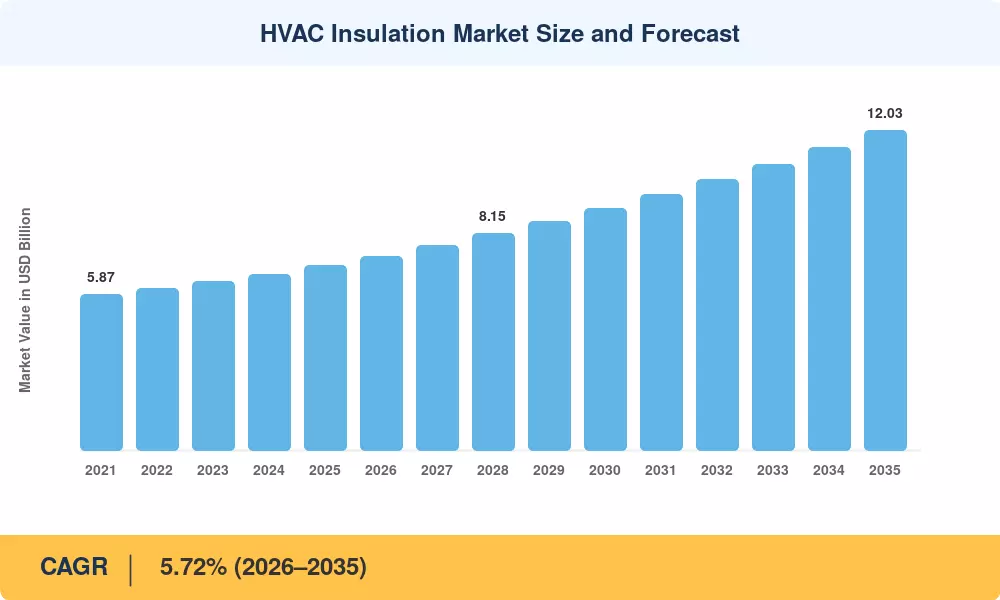
The HVAC Insulation Market reached an estimated USD 6.95 Billion in 2025, and is projected to grow from USD 7.29 Billion in 2026 to USD 12.03 Billion by 2035, registering a CAGR of 5.72% during the forecast period. Two forces are driving this trajectory harder than any others: mandatory energy renovation codes sweeping through the European Union's Energy Performance of Buildings Directive (EPBD) recast and the U.S. Department of Energy's updated commercial building insulation standards finalized in late 2024 [1][2]. These policy frameworks have raised minimum R-value thresholds for ductwork and piping systems in both new construction and major retrofits, pulling specification decisions toward higher-performance materials.
The technology landscape is shifting away from commodity fiberglass batts toward engineered systems that combine thermal resistance with moisture management and fire compliance. Heat pump adoption across residential and light commercial buildings has changed the insulation calculus — low-temperature refrigerant lines and condensate-prone air handlers demand materials that prevent moisture ingress while maintaining thermal performance at lower operating differentials. Global capital expenditure on building energy efficiency crossed USD 285 Billion in 2024, according to the IEA, with mechanical system insulation capturing a growing slice of that spend .
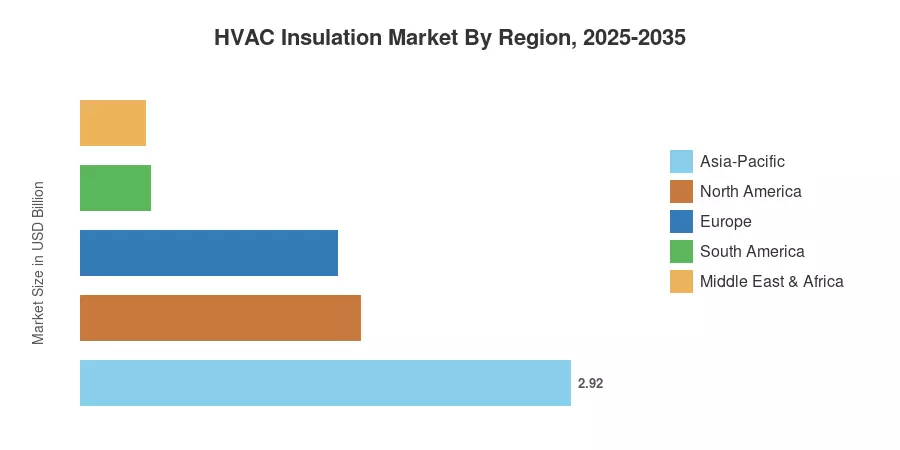
Asia-Pacific commands the largest share of the HVAC Insulation Market at roughly 42% of 2025 revenue, underpinned by commercial construction pipelines in China, India, and Southeast Asia. The region is also the fastest-growing, projected at a 6.57% CAGR through 2035. North America follows with approximately a 24% share, led by data center and healthcare facility demand. Europe holds around 22%, propelled by deep renovation mandates. As building decarbonization timelines compress globally, insulation systems that deliver verified lifecycle performance will capture disproportionate value through 2035.
Key Report Takeaways
• By Product Type
- Duct Insulation led the HVAC Insulation Market with approximately a 39.5% share in 2025, reflecting the dominance of centralized air distribution in commercial buildings.
- Pre-Insulated Duct Panels are the fastest-growing product type, forecast at a 6.78% CAGR through 2035, driven by prefabrication trends and labor cost pressures.
• By Material Type
- Glass Wool held the largest material share of the HVAC Insulation Market in 2025, valued at approximately USD 2.36 Billion.
- Polyisocyanurate (PIR) Foam is projected to expand at a 6.92% CAGR through 2035 as fire-rated insulation specifications tighten.
• By Application
- Duct Insulation applications accounted for roughly 45.5% of the HVAC Insulation Market in 2025.
- Air Handling Unit (AHU) Insulation is forecast to grow at a 6.52% CAGR, supported by cleanroom and healthcare expansion.
• By End-User Industry
- The Commercial segment represented approximately 48.5% of the HVAC Insulation Market in 2025.
• By Region
- Asia-Pacific accounted for roughly 42% revenue share, making it the dominant geography in the HVAC Insulation Market.
Market Size and Forecast (2021–2035)
Market Research Future's estimates integrate primary interviews with HVAC contractors, insulation manufacturers, and building envelope consultants alongside secondary data from trade associations (NAIMA, EiiF), government energy agencies, and corporate filings. Historical figures (2021–2024) reflect actual shipment data; the 2025 base year blends preliminary actuals with model interpolation; forecast years (2026–2035) apply a calibrated compound growth model anchored to construction activity indices and regulatory phase-in schedules.




 Noah Malgeri
Co-Founder

 Peter Groot koerkamp
Account and Business Manager

 Younghwan Choi
Senior Retail Manager

 Mark Irwin
Management Consultant

 Akif Moroglu
Strategy & Business Development Director

 Guilherme Gomes Martins
Product Management Director

 Joseph Aguayo
Sales Operations & Pricing Manager

 La Terria Dodd
Program Support Specialist

 Rob Kooiker
Group Product Manager HVAC & Fire Protection GMA


