Human Platelet Lysate Market (2026 - 2035)

Human Platelet Lysate Market Research Report By Application (Cell Therapy, Regenerative Medicine, Tissue Engineering, Vaccines Development, Drug Development), By End Use (Pharmaceutical Companies, Academic Research Institutes, Biotechnology Companies, Contract Research Organizations), By Source (Peripheral Blood, Umbilical Cord Blood, Bone Marrow, Platelet Rich Plasma), By Formulation Type (Liquid Formulation, Lyophilized Formulation, Cell Culture Supplement) and By Regional (North America, Europe, South America, Asia Pacific, Middle East and Africa) - Growth & Industry Forecast 2025 To 2035
ID: MRFR/HC/35200-HCR 128 Pages Satyendra Maurya, Rahul Gotadki Last Updated: September 17, 2026
Human Platelet Lysate Market
Market Size
Forecast Period2026-2035
CAGR (2026-2035)6.68%
2025 Market SizeUSD 65.2 Million
2035 Market SizeUSD 124.5 Million
Key Players
Merck KGaA
PL BioScience GmbH
STEMCELL Technologies Inc.
Sartorius CellGenix GmbH
Compass Biomedical Inc.
Mill Creek Life Sciences Inc.
Opportunities
  • Lyophilized Formats Unlocking Distributed Manufacturing
  • Emerging Market Entry Through Local Blood Services
  • Documentation-as-a-Product

Human Platelet Lysate Market Summary

The Human Platelet Lysate Market was valued at USD 65.2 million in 2025 and is projected to grow to USD 124.5 million by 2035, expanding at a compound annual growth rate (CAGR) of 6.68% between 2026 and 2035. Market value is expected to reach USD 69.6 million in 2026 as the first year of the forecast period. This growth is being driven primarily by tightening pharmacopoeial standards for cell culture supplements and expanding regulatory expectations around donor traceability, alongside a structural shift away from animal-derived culture media toward xeno-free alternatives.

European Pharmacopoeia general chapter 5.2.12 pushed sponsors to treat culture supplements as qualified critical raw materials rather than commodity reagents. This regulatory reclassification has raised the documentation and quality bar for suppliers entering clinical-stage manufacturing programs. Regulators on both sides of the Atlantic now expect donor traceability, viral risk assessment, and defined release criteria before a supplement can enter a clinical dossier, reinforcing the need for suppliers with robust quality documentation.

Manufacturing teams are also retiring fetal bovine serum in favor of pooled, pathogen-reduced human platelet lysate. This shift is structural rather than experimental: the Human Platelet Lysate Market has become the default answer for sponsors building xeno-free cell culture media strategies into commercial-stage programs. More than 2,500 active cell and gene therapy Investigational New Drug (IND) applications sat with the FDA's Office of Therapeutic Products across 2023 to 2024, and each one carries its own raw material qualification decision. Suppliers holding Type II Drug Master Files and country-specific certificates hold a measurable advantage in that qualification process.

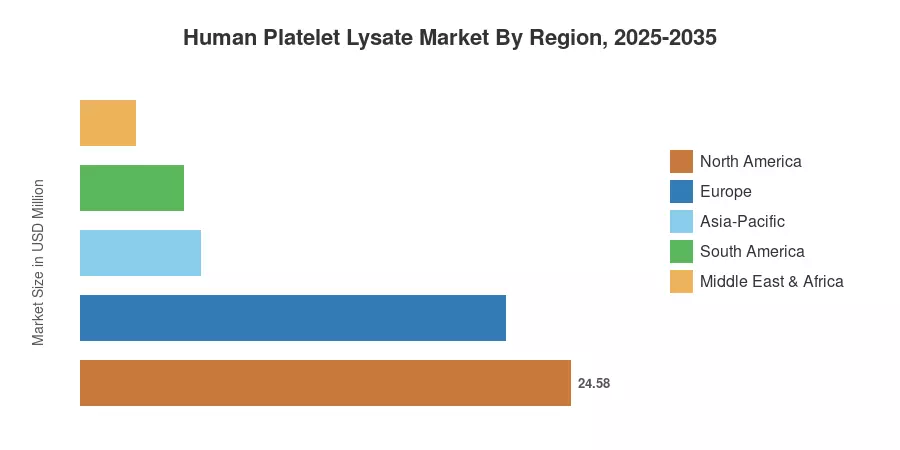
By region, North America holds the largest share of the Human Platelet Lysate Market, at 37.7% of 2025 revenue, supported by its advanced therapy manufacturing base. Asia-Pacific posts the fastest growth, with a projected CAGR of 9.2% through 2035. Europe holds the second-largest share, at USD 21.3 million, carried by blood establishment partnerships and a pharmacopoeial framework that arrived earlier than in other regions. Over the coming years, supply capacity, rather than demand, is expected to determine how quickly the Human Platelet Lysate Market converts pipeline interest into recurring commercial volume.


Key Report Takeaways

• By Product Type

  • Heparin-free formulations led the Human Platelet Lysate Market with 54.5% of 2025 revenue.
  • Heparin-containing formats are projected to expand at a 9.6% CAGR through 2035
  • Pathogen-reduced products generated USD 12.4 Million in 2025

• By Application and End User

  • Cell and gene therapy manufacturing held 39.9% of application revenue in 2025
  • Tissue engineering is the fastest-growing application at a 10.5% CAGR
  • Pharmaceutical and biotechnology companies accounted for 45.2% of end-user revenue

• By Region

  • North America commanded 37.7% of Human Platelet Lysate Market revenue in 2025
  • Asia-Pacific is forecast to grow at a 9.2% CAGR through 2035
  • Europe contributed USD 21.3 Million in 2025


Market Size and Forecast (2021–2035)

Estimates below combine supplier-level revenue triangulation, blood establishment output data, and bottom-up modelling of advanced therapy manufacturing volumes. Historical years reflect reported and inferred supplier revenue; forecast years apply demand elasticity against the active clinical pipeline tracked by regulatory filings [1][14]. The Human Platelet Lysate Market is modelled in USD Million throughout.
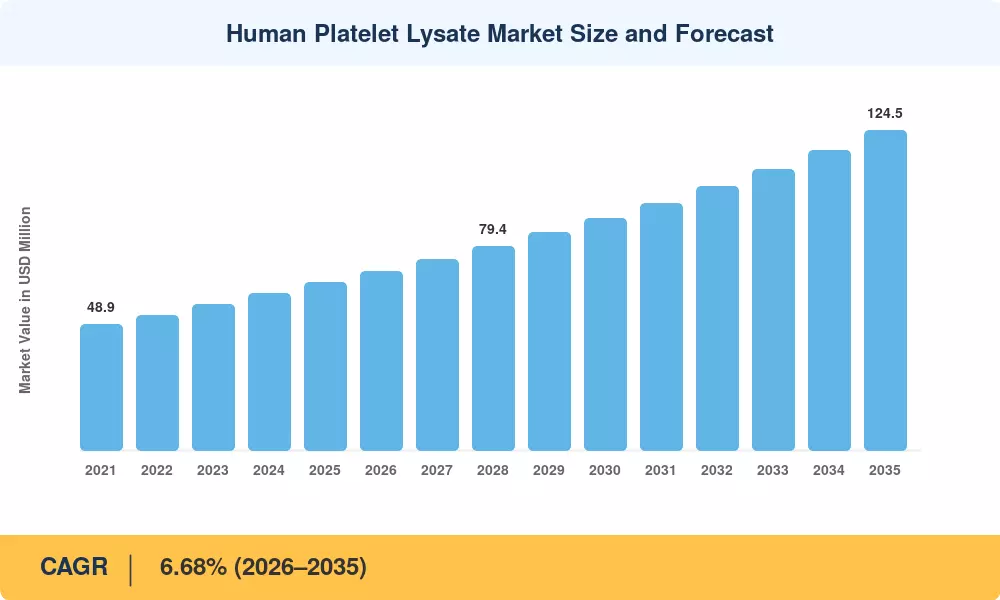
Human Platelet Lysate Market Size and Forecast
Our Impact

Enabled $4.3B Revenue Impact for Fortune 500 and Leading Multinationals

Partnering with 2000+ Global Organizations Each Year

30K+ Citations by Top-Tier Firms in the Industry

Driver Impact Analysis

Driver ~% Impact on CAGR Geographic Relevance Impact Timeline
Regulatory pressure to eliminate bovine serum +1.4 Global, Europe-led Medium-term (2–4 yr)
Expanding cell and gene therapy clinical pipeline +1.6 North America, Europe Short-term (≤2 yr)
Commercial-scale ATMP launches +1.1 North America Long-term (≥4 yr)
Pathogen-reduction technology adoption +0.7 Europe, Asia-Pacific Medium-term (2–4 yr)
Lyophilization and ambient logistics +0.6 Asia-Pacific, MEA Long-term (≥4 yr)
Blood establishment supply partnerships +0.5 Europe Medium-term (2–4 yr)
CDMO capacity build-out for cell therapy +0.8 Asia-Pacific Short-term (≤2 yr)


Regulatory Displacement of Fetal Bovine Serum

Pharmacopoeial language did the heavy lifting here. Chapter 5.2.12 of the European Pharmacopoeia classifies human serum and platelet lysates as blood-derived raw materials requiring documented donor screening, viral safety risk assessment under chapters 5.1.7 and 5.2.8, and defined critical quality attributes . A joint AABB and International Society for Cell & Gene Therapy publication documented that xenogeneic exposure induced anti-bovine alloantibodies in three of twelve patients receiving mesenchymal stromal cells, a finding that moved the conversation from preference to product risk . That evidence base underpins roughly a fifth of current growth in the Human Platelet Lysate Market.

Pipeline Volume as Demand Floor

Scale matters more than any single approval. Roughly 2,500 active cell and gene therapy INDs and about 1,300 gene therapy INDs sat with the FDA's Office of Therapeutic Products through 2023–2024, with at least 35 gene therapy candidates in global Phase 3 [14]. More than 40 cell and gene therapy products now carry US approval, and industry consensus anticipates 30 to 50 further approvals by 2030 [15]. Each conversion multiplies supplement consumption per manufacturing campaign.

Pathogen Reduction as a Qualification Gate

Safety technology has become a purchasing criterion. Published work on THERAFLEX UV-Platelets treatment showed that additive-free short-wave UV irradiation preserved growth factor content and mesenchymal stem cell expansion efficacy while reducing viral risk [8]. Suppliers answered commercially: PL BioScience launched a gamma-irradiated GMP-grade product in April 2025, and AventaCell holds a Type II Drug Master File with the FDA plus a PMDA certificate for its pathogen-reduced line [13]. Buyers running injectable programs increasingly treat untreated lysate as unqualifiable.

Blood Establishment Economics

Feedstock arrives from an unusual place — platelet concentrates that reached transfusion expiry and would otherwise be discarded . That structural link ties supplement availability to national transfusion volumes and to how willing blood services are to divert expired units into industrial processing. European services have moved fastest, which explains why the region carries the second-largest revenue position despite a smaller manufacturing base than North America.


Restraints Impact Analysis

Restraint weightings are directional estimates of drag on growth momentum, expressed as relative contributions rather than subtractive CAGR components. Supply-side constraints dominate the risk register for the Human Platelet Lysate Market.

Restraint ~% Impact on CAGR Geographic Relevance Impact Timeline
Donor-derived raw material supply constraints −1.2 Global Medium-term (2–4 yr)
Lot-to-lot variability and comparability burden −0.9 Global Short-term (≤2 yr)
Price premium over fetal bovine serum −0.7 Asia-Pacific, South America Short-term (≤2 yr)
Fragmented pharmacopoeial standards −0.6 Global Long-term (≥4 yr)
Cold-chain and storage infrastructure gaps −0.4 MEA, South America Medium-term (2–4 yr)


Finite Donor Feedstock

There is no way to scale a supplement that takes human blood as an input. Production depends on the supply of whole-blood-derived or apheresis platelet concentrates from licensed blood establishments. The lack of international consensus on modes of industrial production and release criteria has been identified as a structural bottleneck by the International Society of Blood Transfusion working party . Pooling among donors equalizes growth factor variance but increases the number of units needed in each batch to be screened [6]. Suppliers responded with artificial platelet research – PL BioScience and DewCell Biotherapeutics developed the first reactor-grown platelet lysate in May 2025 – albeit commercial volumes are years away [10].


Comparability and Switching Cost

Sponsors do not lightly trade supplements. Regulators consider the culture supplement to be an important raw material, thus every change requires comprehensive comparability work: growth kinetics, immunophenotype, potency and karyotype across passages . The difficulty is made worse by stability data – a two-year research on GMP-manufactured lysate certified by the Spanish Medicines Agency was published precisely because of thin expiration evidence . Programs already deep in clinical development generally defer conversion to the next product rather than absorbing the delay.


Standards Fragmentation

Requirements are jurisdiction-specific. One approach is suggested by the European Pharmacopeia 5.2.12, another by the US Pharmacopeia general chapter <1043> on accessory materials, and more rules for donor testing are provided by national blood laws [22]. Suppliers covering three continents are bogged down with triplicate documentation that smaller experts cannot afford.


Human Platelet Lysate Market Opportunities

Lyophilized Formats Unlocking Distributed Manufacturing

Freeze-dried lysate is shipped ambient and stored at room temperature, eliminating the freezer dependency that has kept the Human Platelet Lysate Market limited to a few well-equipped countries. PL BioScience’s freeze-dried ELAREM line showed that gamma irradiation and lyophilization may co-exist with GMP release requirements . Distributed and point-of-care manufacturing models can be realized when the supplement no longer requires a cold chain.


Emerging Market Entry Through Local Blood Services

In blood institutions in Asia-Pacific and the Middle East, expiring platelet inventory is currently being wasted. Partnership strategies that will turn national surplus in transfusion into regional supplement production will simultaneously reduce import dependency and foreign exchange exposure. Both countries are expanding their regenerative medicine programs and would benefit from domestic animal-free cell culture inputs.


Documentation-as-a-Product

The commercial differentiator is shifting from the liquid to the dossier. Suppliers holding Type II Drug Master Files let customers cross-reference regulatory filings instead of building qualification packages from scratch, compressing timelines by months [13]. Selling regulatory infrastructure alongside volume — audit-ready batch records, comparability datasets, jurisdiction-specific certificates — creates recurring revenue that pure reagent sales cannot. This is where the Human Platelet Lysate Market rewards incumbency.

Reserved-Lot and Banking Contracts

Commercial-stage sponsors want supply certainty more than unit-price savings. Reserved-lot agreements, in which a supplier banks a defined pooled batch for a product's lifecycle, convert transactional sales into multi-year contracted revenue. Dual-source qualification arrangements create a second lane for challenger suppliers otherwise locked out by incumbency.

Synthetic and Recombinant Adjacency

Reactor-derived platelets sidestep donor dependency entirely [10]. Early-stage economics remain unfavourable, but any supplier that solves cost-per-litre on a synthetic route captures the supply ceiling problem outright and reprices the category.


Human Platelet Lysate Market Future Outlook

Standardization Becomes the Competitive Battleground

The next decade will settle what a compliant product actually is. International consensus on release criteria remains incomplete, and the working party that has studied the question since 2014 continues to press for defined specifications on pathogen safety and potency . Whoever's manufacturing protocol becomes the de facto reference standard inherits a structural advantage across the Human Platelet Lysate Market.

Synthetic Supply Enters the Model

Reactor-grown platelets change the ceiling. Current demonstration volumes are negligible against a market approaching USD 125 Million by 2035, but a viable synthetic route would decouple growth from donation rates entirely [10]. Analyst base case treats synthetic contribution as immaterial before 2032 and meaningful thereafter.

Ambient Logistics Reshape Geography

Lyophilization removes the single largest barrier to emerging market adoption. Freeze-dried, gamma-irradiated formats already exist at GMP grade . As those products mature, distributed manufacturing networks and point-of-care production models become logistically feasible in regions that cannot currently sustain −80°C distribution.

Sustainability Credentials Gain Commercial Weight

Feedstock derived from expired transfusion units that would otherwise be destroyed gives the category a genuine circularity story . Procurement functions at large pharmaceutical buyers increasingly score suppliers on animal-derived material elimination, and the Human Platelet Lysate Market is positioned to benefit as ESG reporting frameworks extend into raw material sourcing disclosures.


Regional Market Share Analysis

Region Metric (2025) Primary Investment Themes
North America 37.7% share ATMP commercial launches, DMF-backed supply, CDMO qualification
Europe USD 21.3 Million Pharmacopoeial compliance, blood service partnerships, pathogen reduction
Asia-Pacific 9.2% CAGR (2026–2035) Regional GMP capacity, PMDA/MFDS pathways, cost-competitive production
South America 7.9% CAGR (2026–2035) Academic research demand, import substitution
Middle East & Africa 4.2% share Sovereign regenerative medicine programs, cold-chain build-out
Total USD 65.2 Million —

Geographic concentration in the Human Platelet Lysate Market tracks advanced therapy manufacturing capacity rather than population or healthcare spend.


North America

Country Metric Key Driver
US 82.4% of region Largest concentration of active CGT INDs [14]
Canada USD 3.0 Million Academic cell therapy centres and public blood services
Mexico 8.1% CAGR Emerging contract manufacturing base


Regulatory throughput drives the region. CBER's Office of Therapeutic Products carried roughly 2,500 active cell and gene therapy INDs across 2023–2024, and its 2025 draft guidance on postapproval safety and efficacy data capture signalled that commercial-stage oversight is tightening [2][14]. Suppliers holding Type II Drug Master Files convert that scrutiny into competitive advantage, since customers can cross-reference an existing filing rather than assemble raw material evidence independently [13]. The North American Human Platelet Lysate Market therefore skews heavily toward pathogen-reduced, fully documented product tiers.

Europe

Country Metric Key Driver
Germany 24.6% of region Domestic GMP production and academic MSC programs
UK USD 3.6 Million Cell and gene therapy catapult ecosystem
France 6.9% CAGR Established transfusion infrastructure
Italy 10.2% of region Regional ATMP hospital exemption programs
Spain USD 1.8 Million Agency-accredited clinical-grade production
Nordic Countries 7.4% CAGR High per-capita donation rates
Russia 4.6% of region Domestic biotech substitution policy
Rest of Europe USD 2.6 Million Cross-border CDMO servicing


Europe wrote the rulebook and kept the manufacturing. Chapter 5.2.12 gave suppliers a compliance target years before comparable clarity existed elsewhere, and German production capacity expanded accordingly — PL BioScience moved to a 1,200 m² Aachen facility in September 2025 after acquiring Macopharma's HPL patent portfolio and customer base in 2023 [12]. Consolidation of that kind concentrates European share among a smaller group of specialists than the fragmented picture elsewhere suggests.

Asia-Pacific

Country Metric Key Driver
China 28.4% of region Domestic cell therapy pipeline scale-up
India 11.3% CAGR Cost-competitive CDMO capacity
Japan USD 3.1 Million PMDA certification pathway for supplements [13]
South Korea 10.1% CAGR Regenerative medicine framework and synthetic platelet R&D [10]
ASEAN USD 1.3 Million Regional clinical trial hosting
Rest of Asia-Pacific 8.7% of region Academic research demand


Asia-Pacific growth in the Human Platelet Lysate Market is capacity-led rather than regulation-led. Korean biotech DewCell Biotherapeutics generated the first reactor-grown platelets used to produce an artificial lysate, working with a German partner — an early signal that regional players intend to compete on technology rather than price alone [10]. Japan's PMDA certification route gives qualified suppliers a defensible position in a market where import documentation requirements are exacting [13].

South America

Country Metric Key Driver
Brazil 56.8% of region Public research institutes and MSC trials
Argentina USD 0.5 Million University-led regenerative medicine programs
Rest of South America 7.2% CAGR Gradual clinical infrastructure expansion


Adoption here remains research-weighted. Import pricing and freezer logistics keep clinical-grade tiers out of reach for most institutions, which makes lyophilized formats the most credible route to volume growth . Brazilian public institutes account for the bulk of current consumption.

Middle East & Africa

Country Metric Key Driver
Saudi Arabia 29.3% of region Vision 2030 biotech localization
UAE USD 0.6 Million Private regenerative medicine clinics
South Africa 8.4% CAGR Established transfusion service base
Egypt 11.7% of region Academic cell culture demand
Rest of MEA USD 0.5 Million Distributor-served research market


Sovereign investment programs are creating demand ahead of local supply. Gulf states are building advanced therapy capability from a low base, which means near-term consumption is almost entirely imported and highly sensitive to cold-chain reliability.


Human Platelet Lysate Market By Region, 2025-2035

Human Platelet Lysate Market Segmentation

Segment structure in the Human Platelet Lysate Market follows manufacturing requirements more than end-market labels.

By Product Type

Segment Metric (2025) Primary Demand Driver
Heparin-Free 54.5% share Avoids anticoagulant carryover in injectables
Heparin-Containing 9.6% CAGR Lower cost, prevents gel formation
Pathogen-Reduced USD 12.4 Million Viral safety requirement for clinical use


Heparin-free formats dominate because they simplify release testing for products destined for injection, removing an entire analytical workstream from the QC burden. Pathogen-reduced tiers carry the highest price per litre and are increasingly non-negotiable for programs entering clinical phases, which is why their growth outpaces their current share [8].

By Source

Segment Metric (2025) Primary Demand Driver
Platelet-Rich Plasma 51.4% share Established processing infrastructure
Apheresis USD 19.7 Million Controlled donor pools, higher traceability
Whole Blood 10.3% CAGR Leukoreduction filter recovery economics


Platelet-rich plasma remains the dominant source segment within the market, driven by widespread clinical integration, established autologous processing infrastructure, and expanding orthopedic and aesthetic applications. Whole blood represents the fastest-growing source segment, propelled by cost-effective processing simplicity and optimized leukoreduction filter recovery economics across resource-constrained clinical settings.

By Form

Segment Metric (2025) Primary Demand Driver
Liquid 52.4% share Direct use, no reconstitution step
Lyophilized 8.9% CAGR Ambient shipping and extended shelf life


Liquid retains majority share on process simplicity, but the growth differential tells the real story within the Human Platelet Lysate Market. Freeze-dried formats trade one operator step for substantial reductions in freezer capital and shipping cost, an equation that increasingly favours lyophilization at multi-site manufacturers .

By Application

Segment Metric (2025) Primary Demand Driver
Cell and Gene Therapy Manufacturing 39.9% share Commercial and clinical batch volume [14]
Regenerative Medicine USD 14.0 Million MSC-based therapy programs [21]
Research and Development USD 12.9 Million Academic and preclinical expansion work
Tissue Engineering 10.5% CAGR Scaffold-seeded construct manufacturing
Vaccine Production 6.2% share Cell substrate expansion


Cell and gene therapy manufacturing remains the dominant application segment within the market, driven by escalating commercial and clinical batch volume requirements. Tissue engineering represents the fastest-growing application segment, propelled by advanced scaffold-seeded construct manufacturing and expanding translational regenerative protocols.

By End User

Segment Metric (2025) Primary Demand Driver
Pharmaceutical and Biotechnology Companies 45.2% share Owned ATMP manufacturing capacity
CROs and CDMOs USD 15.6 Million Outsourced clinical batch production
Academic and Research Institutes 18.6% share Grant-funded preclinical programs
Hospitals and Cell Therapy Centres 9.4% CAGR Hospital exemption and point-of-care models


Pharmaceutical and biotechnology companies anchor demand because they control the batch records that regulators inspect. Hospital and cell therapy centre growth reflects European hospital exemption pathways and emerging point-of-care manufacturing, a channel that behaves very differently on price sensitivity and order size.


Competitive Benchmarking

Concentration sits in the medium band. The top five suppliers control an estimated 44–52% of revenue, producing an HHI in the 700–900 range — fragmented enough for challengers to enter, concentrated enough that regulatory documentation depth decides most large contracts. Consolidation is active: PL BioScience acquired Macopharma's worldwide HPL patent rights in 2023 along with a customer transition arrangement, materially reshaping European supply .

Company Est. Revenue Share Range Key Offerings for Human Platelet Lysate Market Strategic Positioning
Merck KGaA ~10–13% GMP-grade supplements, integrated media systems Scale distribution, bundled with broader bioprocess portfolio
PL BioScience GmbH ~9–12% ELAREM liquid and freeze-dried, gamma-irradiated GMP lines Technology leader; patent consolidation and synthetic HPL R&D [10]
STEMCELL Technologies Inc. ~7–10% Research and clinical-grade supplements Strong academic channel and catalogue reach
Sartorius CellGenix GmbH ~6–9% GMP raw materials for cell therapy Positioned within a broader ATMP raw material franchise
Compass Biomedical Inc. ~5–8% PLUS platelet lysate product family Distribution expansion via Captivate Bio Access Program
Mill Creek Life Sciences Inc. ~4–7% PLTMax and clinical-grade lysates Long-standing clinical manufacturing relationships
AventaCell BioMedical Corp. ~4–6% UltraGRO pathogen-reduced GMP lines Regulatory depth: FDA DMF, PMDA certificate, Ph. Eur. alignment [13]
Cook Regentec ~3–6% Clinical-grade lysates, packaging formats Biopharma partnership network and modular presentation
Lonza Group Ltd. ~3–5% Supplements within CDMO service packages Captive demand through cell therapy manufacturing services
Trinova Biochem GmbH ~2–4% Research and GMP-grade supply European specialist and distribution partner
BioIVT / ZenBio Inc. ~2–4% Research-grade lysate and biofluids Volume research channel, price-competitive tiers


Recent News & Developments

Developments below are verified public events shaping the Human Platelet Lysate Market.

  • PL BioScience & Macopharma S.A.S. (June 2023): Signed a worldwide patent license and assignment agreement covering HPL cell culture supplements, with Macopharma introducing its existing customers to PL BioScience following a comparative equivalence evaluation — a consolidation that reshaped European supply concentration
  • PL BioScience GmbH (April 2025): Launched ELAREM Ultimate-FD PLUS, a gamma-irradiated GMP-grade product manufactured in Germany under a patented process, raising the viral safety bar for clinical-trial applications
  • PL BioScience & DewCell Biotherapeutics (May 2025): Announced the first production of an artificial HPL solution from reactor-grown platelets, an early proof point for decoupling supply from human donation [10]
  • Captivate Bio & Compass Biomedical (August 2025): Made the PLUS platelet lysate product family available through the Captivate Bio Access Program, widening distribution of GMP-grade material for large-scale research use
  • PL BioScience GmbH (September 2025): Announced relocation to a 1,200 m² facility in Aachen, Germany, expanding production capacity and consolidating operations at a new headquarters [12]
  • U.S. FDA / CBER (2025): Issued draft guidance on postapproval methods to capture safety and efficacy data for cell and gene therapy products under docket FDA-2025-D-3049, extending documentation expectations into commercial-stage supply chains [2]
  • AventaCell BioMedical (ongoing through 2025): Maintains a Type II Drug Master File with the FDA for UltraGRO-PURE GI, a Japan PMDA certificate, and compliance with European Pharmacopoeia general chapter 5.2.12 — the reference documentation package for the category [13]


Human Platelet Lysate Market Report Scope

Parameter Detail
Market Scope Global human platelet lysate supply for research, clinical, and commercial cell culture applications, segmented by product type, source, form, application, end user, and geography
Study Period 2021–2035 (Historical 2021–2024; Base Year 2025; Forecast 2026–2035)
CAGR 6.68% (2026–2035)
Market Size Checkpoints USD 65.2 Million (2025); USD 69.6 Million (2026); USD 124.5 Million (2035)
Fastest Growing Segments Tissue engineering (application); whole blood-derived (source); lyophilized (form); hospitals and cell therapy centres (end user); Asia-Pacific (geography)
Companies Profiled Merck KGaA, PL BioScience, STEMCELL Technologies, Sartorius CellGenix, Compass Biomedical, Mill Creek Life Sciences, AventaCell BioMedical, Cook Regentec, Lonza Group, Trinova Biochem, BioIVT/ZenBio
Valuation Currency USD Million

FAQs

How should buyers qualify a supplier before committing to a clinical program in the Human Platelet Lysate Market?
Request the Type II Drug Master File reference, donor pool size, and pathogen-reduction method upfront. Audit lot-to-lot growth factor variance across at least three consecutive batches. Suppliers without filing history create qualification delays that outlast any unit-price saving. [13]
What does switching from fetal bovine serum to HPL actually require?
Expect a full comparability protocol covering growth kinetics, immunophenotype, potency assay, and karyotype across passages. Most sponsors budget six to nine months. Regulators treat the supplement as a critical raw material, not a minor process change.
What contracting structures protect against donor supply volatility in the Human Platelet Lysate Market?
Multi-year volume commitments with reserved-lot clauses are becoming standard for commercial-stage programs. Dual-source qualification adds cost but removes single-supplier exposure. Some buyers negotiate the right to bank a defined pooled batch for a product's full lifecycle.
Does heparin-containing or heparin-free lysate suit mesenchymal stromal cell expansion better?
Heparin-free formats avoid anticoagulant carryover and simplify release testing, which matters for injectable products. Heparin-containing versions cost less and prevent gel formation in certain media systems. Cell type and downstream fill-finish should drive the decision. [6]
How does lyophilized product change cold-chain economics for Human Platelet Lysate Market buyers?
Freeze-dried formats ship ambient and store at room temperature, cutting shipping and freezer capital substantially. Reconstitution adds one operator step and an in-process control. Organizations running several remote manufacturing sites capture the largest benefit.
What intellectual property risks accompany sourcing decisions?
Pooling, pathogen-reduction, and freeze-drying methods are patented across several jurisdictions. Licensing agreements between manufacturers have already redirected entire customer bases. Confirm freedom-to-operate for your manufacturing geography before naming a supplier in a regulatory filing.
How do Japanese and Korean regulators treat human-derived culture supplements?
Japan's PMDA accepts certified products supported by dossier evidence, and several suppliers hold country-specific certificates. Korea's regenerative medicine framework has accelerated domestic approvals. Both expect donor traceability documentation matching European pharmacopoeial standards. [13]      
Author
Author Author Profile Satyendra Maurya LinkedIn Research Analyst
An accomplished research analyst with high proficiency in market forecasting, data visualization, competitive benchmarking, and others. He holds a pronounced track record in research and consulting projects for sectors such as life sciences, medical devices, and healthcare IT. His capabilities in qualitative and quantitative analysis have resulted in positive client outcomes. Working on niche market trends, opportunities, sales, and forecasted value is part of his skill set.
Co-Author Co-Author Profile Rahul Gotadki LinkedIn Research Manager
He holds an experience of about 9+ years in Market Research and Business Consulting, working under the spectrum of Life Sciences and Healthcare domains. Rahul conceptualizes and implements a scalable business strategy and provides strategic leadership to the clients. His expertise lies in market estimation, competitive intelligence, pipeline analysis, customer assessment, etc.

Research Approach


Secondary Research

The secondary research process involved comprehensive analysis of regulatory databases, peer-reviewed biomedical journals, clinical publications, and authoritative health and biotechnology organizations. Key sources included the US Food & Drug Administration (FDA), European Medicines Agency (EMA), International Society for Cellular Therapy (ISCT), International Society for Stem Cell Research (ISSCR), National Institutes of Health (NIH), National Center for Biotechnology Information (NCBI/PubMed), Centers for Disease Control and Prevention (CDC), World Health Organization (WHO) Global Health Observatory, European Centre for Disease Prevention and Control (ECDC), Organisation for Economic Co-operation and Development (OECD) Health Statistics, and national health ministry reports from key markets including China NMPA, Japan PMDA, and India CDSCO. These sources were used to collect clinical trial data, regulatory approval pathways, cell therapy adoption statistics, manufacturing standards, and market landscape analysis for peripheral blood-derived, umbilical cord blood-derived, bone marrow-derived, and platelet-rich plasma lysate technologies across liquid formulation, lyophilized formulation, and cell culture supplement categories.


Primary Research

Qualitative and quantitative insights were obtained by interviewing supply-side and demand-side stakeholders during the primary research process. CEOs, Chief Scientific Officers, VPs of Manufacturing, regulatory affairs leaders, and commercial directors from human platelet lysate manufacturers, cell culture media suppliers, and biotechnology OEMs comprised supply-side sources. Principal investigators, directors of cell therapy manufacturing, heads of regenerative medicine programs, and procurement leads from pharmaceutical companies, academic research institutes, biotechnology companies, and contract research organizations constituted demand-side sources. Market segmentation was validated across cell therapy, regenerative medicine, tissue engineering, vaccine development, and drug development applications through primary research. Additionally, product pipeline timelines were confirmed, and insights regarding clinical adoption patterns, pricing strategies, and supply chain dynamics were gathered.

Primary Respondent Breakdown:

By Designation: C-level Primaries (28%), Director Level (32%), Others (40%)

By Region: North America (32%), Europe (30%), Asia-Pacific (28%), Rest of World (10%)


Market Size Estimation

Global market valuation was derived through revenue mapping and product volume analysis. The methodology included:

Identification of 35+ key manufacturers across North America, Europe, Asia-Pacific, and Latin America

Product mapping across peripheral blood, umbilical cord blood, bone marrow, and platelet-rich plasma sources

Formulation analysis across liquid formulation, lyophilized formulation, and cell culture supplement types

Analysis of reported and modeled annual revenues specific to human platelet lysate portfolios

Coverage of manufacturers representing 75-80% of global market share in 2024

Extrapolation using bottom-up (product volume × ASP by country/region) and top-down (manufacturer revenue validation) approaches to derive segment-specific valuations across pharmaceutical companies, academic research institutes, biotechnology companies, and contract

Download Free Sample

Kindly complete the form below to receive a free sample of this Report

Download PDF ×

We do not share your information with anyone. However, we may send you emails based on your report interest from time to time. You may contact us at any time to opt-out.

















