Healthcare RFID Market Summary
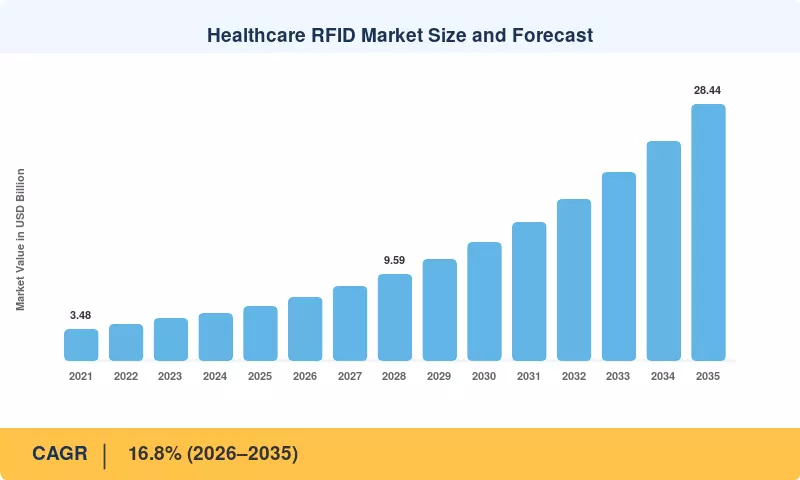
The Healthcare RFID Market reached USD 6.02 billion in 2025 and opens the forecast window at USD 7.03 billion in 2026, expanding to USD 28.44 billion by 2035 at a 16.8% CAGR. Two catalysts anchor that trajectory. The U.S. Drug Supply Chain Security Act reached full interoperable electronic tracing enforcement in November 2024 after a one-year stabilisation period, pushing unit-level identification down to the dispensing node [1]. Parallel to that, the European Union's Falsified Medicines Directive verification infrastructure now processes several billion pack scans annually across 30 national systems, normalising serialisation economics for manufacturers that supply both continents [2].
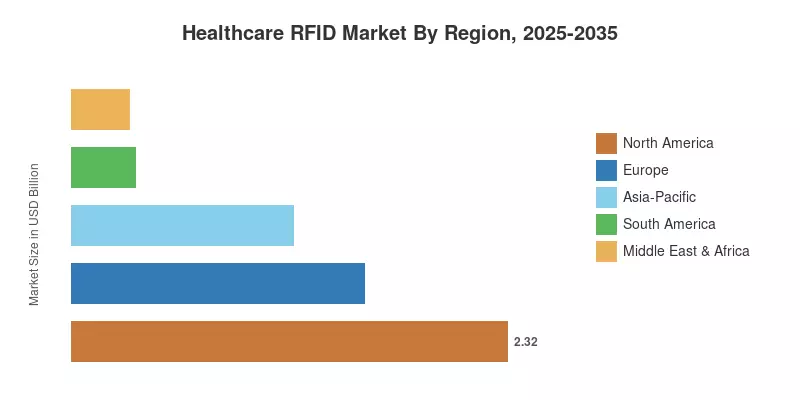
With dense capital-equipment fleets and the strongest traceability regulations, North America accounts for 38.5% of 2025 revenue. Asia-Pacific is the fastest-growing at 19.6% CAGR, with India, China and the Gulf-adjacent ASEAN corridor commissioning greenfield tertiary hospitals with digital infrastructure specified at the design stage. Next is Europe at 26.0%, where reimbursement pressure and sustainability requirements for reusable devices are driving investment in sterile processing. Over the next 10 years, the Healthcare RFID Market will progress from asset visibility to closed-loop clinical and supply orchestration.
Key Report Takeaways
• By Component
- Tags and Labels held 42.9% of Healthcare RFID Market revenue in 2025, reflecting the physical identifier layer that every deployment begins with
- Software and Analytics is the fastest-expanding component at a 19.9% CAGR through 2035
- Services revenue reached USD 0.72 billion in 2025 as workflow redesign and cybersecurity hardening became billable engagements.
• By Tag Frequency
- UHF/RAIN accounted for 51.2% of 2025 revenue on the strength of multi-room passive portal reads
- Microwave tags post the steepest trajectory at a 20.5% CAGR, driven by centimetre-level perioperative pinpointing.
- HF/NFC generated USD 1.48 billion in 2025 across controlled-access medication carts and cabinets.
• By Application
- Asset Tracking commanded 29.5% of revenue, covering pumps, monitors, wheelchairs, and beds.
- Surgical-Instrument Visibility grows at a 20.4% CAGR, the fastest application line.
- Blood and Specimen Monitoring reached USD 0.55 billion in 2025 under chain-of-custody audit pressure.
• By End User
- Hospitals anchored 56.2% of 2025 revenue given capital fleet ownership and adverse-event liability
- Contract Logistics and Third-Party Providers expand at a 19.6% CAGR as serialisation moves to outsourced centres
- Research Labs and Biobanks contributed USD 0.48 billion, constrained by grant-cycle budgeting
• By Region
- North America led the Healthcare RFID Market with 38.5% share in 2025
- Asia-Pacific advances at a 19.6% CAGR, the fastest regional rate
- Middle East & Africa generated USD 0.31 billion, concentrated in Gulf tertiary networks
Market Size and Forecast (2021–2035)
Estimates are derived from a bottom-up modeling of installed reader and portal counts across ~168,000 acute and specialty hospitals worldwide, triangulated top-down against component vendor disclosures, RAIN chip shipment numbers and hospital capital expenditure surveys. Historical numbers for 2021 to 2024 are reconciled using reported segment revenue from listed hardware vendors. Forecast years are based on adoption-curve modeling, calibrated to serialization compliance deadlines and regional facility construction pipelines. All figures are in constant 2025 U.S. dollars. The total for the Healthcare RFID Market excludes barcode-only and pure Wi-Fi RTLS deployments.




 Noah Malgeri
Co-Founder

 Peter Groot koerkamp
Account and Business Manager

 Younghwan Choi
Senior Retail Manager

 Mark Irwin
Management Consultant

 Akif Moroglu
Strategy & Business Development Director

 Guilherme Gomes Martins
Product Management Director

 Joseph Aguayo
Sales Operations & Pricing Manager

 La Terria Dodd
Program Support Specialist

 Rob Kooiker
Group Product Manager HVAC & Fire Protection GMA


