Guillain-Barre Syndrome Market Summary
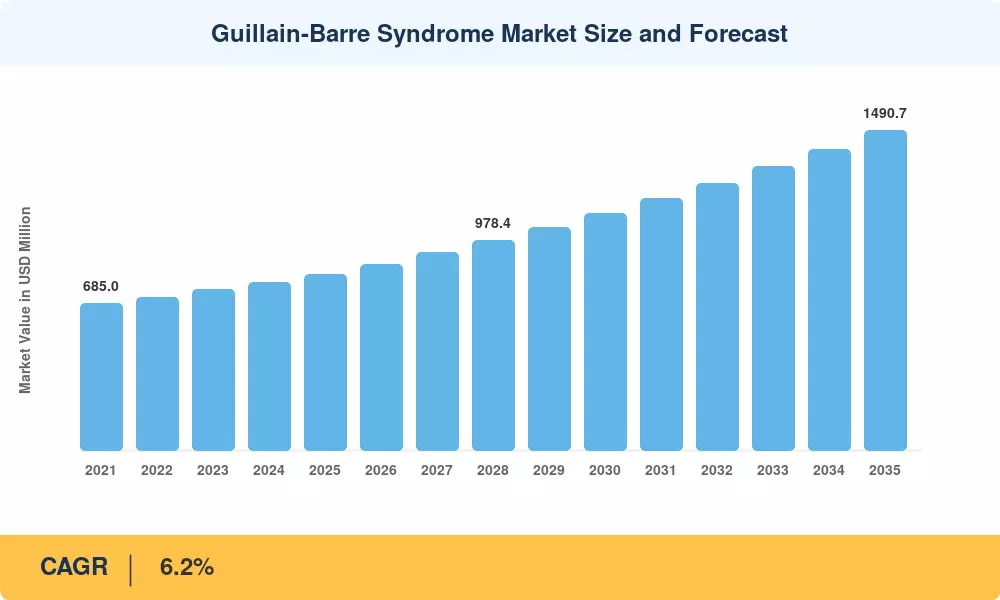
The Guillain-Barré Syndrome Market reached an estimated USD 820.5 Million in 2025 and is projected to grow from USD 867.5 Million in 2026 to USD 1,490.7 Million by 2035, registering a CAGR of 6.2% during the forecast period. Two catalysts anchor this trajectory: expanded Medicare reimbursement for home-based immunoglobulin infusion, which broadened treatment access across the United States starting in 2024, and the WHO's updated post-infectious neuropathy surveillance guidelines that prompted national health ministries to allocate incremental diagnostic funding [1][2]. Together, these policy shifts converted latent clinical demand into billable treatment episodes, particularly for patients previously managed with supportive care alone.
Legacy plasma exchange protocols are paving the way to precision biologics in the treatment landscape. Complement inhibitor candidates, some of which are already in phase III studies, are designed to stop the terminal complement cascade that causes nerve demyelination by providing disease-specific intervention as opposed to general immunosuppression. The global investment in complement biology across all indications was above USD 4.8 billion between 2022 and 2025 [3], with GBS-specific trials being a significant part of this pipeline. At the same time, increases in capacity for plasma fractionation in India, South Korea and Australia are alleviating long-term supply shortages for intravenous immunoglobulin. This development lowers treatment costs while increasing competition in the region.
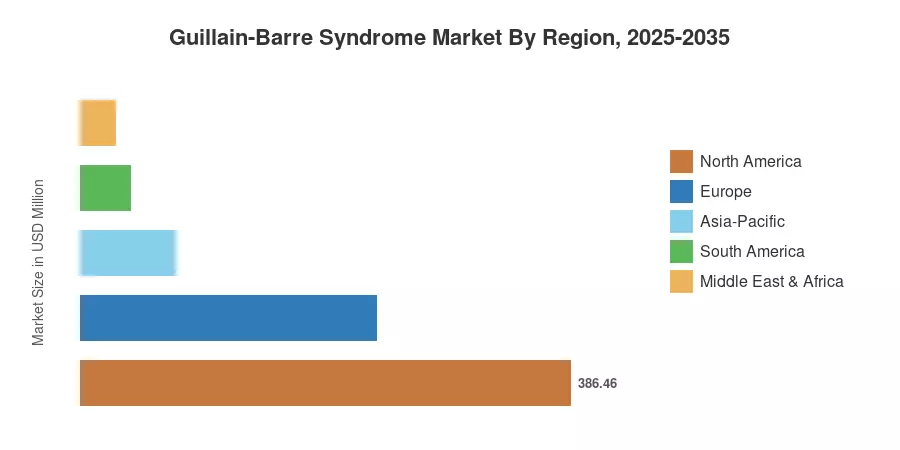
North America was estimated to hold around 47.1% of the Guillain-Barré Syndrome Market in 2025 owing to strong private-payer coverage and a high concentration of specialty infusion centers. The Asia-Pacific region is the fastest-growing region with a CAGR of 9.1% through 2035, supported by the growing diagnostic infrastructure and awareness campaigns for neurological disorders. Europe accounted for the second largest share, at around 28.5 %, but its continued reliance on imported US plasma introduces supply-chain fragility . With biologics pipelines maturing and reimbursement pathways broadening across the globe, the Guillain-Barré Syndrome Market is poised to continue its growth for a long time to come, far beyond current consensus estimates.
Key Report Takeaways
• By Therapeutics
- Intravenous immunoglobulin retained approximately 76.5% of the Guillain-Barré Syndrome Market share in 2025, reflecting entrenched clinical guidelines and broad payer coverage.
- Complement inhibitors and novel biologics are tracking a 10.2% CAGR through 2035, signaling an inflection toward disease-specific treatment strategies.
• By Distribution Channel
- Hospital pharmacies accounted for a 61.3% share of the Guillain-Barré Syndrome Market in 2025, reinforced by acute-care treatment protocols.
- Home infusion providers are expanding at a 10.0% CAGR, driven by Medicare home-infusion mandates and patient preference for outpatient settings.
• By Region
- North America represented 47.1% of the Guillain-Barré Syndrome Market in 2025, anchored by specialty neurology networks and favorable reimbursement.
- Asia-Pacific is the fastest-growing region at a 9.1% CAGR, propelled by fractionation plant investments and expanding health insurance penetration.
Guillain-Barré Syndrome Market Size and Forecast (2021–2035)
Market sizing draws on triangulated inputs: proprietary demand models calibrated against published epidemiological incidence rates (1–2 per 100,000 population annually), payer claims databases, manufacturer revenue disclosures, and regional plasma procurement volumes. Historical figures reflect confirmed shipment and reimbursement data, while forecast values apply a bottom-up incidence-to-treatment conversion methodology adjusted for biologic pipeline probabilities.




 Noah Malgeri
Co-Founder

 Peter Groot koerkamp
Account and Business Manager

 Younghwan Choi
Senior Retail Manager

 Mark Irwin
Management Consultant

 Akif Moroglu
Strategy & Business Development Director

 Guilherme Gomes Martins
Product Management Director

 Joseph Aguayo
Sales Operations & Pricing Manager

 La Terria Dodd
Program Support Specialist

 Rob Kooiker
Group Product Manager HVAC & Fire Protection GMA



