Gluten Intolerance Treatment Market

Gluten Intolerance Treatment Market Research Report By Treatment Type (Dietary Management, Pharmaceuticals, Nutritional Supplements), By Distribution Channel (Online Pharmacies, Retail Pharmacies, Supermarkets), By Patient Type (Pediatric Patients, Adult Patients, Geriatric Patients), By Formulation (Tablets, Powders, Liquid) and By Regional (North America, Europe, South America, Asia Pacific, Middle East and Africa) - Growth & Industry Forecast 2025 To 2035
ID: MRFR/HC/34362-HCR
128 Pages
Satyendra Maurya, Rahul Gotadki
Last Updated: May 15, 2026
Gluten Intolerance Treatment Market

Market Size

Forecast Period2025 - 2035
CAGR (2025 - 2035)5.82%
2024 Market Size$ 6.87 Billion
2025 Market Size$ 7.27 Billion
2035 Market Size$ 12.81 Billion

Key Players

Gluten Free Holdings
General Mills
Kraft Heinz
Nestle
Boulder Brands
Canyon Bakehouse
Opportunities
  • Advancements in Diagnostic Technologies
  • Expansion of Gluten-Free Product Offerings
  • Increasing Prevalence of Gluten Intolerance

Gluten Intolerance Treatment Market Summary

As per Market Research Future analysis, the Gluten Intolerance Treatment Market was estimated at 6.873 USD Billion in 2024. The gluten intolerance treatment industry is projected to grow from 7.273 USD Billion in 2025 to 12.81 USD Billion by 2035, exhibiting a compound annual growth rate (CAGR) of 5.8% during the forecast period 2025 - 2035

Key Market Trends & Highlights

The Gluten Intolerance Treatment Market is experiencing robust growth driven by rising consumer awareness and technological advancements.

  • Consumer awareness regarding gluten intolerance is rising, leading to increased demand for gluten-free products in North America.
  • Technological advancements in food production are enhancing the quality and variety of gluten-free offerings, particularly in the Asia-Pacific region.
  • The dietary management segment remains the largest, while the pharmaceuticals segment is witnessing the fastest growth due to innovative treatment options.
  • Key market drivers include the increasing prevalence of gluten intolerance and the expansion of gluten-free product offerings, which are shaping consumer preferences.

Market Size & Forecast

2024 Market Size 6.873 (USD Billion)
2035 Market Size 12.81 (USD Billion)
CAGR (2025 - 2035) 5.82%

Major Players

Gluten Free Holdings (US), General Mills (US), Kraft Heinz (US), Nestle (CH), Boulder Brands (US), Canyon Bakehouse (US), Schรคr(IT), Enjoy Life Foods (US), Udi's Gluten Free (US)

Our Impact
Enabled $4.3B Revenue Impact for Fortune 500 and Leading Multinationals
Partnering with 2000+ Global Organizations Each Year
30K+ Citations by Top-Tier Firms in the Industry

Gluten Intolerance Treatment Market Drivers

Advancements in Diagnostic Technologies

Technological advancements in diagnostic tools are significantly influencing the Gluten Intolerance Treatment Market. Enhanced testing methods, such as genetic testing and advanced serological assays, allow for more accurate and timely diagnosis of gluten-related disorders. These innovations facilitate early intervention, which is crucial for effective management of gluten intolerance. As healthcare providers adopt these advanced diagnostic technologies, the number of diagnosed cases is expected to rise, subsequently increasing the demand for gluten intolerance treatments. This trend underscores the importance of continuous investment in research and development within the healthcare sector to improve patient outcomes.

Expansion of Gluten-Free Product Offerings

The Gluten Intolerance Treatment Market is experiencing a notable expansion in gluten-free product offerings. Food manufacturers are increasingly recognizing the demand for gluten-free alternatives, leading to a proliferation of products ranging from baked goods to snacks and beverages. According to market data, the gluten-free food segment is projected to grow at a compound annual growth rate of over 10% in the coming years. This surge in product availability not only caters to those with gluten intolerance but also attracts health-conscious consumers who perceive gluten-free diets as beneficial. Consequently, this diversification of product lines is likely to enhance market growth and consumer engagement.

Increasing Prevalence of Gluten Intolerance

The rising incidence of gluten intolerance is a pivotal driver for the Gluten Intolerance Treatment Market. Recent studies indicate that approximately 1 in 100 individuals are affected by celiac disease, while non-celiac gluten sensitivity is also on the rise. This growing awareness among consumers about gluten-related disorders has led to an increased demand for gluten-free products and treatments. As more individuals seek diagnosis and management options, healthcare providers are responding by offering specialized treatments and dietary plans. This trend is likely to continue, as the population becomes more educated about the health implications of gluten intolerance, thereby propelling the market forward.

Growing Health Consciousness Among Consumers

The increasing health consciousness among consumers is a driving force in the Gluten Intolerance Treatment Market. As individuals become more aware of the impact of diet on overall health, there is a growing inclination towards gluten-free diets, even among those without diagnosed gluten intolerance. This shift is often motivated by perceived health benefits, such as improved digestion and increased energy levels. Market data suggests that the gluten-free food market is expanding beyond those with gluten intolerance, appealing to a broader audience seeking healthier lifestyle choices. This trend is likely to sustain the growth of the market as more consumers opt for gluten-free options.

Integration of Dietary Management in Healthcare

The integration of dietary management into healthcare practices is emerging as a significant driver for the Gluten Intolerance Treatment Market. Healthcare professionals are increasingly recognizing the role of nutrition in managing gluten intolerance and related disorders. This shift is leading to the development of comprehensive treatment plans that include dietary modifications alongside medical interventions. As healthcare systems adopt a more holistic approach to patient care, the demand for gluten intolerance treatments is expected to rise. This integration not only enhances patient outcomes but also fosters collaboration between healthcare providers and nutritionists, thereby strengthening the market's growth potential.
Market Segment Insights

By Treatment Type: Dietary Management (Largest) vs. Pharmaceuticals (Fastest-Growing)

The Gluten Intolerance Treatment Market is primarily driven by dietary management strategies, which have long been acknowledged as the cornerstone of gluten intolerance care. This segment garners the largest share due to the increasing awareness of gluten-related disorders and the effectiveness of dietary restrictions in managing symptoms. Conversely, pharmaceuticals represent the fastest-growing segment as researchers develop innovative solutions aimed at alleviating symptoms or altering glutenโ€™s effects on the body, reflecting a significant paradigm shift in treatment approaches.

Dietary Management (Dominant) vs. Nutritional Supplements (Emerging)

Dietary management remains the dominant strategy in treating gluten intolerance, involving strict adherence to a gluten-free diet. This segment benefits from a well-established consumer base and extensive educational resources available for patients. On the other hand, nutritional supplements are emerging in the Gluten Intolerance Treatment Market as valuable adjuncts to dietary management. These supplements focus on addressing nutritional deficiencies often caused by gluten-restricted diets, and their rise is fueled by increasing consumer interest in overall health optimization. As more individuals seek to balance dietary restrictions with necessary nutrients, this segment is gaining traction in the gluten intolerance treatment market.

By Distribution Channel: Online Pharmacies (Largest) vs. Retail Pharmacies (Fastest-Growing)

In the Gluten Intolerance Treatment Market, distribution channels such as Online Pharmacies, Retail Pharmacies, and Supermarkets play crucial roles in delivering products to consumers. Online Pharmacies dominate the distribution channel segment, capturing a significant share of the market due to the growing trend of e-commerce and the convenience it offers to consumers seeking gluten intolerance treatments. Retail Pharmacies follow closely, providing accessible services and specialized products to a broad customer base, while Supermarkets cater to everyday shopping needs but hold a comparatively smaller share. The growth trends within this segment highlight a shifting consumer preference towards online purchasing, propelled by an increasing reliance on digital platforms and home delivery services. Retail Pharmacies are identified as the fastest-growing channel, driven by personalized customer service and expert advice from pharmacists. This sector is expected to see enhanced growth as awareness regarding gluten intolerance rises and more consumers seek convenient, accessible treatment options through trusted retail platforms.

Online Pharmacies (Dominant) vs. Retail Pharmacies (Emerging)

Online Pharmacies have established themselves as the dominant channel in the Gluten Intolerance Treatment Market due to their comprehensive selection of products, user-friendly interfaces, and door-to-door delivery services. They cater to a broad demographic, allowing individuals with gluten sensitivities to access treatments discreetly and conveniently. In contrast, Retail Pharmacies are emerging strongly in this space by offering personalized services, consultations, and a limited range of gluten intolerance products. Their strategic location and face-to-face interactions appeal to consumers who prioritize trustworthy information and immediate gratification when purchasing treatment options. Both channels play pivotal roles, with Online Pharmacies leading in market share while Retail Pharmacies are rapidly adapting to changing consumer behaviors.

By Patient Type: Adult Patients (Largest) vs. Pediatric Patients (Fastest-Growing)

The Gluten Intolerance Treatment Market exhibits a diverse patient distribution, with Adult Patients representing the largest segment. This demographic's established awareness of gluten-related disorders has significantly influenced treatment demand. Conversely, Pediatric Patients are emerging rapidly, driven by increasing diagnoses of gluten intolerance among children arising from heightened screening practices and parental advocacy for awareness and education. The Geriatric Patients segment accounts for a smaller share, reflecting the unique dietary needs of older adults but still representing a vital market component.

Adult Patients (Dominant) vs. Pediatric Patients (Emerging)

Adult Patients dominate the Gluten Intolerance Treatment Market, benefiting from a significant focus on nutritional education and awareness about gluten sensitivities. This demographic often seeks comprehensive treatment options, including dietary adjustments and supportive therapies, leading to a robust market presence. Meanwhile, Pediatric Patients are on the rise, characterized by increased incidences of gluten intolerance diagnoses, heightened parental awareness, and advocacy for gluten-free diets. This segment is projected to grow as healthcare systems implement more rigorous screening and educational initiatives, addressing dietary requirements for children with gluten intolerance and expanding product offerings tailored for this younger population.

By Formulation: Tablets (Largest) vs. Powders (Fastest-Growing)

The Gluten Intolerance Treatment Market is segmented into Tablets, Powders, and Liquid formulations. Tablets currently dominate this market segment, capturing the largest share due to their convenience, precise dosage, and widespread acceptance among consumers. Powders, while smaller in market share, are emerging as a strong competitor, appealing particularly to health-conscious consumers looking for customizable options. Liquid formulations, although less popular, offer alternative solutions for those who find tablets difficult to ingest or prefer liquid consumption.

Tablets (Dominant) vs. Powders (Emerging)

Tablets represent the dominant formulation in the Gluten Intolerance Treatment Market, appreciated for their ease of use and consistent dosing, making them the first choice for many users. Their established presence in pharmacies and supermarkets bolsters their popularity. Conversely, Powders are gaining traction as an emerging option, particularly among younger demographics and fitness enthusiasts who seek versatile products for smoothies and shakes. The flexibility of powdered formulations allows consumers to adjust their intake according to personal preferences, driving growth in this segment. As awareness around gluten intolerance rises, both formulations will continue to carve their niches, driven by evolving consumer preferences.

Get more detailed insights about Gluten Intolerance Treatment Market

Regional Insights

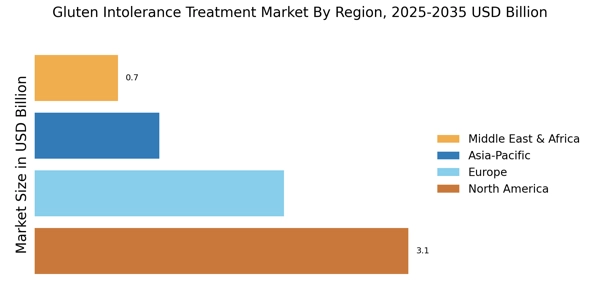
The Regional segment of the Gluten Intolerance Treatment Market shows a robust framework with notable valuations set for the upcoming years. In 2023, North America led this segment, valued at 2.54 USD Billion, contributing to a majority holding in the Gluten Intolerance Treatment Market, driven by increased awareness and healthcare accessibility.

Europe follows, valued at 1.84 USD Billion, supported by a growing population seeking gluten-free options and treatment substances. The APAC Gluten Intolerance Treatment Market, valued at 1.38 USD Billion in 2023, is showing significant potential due to rising health consciousness and dietary changes.

South America, while smaller with a valuation of 0.54 USD Billion, is gradually expanding, reflecting a shift towards gluten-free diets. Lastly, the MEA region, valued at 0.8 USD Billion, is also emerging with unique opportunities amidst challenging economic conditions.

The combined performance of these regions reflects varied market trends, growth drivers, and the need for awareness and product availability, positioning the Gluten Intolerance Treatment Market for steady growth in the coming years.

Gluten Intolerance Treatment Market Regional Image

Key Players and Competitive Insights

The Gluten Intolerance Treatment Market is currently characterized by a dynamic competitive landscape, driven by increasing consumer awareness and demand for gluten-free products. Key players are actively engaging in strategies that emphasize innovation, regional expansion, and partnerships to enhance their market presence. For instance, General Mills (US) has been focusing on product diversification, introducing new gluten-free options that cater to various dietary preferences. Similarly, Schรคr (IT) has positioned itself as a leader in the European market by leveraging its strong brand reputation and extensive distribution networks, which collectively shape a competitive environment that is both fragmented and highly competitive. In terms of business tactics, companies are increasingly localizing manufacturing to reduce costs and improve supply chain efficiency. This approach not only enhances responsiveness to local market demands but also mitigates risks associated with global supply chain disruptions. The market structure appears moderately fragmented, with several players vying for market share, yet the influence of major companies remains substantial, as they set trends and standards that smaller firms often follow. In August 2025, Kraft Heinz (US) announced a strategic partnership with a leading health food retailer to co-develop a new line of gluten-free snacks. This collaboration is significant as it allows Kraft Heinz to tap into the retailer's established customer base, thereby enhancing its market penetration and brand visibility. The partnership also reflects a broader trend of companies seeking synergies to innovate and meet evolving consumer preferences. In September 2025, Nestlรฉ (CH) launched a new gluten-free product line aimed at children, which includes snacks and breakfast cereals. This initiative is particularly noteworthy as it targets a demographic that is increasingly health-conscious, thereby expanding Nestlรฉ's reach within the gluten-free segment. The focus on childrenโ€™s health aligns with current consumer trends that prioritize nutrition and wellness, suggesting a strategic pivot towards more health-oriented offerings. In October 2025, Enjoy Life Foods (US) unveiled a new marketing campaign centered around sustainability and clean ingredients, emphasizing its commitment to transparency in sourcing. This move is indicative of a growing trend where consumers are not only looking for gluten-free options but also prioritizing environmentally friendly practices. Such initiatives may enhance brand loyalty and attract a more conscientious consumer base. As of October 2025, the competitive trends within the Gluten Intolerance Treatment Market are increasingly defined by digitalization, sustainability, and the integration of artificial intelligence in product development and marketing strategies. Strategic alliances are becoming more prevalent, as companies recognize the value of collaboration in navigating the complexities of consumer demands and market dynamics. Looking ahead, competitive differentiation is likely to evolve from traditional price-based competition towards a focus on innovation, technological advancements, and the reliability of supply chains, underscoring the importance of adaptability in a rapidly changing market.

Key Companies in the Gluten Intolerance Treatment Market include

Industry Developments

The Gluten Intolerance Treatment Market has recently witnessed significant activity. Gluten-Free Holdings has been making strides in expanding its product line to cater to increasing consumer demand for gluten-free options. Kraft Heinz and Nestle are also focusing on innovation within their gluten-free segments, tapping into the growing awareness of gluten-related health issues.

Companies like Schรคr and Canyon Bakehouse are enhancing their market presence through targeted marketing strategies aimed at educating consumers about gluten intolerance. PepsiCo recently announced its commitment to developing new gluten-free snacks, aiming to capture a larger market share.

In terms of mergers and acquisitions, General Mills has been actively pursuing strategic partnerships to bolster its gluten-free product offerings, while Bob's Red Mill continues to expand its footprint through collaborations that enhance distribution capabilities.

Additionally, Enjoy Life Foods and Udi's Gluten Free are working on product diversification to appeal to health-conscious consumers, thus influencing market dynamics. As the Gluten Intolerance Treatment Market valuation of these companies rises due to increased demand, it is impacting the overall gluten intolerance treatment landscape, signaling robust opportunities for continued growth and development within this sector.

Future Outlook

Gluten Intolerance Treatment Market Future Outlook

The Gluten Intolerance Treatment Market is projected to grow at a 5.82% CAGR from 2025 to 2035, driven by increasing awareness and demand for gluten-free products.

New opportunities lie in:

  • Development of personalized gluten intolerance diagnostic kits Expansion of gluten-free meal delivery services Investment in gluten-free ingredient innovation for food manufacturers

By 2035, the Gluten Intolerance Treatment Market is expected to be robust, reflecting substantial growth and innovation.

Market Segmentation

Gluten Intolerance Treatment Market Formulation Outlook

  • Tablets
  • Powders
  • Liquid

Gluten Intolerance Treatment Market Patient Type Outlook

  • Pediatric Patients
  • Adult Patients
  • Geriatric Patients

Gluten Intolerance Treatment Market Treatment Type Outlook

  • Dietary Management
  • Pharmaceuticals
  • Nutritional Supplements

Gluten Intolerance Treatment Market Distribution Channel Outlook

  • Online Pharmacies
  • Retail Pharmacies
  • Supermarkets

Report Scope

MARKET SIZE 2024 6.873(USD Billion)
MARKET SIZE 2025 7.273(USD Billion)
MARKET SIZE 2035 12.81(USD Billion)
COMPOUND ANNUAL GROWTH RATE (CAGR) 5.82% (2025 - 2035)
REPORT COVERAGE Revenue Forecast, Competitive Landscape, Growth Factors, and Trends
BASE YEAR 2024
Market Forecast Period 2025 - 2035
Historical Data 2019 - 2024
Market Forecast Units USD Billion
Key Companies Profiled Gluten Free Holdings (US), General Mills (US), Kraft Heinz (US), Nestle (CH), Boulder Brands (US), Canyon Bakehouse (US), Schรคr (IT), Enjoy Life Foods (US), Udi's Gluten Free (US)
Segments Covered Treatment Type, Distribution Channel, Patient Type, Formulation, Regional
Key Market Opportunities Emergence of innovative gluten-free products catering to diverse dietary preferences and health-conscious consumers.
Key Market Dynamics Rising consumer awareness drives demand for innovative gluten intolerance treatments and enhances market competition.
Countries Covered North America, Europe, APAC, South America, MEA

FAQs

What is the current valuation of the Gluten Intolerance Treatment Market?

The market valuation was 6.873 USD Billion in 2024.

What is the projected market size for the Gluten Intolerance Treatment Market by 2035?

The market is projected to reach 12.81 USD Billion by 2035.

What is the expected CAGR for the Gluten Intolerance Treatment Market during the forecast period?

The expected CAGR for the market from 2025 to 2035 is 5.82%.

Which companies are considered key players in the Gluten Intolerance Treatment Market?

Key players include Gluten Free Holdings, General Mills, Kraft Heinz, Nestle, Boulder Brands, Canyon Bakehouse, Schรคr, Enjoy Life Foods, and Udi's Gluten Free.

What are the main treatment types in the Gluten Intolerance Treatment Market?

The main treatment types include Dietary Management, Pharmaceuticals, and Nutritional Supplements.

How much revenue is generated from Dietary Management in the market?

Dietary Management generated revenues of 2.5 USD Billion in 2024 and is projected to reach 4.5 USD Billion by 2035.

What distribution channels are utilized in the Gluten Intolerance Treatment Market?

Distribution channels include Online Pharmacies, Retail Pharmacies, and Supermarkets.

What is the revenue projection for Retail Pharmacies by 2035?

Retail Pharmacies are expected to generate revenues of 4.5 USD Billion by 2035.

Which patient types are targeted in the Gluten Intolerance Treatment Market?

The market targets Pediatric, Adult, and Geriatric Patients.

What is the expected revenue from Nutritional Supplements in 2035?

Nutritional Supplements are projected to generate 5.31 USD Billion by 2035.
Author
Author
Author Profile
Satyendra Maurya LinkedIn
Research Analyst
An accomplished research analyst with high proficiency in market forecasting, data visualization, competitive benchmarking, and others. He holds a pronounced track record in research and consulting projects for sectors such as life sciences, medical devices, and healthcare IT. His capabilities in qualitative and quantitative analysis have resulted in positive client outcomes. Working on niche market trends, opportunities, sales, and forecasted value is part of his skill set.
Co-Author
Co-Author Profile
Rahul Gotadki LinkedIn
Research Manager
He holds an experience of about 9+ years in Market Research and Business Consulting, working under the spectrum of Life Sciences and Healthcare domains. Rahul conceptualizes and implements a scalable business strategy and provides strategic leadership to the clients. His expertise lies in market estimation, competitive intelligence, pipeline analysis, customer assessment, etc.
Leave a Comment

Research Approach

Secondary Research

The secondary research process involved comprehensive analysis of regulatory databases, peer-reviewed medical journals, clinical publications, food safety standards, and authoritative health organizations. Key sources included the US Food & Drug Administration (FDA), European Food Safety Authority (EFSA), National Institutes of Health (NIH), National Center for Biotechnology Information (NCBI/PubMed), Centers for Disease Control and Prevention (CDC), World Health Organization (WHO) Global Health Observatory, EU Eurostat Health Database, National Institute of Diabetes and Digestive and Kidney Diseases (NIDDK), Celiac Disease Foundation, Gluten Intolerance Group, American Gastroenterological Association (AGA), British Society of Gastroenterology, Food and Agriculture Organization (FAO) of the United Nations, national health ministry reports from key markets, and gluten-free certification bodies such as the Gluten-Free Certification Organization (GFCO).

Prevalence statistics, diagnostic data, regulatory approval information, clinical safety studies, dietary guideline developments, and market landscape analysis for pharmaceuticals, nutritional supplements, and dietary management solutions targeting gluten intolerance, celiac disease, and non-celiac gluten sensitivity were gathered from these sources.

Primary Research

In order to gather both qualitative and quantitative insights, supply-side and demand-side stakeholders were interviewed during the primary research process. CEOs, VPs of Product Development, heads of regulatory affairs, R&D directors, and marketing directors from producers of nutritional supplements, pharmaceutical businesses creating enzyme therapy, and manufacturers of gluten-free foods were examples of supply-side sources. Board-certified gastroenterologists, allergists, registered dietitians, nutritionists, pediatric specialists, hospital pharmacy procurement leads, retail pharmacy directors, supermarket category managers, and representatives of patient advocacy groups were among the demand-side sources. In addition to gathering information on clinical adoption patterns, consumer purchasing behavior, pricing strategies, reimbursement dynamics, and distribution channel preferences, primary research validated market segmentation across treatment types and confirmed product pipeline timelines for emerging enzyme therapies.

Primary Respondent Breakdown:

By Designation: C-level Primaries (32%), Director Level (30%), Others (38%)

By Region: North America (32%), Europe (30%), Asia-Pacific (28%), Rest of World (10%)

Market Size Estimation

Global market valuation was derived through revenue mapping and consumption volume analysis. The methodology included:

Identification of 50+ key manufacturers and brands across North America, Europe, Asia-Pacific, and Latin America specializing in gluten-free products, enzyme therapies, and nutritional supplements

Product mapping across dietary management (gluten-free foods), pharmaceuticals (enzyme therapies, investigational drugs), and nutritional supplements (probiotics, vitamins, minerals) categories

Analysis of reported and modeled annual revenues specific to gluten intolerance treatment portfolios

Coverage of manufacturers representing 72-78% of global market share in 2024

Extrapolation using bottom-up (patient population ร— treatment adoption rate ร— ASP by country/region) and top-down (manufacturer revenue validation) approaches to derive segment-specific valuations across treatment types, distribution channels, patient demographics, and formulation types

Download Free Sample

Kindly complete the form below to receive a free sample of this Report

Download PDF ×

We do not share your information with anyone. However, we may send you emails based on your report interest from time to time. You may contact us at any time to opt-out.