Germanium Market (2026 - 2035)

Germanium Market Research Report Information By Type (germanium tetrachloride, germanium dioxide, germanium ingot, and Others (germanium wafers, germanium compounds)), and By Application (IR optics, fiber optics, electronics, and Others (LED technology, solar cells)) – Forecast Till 2035.
ID: MRFR/CnM/20850-HCR 100 Pages Priya Nagrale Last Updated: October 05, 2026
Germanium Market
Market Size
Forecast Period2026-2035
CAGR (2026-2035)4.90%
Key Players
Umicore
Yunnan Chihong Zinc & Germanium
Yunnan Lincang Xinyuan Germanium Industry
Teck Resources
5N Plus
AXT Inc.
Opportunities
  • Closed-Loop Recycling of Optics and Fiber Scrap
  • Emerging-Market Feedstock in Africa and India
  • Tolling, Lease, and Traceability Business Models

Germanium Market Summary

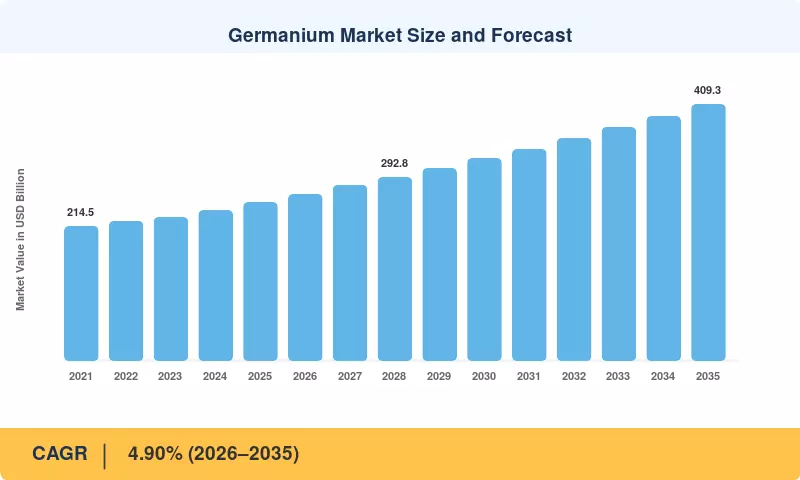
The global germanium market reached 252.8 tons in 2025. It is projected to rise from 266.1 tons in 2026 to 409.3 tons by 2035, a CAGR of 4.90% over 2026–2035. Two policy shocks frame this outlook. China's export-licensing regime for germanium items took effect on 1 August 2023 [2]. China followed it with a December 2024 ban on shipments to the United States [3]. Both measures pushed Western buyers to sign long-term offtakes and fund new refining capacity outside China.

The demand composition is evolving beneath the headline volume. Germanium tetrachloride is required as a core dopant in every preform drawn on MCVD and PCVD lines, as copper telecom lines and legacy coaxial networks are being replaced by fiber-to-the-home and hyperscale data-center optics. Cooled thermal cameras are transitioning to uncooled, lens-heavy architectures in border surveillance and vehicles. The EU Critical Raw Materials Act establishes a goal of 40% domestic processing of strategic materials by 2030 [5]. The production of germanium substrates is also becoming more accessible to end users.

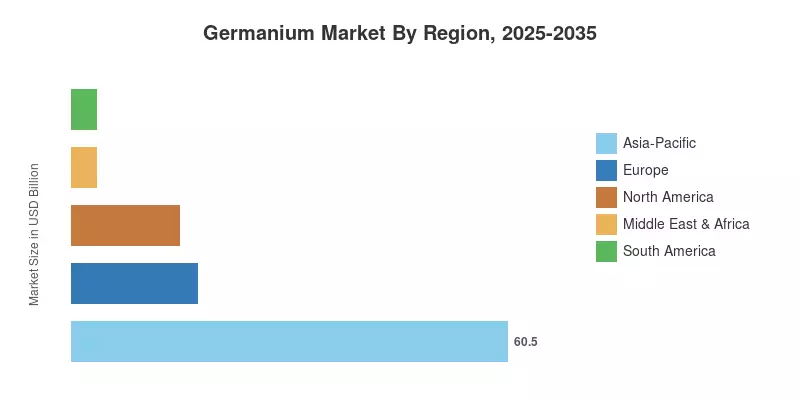
The Germanium market is dominated by the Asia-Pacific region, which has a 60.5% volume share in 2025. Additionally, it is the fastest-growing region, with Chinese refining and Indian fiber rollout being the primary factors. The demand for defense optics and Belgian refining is the reason for Europe's second-place ranking at 17.5%. Supply conditions will be established by the region that secures by-product feedstock, rather than the region with the highest demand, over the next decade.

Ā 

Ā 

Key Report Takeaways

• By Type

  • Germanium tetrachloride is the fastest-growing type in the germanium market, at a 5.20% CAGR through 2035, as optical-fiber preform output scales.
  • Germanium dioxide holds the largest type share at 28.0% in 2025, anchored by PET polymerization catalysts and optical glass.
  • Germanium ingot volume reached 67.0 tons in 2025, mostly sliced into IR lens blanks and substrates.

• By Application

  • Fiber optics leads the germanium market by application with a 32.4% share in 2025 and is also its fastest-expanding end use.
  • IR optics consumed 70.8 tons in 2025 across defense, automotive night vision, and industrial thermography.

• By Region

  • Asia-Pacific accounts for 60.5% of global volume, led by China's integrated zinc-germanium refiners
  • Europe holds 17.5%, with demand concentrated in Germany and refining in Belgium
  • North America represents 15.0%, as defense procurement drives reshoring efforts

Market Size and Forecast (2021–2035)

The figures below combine refinery output data published by the US Geological Survey [1], company production disclosures [14][15][16], and trade-flow reconciliation, all expressed in metric tons of contained germanium. Historical years reflect reported and estimated consumption. Forecast years apply the calibrated growth path for the germanium market described throughout this report.
Germanium Market Size and Forecast
Our Impact

Enabled $4.3B Revenue Impact for Fortune 500 and Leading Multinationals

Partnering with 2000+ Global Organizations Each Year

30K+ Citations by Top-Tier Firms in the Industry

Driver Impact Analysis

The impact percentages below show the direction and relative weight of each driver. They are not additive and should not be summed to reproduce the headline CAGR, because drivers overlap and interact with the restraints in Section 5.

Driver ~% Impact on CAGR Geographic Relevance Impact Timeline
Fiber-to-the-home and data-center optical build-out +1.1% Global; strongest in Asia-Pacific Medium-term (2–4 yr)
Defense and automotive thermal imaging +0.9% North America, Europe Long-term (≄4 yr)
Supply-chain localization policies +0.7% EU, US, Japan, Korea Short-term (≤2 yr)
SiGe RF chips for 5G and radar +0.6% Asia-Pacific, North America Medium-term (2–4 yr)
Space solar cell demand +0.5% North America, Europe, China Long-term (≄4 yr)
High-purity detectors for nuclear security +0.4% North America, Europe Long-term (≄4 yr)

Ā 

Fiber-to-the-Home and Data-Center Optical Build-Out

About 2.6 billion people were still offline in 2024, according to ITU [24], and most new connections in emerging economies now run on fiber. AI training clusters add a second, faster-growing pull: 800G transceivers and dense interconnect cabling need large volumes of preform. Each kilometer of single-mode fiber uses only grams of germanium tetrachloride, but billions of kilometers of fiber add up to the largest single demand stream in the germanium market.

Defense and Automotive Thermal Imaging

Germanium's high refractive index and transparency in the 8–12 µm band make it the default lens material for long-wave thermal cameras. Defense modernization budgets in NATO countries, together with Defense Production Act Title III awards aimed at domestic germanium wafer capacity [19], are lifting procurement. Night-vision pedestrian detection in premium vehicles widens the civilian base and adds lens volume that does not depend on defense cycles.

Supply-Chain Localization Policies

The EU Critical Raw Materials Act sets 2030 benchmarks of 10% domestic extraction, 40% processing, and 25% recycling. It also caps dependence on any single third country at 65% for each strategic material [5]. Korea's 2023 strategy named 33 critical minerals for priority stockpiling [10]. These targets turn purchasing that used to depend on price into purchasing that depends on security of supply, which supports volume commitments.

SiGe RF Chips for 5G and Radar

Silicon-germanium heterojunction bipolar transistors power 5G front ends, automotive radar, and satellite links. The US CHIPS and Science Act committed USD 52.7 billion to domestic semiconductor manufacturing [11], and the European Chips Act targets EUR 43 billion in public and private investment [12]. Both programs fund compound and SiGe foundry lines that consume epitaxial-grade germanium precursors.

Space Solar Cell Demand

Multi-junction solar cells grown on germanium substrates exceed 30% conversion efficiency in orbit and dominate power systems for satellites [23]. Low-Earth-orbit broadband constellations launch thousands of spacecraft and replace them every five to seven years. This creates recurring substrate demand that is largely insensitive to price.

High-Purity Detectors for Nuclear Security

High-purity germanium detectors offer energy resolution that scintillators cannot match for isotope identification at ports and borders. The USGS 2022 critical-minerals designation [8] supports federal procurement of these systems. Although detector volumes are small in tonnage, they generate disproportionate revenue per kilogram for zone-refining specialists.

Restraints Impact Analysis

Restraint ~% Impact on CAGR Geographic Relevance Impact Timeline
Export controls and supply concentration āˆ’0.9% Global; acute in US and EU Short-term (≤2 yr)
Price volatility āˆ’0.6% Global Short-term (≤2 yr)
Material substitution āˆ’0.5% Europe, North America Medium-term (2–4 yr)
Inelastic by-product supply āˆ’0.4% Global Long-term (≄4 yr)
Environmental compliance costs āˆ’0.2% China, Europe Medium-term (2–4 yr)

Ā 

Export Controls and Supply Concentration

China accounts for most of global refined germanium output, according to USGS [1]. MOFCOM's 2023 licensing rule [2] and the December 2024 U.S.-specific ban [3] showed how quickly that concentration can turn into supply shortfalls. A later suspension of the US ban [4] eased the immediate pressure, but buyers still face licensing risk that can stall projects.

Price Volatility

European spot germanium prices more than doubled between mid-2023 and late 2024 as licensing slowed Chinese shipments [1][21]. That volatility squeezes PET resin producers and commercial thermal-camera makers that cannot pass costs on. Some have cut germanium loadings, and others have redesigned products, which dampens near-term volume.

Material Substitution

Chalcogenide glasses now replace germanium in many low-cost uncooled thermal lenses, and antimony and titanium catalysts compete with germanium dioxide in PET production. The EU's 2023 criticality assessment [6] flags substitution as a lever for reducing dependence. Policy support for alternatives slowly erodes germanium's share of the applications where it is easiest to replace.

Inelastic By-Product Supply

Germanium is recovered almost entirely as a by-product of zinc refining and coal fly-ash processing [1]. Output therefore follows zinc-smelter throughput, not germanium prices. Even a sustained price spike adds little new supply within two years, which caps how fast consumption can grow.

Environmental Compliance Costs

Recovering germanium from fly ash generates acidic leach residues, and tighter Chinese emissions rules have closed several smaller plants. European operators also face permitting timelines that the CRMA's strategic-project fast-track only partly shortens [6]. These costs raise the marginal price of new capacity.

Germanium Market Opportunities

Closed-Loop Recycling of Optics and Fiber Scrap

Recycled material already supplies a meaningful share of germanium consumption, and the CRMA's 25% recycling benchmark [5] gives processors a policy anchor. Recovering germanium tetrachloride off-gas at preform plants and reclaiming end-of-life lenses offer low-cost secondary feedstock that buyers outside China can secure.

Emerging-Market Feedstock in Africa and India

The Big Hill tailings in the Democratic Republic of Congo are a newly opened germanium-bearing resource, developed through GƩcamines' partnership with Umicore [22]. India listed germanium among its 30 critical minerals in 2023 [9], which encourages domestic recovery from zinc residues. Both regions offer supply diversification and local demand growth.

Tolling, Lease, and Traceability Business Models

Refiners increasingly process customer-owned scrap for a fee rather than buying feedstock outright, which keeps metal ownership with the customer. Defense primes are piloting lens-lease programs with guaranteed buyback. Digital chain-of-custody records that document origin, purity, and recycled content can be sold as a premium data service to buyers that must comply with origin and sourcing rules.

Germanium-on-Silicon Photonics

Ge-on-Si photodetectors integrate optical receivers directly onto CMOS wafers, cutting transceiver cost and power use. Foundries funded under the CHIPS Act [11] are adding photonics process lines. This could create a new epitaxial demand stream beyond traditional SiGe RF devices.

Quantum and Radiation-Detection Niches

Isotopically enriched germanium supports spin-qubit research and neutrinoless double-beta-decay experiments. Volumes are small, but prices for 7N-plus material run many times higher than for commodity ingot. Specialists with zone-refining expertise can earn premium margins in this niche.

Germanium Market Future Outlook

AI Infrastructure and Optical Interconnect

The IEA projects that data-center electricity demand will roughly double by 2030 [7]. Each new AI cluster needs dense fiber cabling and co-packaged optics. This sustains germanium tetrachloride consumption even as consumer broadband build-outs mature in developed markets.

Defense Optics and Autonomous Mobility

Thermal imaging is spreading from military platforms to drones, autonomous trucks, and safety systems in passenger cars. Buyers in this germanium market segment will pay a premium for supply from allied countries. Expect multi-year contracts tied to DPA awards and NATO standardization [19].

Strategic Stockpiling and Supply Reshoring

Governments in the US, EU, Japan, and Korea are moving from designating germanium as critical to holding physical stocks [5][10][20]. Public stockpile purchases will add steady baseline demand through 2030. New refineries outside China will gradually ease the current supply concentration.

Circularity and ESG Disclosure

Corporate sustainability reporting under the EU's CSRD framework will push buyers to disclose the origin of critical materials and their recycled content. The World Bank's commodity outlook highlights rising pressure on minerals supply chains to show traceability [21]. Refiners able to certify recycled germanium will win preferred-supplier status.

Regional Market Share Analysis

Region Volume Share (2025) Primary Investment Themes
North America 15.0% Defense reshoring, Canadian zinc-smelter recovery
Europe 17.5% CRMA processing projects, recycling
Asia-Pacific 60.5% Integrated refining, fiber rollout
South America 3.5% Zinc-residue potential, telecom expansion
Middle East & Africa 3.5% DRC tailings, Gulf data centers
Total 100.0% —

The germanium market shows a sharp split between regions that refine germanium and regions that mainly consume it.

Ā 

North America

Country Metric Key Driver
US 78% of regional volume Defense optics and detectors
Canada 5.4% CAGR (2026–2035) Trail smelter germanium recovery
Mexico 2.1 tons (2025) Automotive electronics assembly

Ā 

The North American germanium market is shaped by procurement for national security. The US lists germanium as a critical mineral [8], and DPA Title III funding targets domestic wafer capacity [19]. Teck's Trail Operations in British Columbia remain the region's main primary source [15]. Mexico's demand comes mainly from radar and sensor assembly for vehicle exports.

Europe

Country Metric Key Driver
Germany 26% of regional volume Thermal imaging and photonics
UK 4.4% CAGR (2026–2035) Defense optics
France 6.2 tons (2025) Space solar and aerospace
Italy 9% of regional volume Fiber cable manufacturing
Spain 4.1% CAGR (2026–2035) FTTH densification
Nordic Countries 3.1 tons (2025) Fiber and telecom equipment
Russia 14% of regional volume Domestic optics production
Rest of Europe 3.9% CAGR (2026–2035) Recycling and refining in Belgium

Ā 

Belgium-based Umicore anchors European refining and substrate production [14]. Germany leads consumption through its optics and photonics clusters. The CRMA's strategic-project designation [5] gives qualifying recycling plants faster permitting. Russia's domestic production operates largely outside Western supply chains because of sanctions.

Asia-Pacific

Country Metric Key Driver
China 71% of regional volume Integrated zinc-germanium refining
India 7.1% CAGR (2026–2035) BharatNet fiber rollout
Japan 14.8 tons (2025) Semiconductor and optics stockpiling
South Korea 8% of regional volume SiGe RF chips
ASEAN 6.3% CAGR (2026–2035) Data-center construction
Rest of Asia-Pacific 4.5 tons (2025) Australian zinc residues

Ā 

The Asia-Pacific germanium market combines dominant Chinese supply with fast-growing demand elsewhere in the region. Yunnan-based producers control most of the region's refining output [18]. Japan's JOGMEC maintains rare-metal stockpiles for economic security [20]. India's critical-minerals policy [9] and ASEAN data-center construction make them the region's fastest-growing consumers.

South America

Country Metric Key Driver
Brazil 58% of regional volume Fiber network expansion
Argentina 4.8% CAGR (2026–2035) Telecom modernization
Rest of South America 1.6 tons (2025) Peruvian zinc residues

Ā 

South America consumes far more germanium than it refines, despite large zinc output in Peru and Bolivia. Brazil's regional fiber operators drive most demand. Recovering germanium from Andean zinc-smelter residues is still largely untapped, which makes the region a candidate for future tolling partnerships.

Middle East & Africa

Country Metric Key Driver
Saudi Arabia 5.6% CAGR (2026–2035) Vision 2030 data centers
UAE 22% of regional volume Defense procurement
South Africa 1.9 tons (2025) Mining by-product potential
Egypt 4.5% CAGR (2026–2035) Subsea cable landings
Rest of MEA 14% of regional volume DRC tailings feedstock

Ā 

Gulf states buy finished optics and fiber, while Central Africa is becoming an upstream source. Shipments of concentrate from the DRC's Big Hill site to Belgian refining [22] give the region a role in supply diversification. Saudi and Emirati data-center programs are lifting demand for imported optical components.

Germanium Market By Region, 2025-2035

Germanium Market Segmentation

By Type

Segment Metric Primary Demand Driver
germanium tetrachloride 5.20% CAGR (2026–2035) Optical-fiber preform doping
germanium dioxide 28.0% share (2025) PET catalysts and optical glass
germanium ingot 67.0 tons (2025) IR lens blanks
Others (germanium wafers, germanium compounds) 18.0% share (2025) Space solar and detectors

Ā 

Within the germanium market by type, germanium dioxide holds the largest share at 28.0%, supported by PET resin catalysts and high-index optical glass. Germanium tetrachloride grows fastest at a 5.20% CAGR because MCVD and PCVD preform lines rely on it for core doping. Germanium ingot feeds lens grinding and substrate slicing. Under others, germanium wafers serve multi-junction solar cells, while specialty germanium compounds such as tetrafluoride address niche deposition needs.

By Application

Segment Metric Primary Demand Driver
IR optics 70.8 tons (2025) Defense and automotive thermal imaging
fiber optics 32.4% share (2025) FTTH and data-center cabling
electronics 5.0% CAGR (2026–2035) SiGe RF chips and detectors
Others (LED technology, solar cells) 47.0 tons (2025) Space power and phosphors

Ā 

Fiber optics leads the germanium market by application with a 32.4% share and is also the fastest-growing use, driven by AI data-center interconnect. IR optics consumed 70.8 tons in 2025, supported by defense lens demand. Electronics grows at 5.0% on SiGe 5G and radar chips. In other areas, solar cells for satellites outweigh LED technology phosphors in tonnage.

Competitive Benchmarking

The germanium market is moderately concentrated, with an estimated Herfindahl-Hirschman Index of about 1,200. The top five producers together control roughly 55–60% of refined supply. Chinese integrated refiners dominate primary volume, while Western players compete on purity, substrate technology, and supply security. The tail of the market is fragmented, made up of recyclers and zone-refining specialists.

Company Est. Revenue Share Range Key Offerings for Germanium Market Strategic Positioning
Umicore ~12–16% Substrates, optics blanks, GeClā‚„ Leading Western refiner and recycler
Yunnan Chihong Zinc & Germanium ~10–14% Ingot, dioxide, tetrachloride Integrated zinc-germanium producer
Yunnan Lincang Xinyuan Germanium Industry ~8–12% Ingot, IR lenses, wafers Leader in coal-sourced germanium
Teck Resources ~6–9% Germanium concentrate and metal Primary North American source
5N Plus ~5–8% High-purity metal, space solar substrates Specialist in high-purity materials
AXT Inc. ~4–7% Germanium substrates Wafer supplier with operations in China
JSC Germanium ~3–6% Ingot, optics Russian domestic supplier
Photonic Sense ~2–4% IR optical components Niche optics fabricator
Indium Corporation ~2–4% Germanium compounds Diversified specialty-chemicals supplier
PPM Pure Metals ~1–3% High-purity metal European zone-refining specialist

Ā 

Recent News & Developments

  • China MOFCOM and General Administration of Customs (Jul 2023): Announced export licensing for gallium and germanium items, effective 1 August 2023, which triggered Western stockpiling [2]
  • European Commission (Mar 2023): Proposed the Critical Raw Materials Act alongside its fifth criticality list, which names germanium [6]
  • Ministry of Mines, India (Jun 2023): Released a list of 30 critical minerals that includes germanium, supporting domestic recovery programs [9]
  • European Union (May 2024): The Critical Raw Materials Act entered into force with 2030 processing and recycling benchmarks [5]
  • China MOFCOM (Dec 2024): Banned exports of germanium and related items to the United States, tightening Western supply [3]
  • US Geological Survey (Jan 2025): Mineral Commodity Summaries documented sharp germanium price increases and heavy import reliance [1]
  • China MOFCOM (Nov 2025): Suspended the U.S.-specific export ban while keeping general licensing in place [4]

Germanium Market Report Scope

Parameter Detail
Market Scope Global germanium consumption by type, application, and region
Study Period 2021–2035 (Base Year 2025; Forecast 2026–2035)
CAGR 4.90% (2026–2035)
Market Size checkpoints 252.8 tons (2025); 266.1 tons (2026); 409.3 tons (2035)
Fastest Growing Segments germanium tetrachloride (5.20% CAGR); fiber optics
Companies Profiled Umicore, Yunnan Chihong Zinc & Germanium, Yunnan Lincang Xinyuan Germanium Industry, Teck Resources, 5N Plus, AXT Inc., JSC Germanium, Photonic Sense, Indium Corporation, PPM Pure Metals
Valuation Currency Volume in metric tons of contained germanium
CAGR Driver Disclaimer Driver and restraint impacts are directional and not additive.

FAQs

How can buyers in the germanium market reduce exposure to export-license delays?
Dual-source between Chinese and Western refiners, and hold three to six months of buffer stock. Tolling agreements that return reclaimed scrap as finished metal also cut dependence on new licenses [2].
What purity grades matter when sourcing from the germanium market?
Fiber and optics buyers typically specify 5N–6N material. Radiation detectors require zone-refined material approaching 13N electrically active purity, which only a handful of suppliers can produce [16].
Can chalcogenide glass fully replace germanium lenses?
Not for high-performance systems. Chalcogenides suit molded, low-cost uncooled cameras, but germanium still offers better durability and transmission for military long-range optics [6].
How does fly-ash recovery compare with zinc-residue recovery?
Fly-ash recovery is common in Yunnan and Inner Mongolia but produces heavier waste streams. Zinc-residue recovery integrates with existing smelters and usually costs less per kilogram recovered [18].
What new use cases could expand the germanium market after 2030?
Germanium-tin lasers for silicon photonics and germanium spin qubits are the leading candidates. Both remain at pilot scale but would need ultra-high-purity, isotopically controlled material [11].
Which certifications do defense buyers request from optics suppliers?
Defense buyers commonly require AS9100 quality management and ITAR registration for US programs. Many also demand domestic-origin documentation under DFARS specialty-metals clauses [19].
Why are tolling contracts gaining ground in the germanium market?
Tolling lets manufacturers keep ownership of their germanium while paying refiners only a processing fee. This protects them from spot-price swings and qualifies recycled content toward the CRMA's 25% benchmark [5].
Author
Author Author Profile Priya Nagrale LinkedIn Senior Research Analyst
With an experience of over five years in market research industry (Chemicals & Materials domain), I gather and analyze market data from diverse sources to produce results, which are then presented back to a client. Also, provide recommendations based on the findings. As a Senior Research Analyst, I perform quality checks (QC) for market estimations, QC for reports, and handle queries and work extensively on client customizations. Also, handle the responsibilities of client proposals, report planning, report finalization, and execution

Research Approach

Ā 

Secondary Research

The secondary research process involved comprehensive analysis of geological surveys, mining databases, semiconductor industry publications, critical minerals reports, and authoritative regulatory bodies. Key sources included the U.S. Geological Survey (USGS), European Commission Critical Raw Materials List, International Energy Agency (IEA), International Renewable Energy Agency (IRENA), National Minerals Information Center (NMIC), China Ministry of Natural Resources, Geological Survey of Japan (GSJ), British Geological Survey (BGS), Australian Bureau of Statistics (ABS), Statistics Canada, World Mining Data, International Semiconductor Industry Association (SEMI), Optoelectronics Industry Development Association (OIDA), Fiber Optic Association (FOA), Solar Power Europe, National Renewable Energy Laboratory (NREL), Lawrence Berkeley National Laboratory, MIT Materials Research Laboratory, and national mining ministry reports from key producing regions.

For polycrystalline germanium, single-crystal germanium, and germanium compounds used in electronics, optics, solar cells, infrared systems, and telecommunications, these sources were utilized to gather estimates of mineral reserves, production statistics, trade flow data, price trends, regulatory frameworks, and technological advancement analysis.

Ā 

Primary Research

In order to gather both qualitative and quantitative insights, supply-side and demand-side stakeholders were interviewed during the primary research process. CEOs, VPs of Mining Operations, Chief Geologists, refining plant managers, and commercial directors from smelters, advanced material producers, and germanium mining firms were examples of supply-side sources. Procurement chiefs from semiconductor foundries, makers of optical fiber and solar cells, defense contractors, manufacturers of telecommunications equipment, and R&D directors from electronics and renewable energy firms were examples of demand-side suppliers. In addition to gathering information on supply chain dynamics, pricing mechanisms, replacement risks, and geopolitical sourcing strategies, primary research verified capacity growth timetables and validated market segmentation.

Primary Respondent Breakdown:

By Designation: C-level Primaries (32%), Director Level (30%), Others (38%)

By Region: North America (32%), Europe (30%), Asia-Pacific (33%), Rest of World (5%)

Ā 

Market Size Estimation

Global market valuation was derived through production volume analysis and revenue mapping across the value chain. The methodology included:

Identification of 35+ key producers and refiners across North America, Europe, Asia-Pacific, and Africa

Product mapping across polycrystalline germanium, single-crystal germanium, and germanium compounds

Analysis of reported and modeled annual revenues specific to germanium product portfolios

Coverage of producers representing 75-80% of global market share in 2024

Extrapolation using bottom-up (production volume Ɨ ASP by region) and top-down (manufacturer revenue validation) approaches to derive segment-specific valuations across electronics, fiber optics, solar energy, infrared systems, and military applications

Download Free Sample

Kindly complete the form below to receive a free sample of this Report

Download PDF ×

We do not share your information with anyone. However, we may send you emails based on your report interest from time to time. You may contact us at any time to opt-out.
















