Gas Detection System Market Summary
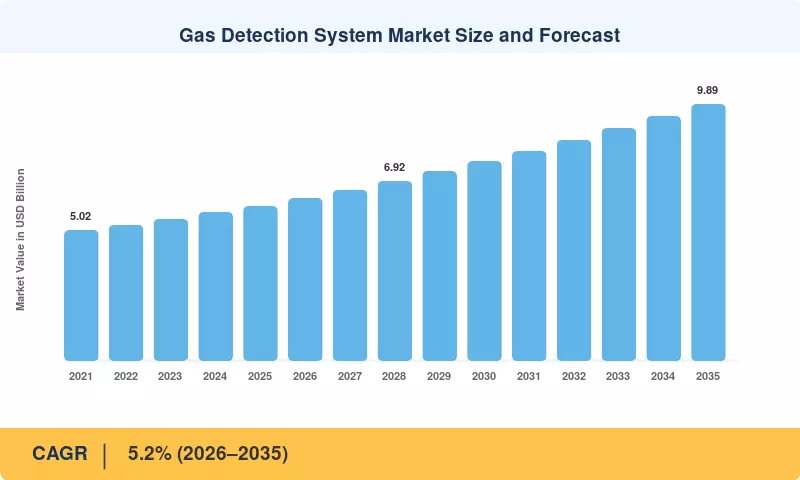
The Gas Detection System Market was valued at USD 5.96 Billion in 2025 and is projected to reach USD 6.27 Billion in 2026, rising to USD 9.89 Billion by 2035 at a CAGR of 5.2% over 2026–2035. Two policy catalysts frame the outlook. The U.S. EPA's final oil and natural gas methane standards are expected to avoid roughly 58 million tons of methane through 2038 [3], and the European Union's methane regulation makes periodic leak detection and repair mandatory across the energy supply chain [5]. Both convert detection from a discretionary safety purchase into a recurring compliance obligation.
Technology is shifting just as fast as regulation. Legacy catalytic-bead heads hard-wired to standalone alarm panels are being replaced by infrared, photoacoustic and multi-sensor instruments that report over wireless mesh or cellular links into cloud dashboards. That change turns workplace safety monitoring into a data service, with calibration status, exposure logs and alarm histories visible in real time. Public money accelerates the transition: the Inflation Reduction Act's Methane Emissions Reduction Program commits USD 1.55 billion to monitoring and mitigation [4], while the CHIPS and Science Act's USD 52.7 billion is funding fabs that depend on ultra-trace specialty-gas monitoring [12].
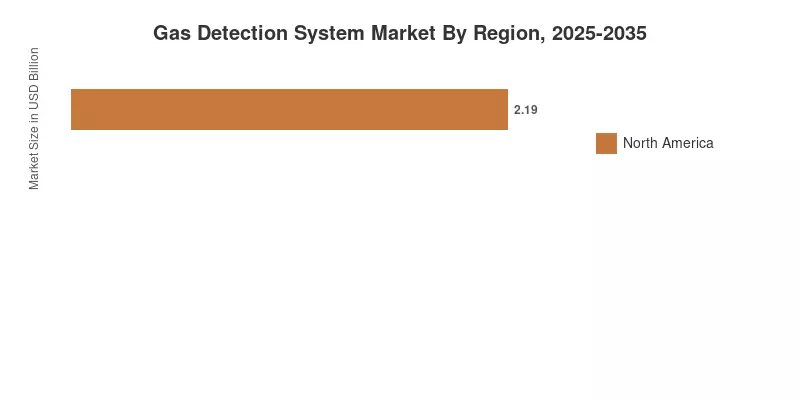
North America remains the largest regional revenue pool at USD 2.19 Billion in 2025, anchored by OSHA enforcement and dense oil, gas and chemical infrastructure. Asia-Pacific is the fastest-growing region at a 6.3% CAGR, driven by semiconductor capacity, chemical parks and stricter factory codes in China and India. Europe ranks second, supported by ATEX equipment rules and the revised F-gas regulation [6][13]. Over the next decade, the Gas Detection System Market will reward vendors that pair certified hardware with software, services and verifiable emissions data.
Key Report Takeaways
• By Communication Type
- Wired links remain the backbone of the Gas Detection System Market, holding 62.4% of 2025 revenue
- Wireless installations are the fastest-expanding communication layer, advancing at a 6.6% CAGR through 2035
• By Detector Type
- Fixed detectors captured 66.0% share in 2025 on code requirements for continuous area coverage
- Portable instruments are growing at a 5.9% CAGR as turnaround, shutdown and contractor work expands
• By Sensor Technology
- Electrochemical cells accounted for 41.6% of 2025 revenue, reflecting their dominance in toxic and oxygen sensing
- Infrared sensing is rising at a 7.3% CAGR on low drift and reduced recalibration needs
• By Gas Type
- Combustible Hydrocarbons led with 50.4% share, tied to oil, gas and petrochemical hazard zones
- Refrigerants detection is growing at a 5.4% CAGR as flammable A2L refrigerants enter HVAC-R equipment
• By Device Type
- Multi-Gas Detectors held 63.5% share as facilities standardize on fewer instrument platforms
- Single-Gas Detectors retained 36.5% share in applications where one hazard dominates
• By Power Source
- Battery-Powered units are expanding at a 6.4% CAGR on improved lithium-ion density and low-power firmware
- Hard-Wired products held 63.7% share, backed by code preferences for continuous power
• By End-user Industry
- Oil and Gas generated USD 1.94 Billion in 2025, the largest end-use revenue base
- Discrete Manufacturing is the fastest-growing end user at a 6.2% CAGR
• By Region
- North America leads the Gas Detection System Market with USD 2.19 Billion in 2025 revenue
- The United States represents 85.2% of North American demand
- Asia-Pacific is the fastest-growing region at a 6.3% CAGR
Market Size and Forecast (2021–2035)
Market Research Future built the Gas Detection System Market model bottom-up from unit shipments, average selling prices and installed-base service revenue across detector, sensor and end-use categories. Totals were reconciled top-down against segment disclosures in leading vendors' annual filings [16][17][20] and against energy-sector capital spending trends published by the IEA [21]. Historical years reflect reported activity; forecast years incorporate regulatory timelines, announced capacity additions and replacement-cycle assumptions.




 Noah Malgeri
Co-Founder

 Peter Groot koerkamp
Account and Business Manager

 Younghwan Choi
Senior Retail Manager

 Mark Irwin
Management Consultant

 Akif Moroglu
Strategy & Business Development Director

 Guilherme Gomes Martins
Product Management Director

 Joseph Aguayo
Sales Operations & Pricing Manager

 La Terria Dodd
Program Support Specialist

 Rob Kooiker
Group Product Manager HVAC & Fire Protection GMA



