G Fast Chipset Market Summary
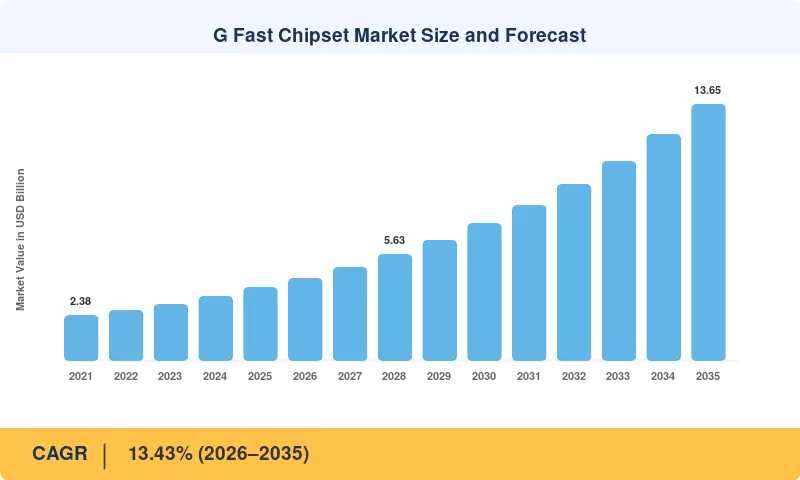
The G Fast Chipset Market was valued at USD 3.87 Billion in 2025 and is projected to reach USD 4.39 Billion in 2026, rising to USD 13.65 Billion by 2035 at a CAGR of 13.43% over 2026–2035. Two policy catalysts anchor this outlook. The U.S. Broadband Equity, Access, and Deployment (BEAD) programme allocated USD 42.45 billion to states and territories in June 2023, and its 2025 restructuring opened funding to lower-cost delivery technologies [4][5]. In Europe, the Gigabit Infrastructure Act, applicable from November 2025, speeds permitting and grants access to in-building physical infrastructure [6].
Operators are retiring VDSL2 vectoring cards in street cabinets and replacing them with distribution point units placed within roughly 250 metres of the subscriber, using G.fast silicon to push aggregate rates beyond 1 Gbps over existing twisted pair [1]. That shift has given copper broadband technology a second role as a fibre-extension tool rather than a stranded asset. Public programmes such as the UK's GBP 5 billion Project Gigabit and India's ₹1.39 lakh crore BharatNet expansion are pushing fibre deeper, which raises demand for equipment that bridges the final in-building segment [9][10].
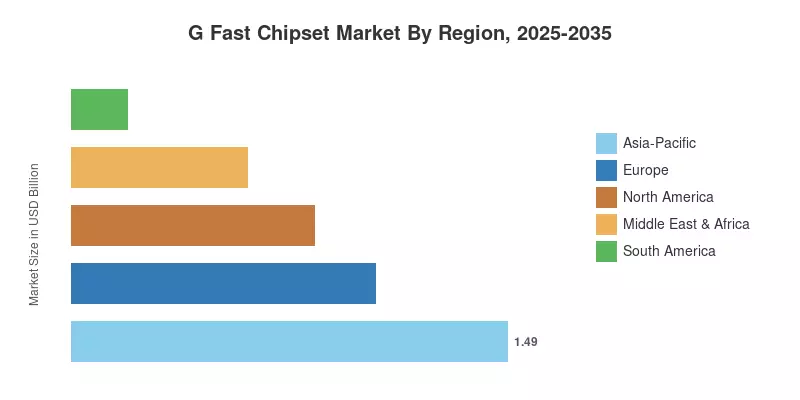
Asia-Pacific leads with a 38.5% revenue share in 2025, supported by dense high-rise housing in China, Japan, and South Korea. Middle East & Africa is the fastest-growing region at a 15.6% CAGR, as Gulf operators retrofit tower blocks built before fibre-ready building codes. Europe ranks second with 27.0% of revenue, backed by Digital Decade gigabit targets [7]. Over the forecast period, the G Fast Chipset Market will lean increasingly on short-loop, high-frequency use cases rather than broad suburban coverage.
Key Report Takeaways
• By Deployment Type
- Distribution Point Unit (DPU) Chipsets held a 52.4% share of the G Fast Chipset Market in 2025, reflecting operator preference for reverse-powered curbside nodes.
- Customer Premises Equipment (CPE) Chipsets are forecast to expand at a 14.2% CAGR as subscribers migrate from legacy DSL modems.
• By Frequency Profile
- The 212 MHz Profile accounted for 43.5% of 2025 revenue, favoured by tier-1 incumbents for its proven reach.
- The 424 MHz Profile is projected to grow at a 13.8% CAGR through 2035 on symmetrical multi-gigabit demand.
• By Process Node
- Chipsets built on 14–22 nm captured 46.9% of 2025 revenue, the current balance point of performance and wafer cost.
- The 10 nm and Below node is set to grow at a 13.7% CAGR as power-per-bit thresholds tighten.
• By End-Use Application
- Multi-Dwelling Unit Broadband generated 40.1% of G Fast Chipset Market revenue in 2025.
- Small-Cell / Wi-Fi Offload Backhaul is forecast to advance at a 14.0% CAGR, driven by 5G densification.
• By Region
- Asia-Pacific held a 38.5% share in 2025, the largest of any region.
- Middle East & Africa is expected to post a 15.6% CAGR over 2026–2035.
- North America generated USD 0.83 Billion in 2025.
Market Size and Forecast (2021–2035)
Estimates for the G Fast Chipset Market combine bottom-up shipment tracking of DPU and CPE silicon, average selling price analysis by process node, and top-down reconciliation against vendor broadband segment disclosures and operator capital expenditure filings [16][17][18]. Historical values for 2021–2024 were validated against ITU and OECD fixed-line statistics, while forecast years apply scenario weighting for public funding drawdowns and fibre substitution rates [15].




 Noah Malgeri
Co-Founder

 Peter Groot koerkamp
Account and Business Manager

 Younghwan Choi
Senior Retail Manager

 Mark Irwin
Management Consultant

 Akif Moroglu
Strategy & Business Development Director

 Guilherme Gomes Martins
Product Management Director

 Joseph Aguayo
Sales Operations & Pricing Manager

 La Terria Dodd
Program Support Specialist

 Rob Kooiker
Group Product Manager HVAC & Fire Protection GMA


