Exoskeleton Market Summary
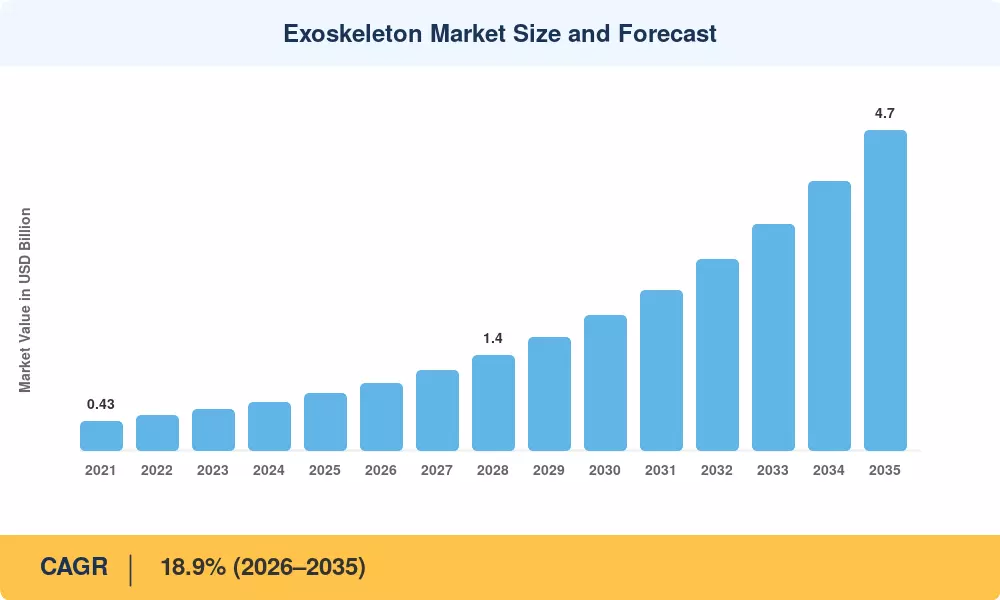
The global Exoskeleton Market was valued at USD 0.83 billion in 2025 and is projected to grow from USD 0.99 billion in 2026 to USD 4.70 billion by 2035, registering a CAGR of 18.9% during the forecast period (2026–2035). This expansion is driven by aging demographics across developed economies and a sharp increase in workplace injury prevention mandates, with the U.S. Occupational Safety and Health Administration (OSHA) reporting over 2.6 million nonfatal workplace injuries annually . Government rehabilitation programs in Europe and North America continue to channel funding into assistive device reimbursement, accelerating clinical adoption of powered systems.
The Exoskeleton Market is undergoing a major technology revolution. Rigid, hydraulic-powered frames that dominated early-generation goods are giving way to lightweight, sensor-laden systems with AI-driven gait adaptability. For example, in its 2024–2025 cycle, the U.S. Department of Veterans Affairs funded over USD 80 million for robotic-assisted rehabilitation for spinal cord injury patients , while the European Commission’s Horizon Europe program funded EUR 45 million for next-generation wearable robotics research . These commitments are pulling the industry from niche clinical use toward broader industrial and consumer adoption.
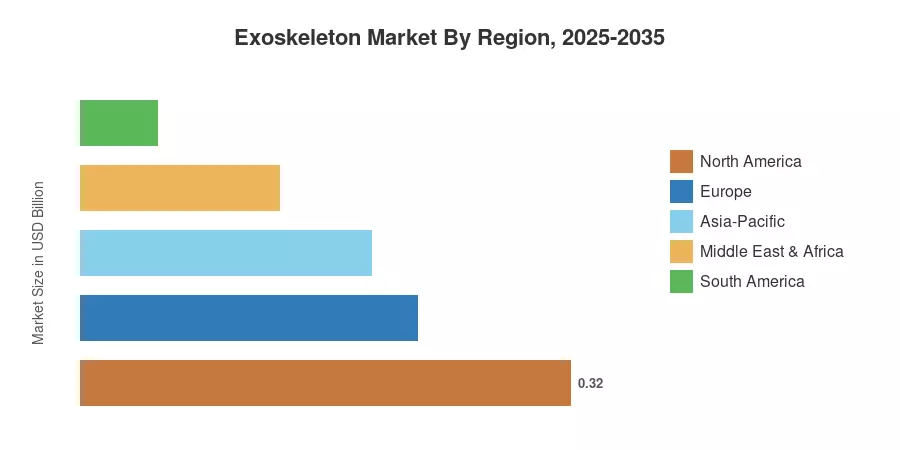
The North America Exoskeleton Market holds about 38% market share, attributed to defense R&D spending and a well-established healthcare reimbursement infrastructure. Asia-Pacific is anticipated to have the highest CAGR of 22.4% over the forecast period, driven by Japan’s national robotics strategy and factory automation push in China. Europe, with around 27% of the share, is the second-largest, underpinned by strict EU laws on worker safety. The Exoskeleton Market is forecast to see rapid growth in logistics, construction and elder care through 2035 as unit costs decrease and battery technology improves.
Key Report Takeaways
• By Mobility Type
- Lower-body systems account for approximately 42% of the Exoskeleton Market, driven by spinal cord injury rehabilitation and industrial load-bearing applications.
- Full-body configurations are projected to register the highest segment CAGR of 24.1%, reflecting demand from defense and heavy industry end users.
• By Power Source
- Powered/active exoskeletons generated an estimated USD 0.52 billion in 2025, representing the dominant technology class.
- Passive systems hold a 28% share of the Exoskeleton Market, preferred in manufacturing settings where battery weight is a constraint.
• By Geography
- North America commands the largest regional share at 38%, with the United States alone contributing over 30% of global revenue.
- Asia-Pacific is expected to surpass Europe in absolute revenue by 2031, growing at a CAGR of 22.4% through the forecast period.
Market Size and Forecast (2021–2035)
MRFR adopts a bottom-up approach for the size of the market, following the revenue from the device manufacturers, which is cross-validated by the hospital procurement databases, defense contracts disclosures and buy orders of industrial safety equipment in 28 countries. Historical data based on actual shipments. Forecast estimates based on calibrated 18.9% CAGR with modifications for expected regulatory milestones and technology cost curves.




 Noah Malgeri
Co-Founder

 Peter Groot koerkamp
Account and Business Manager

 Younghwan Choi
Senior Retail Manager

 Mark Irwin
Management Consultant

 Akif Moroglu
Strategy & Business Development Director

 Guilherme Gomes Martins
Product Management Director

 Joseph Aguayo
Sales Operations & Pricing Manager

 La Terria Dodd
Program Support Specialist

 Rob Kooiker
Group Product Manager HVAC & Fire Protection GMA



