Germany : Strong industrial base drives growth
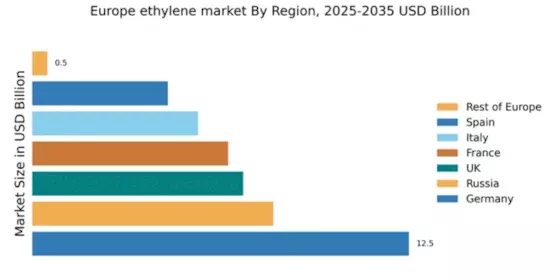
Germany holds a dominant market share of 12.5% in the European ethylene market, valued at approximately €5 billion. Key growth drivers include a robust automotive sector, increasing demand for plastics, and government initiatives promoting sustainable chemical production. Regulatory policies favoring green technologies and investments in infrastructure, such as the expansion of chemical parks, further bolster market growth. The country is also focusing on reducing carbon emissions, aligning with EU sustainability goals.
UK : Innovation fuels ethylene demand
The UK accounts for 7.0% of the European ethylene market, valued at around €2.8 billion. Growth is driven by advancements in recycling technologies and a shift towards bio-based feedstocks. Demand trends indicate a rising consumption of ethylene in packaging and automotive applications. The UK government has introduced policies to support the transition to a circular economy, enhancing the market's appeal. Infrastructure investments in ports and logistics are also crucial for supply chain efficiency.
France : Strong focus on sustainability
France holds a 6.5% share of the ethylene market in Europe, valued at approximately €2.6 billion. The market is driven by the demand for ethylene in sectors like packaging, automotive, and construction. Government initiatives promoting sustainable practices and circular economy principles are shaping consumption patterns. The French government is also investing in renewable energy sources, which positively impacts the chemical industry. Regulatory frameworks are increasingly favoring eco-friendly production methods.
Russia : Natural resources boost production
Russia commands an 8.0% share of the European ethylene market, valued at about €3.2 billion. The country's vast natural gas reserves serve as a key growth driver, providing a competitive advantage in feedstock availability. Demand is rising in the construction and automotive sectors, supported by government initiatives to modernize industrial infrastructure. However, geopolitical factors and regulatory challenges may impact market dynamics. Major cities like Moscow and St. Petersburg are central to market activities.
Italy : Manufacturing backbone supports demand
Italy represents 5.5% of the European ethylene market, valued at approximately €2.2 billion. The market is driven by a strong manufacturing sector, particularly in textiles and automotive. Demand trends show a growing preference for high-performance plastics, supported by government policies promoting innovation. Infrastructure improvements in logistics and transportation are enhancing market accessibility. Key players like Ineos and LyondellBasell have a significant presence, contributing to a competitive landscape.
Spain : Strategic location enhances trade
Spain holds a 4.5% share of the ethylene market in Europe, valued at around €1.8 billion. The growth is driven by increasing demand in the packaging and construction sectors. Government initiatives aimed at boosting industrial competitiveness and sustainability are shaping market dynamics. The strategic location of Spanish ports facilitates trade with other European countries. Major cities like Barcelona and Madrid are key markets, with significant investments from players like Dow and Ineos.
Rest of Europe : Diverse opportunities across regions
The Rest of Europe accounts for a mere 0.5% of the ethylene market, valued at approximately €200 million. This sub-region includes smaller markets with unique characteristics and opportunities. Growth is driven by localized demand in niche applications, such as specialty chemicals and bio-based products. Regulatory frameworks vary significantly, impacting market entry and competition. Countries like Belgium and the Netherlands are notable for their advanced chemical industries, attracting investments from major players.






 Noah Malgeri
Co-Founder

 Peter Groot koerkamp
Account and Business Manager

 Younghwan Choi
Senior Retail Manager

 Mark Irwin
Management Consultant

 Akif Moroglu
Strategy & Business Development Director

 Guilherme Gomes Martins
Product Management Director

 Joseph Aguayo
Sales Operations & Pricing Manager

 La Terria Dodd
Program Support Specialist

 Rob Kooiker
Group Product Manager HVAC & Fire Protection GMA