eTMF Systems Market (2026 - 2035)

Electronic Trial Master File (eTMF) Systems Market Research Report Information By Component (Software, and Services), By Deployment Mode (Cloud/Web-Based, and On-Premise), By End User (Pharmaceutical and Biotechnology Companies, Contract Research Organizations, and Others) And By Region (North America, Europe, Asia-Pacific, And Rest Of The World) - Growth & Industry Forecast 2025 To 2035
ID: MRFR/HC/7300-HCR 90 Pages Satyendra Maurya, Rahul Gotadki Last Updated: September 29, 2026
eTMF Systems Market
Market Size
Forecast Period2026-2035
CAGR (2026-2035)13.2%
2025 Market SizeUSD 2.02 Billion
2035 Market SizeUSD 6.99 Billion
Key Players
Veeva Systems
Oracle Corporation
IQVIA
Phlexglobal
TransPerfect
Ennov
Opportunities
  • AI-Assisted Classification and Automated Quality Control
  • Emerging Clinical Hubs in Asia-Pacific and Rest of the World
  • TMF Operational Data and Benchmarking Services

eTMF Systems Market Summary

The Electronic Trial Master File Systems Market was valued at USD 2.02 Billion in 2025 and is projected to reach USD 2.29 Billion in 2026, rising to USD 6.99 Billion by 2035 at a CAGR of 13.2% over 2026–2035. Two regulatory catalysts anchor that trajectory. The ICH E6(R3) Good Clinical Practice guideline, finalized in January 2025, formalizes risk-proportionate oversight and sets explicit expectations for essential-record management [2]. The close of the EU Clinical Trials Regulation transition on 31 January 2025 moved every ongoing EU trial onto the Clinical Trials Information System [3][4]. Sponsors can no longer treat the trial master file as an end-of-study archive. Regulators expect it to be current, complete, and inspection-ready from first patient in.

Paper binders, shared network devices, and general-purpose document repositories that were borrowed from regulatory affairs are being phased out. Sponsors and CROs are replacing them with cloud-native, purpose-built trial master file software that is aligned with the CDISC TMF Reference Model. This software includes metadata-driven filing, workflow routing, and live completeness dashboards [10]. The spend base that underpins this transition is substantial: The annual investment in research and development by PhRMA member companies is approximately USD 100 billion [15]. ClinicalTrials.gov currently maintains a database of over 500,000 registered studies [1].

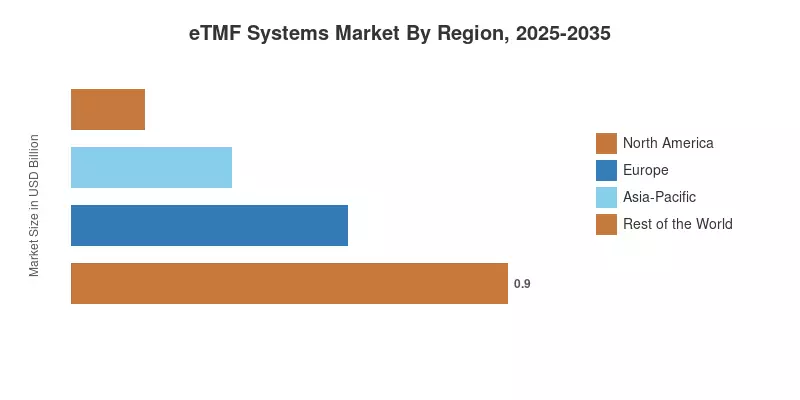
North America's 44.6% share is bolstered by the FDA's inspection intensity and the density of sponsor headquarters. China, India, and South Korea are expediting trial approval timelines, resulting in the Asia-Pacific region being the fastest-growing at a 16.1% CAGR. Europe's 28.1% market share is the second highest, primarily due to its transparent CTR obligations. In the coming decade, competitive advantage will transition from the mere storage of documents to the demonstration of inspection readiness in real time.


Key Report Takeaways

• By Product Type

  • Software held a 62.4% share of the Electronic Trial Master File Systems Market in 2025, reflecting sponsor preference for validated, subscription-based cloud applications.
  • Services is set to expand at a 14.6% CAGR through 2035 as sponsors outsource migration, quality review, and inspection-readiness work.

• By End-User

  • Pharmaceutical & Biotechnology Companies accounted for a 55.3% share in 2025, anchored by large sponsors running global portfolios.
  • Contract Research Organizations form the fastest-growing end-user group in the Electronic Trial Master File Systems Market, advancing at a 15.1% CAGR.
  • Other End-Users generated USD 0.18 Billion in 2025, led by academic medical centers and site networks.

• By Region

  • North America commanded a 44.6% share in 2025 on the back of sponsor concentration and rigorous FDA oversight.
  • Asia-Pacific is expected to post a 16.1% CAGR, the highest of any region.
  • Rest of the World contributed USD 0.15 Billion in 2025, with Latin America and the Gulf states building trial capacity.

Market Size and Forecast (2021–2035)

Estimates for the Electronic Trial Master File Systems Market combine bottom-up vendor revenue mapping, sponsor and CRO procurement interviews, and trial-volume data from public registries [1][16]. Company filings from listed vendors were used to calibrate software subscription revenue [11][13], while services revenue was modeled from outsourcing penetration rates by sponsor size. Historical values reflect reported and estimated spend; forecast values incorporate regulatory timelines, trial-start projections, and cloud migration rates.
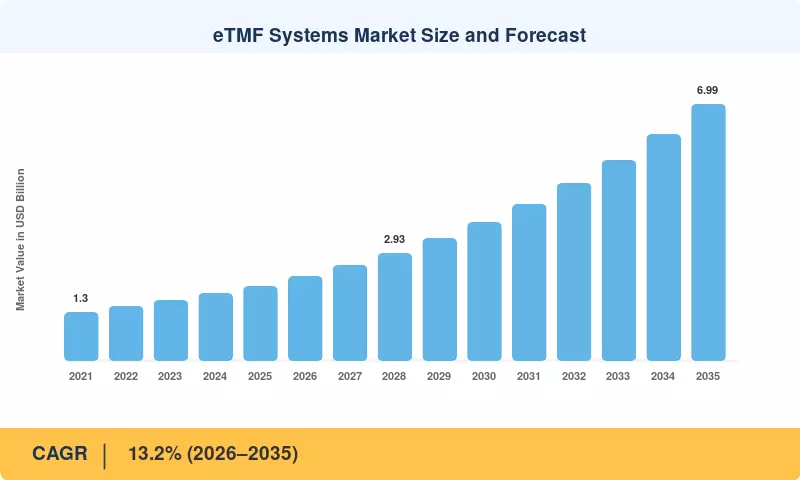
eTMF Systems Market Size and Forecast
Our Impact

Enabled $4.3B Revenue Impact for Fortune 500 and Leading Multinationals

Partnering with 2000+ Global Organizations Each Year

30K+ Citations by Top-Tier Firms in the Industry

Driver Impact Analysis

Driver ~% Impact on CAGR Geographic Relevance Impact Timeline
ICH E6(R3) adoption and risk-based quality management +2.6% Global Medium-term (2–4 yr)
EU Clinical Trials Regulation and CTIS transparency +2.1% Europe Short-term (≤2 yr)
Rising trial volume, complexity, and outsourcing +2.3% Global Long-term (≥4 yr)
Decentralized and hybrid trial models +1.6% North America, Europe Medium-term (2–4 yr)
Cloud migration and unified eClinical platforms +1.9% Global Long-term (≥4 yr)
Inspection readiness and sponsor oversight +1.4% North America, Europe Short-term (≤2 yr)


ICH E6(R3) Adoption and Risk-Based Quality Management

ICH E6(R3) reached Step 4 in January 2025, and the EMA applied it from 23 July 2025 [2]. The revision asks sponsors to identify critical-to-quality factors and demonstrate proportionate oversight, which depends on knowing, at any moment, which essential records exist and which are missing. Tufts CSDD research shows roughly three-quarters of protocols now undergo at least one substantial amendment [21], each generating new documents to file, version, and reconcile. Manual trackers cannot keep pace with that churn.

EU Clinical Trials Regulation and CTIS Transparency

Regulation (EU) No 536/2014 requires the TMF to be readily available and directly accessible to inspectors on request [3]. Since 31 January 2025, every EU trial runs through CTIS, where public-facing documents must be prepared and redacted on fixed timelines [4]. With European pharmaceutical R&D spending near EUR 50 billion a year [22], sponsors are standardizing on systems that link CTIS submissions to the underlying master file rather than maintaining parallel copies.

Rising Trial Volume, Complexity, and Outsourcing

Registered studies on ClinicalTrials.gov have passed 500,000 [1], and Tufts CSDD estimates a typical Phase III protocol now generates about 3.6 million data points, roughly three times the level of a decade earlier [21]. More endpoints, more sites, and more vendors multiply the document load per study. Sponsors increasingly hand this load to CROs, who in turn need multi-sponsor platforms that segregate content cleanly and support sponsor audits.

Decentralized and Hybrid Trial Models

The FDA's September 2024 final guidance on conducting trials with decentralized elements clarified how remote visits, local health providers, and direct-to-patient drug shipment should be documented [7]. Each element introduces new record types, from telehealth vendor agreements to courier chain-of-custody logs. Market Research Future estimates that about 30% of eTMF deployments contracted in 2025 included site-facing modules to capture these records at source rather than through email attachments.

Cloud Migration and Unified eClinical Platforms

Veeva Systems reported total revenue of about USD 2.75 billion for fiscal 2025, with its clinical operations suite among the fastest-growing product families [11]. The commercial signal is clear: sponsors are buying eTMF as one module within connected CTMS, study start-up, and site collaboration suites. Unified data models remove re-keying between systems and let milestone events automatically trigger expected document placeholders.

Inspection Readiness and Sponsor Oversight

The EMA's TMF guideline states that the file should tell the story of the trial and allow inspectors to reconstruct its conduct [9], while 21 CFR Part 11 sets the electronic-record controls the FDA expects [5]. Roughly seven in ten quality assurance leads interviewed by Market Research Future cited inspection findings, not efficiency, as the trigger for their most recent eTMF upgrade. Completeness metrics are now reviewed at the executive level in many sponsors.

Restraints Impact Analysis

Restraint ~% Impact on CAGR Geographic Relevance Impact Timeline
Implementation, validation, and total cost of ownership −1.4% Global Short-term (≤2 yr)
Legacy content migration and interoperability gaps −1.0% Global Medium-term (2–4 yr)
Data privacy and cross-border transfer rules −0.9% Europe, Asia-Pacific Long-term (≥4 yr)
Change management and specialist talent shortages −0.7% Global Medium-term (2–4 yr)
Budget constraints at early-stage biotechs −0.8% North America, Europe Short-term (≤2 yr)


Implementation, Validation, and Total Cost of Ownership

Every eTMF used in regulated trials must be validated against 21 CFR Part 11 and the EMA's 2023 guideline on computerised systems and electronic data [5][8]. Validation documentation, vendor audits, and periodic re-testing after each release add cost beyond licensing. Market Research Future estimates enterprise deployments can exceed USD 1 million over three years once configuration, migration, and training are included, which delays decisions at mid-sized sponsors.

Legacy Content Migration and Interoperability Gaps

Legacy archives rarely map cleanly to the CDISC TMF Reference Model, which defines more than 200 artifact types [10]. Sponsors migrating closed studies face inconsistent naming, missing metadata, and scanned documents without searchable text. Limited exchange standards between competing eTMF vendors mean CRO-to-sponsor transfers often still rely on bulk exports and manual reconciliation, eroding the efficiency case for new systems.

Data Privacy and Cross-Border Transfer Rules

TMF content includes investigator CVs, patient-identifiable safety narratives, and signed consent records. GDPR penalties reach 4% of global annual turnover or EUR 20 million, whichever is higher [23], while China's Personal Information Protection Law restricts outbound transfer of personal data [24]. Global sponsors must choose between regional hosting, redaction workflows, or segmented instances, each adding complexity and cost.

Change Management and Specialist Talent Shortages

Dedicated TMF specialists remain scarce. About 40% of small sponsors interviewed by Market Research Future had no full-time TMF owner, leaving filing to study managers already stretched by operational work. Without clear ownership, adoption stalls, documents are uploaded late, and completeness metrics look worse after go-live than before, a pattern that undermines internal support for expansion.

Budget Constraints at Early-Stage Biotechs

Emerging biopharma companies originate about 65% of the development pipeline according to the IQVIA Institute [14], yet many operate on short cash runways. These sponsors frequently defer enterprise licenses and rely on CRO-provided systems or shared drives until a pivotal study. That behavior shifts revenue toward CROs and slows direct vendor penetration of the fastest-growing sponsor tier.

eTMF Systems Market Opportunities

Vendors that align product roadmaps with regulatory change and underserved buyer groups can capture share faster than the headline growth rate of the Electronic Trial Master File Systems Market.

AI-Assisted Classification and Automated Quality Control

Machine learning models that read incoming documents, assign Reference Model artifacts, and extract metadata can cut filing time sharply and flag misfiled or unsigned records before an inspector does. The EU AI Act, in force since August 2024, sets transparency and risk-management expectations that vendors can turn into a selling point through documented model validation [20]. Early movers are pairing automation with measurable accuracy thresholds and human review queues.

Emerging Clinical Hubs in Asia-Pacific and Rest of the World

India's New Drugs and Clinical Trials Rules set a 30-working-day approval window for drugs developed domestically [18], and China adopted a 60-working-day implied approval for trial applications [17]. Faster approvals are drawing global studies and nurturing local sponsors that have never deployed an eTMF. Localized hosting, regional language support, and pricing tuned to domestic budgets can open a large greenfield base.

TMF Operational Data and Benchmarking Services

Every eTMF generates timestamps showing how long documents take to be collected, reviewed, and approved. Aggregated and anonymized, this metadata supports cycle-time benchmarks, contract research organization performance scorecards, and predictive risk scores for inspection readiness. Vendors can package these insights as premium analytics subscriptions or pair them with outsourced trial master file management, shifting revenue from seats toward outcomes.


Site-Facing eISF and Sponsor–Site Connectivity

Investigator sites remain the largest source of late and duplicated documents. Electronic investigator site file tools that sync approved records directly into the sponsor's electronic trial master file remove double uploads and improve site experience. Networks connecting thousands of sites create switching costs, and sponsors increasingly weigh site adoption when selecting platforms, addressing delays that impact an estimated 85% of clinical trials.


Right-Sized SaaS for Emerging Biopharma

With emerging biopharma companies driving roughly 65% of novel drug innovation and sponsoring the vast majority of trial starts, pre-validated, template-driven offerings that go live in weeks address an underserved segment. Study-based pricing, preconfigured Reference Model structures, and bundled validation packages reduce the entry barrier. Vendors that win these sponsors early can expand rapidly as assets progress into later-phase clinical trials.


eTMF Systems Market Future Outlook

Four structural themes will define the Electronic Trial Master File Systems Market over the forecast period.

Agentic AI and Automated Inspection Readiness

AI will move from classifying documents to managing workflows: chasing missing signatures, predicting which sites will miss filing deadlines, and producing inspection-readiness scores continuously. Vendors have begun announcing AI agents embedded across clinical applications [11]. The practical ceiling is validation, since each model update must satisfy computerised-system expectations [8], so winners will build auditable, explainable pipelines rather than opaque automation.

Platform Consolidation and Unified Clinical Data Flows

Standalone clinical trial document platforms will increasingly give way to suites where CTMS, eTMF, study start-up, and site tools share one data model. That consolidation favors vendors with broad portfolios and deep integration budgets, while niche specialists will differentiate on services, cost, or specific ecosystems such as Microsoft 365. Expect bundled pricing and multi-year enterprise agreements to become standard.

Global Regulatory Convergence Around ICH E6(R3)

With E6(R3) adopted across ICH member regulators [2], expectations for essential records are converging among the FDA, EMA, PMDA, and NMPA. Convergence lowers the cost of running one global configuration and encourages sponsors in newer ICH regions to adopt the same platforms as Western peers. The CDISC TMF Reference Model will remain the common structural language [10].

Paperless Trials and Long-Term Digital Archiving

Wet-ink signatures and courier shipments of binders are disappearing as eConsent, e-signatures, and remote monitoring mature. Digital archiving, however, raises questions of format longevity and system decommissioning that sponsors will need to solve over decades. Archive-grade export formats, certified copies, and vendor-neutral storage will emerge as distinct buying criteria.

Regional Market Share Analysis

Region Metric (Share, USD, or CAGR) Primary Investment Themes
North America 44.6% share (2025) Unified clinical platforms, AI-assisted quality control, inspection readiness
Europe 28.1% share (2025) CTR and CTIS alignment, GDPR-compliant hosting, E6(R3) implementation
Asia-Pacific 16.1% CAGR (2026–2035) Greenfield deployments, local hosting, CRO expansion
Rest of the World USD 0.15 Billion (2025) Trial capacity building, CRO-led adoption
Total USD 2.02 Billion (2025) —

North America leads the Electronic Trial Master File Systems Market, Europe follows on regulatory pull, and Asia-Pacific delivers the fastest expansion as trial activity shifts east.


North America

Country Metric (Share of Region, USD, or CAGR) Key Driver
United States 86.4% share of region (2025) Sponsor headquarters density and FDA BIMO inspections
Canada 13.9% CAGR (2026–2035) Health Canada trial modernization and oncology networks
Mexico USD 0.04 Billion (2025) COFEPRIS approval reforms attracting global studies


The United States anchors regional demand in the Electronic Trial Master File Systems Market. The FDA's 2024 final guidance on electronic systems, records, and signatures in clinical investigations clarified expectations for cloud services and audit trails [6], reducing ambiguity that had slowed some deployments. Large sponsors are consolidating onto single enterprise platforms, while mid-sized biotechs increasingly specify eTMF access in CRO contracts. Canada's growth reflects cooperative oncology groups digitizing, and Mexico benefits from faster approvals and competitive per-patient costs.

Europe

Country Metric (Share of Region, USD, or CAGR) Key Driver
Germany 24.3% share of region (2025) Medical Research Act streamlining approvals
United Kingdom USD 0.12 Billion (2025) New MHRA clinical trial regulations
France 12.8% CAGR (2026–2035) ANSM fast-track pathways and biotech clusters
Italy 10.6% share of region (2025) Hospital-based research digitization
Spain 13.5% CAGR (2026–2035) High trial-start volumes and rapid site activation
Rest of Europe USD 0.12 Billion (2025) Nordic and Central European trial growth


Europe's demand is shaped by the CTR's requirement that the master file be directly accessible to inspectors [3] and by CTIS publication rules [4]. The UK signed new clinical trial regulations into law in 2025, taking effect in 2026, which emphasize proportionate oversight and faster review [25]. Spain has become one of the continent's most active trial locations, and GDPR hosting requirements push European sponsors toward EU-resident cloud regions [23].

Asia-Pacific

Country Metric (Share of Region, USD, or CAGR) Key Driver
China 34.2% share of region (2025) Implied approval pathway and domestic innovator growth
Japan USD 0.10 Billion (2025) Efforts to reduce drug lag and attract global trials
India 18.7% CAGR (2026–2035) NDCT Rules timelines and CRO capacity
Australia 9.8% share of region (2025) R&D tax incentive supporting early-phase trials
South Korea 16.9% CAGR (2026–2035) Seoul trial hub and government-backed trial infrastructure
Rest of Asia-Pacific USD 0.04 Billion (2025) Singapore, Taiwan, and Southeast Asian trial growth


Asia-Pacific is the growth engine of the Electronic Trial Master File Systems Market. China's 60-working-day implied approval [17] has lifted domestic sponsor activity, though personal-data rules require localized hosting [24]. India's timelines under the NDCT Rules [18] support CRO expansion, and Japan's PMDA is working to reduce the drug-lag gap with Western markets [19]. Australia's 43.5% refundable R&D tax offset for smaller companies continues to attract early-phase studies.

Rest of the World

Country Metric (Share of Region, USD, or CAGR) Key Driver
Rest of the World 14.4% CAGR (2026–2035) CRO-led adoption in Latin America and the Middle East


Brazil, Argentina, and the Gulf states are building trial capacity through regulatory reform and national health research programs. Adoption is largely CRO-driven: global CROs extend their platforms to local sites, and domestic sponsors gain eTMF access through outsourcing rather than direct licensing. As these markets host more registrational studies listed on the WHO registry platform [16], direct demand should broaden.

eTMF Systems Market By Region, 2025-2035

eTMF Systems Market Segmentation

By Product Type

Segment Metric (Share, USD, or CAGR) Primary Demand Driver
Services 14.6% CAGR (2026–2035) Outsourced migration, quality review, and TMF management
Software 62.4% share (2025) Validated cloud subscriptions and unified clinical suites


Within the Electronic Trial Master File Systems Market, Software dominates because every sponsor and CRO needs a validated system of record, and subscription models spread cost across studies. Services grow faster. Sponsors lacking in-house TMF specialists buy migration projects, periodic quality reviews, and fully managed filing, often bundled with the software license. Vendors with strong services arms, such as those offering dedicated TMF quality review teams, convert these engagements into long-term platform relationships.

By End-User

Segment Metric (Share, USD, or CAGR) Primary Demand Driver
Pharmaceutical & Biotechnology Companies 55.3% share (2025) Sponsor accountability for TMF completeness
Contract Research Organizations 15.1% CAGR (2026–2035) Rising outsourcing and multi-sponsor platforms
Other End-Users USD 0.18 Billion (2025) Academic centers, site networks, and medical device sponsors


Pharmaceutical & Biotechnology Companies lead the Electronic Trial Master File Systems Market because regulators hold sponsors ultimately responsible for the master file, even when work is outsourced [2]. Contract Research Organizations expand fastest as outsourcing penetration rises and sponsors require CROs to work inside sponsor-owned systems or provide inspection-ready alternatives. Other End-Users, including academic research centers and device manufacturers, adopt lighter configurations suited to investigator-initiated studies.

Competitive Benchmarking

The Electronic Trial Master File Systems Market is moderately concentrated, with an estimated Herfindahl-Hirschman Index of about 1,200–1,400. The top five vendors hold an estimated 50–60% of revenue, led by one clear category leader, while a long tail of specialists competes on price, ecosystem fit, and services depth. Competition centers on platform breadth, site connectivity, and AI-enabled quality control.

Company Est. Revenue Share Range Key Offerings for Electronic Trial Master File Systems Market Strategic Positioning
Veeva Systems ~28–34% Vault eTMF within Vault Clinical Operations (CTMS, Study Start-Up, Site Connect) Category leader with unified clinical platform and embedded AI roadmap
Oracle Corporation ~5–8% Clinical One platform with trial and document management capabilities Enterprise data integration across clinical and safety systems
IQVIA ~5–8% eTMF software and TMF managed services within its technology portfolio CRO-plus-technology model bundling services and platform
Phlexglobal (part of Cencora) ~5–8% PhlexTMF and TMF Quality Review services TMF specialist combining software with expert quality services
TransPerfect (Trial Interactive) ~4–7% Trial Interactive eTMF, eISF, and study start-up Strong CRO footprint and multilingual content capabilities
Ennov ~2–4% Ennov Clinical suite including eTMF Single platform across clinical, regulatory, and quality; European base
MasterControl ~2–4% Clinical excellence suite with eTMF Quality-management heritage extended into clinical operations
Florence Healthcare ~2–4% eBinders eISF, site-sponsor connectivity, sponsor eTMF Site-first network strategy
SureClinical ~1–3% Cloud eTMF with integrated e-signatures Pre-validated offering for small and mid-sized biotechs
Montrium ~1–3% eTMF Connect built on Microsoft 365 Cost-efficient option for Microsoft-standardized sponsors


Recent News & Developments

  • EMA (March 2023): Published its guideline on computerised systems and electronic data in clinical trials, raising validation and audit-trail expectations for eTMF platforms. [8]
  • European Union (August 2024): The AI Act entered into force, setting obligations that shape how vendors document and validate AI classification features. [20]
  • FDA (September 2024): Issued final guidance on trials with decentralized elements, expanding record types sponsors must capture and file. [7]
  • FDA (October 2024): Finalized its questions-and-answers guidance on electronic systems, records, and signatures in clinical investigations, clarifying cloud and audit-trail expectations. [6]
  • ICH (January 2025): E6(R3) Good Clinical Practice reached Step 4, formalizing risk-proportionate management of essential records. [2]
  • European Commission (January 2025): The CTR transition ended on 31 January, requiring all ongoing EU trials to operate through CTIS. [3][4]
  • Veeva Systems (April 2025): Announced plans to embed AI agents across its Vault applications, including clinical operations, signaling automation as a competitive battleground. [11]
  • MHRA (April 2025): New UK clinical trial regulations were signed into law for implementation in 2026, emphasizing proportionate oversight and faster review. [25]

eTMF Systems Market Report Scope

Parameter Details
Market Scope Electronic Trial Master File Systems Market by Product Type (Services, Software), End-User (Pharmaceutical & Biotechnology Companies, Contract Research Organizations, Other End-Users), and Geography (North America, Europe, Asia-Pacific, Rest of the World)
Study Period 2021–2035 (Historical: 2021–2024; Base Year: 2025; Forecast: 2026–2035)
CAGR 13.2% (2026–2035)
Market Size checkpoints USD 2.02 Billion (2025); USD 2.29 Billion (2026); USD 3.76 Billion (2030); USD 6.99 Billion (2035)
Fastest Growing Segments Services (Product Type); Contract Research Organizations (End-User); Asia-Pacific (Region)
Companies Profiled Veeva Systems, Oracle Corporation, IQVIA, Phlexglobal (part of Cencora), TransPerfect (Trial Interactive), Ennov, MasterControl, Florence Healthcare, SureClinical, Montrium
Valuation Currency USD Billion

FAQs

What archiving obligations should buyers in the Electronic Trial Master File Systems Market plan for?
The EU Clinical Trials Regulation requires sponsors to archive the master file for at least 25 years after trial completion [3]. Contracts should guarantee export in open formats with audit trails intact, so records survive a vendor exit.
Do regulators accept AI-generated document classification in an eTMF?
Yes, provided the sponsor retains accountability and can show the tool is validated for its intended use [6]. Inspectors expect human review of low-confidence classifications and a documented error rate.
How do eTMF and eISF systems differ?
An eTMF holds the sponsor's essential records, while an electronic investigator site file holds records under investigator control [2]. Integration lets documents flow once, but access rights must keep each party's file distinct.
Which pricing models dominate procurement in the Electronic Trial Master File Systems Market?
Annual SaaS subscriptions priced per study, per user, or by document volume are standard. Sponsors with fluctuating portfolios should negotiate study-based tiers, since per-user licenses scale poorly when CRO staff need access.
How long does a typical migration from a legacy repository take?
Across the Electronic Trial Master File Systems Market, mid-sized sponsors typically need six to twelve months, mostly spent mapping legacy folders to the TMF Reference Model [10]. Piloting one closed study first exposes metadata gaps early.
Can a single global eTMF instance serve trials in China?
Often not. Sponsors frequently deploy a local instance or redact identifiers before replicating content abroad to satisfy outbound data-transfer rules [24].
What should investors watch in the Electronic Trial Master File Systems Market beyond revenue growth?
Net revenue retention and attach rates for adjacent clinical modules signal platform stickiness better than new logos. Vendors adding AI quality control without raising validation costs are best placed to defend pricing.
Author
Author Author Profile Satyendra Maurya LinkedIn Research Analyst
An accomplished research analyst with high proficiency in market forecasting, data visualization, competitive benchmarking, and others. He holds a pronounced track record in research and consulting projects for sectors such as life sciences, medical devices, and healthcare IT. His capabilities in qualitative and quantitative analysis have resulted in positive client outcomes. Working on niche market trends, opportunities, sales, and forecasted value is part of his skill set.
Co-Author Co-Author Profile Rahul Gotadki LinkedIn Research Manager
He holds an experience of about 9+ years in Market Research and Business Consulting, working under the spectrum of Life Sciences and Healthcare domains. Rahul conceptualizes and implements a scalable business strategy and provides strategic leadership to the clients. His expertise lies in market estimation, competitive intelligence, pipeline analysis, customer assessment, etc.

Research Approach


Secondary Research

The secondary research process involved comprehensive analysis of regulatory databases, peer-reviewed medical journals, clinical publications, and authoritative health organizations. Key sources included the US Food & Drug Administration (FDA) - Division of Clinical Compliance and Quality, European Medicines Agency (EMA) - GCP Inspections and Certification, International Council for Harmonisation of Technical Requirements for Pharmaceuticals for Human Use (ICH) - E6(R2) Good Clinical Practice Guidelines, Clinical Trials Transformation Initiative (CTTI), Society for Clinical Data Management (SCDM), Drug Information Association (DIA), TransCelerate BioPharma Inc., International Society for Pharmaceutical Engineering (ISPE), National Institutes of Health (NIH) - ClinicalTrials.gov, National Center for Biotechnology Information (NCBI/PubMed), World Health Organization (WHO) - International Clinical Trials Registry Platform (ICTRP), European Clinical Research Infrastructure Network (ECRIN), and national regulatory authority databases from key markets including China's National Medical Products Administration (NMPA), Japan's Pharmaceuticals and Medical Devices Agency (PMDA), and India's Central Drugs Standard Control Organization (CDSCO). These sources were used to collect clinical trial statistics, regulatory compliance data, eTMF adoption metrics, pharmaceutical R&D expenditure trends, and market landscape analysis for software, services, cloud-based, and on-premise deployment models.


Primary Research

In order to gather both qualitative and quantitative insights, supply-side and demand-side stakeholders were interviewed during the primary research process. CEOs, CTOs, VPs of Product Development, heads of regulatory affairs, and commercial directors from eTMF software vendors, clinical technology providers, and contract research companies were examples of supply-side sources. Chief medical officers, clinical operations directors, heads of data management, regulatory affairs managers, and procurement leaders from biotech businesses, pharmaceutical companies, contract research organizations (CROs), and academic medical institutions were examples of demand-side sources. In addition to gathering information on pricing strategies, technology adoption patterns, compliance implementation costs, and integration dynamics with current healthcare systems including CTMS, EDC, and EHR platforms, primary research validated market segmentation and corroborated product pipeline deadlines.

Primary Respondent Breakdown:

By Designation: C-level Primaries (32%), Director Level (31%), Others (37%)

By Region: North America (38%), Europe (25%), Asia-Pacific (28%), Rest of World (9%)


Market Size Estimation

Global market valuation was derived through revenue mapping and clinical trial volume analysis. The methodology included:

Identification of 40+ key eTMF solution providers across North America, Europe, Asia-Pacific, and Latin America

Product mapping across software platforms (cloud-based, on-premise, hybrid) and professional services (implementation, validation, training, support)

Analysis of reported and modeled annual revenues specific to eTMF portfolios

Coverage of vendors representing 72-78% of global market share in 2024

Extrapolation using bottom-up (clinical trial volume × average contract value by region/therapeutic area) and top-down (vendor revenue validation) approaches to derive segment-specific valuations

Download Free Sample

Kindly complete the form below to receive a free sample of this Report

Download PDF ×

We do not share your information with anyone. However, we may send you emails based on your report interest from time to time. You may contact us at any time to opt-out.

















