Digital Twin In Finance Market (2026 – 2035)

Digital Twin In Finance Market Size, Share and Research Report By Component (Software, Platforms, Services), By Application (Risk Management, Fraud Detection and Prevention, Customer Experience and Personalization, Process Automation and Optimization, Compliance and Regulatory Reporting), By Deployment Mode (Cloud, On-Premises, Hybrid), By Organisation Size (Large Enterprises, Small and Medium-Sized Enterprises), By End-User Industry (Banking, Insurance, Asset Management, Fintech and Payments, Capital Markets and Investment Banking) and By Regional (North America, Europe, Asia-Pacific, South America, Middle East & Africa) - Industry Forecast to 2035.
ID: MRFR/ICT/29959-HCR 128 Pages Kiran Jinkalwad Last Updated: September 30, 2026
Digital Twin In Finance Market
Market Size
Forecast Period2026-2035
CAGR (2026-2035)31.8%
2025 Market SizeUSD 0.60 Billion
2035 Market SizeUSD 9.60 Billion
Key Players
Microsoft Corporation
IBM Corporation
SAP SE
Amazon Web Services
Oracle Corporation
Accenture plc
Opportunities
  • Supervisory and Regulatory Twins
  • India and Southeast Asia Leapfrog Demand
  • Twin-as-a-Service and Synthetic Data Monetization

Digital Twin In Finance Market Summary

The Digital Twin In Finance Market was valued at USD 0.60 billion in 2025 and is projected to reach USD 0.80 billion in 2026, rising to USD 9.60 billion by 2035 at a CAGR of 31.8% over 2026–2035. Two catalysts set the pace. The EU's Digital Operational Resilience Act (DORA), applicable since January 2025, requires more than 22,000 financial entities to test ICT resilience against severe but plausible scenarios [2]. The Federal Reserve's FedNow service, launched in July 2023, pushed US settlement toward round-the-clock real time [4].

Banks are retiring overnight batch simulations, spreadsheet-based capital models, and static stress-test templates. In their place sit continuously synchronized virtual replicas of balance sheets, payment flows, and customer journeys, built on cloud-native digital twin technology and streaming data. Capital is following the shift: estimates generative AI alone could add USD 200–340 billion in annual value to banking , and much of that value depends on simulation layers that test decisions before they reach production.

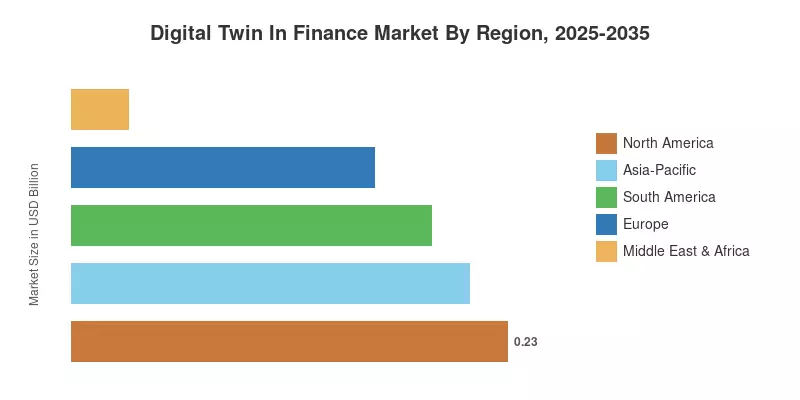
North America leads the Digital Twin In Finance Market with a 38.5% share in 2025, supported by large US banks and card networks that adopted early. Asia-Pacific is the fastest-growing region at a 35.2% CAGR, driven by India's UPI rails and Singapore's tokenization pilots. Europe ranks second with 27.0%, where DORA and the AI Act make testable, explainable models a compliance requirement. Over the next decade, twins are set to move from pilot tools to core operating infrastructure.

Key Report Takeaways

• By Component

  • Software held 43.5% of the Digital Twin In Finance Market in 2025, reflecting simulation engines bundled into enterprise risk and process suites
  • Platforms are the fastest-growing component at a 32.8% CAGR as API-first architectures replace monolithic tools

• By Application

  • Risk Management commanded 28.2% of revenue in 2025, anchored by liquidity and capital stress testing
  • Fraud Detection and Prevention leads growth at a 32.6% CAGR as instant payments collapse manual review windows

• By Deployment Mode

  • Cloud accounted for 58.4% of revenue in 2025 on the back of elastic compute for large scenario runs
  • Hybrid deployments are expanding at a 32.9% CAGR as data-residency rules tighten

• By Organisation Size

  • Large Enterprises generated 67.0% of spending in 2025 through multi-year transformation programs
  • Small and Medium-Sized Enterprises are growing at a 32.7% CAGR as consumption pricing lowers entry costs

• By End-User Industry

  • Banking represented 49.4% of Digital Twin In Finance Market revenue in 2025
  • Fintech and Payments is the fastest-growing end user at a 32.5% CAGR, driven by 24×7 settlement rails

• By Region

  • North America held a 38.5% share in 2025
  • Asia-Pacific is set to expand at a 35.2% CAGR through 2035
  • Europe captured 27.0% of global revenue on regulatory-driven demand

Market Size and Forecast (2021–2035)

Estimates for the Digital Twin In Finance Market combine bottom-up vendor revenue mapping across software, platform, and services providers with top-down analysis of financial-sector IT spending, supervisory filings, and public disclosures from banks, insurers, and payment operators. Historical values for 2021–2024 were triangulated against vendor annual reports and primary interviews with technology buyers, while forecast values reflect adoption curves observed in comparable enterprise simulation categories.
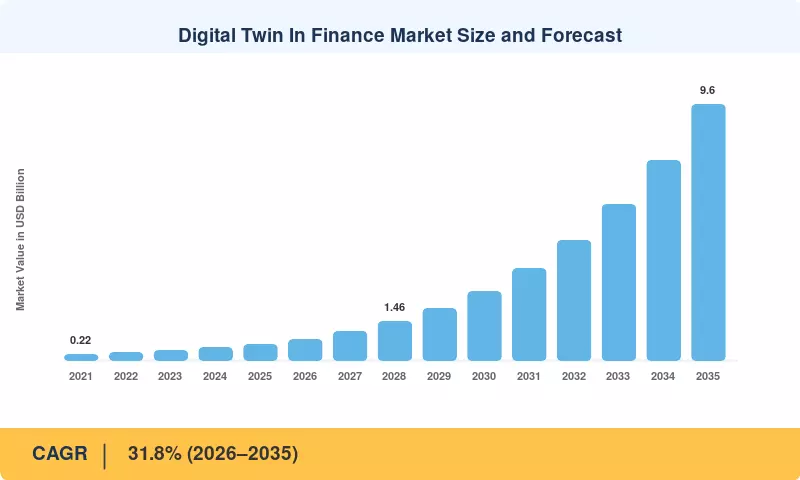
Digital Twin In Finance Market Size and Forecast
Our Impact

Enabled $4.3B Revenue Impact for Fortune 500 and Leading Multinationals

Partnering with 2000+ Global Organizations Each Year

30K+ Citations by Top-Tier Firms in the Industry

Driver Impact Analysis

Driver ~% Impact on CAGR Geographic Relevance Impact Timeline
Real-time payment rails and instant settlement +5.5% Global; North America and Asia-Pacific lead Short-term (≤2 yr)
Operational resilience mandates +4.8% Europe, UK Short-term (≤2 yr)
Generative and agentic AI maturation +5.2% Global Medium-term (2–4 yr)
Escalating fraud losses +4.1% North America, Europe Short-term (≤2 yr)
Climate risk stress testing +3.2% Europe, Asia-Pacific Long-term (≥4 yr)
Composable cloud platforms +3.6% Global Medium-term (2–4 yr)
Digital rail expansion in emerging markets +2.9% Asia-Pacific, MEA, South America Long-term (≥4 yr)


Real-Time Payment Rails and Instant Settlement

Institutions require live replicas of liquidity positions and payment flows, as instant payments do not provide a batch window for reconciliation or fraud review. In 2023, ACI Worldwide and the Fed both recorded 266.2 billion real-time transactions worldwide [21].In July 2023, a US rail was incorporated [4]. Treasury teams are currently conducting simulations of intraday liquidity during peak loads, while payment operators are conducting settlement-system replicas to test ISO 20022 message changes prior to the go-live date.

Operational Resilience Mandates

DORA mandates scenario-based continuity testing, ICT third-party registers, and threat-led penetration testing for over 22,000 EU financial entities as of January 17, 2025 [2]. A bank can simulate the outage of a cloud provider or payment processor without affecting production by utilizing a twin of critical services. Parallel demand is generated by the UK's operational resilience framework, which mandated that firms adhere to impact tolerances by March 2025. Documentation-funded budgets are now allocated to simulation environments that can be tested.


Generative and Agentic AI Maturation

AI agents that approve credit, rebalance portfolios, or triage alerts need a safe environment for testing before deployment. sizes the generative AI opportunity in banking at USD 200–340 billion annually , and expects worldwide AI spending to reach USD 632 billion by 2028 . Twins provide the sandbox: an agent runs against thousands of synthetic market or customer states, and every decision is logged for model-risk review.

Escalating Fraud Losses

Center for Financial Services projects that generative AI could push US fraud losses to USD 40 billion by 2027, up from USD 12.3 billion in 2023 [22]. Rules-based engines struggle with synthetic identities and deepfake-enabled account takeovers. Behavioral twins model each customer's normal transaction pattern and flag deviations in milliseconds, which cuts false positives on instant payments. Fraud vendors such as FICO are building profile-based simulation into decisioning platforms [14], broadening the buyer base.

Climate Risk Stress Testing

Supervisors increasingly expect banks to project losses under multi-decade climate pathways. The Network for Greening the Financial System, with more than 140 central bank and supervisor members, publishes the reference scenarios most banks adopt [7]. Supervisory exercises are also widening: the EBA's 2025 EU-wide stress test covered 64 banks holding roughly 75% of EU banking assets [19]. Twins link hazard maps and transition-policy scenarios to loan-level exposures in repeatable, auditable runs.

Composable Cloud Platforms

Vendors have unbundled simulation engines into API-first services. Microsoft's Azure Digital Twins exposes a graph-based modelling language that third-party developers can extend [12], and SAP Signavio links process mining to simulated process variants [13]. Integrators are building practices on top, and Accenture's 2025 move to acquire Percipient signals that platform programs will anchor multi-year consulting work [16]. Buyers gain the option to start small, adding use cases on a shared data layer rather than licensing separate tools.

Digital Rail Expansion in Emerging Markets

India's UPI processed roughly 131 billion transactions in fiscal 2023–24 [8], and the World Bank's Global Findex found 76% of adults worldwide held an account in 2021 [18]. Such volumes create systemic infrastructure that central banks and operators must model for capacity, fraud, and settlement risk. Banks in Southeast Asia, the Gulf, and Brazil are skipping legacy batch architectures and procuring cloud-native twins directly, extending demand well beyond mature markets.

Restraints Impact Analysis

Restraint impacts represent directional drag on Digital Twin In Finance Market growth and are not additive; several restraints compound in legacy-heavy institutions while barely registering at cloud-native fintechs.

Restraint ~% Impact on CAGR Geographic Relevance Impact Timeline
Legacy core systems and weak data lineage −3.4% Global; incumbents in North America and Europe Medium-term (2–4 yr)
Model explainability and AI regulation −2.9% Europe, expanding globally Medium-term (2–4 yr)
Cyber and data-sovereignty exposure −2.5% Global Short-term (≤2 yr)
Skills scarcity −2.2% Global Medium-term (2–4 yr)
Cloud and vendor concentration risk −1.8% North America, Europe Long-term (≥4 yr)


Legacy Core Systems and Weak Data Lineage

The quality of a twin depends on the data it replicates. Ten years after it was published, the Basel Committee's 2023 progress report revealed that just two of the thirty-one evaluated global systemically important banks fully complied with its risk data aggregation guidelines [6]. Core platforms with uneven product hierarchies are still used by many organizations. According to Market Research Future interviews, twin programs can be extended by 12 to 18 months through data remediation.

Model Explainability and AI Regulation

Creditworthiness assessment and life and health insurance pricing are considered high-risk uses under the EU AI Act, which went into effect in August 2024. Penalties for high-risk breaches can exceed 3% of global sales, while forbidden practices can reach 7% [3]. Machine learning-embedded twins need to record training data, validation, and human supervision. Risk committees postpone production approval and lengthen sales cycles when explainability cannot be demonstrated.


Cyber and Data-Sovereignty Exposure

A high-fidelity replica concentrates sensitive customer, position, and control data in one environment, creating an attractive target. The IMF's April 2024 Global Financial Stability Report found cyberattacks have nearly doubled since before the pandemic, with financial firms accounting for close to one-fifth of incidents [17]. Data-localization rules in India, China, and several Gulf states also restrict where twin workloads can run.

Skills Scarcity

Twin programs need people who understand stochastic modelling, cloud engineering, and banking products at once. The World Economic Forum's Future of Jobs Report 2025 found that 63% of employers view skills gaps as the main barrier to business transformation [25]. Banks compete with technology firms for the same engineers, and smaller institutions often lack the internal teams needed to validate vendor models independently.

Cloud and Vendor Concentration Risk

Most cloud-deployed twins run on a handful of hyperscalers. The Financial Stability Board has flagged third-party concentration among AI and cloud providers as a potential systemic vulnerability [11], and DORA introduces direct oversight of critical ICT providers. Supervisors now ask for credible exit plans, which pushes banks toward multi-cloud designs that add roughly a fifth to integration effort and slow deployment.

Digital Twin In Finance Market Opportunities

Several gaps in the Digital Twin In Finance Market remain underserved, particularly where regulation, new settlement infrastructure, and emerging-market scale intersect.

Supervisory and Regulatory Twins

Regulators themselves are becoming buyers. Supervisors running exercises such as the EBA's 2025 stress test, which spanned 64 banks [19], need system-wide replicas to observe contagion between institutions rather than bank-by-bank submissions. Vendors that package supervisor-grade twins, alongside bank-side templates that auto-generate DORA scenario evidence [2], can sell to both sides of the compliance relationship.

India and Southeast Asia Leapfrog Demand

The Reserve Bank of India's August 2025 FREE-AI framework calls for sandboxed testing and governance of AI models in regulated entities [24], and UPI's transaction scale [8] creates capacity and fraud-modelling needs few vendors address locally. Cooperative banks, NBFCs, and ASEAN digital banks represent a large, price-sensitive segment where pre-built, cloud-delivered twins can win quickly.

Twin-as-a-Service and Synthetic Data Monetization

Banks that build behavioral twins accumulate privacy-safe synthetic datasets with commercial value. Licensing anonymized synthetic customer populations to fintechs, model validators, and insurers opens a new revenue line, while vendors can move from licences to per-scenario consumption pricing. This model suits smaller institutions that cannot fund full builds.

Tokenized Asset and Collateral Twins

The Monetary Authority of Singapore's Project Guardian has expanded to include global banks and asset managers testing tokenized funds and bonds [9], and the Bank of England's Digital Securities Sandbox opened in January 2024 [10]. Each tokenized instrument needs a replica that mirrors on-chain and off-chain states for margin, custody, and settlement risk, a niche with few incumbents.

US Treasury Clearing Transition

The SEC's December 2023 rule requires central clearing of eligible cash Treasury trades by December 2026 and repo by June 2027 [23]. Dealers, hedge funds, and clearing members must simulate margin calls, netting benefits, and liquidity drains before the deadlines, creating a time-bound procurement window for collateral and liquidity twins.

Digital Twin In Finance Market Future Outlook

Four themes will define how the Digital Twin in Finance Market evolves over the coming decade.

Agentic AI and Autonomous Operations

The BIS expects AI to reshape intermediation, supervision, and payments [1], but autonomous agents cannot enter production without a verifiable testing ground. Twins will become the standard control layer where agents are trained, stress-tested, and audited, and predictive financial analytics will feed directly into agent decisions. The FSB's warnings on correlated AI behaviour [11] suggest supervisors will ask for twin-based evidence that agents do not amplify market moves.

Platform Economics and Consolidation

Vendors that own the data layer will capture most of the value. Each new connector to a payment rail, core system, or market-data feed raises switching costs and encourages multi-year commitments. Expect hyperscalers and enterprise software houses to acquire specialist twin vendors, and integrators to follow Accenture's lead [16] in building platform-anchored practices, leaving independent point-solution providers under pressure by the early 2030s.

Tokenization and Always-On Settlement

Real-time volumes keep climbing [21], and tokenized deposits, funds, and bonds tested under Project Guardian [9] will need replicas that mirror both ledger states and legal ownership. As settlement moves toward continuous operation, twins will shift from periodic analysis tools to always-on monitors that forecast liquidity gaps minutes, not days, ahead.

Climate and Sustainability Risk

NGFS scenarios [7] extend to 2050 and beyond, well past the horizon of traditional credit models. Insurers and banks will use twins to connect physical hazard data with portfolio exposures and transition policies, and to produce disclosures under ISSB and European reporting standards. Climate twins are likely to be among the longest-lived deployments because the underlying scenarios are revised on a regular supervisory cycle.

Regional Market Share Analysis

Region Key Metric (one per row) Primary Investment Themes
North America 38.5% share (2025) Fraud twins, Treasury clearing readiness, AI model testing
Europe 27.0% share (2025) DORA resilience testing, AI Act explainability, climate stress
Asia-Pacific 35.2% CAGR (2026–2035) Real-time rail capacity, tokenization, digital banks
South America 32.4% CAGR (2026–2035) Pix-linked fraud and liquidity twins
Middle East & Africa USD 0.03 Billion (2025) Vision-led banking modernization, mobile money
Total USD 0.60 Billion (2025) —

Regional demand in the Digital Twin In Finance Market tracks the maturity of real-time payment infrastructure, the strictness of operational resilience rules, and cloud readiness among incumbent banks.


North America

Country Key Metric (one per row) Key Driver
US 81.0% share of region FedNow, Treasury clearing mandate, large-bank AI programs
Canada 32.9% CAGR Real-Time Rail rollout and open banking framework
Mexico USD 16 Million (2025) SPEI-based instant payments and fintech growth


The US dominates regional spending because its largest banks run model-risk functions large enough to justify enterprise twin programs. FedNow [4] and the SEC's Treasury clearing rule [23] give those programs hard deadlines, while fraud pressure on card and instant payments keeps budgets flowing to behavioral replicas. Canada's growth follows its Real-Time Rail and consumer-driven banking legislation, which require new liquidity and data-sharing simulations at the Big Six banks.

Europe

Country Key Metric (one per row) Key Driver
Germany 21.5% share of region BaFin model-risk expectations, savings-bank IT consolidation
UK USD 43 Million (2025) Operational resilience regime, Digital Securities Sandbox
France 31.2% CAGR Insurer climate stress testing, ACPR supervision
Italy 7.5% share of region Core banking modernization at mid-tier banks
Spain USD 11 Million (2025) Digital-first retail banking and instant payments
Nordic Countries 33.4% CAGR Cloud-native banks and cashless payment systems
Russia 2.5% share of region Domestic platforms under sanctions constraints
Rest of Europe USD 15 Million (2025) Instant Payments Regulation compliance


Europe's demand is regulation-led. DORA [2] turned resilience testing into a legal obligation, and the AI Act [3] requires documented validation for high-risk credit and insurance models, a natural fit for twin environments. The UK combines its own resilience regime with the Bank of England's Digital Securities Sandbox [10], positioning London as a testing hub for tokenized settlement. Nordic banks grow fastest thanks to cloud-native architectures that shorten deployment cycles.

Asia-Pacific

Country Key Metric (one per row) Key Driver
China 38.0% share of region Large-bank AI platforms and e-CNY infrastructure
India 38.6% CAGR UPI scale, RBI FREE-AI framework
Japan USD 26 Million (2025) Megabank legacy modernization and FSA resilience rules
South Korea 9.5% share of region Internet-only banks and MyData regime
ASEAN 37.2% CAGR Project Guardian, digital bank licences
Rest of Asia-Pacific USD 10 Million (2025) Australian CPS 230 operational risk standard


Asia-Pacific's growth rests on transaction scale and regulatory experimentation. UPI's volumes [8] force Indian banks and payment operators to model capacity and fraud continuously, and the RBI's FREE-AI framework [24] encourages sandboxed model testing. Singapore's Project Guardian [9] draws global institutions to test tokenized assets, and ASEAN digital banks build twins from day one. China's large state banks invest heavily but mostly through domestic vendors.

South America

Country Key Metric (one per row) Key Driver
Brazil 58.0% share of region Pix instant payments and open finance
Argentina 30.9% CAGR Inflation-driven liquidity and FX scenario modelling
Rest of South America USD 5 Million (2025) Colombia and Chile instant-payment projects


Brazil recorded 37.4 billion real-time transactions in 2023, second only to India [21], and its Pix system makes fraud and liquidity twins a priority for incumbent banks and neobanks alike. Open finance rules add data-sharing scenarios that institutions must test before exposing APIs. Argentina's demand centres on stress-testing balance sheets against inflation and currency volatility, where static annual models age too quickly.

Middle East & Africa

Country Key Metric (one per row) Key Driver
Saudi Arabia 27.0% share of region Financial Sector Development Program under Vision 2030
UAE 36.4% CAGR Central bank digital transformation and fintech hubs
South Africa USD 6 Million (2025) Basel-aligned stress testing and PayShap rollout
Egypt 8.0% share of region Instant Payment Network and financial inclusion push
Rest of MEA 29.7% CAGR Mobile money and pan-African payment systems


Gulf banks are funding cloud-native core replacements under national modernization plans, and Saudi Arabia's push toward a largely cashless economy creates demand for payment-flow twins. The UAE grows fastest as regulators license digital banks and virtual-asset providers that need simulation before launch. In sub-Saharan Africa, where account ownership stood at 55% in 2021 [18], mobile-money operators represent a longer-term buyer group.

Digital Twin In Finance Market By Region, 2025-2035

Digital Twin In Finance Market Segmentation

By Component

Segment Key Metric (one per row) Primary Demand Driver
Software 43.5% share (2025) Simulation engines bundled in risk and process suites
Platforms 32.8% CAGR (2026–2035) Composable, API-first architectures
Services USD 0.14 Billion (2025) Process mapping, model validation, explainability


Within the Digital Twin in Finance Market, software leads because banks first bought simulation engines embedded in risk, asset-liability, and process suites. Platforms are gaining ground as buyers favour modular microservices that allow incremental rollouts: a bank can start with a liquidity twin and add a fraud replica later on the same data layer. Services remain essential, since process mapping, validation, and explainability documentation still require specialists under DORA and the AI Act.

By Application

Segment Key Metric (one per row) Primary Demand Driver
Risk Management 28.2% share (2025) Liquidity, capital, and market stress testing
Fraud Detection and Prevention 32.6% CAGR (2026–2035) Instant payments and synthetic identity fraud
Customer Experience and Personalization USD 0.11 Billion (2025) Journey simulation in mobile banking apps
Process Automation and Optimization 14.5% share (2025) Faster reconciliation and settlement
Compliance and Regulatory Reporting 30.4% CAGR (2026–2035) Automated stress-test and resilience evidence
Other Applications USD 0.05 Billion (2025) Treasury, trade finance, and M&A modelling


Risk management remains the entry point for the Digital Twin In Finance Market because liquidity and capital stress testing already has budget owners and supervisory mandates. Fraud Detection and Prevention grows fastest as real-time rails eliminate batch review windows and behavioral replicas cut false positives. Process Automation and Optimization twins move settlement toward same-day cycles, while Compliance and Regulatory Reporting twins generate scenario evidence that supervisors can audit.

By Deployment Mode

Segment Key Metric (one per row) Primary Demand Driver
Cloud 58.4% share (2025) Elastic compute for large scenario runs
On-Premises USD 0.14 Billion (2025) Proprietary trading and co-tenancy concerns
Hybrid 32.9% CAGR (2026–2035) Data-residency and sovereignty rules


Cloud holds the largest slice of the Digital Twin In Finance Market because Monte Carlo and agent-based simulations need burst compute that few banks own. Hybrid configurations are growing fastest as residency rules tighten in Europe, India, and the Gulf, letting institutions keep personal data on-premises while running heavy calculations in public cloud. On-premises systems persist at proprietary trading desks unwilling to accept shared-infrastructure risk.

By Organisation Size

Segment Key Metric (one per row) Primary Demand Driver
Large Enterprises 67.0% share (2025) Enterprise data-lake and AI programs
Small and Medium-Sized Enterprises 32.7% CAGR (2026–2035) Pre-built templates and consumption pricing


Large Enterprises dominate the Digital Twin In Finance Market because tier-one banks and insurers pair twins with data-lake consolidation and multi-year AI buildouts. Small and Medium-Sized Enterprises are growing faster as vertical software vendors offer pre-built templates that cut proof-of-concept cycles from quarters to weeks. Subscription pricing lets regional banks, credit unions, and smaller insurers test twins without large licence commitments.

By End-User Industry

Segment Key Metric (one per row) Primary Demand Driver
Banking 49.4% share (2025) Liquidity, credit, and resilience testing
Insurance USD 0.10 Billion (2025) Catastrophe loss and pricing twins
Asset Management 11.0% share (2025) Portfolio and collateral simulation
Fintech and Payments 32.5% CAGR (2026–2035) 24×7 rails and stablecoin settlement
Other End-User Industries USD 0.04 Billion (2025) Market infrastructure and credit bureaus


Banking accounts for the largest share of the Digital Twin In Finance Market, reflecting the breadth of its regulatory testing obligations. Fintech and Payments grows fastest because instant rails and stablecoins require millisecond-level replicas of transaction flows. Insurers deploy catastrophe-loss twins to refine pricing and reinsurance, while asset managers use collateral twins to manage margin across repo and derivatives books.

Competitive Benchmarking

The Digital Twin In Finance Market is moderately concentrated, with an estimated HHI of around 1,100 and the top five vendors holding roughly 38–45% of revenue. Hyperscalers and enterprise software houses control the platform layer, while integrators capture services revenue and specialists compete in fraud, payments, and collateral niches. Fragmentation remains high among regional vendors in Asia-Pacific and South America.

Company Est. Revenue Share Range Key Offerings for Digital Twin In Finance Market Strategic Positioning
Microsoft Corporation ~9–12% Azure Digital Twins, Fabric data platform, AI agent tooling Platform leader with broad developer ecosystem
IBM Corporation ~7–10% watsonx, OpenPages risk suite, hybrid cloud Hybrid and regulated-industry specialist
SAP SE ~6–9% SAP Signavio, SAP Business Technology Platform Process twins linked to ERP and finance data
Amazon Web Services ~6–8% AWS IoT TwinMaker, SageMaker, financial services cloud Elastic compute for large-scale simulation
Oracle Corporation ~4–6% Oracle Financial Services Analytical Applications, OCI Core banking and risk analytics incumbent
Accenture plc ~4–7% Twin design, integration, Percipient data platform Integrator building platform-anchored practice
FICO ~3–5% Falcon Fraud Manager, decision management platform Fraud and credit decisioning specialist
Broadridge Financial Solutions ~2–4% Distributed ledger repo, post-trade platforms Capital markets and collateral infrastructure
Capgemini SE ~2–4% Financial services twin consulting and engineering European integrator with resilience focus
Matera ~1–2% Real-time payment and core ledger platform Instant payments and stablecoin rails specialist


Recent News & Developments

The developments below shaped buyer priorities in the Digital Twin In Finance Market between 2023 and 2025.

  • Federal Reserve (July 2023): Launched the FedNow instant payment service, creating a new US rail that requires real-time liquidity and fraud simulation at participating banks [4]
  • Monetary Authority of Singapore (November 2023): Expanded Project Guardian with additional global institutions testing tokenized assets, widening demand for ledger-aware twins [9]
  • U.S. Securities and Exchange Commission (December 2023): Adopted rules mandating central clearing of eligible Treasury cash and repo trades, driving margin simulation needs [23]
  • Bank of England (January 2024): Opened the Digital Securities Sandbox for tokenized settlement experiments, giving UK firms a regulated testing venue [10]
  • European Union (August 2024): The AI Act entered into force, placing credit scoring and insurance pricing models under high-risk obligations [3]
  • European Supervisory Authorities (January 2025): DORA became applicable, requiring scenario-based ICT resilience testing across EU financial entities [2]
  • European Banking Authority (August 2025): Published results of its EU-wide stress test covering 64 banks, reinforcing expectations for granular scenario modelling [19]
  • Reserve Bank of India (August 2025): Released the FREE-AI framework, encouraging sandboxed testing and governance of AI models in regulated entities [24]

Digital Twin In Finance Market Report Scope

Parameter Details
Market Scope Digital Twin In Finance Market by Component, Application, Deployment Mode, Organisation Size, End-User Industry, and Region
Study Period 2021–2035 (Historical: 2021–2024; Base Year: 2025; Forecast: 2026–2035)
CAGR 31.8% (2026–2035)
Market Size Checkpoints USD 0.60 Billion (2025); USD 0.80 Billion (2026); USD 9.60 Billion (2035)
Fastest Growing Segments Platforms; Fraud Detection and Prevention; Hybrid; Small and Medium-Sized Enterprises; Fintech and Payments; Asia-Pacific
Companies Profiled Microsoft, IBM, SAP, Amazon Web Services, Oracle, Accenture, FICO, Broadridge, Capgemini, Matera
Valuation Currency USD (Billion/Million)

FAQs

What should buyers evaluate when selecting a vendor in the Digital Twin In Finance Market?
Prioritize connector coverage for your core banking, ledger, and payment systems, plus built-in model-validation tooling. Ask for reference deployments at institutions of similar asset size and a documented exit path for your data [12].
How does a financial digital twin differ from a traditional stress-testing model?
A stress-testing model runs periodically on static snapshots. A twin stays synchronized with live data, so scenarios reflect current positions and can be rerun within minutes [6].
Which emerging use cases could reshape the Digital Twin In Finance Market after 2030?
Central bank digital currency testing stands out. Central banks need replicas of retail payment behaviour to set holding limits and assess deposit outflows before launch [1].
How long does a typical deployment take at a mid-sized bank?
A single-process twin, such as liquidity or reconciliation, usually goes live in six to nine months. Enterprise-wide programs spanning risk, payments, and customer journeys often run two to three years [13].
Can digital twins lower regulatory capital requirements?
Not directly, since supervisors grant no capital relief for twin adoption. Better data lineage can, however, strengthen internal model applications and reduce supervisory add-ons tied to data weaknesses [6].
How are investors valuing companies in the Digital Twin In Finance Market?
Investors pay premiums for recurring platform revenue over project-based services. Acquisitions by integrators and software houses signal that proprietary data connectors drive valuation [16].
What integration issue most often stalls financial twin projects?
Mismatched identifiers across core banking, general ledger, and payment systems. Without a common customer and product key, the replica cannot reconcile to source records, and validation fails [6].
Author
Author Author Profile Kiran Jinkalwad LinkedIn Research Associate Level - II
Kiran Jinkalwad brings over four years of experience in market research, specializing in the ICT and Semiconductor sectors. She has worked on 50+ projects, including custom studies for companies like Microsoft and Huawei, addressing complex business challenges. With a background in Electronics and Telecommunication, Kiran excels in market estimation, forecasting, and strategic analysis. His sharp analytical skills and industry knowledge consistently deliver actionable insights for diverse clients.
Download Free Sample

Kindly complete the form below to receive a free sample of this Report

Global Diameter Signaling Market
Case Study
Information and Communications Technology
Download PDF ×

We do not share your information with anyone. However, we may send you emails based on your report interest from time to time. You may contact us at any time to opt-out.

















