North America : Market Leader in Cristobalite Market
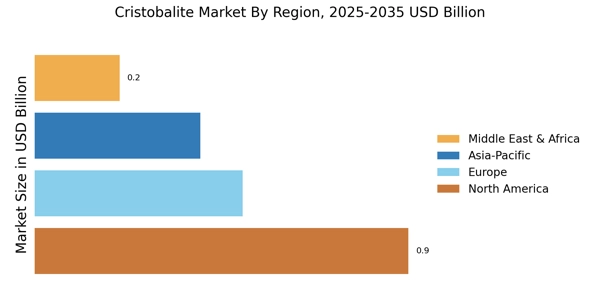
North America is the largest market for cristobalite, holding approximately 45% of the global share. The region's growth is driven by increasing demand in the construction and manufacturing sectors, alongside stringent regulations promoting the use of silica in various applications. The U.S. is the primary contributor, supported by a robust industrial base and technological advancements in silica processing. Canada follows as the second-largest market, accounting for around 20% of the share, with a focus on sustainable mining practices. The competitive landscape in North America features key players such as U.S. Silica Holdings Inc. and Minerals Technologies Inc., which are leveraging innovative technologies to enhance product quality and expand their market reach. The presence of established companies fosters a dynamic environment, encouraging new entrants to innovate. Regulatory frameworks in the U.S. and Canada further support market growth by ensuring safety and environmental compliance, thus enhancing consumer confidence.
Europe : Emerging Market with Growth Potential
Europe is witnessing significant growth in the cristobalite market, driven by increasing industrial applications and a shift towards eco-friendly materials. The region holds approximately 25% of the global market share, with Germany and France being the largest contributors. Germany leads with about 12% of the market, supported by its strong manufacturing sector, while France accounts for around 8%. Regulatory initiatives aimed at reducing environmental impact are catalyzing demand for high-quality silica products. Leading countries in Europe include Germany, France, and the UK, where companies like Quarzwerke GmbH and Imerys S.A. are prominent players. The competitive landscape is characterized by innovation and strategic partnerships, enhancing product offerings. The European market is also influenced by stringent regulations that promote sustainable practices, ensuring that companies adhere to environmental standards. This regulatory environment fosters a competitive edge for firms that prioritize sustainability in their operations.
Asia-Pacific : Rapid Growth in Emerging Economies
The Asia-Pacific region is rapidly emerging as a significant player in the cristobalite market, driven by industrialization and urbanization. This region holds approximately 20% of the global market share, with China and India being the largest contributors. China dominates the market with around 15%, fueled by its extensive manufacturing sector, while India is witnessing a surge in demand due to infrastructure development. Regulatory support for industrial growth is further propelling market expansion. Key players in the Asia-Pacific market include Kossan Rubber Industries Bhd and Hoben International, which are focusing on enhancing production capabilities to meet rising demand. The competitive landscape is evolving, with local manufacturers increasingly adopting advanced technologies to improve product quality. Additionally, government initiatives aimed at promoting sustainable practices are shaping the market dynamics, encouraging companies to innovate and comply with environmental standards.
Middle East and Africa : Untapped Potential in Emerging Markets
The Middle East and Africa region is gradually emerging in the cristobalite market, holding approximately 10% of the global share. The growth is primarily driven by increasing industrial activities and a focus on infrastructure development. Countries like South Africa and the UAE are leading the market, with South Africa accounting for about 6% of the share, supported by its mining sector. Regulatory frameworks are evolving to promote sustainable practices, which is expected to enhance market growth in the coming years. In this region, the competitive landscape is characterized by a mix of local and international players, with companies like Sibelco and Harris & Bruno International establishing a presence. The market is witnessing increased investments in mining and processing technologies, aimed at improving product quality and meeting international standards. As regulatory bodies implement stricter environmental guidelines, companies are adapting their operations to align with these changes, fostering a more sustainable market environment.




 Noah Malgeri
Co-Founder

 Peter Groot koerkamp
Account and Business Manager

 Younghwan Choi
Senior Retail Manager

 Mark Irwin
Management Consultant

 Akif Moroglu
Strategy & Business Development Director

 Guilherme Gomes Martins
Product Management Director

 Joseph Aguayo
Sales Operations & Pricing Manager

 La Terria Dodd
Program Support Specialist

 Rob Kooiker
Group Product Manager HVAC & Fire Protection GMA