Concentrated Milk Fat Market (2026 - 2035)

Concentrated Milk Fat Market Size, Share, Industry Trend & Analysis Research Report By Category (Conventional, Organic), By Product Type (Anhydrous Milk Fat, Butteroil, Others), By Application (Bakery and Confectionery, Dairy Products, Infant Nutrition and Formula, Nutraceuticals, Personal Care and Cosmetics, Others), By Region (North America, Europe, Asia-Pacific, South America, Middle East and Africa) - Forecast to 2035
ID: MRFR/FnB/28470-HCR 128 Pages Varsha More Last Updated: October 27, 2026
Concentrated Milk Fat Market
Market Size
Forecast Period2026-2035
CAGR (2026-2035)6.70%
2025 Market SizeUSD 5.68 Billion
2035 Market SizeUSD 10.85 Billion
Key Players
Fonterra Co-operative Group
Royal FrieslandCampina N.V.
Arla Foods amba
Groupe Lactalis
DMK Group
Gujarat Cooperative Milk Marketing Federation
Opportunities
  • MFGM-Rich Fractions for Premium Infant Nutrition
  • Recombination Hubs in Emerging Markets
  • Verified Low-Carbon Milkfat and Data-Backed Contracts

Concentrated Milk Fat Market Summary

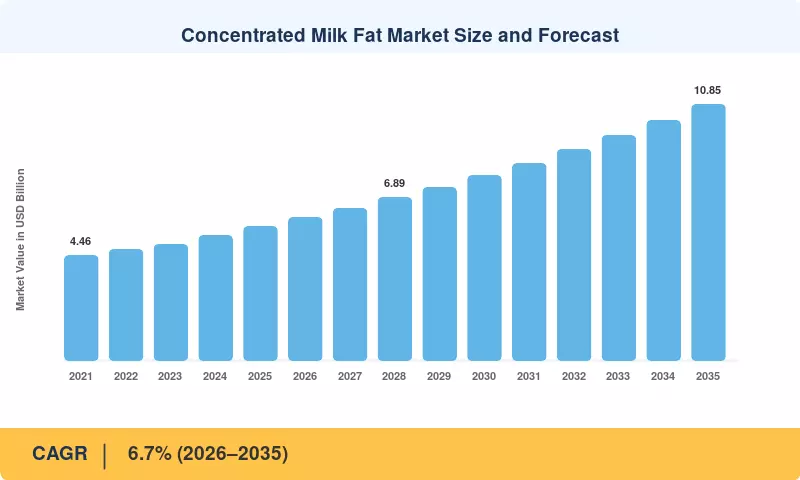
The global concentrated milk fat market was valued at USD 5.68 billion in 2025 and is projected to reach USD 6.05 billion in 2026, rising to USD 10.85 billion by 2035 at a CAGR of 6.7% over 2026–2035. Two catalysts anchor that trajectory. European wholesale butter prices rose by roughly half during 2024, pushing processors to steer cream toward high-value fat fractions instead of whole milk powder [2]. In March 2025, the U.S. Food and Drug Administration launched Operation Stork Speed, its first comprehensive review of infant formula nutrient requirements since 1998, reopening lipid specifications for formula makers .

Processing is shifting from commodity churning toward precision fat engineering. Legacy plants built to convert surplus cream into bulk butter and powder are being retrofitted with continuous separators, vacuum dryers, and dry fractionation lines that split milkfat into stearin and olein grades with tightly controlled melting profiles. Fonterra's NZD 75 million butter expansion at Clandeboye shows the direction of capital, adding flexible capacity that can swing between anhydrous grades and butteroil [6]. Membrane filtration is also enabling milk fat globule membrane (MFGM) concentrates for premium nutrition [3].

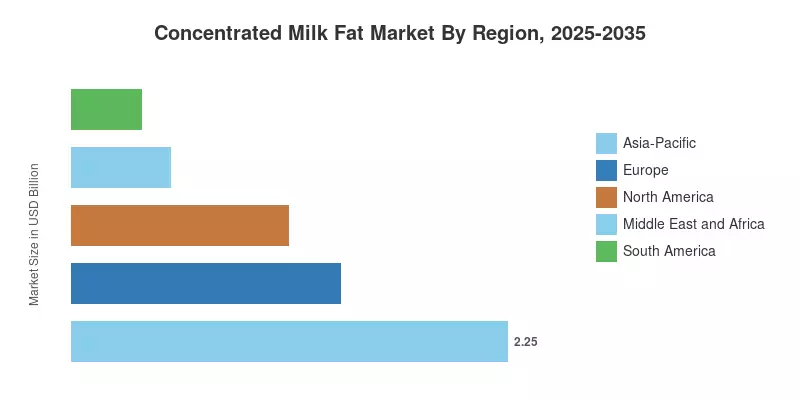
Asia-Pacific anchors the concentrated milk fat market with a 39.7% share of 2025 revenue, supported by recombined dairy, industrial bakery, and infant formula manufacturing in China, Southeast Asia, and India. Middle East and Africa is the fastest-growing region at a 9.0% CAGR as import-dependent economies build recombination capacity. Europe ranks second with a 24.5% share, backed by lamination bakery and chocolate industries. Over the next decade, supply discipline in Oceania and Europe will decide how quickly this demand can be served.

Key Report Takeaways

• By Category

  • Conventional products generated USD 5.24 billion in 2025, keeping the concentrated milk fat market anchored in cost-driven industrial buyers.
  • Organic variants are forecast to post a 10.1% CAGR through 2035 as infant formula and premium bakery brands pursue certified clean-label claims.

• By Product Type

  • Anhydrous Milk Fat (AMF) held a 71.9% share of 2025 revenue on the strength of its long shelf life and high-temperature stability.
  • Butter oil is set to grow at an 8.5% CAGR as chocolate makers adopt it for fat standardization.

• By Application

  • Bakery and Confectionery accounted for a 45.7% share of 2025 demand, led by laminated dough and chocolate coatings.
  • Infant Nutrition and Formula is the fastest-growing application at an 8.3% CAGR.
  • Dairy Products held a 22.5% share, driven by recombined milk in import-reliant economies.

• By Region

  • Asia-Pacific held a 39.7% share of the concentrated milk fat market in 2025
  • Middle East and Africa will expand at a 9.0% CAGR, the fastest of any region
  • Europe captured a 24.5% share, supported by chocolate and bakery manufacturing

Concentrated Milk Fat Market Size and Forecast (2021–2035)

Market Research Future built these estimates bottom-up from processor capacity, cream allocation ratios, and end-use consumption, then validated them top-down against trade flows reported by USDA's Foreign Agricultural Service [1], the European Commission's Milk Market Observatory , and Global Dairy Trade auction results [23]. Historical values for the concentrated milk fat market reflect realized prices and volumes, while forecasts combine volume growth by application with a moderated price outlook. Values are expressed in current USD.
Concentrated Milk Fat Market Size and Forecast
Our Impact

Enabled $4.3B Revenue Impact for Fortune 500 and Leading Multinationals

Partnering with 2000+ Global Organizations Each Year

30K+ Citations by Top-Tier Firms in the Industry

Driver Impact Analysis

Driver ~% Impact on CAGR Geographic Relevance Impact Timeline
Cream reallocation toward high-margin fat fractions +1.4% Global; strongest in Europe and Oceania Short-term (≤2 yr)
Infant formula lipid reformulation and MFGM adoption +1.2% Asia-Pacific, North America, Europe Medium-term (2–4 yr)
Recombined dairy expansion in import-dependent economies +1.1% Middle East and Africa, ASEAN Long-term (≥4 yr)
Deforestation-free and clean-label reformulation +0.9% Europe, North America Medium-term (2–4 yr)
Cocoa butter cost shock favoring milkfat in chocolate +0.7% Europe, North America Short-term (≤2 yr)
Processing capacity investment in Oceania and Europe +0.6% Oceania, Asia-Pacific import markets Medium-term (2–4 yr)


Cream Reallocation Toward High-Margin Fat Fractions

European wholesale butter prices climbed roughly 50% during 2024, and the European Commission's Milk Market Observatory recorded butter quotations above EUR 7,000 per tonne that autumn [2]. Those spreads rewrote plant economics. Processors that once dried cream into whole milk powder now separate it into butter and anhydrous grades, where returns per litre are materially higher. Biweekly Global Dairy Trade auctions reinforced the signal, with fat products repeatedly outperforming powders through 2025 [23].

Infant Formula Lipid Reformulation and MFGM Adoption

Formula makers are raising milkfat inclusion to bring lipid profiles closer to human milk, particularly phospholipid and sn-2 palmitate content. The FDA's Operation Stork Speed opened the first full review of formula nutrient requirements since 1998 . China's GB 10765-2021 standard, in force since February 2023, tightened compositional rules and forced reformulation across registered brands . EFSA's 2025 work on milk fat globule membrane safety has further supported premium formula claims in Europe [3].

Recombined Dairy Expansion in Import-Dependent Economies

Fresh milk output across the Gulf, North Africa, and much of Southeast Asia cannot keep pace with population and income growth, so manufacturers recombine imported milkfat with skim powder and water. The OECD-FAO Agricultural Outlook projects world milk production growth of roughly 1.6% a year to 2034, concentrated in South Asia, leaving deficit regions dependent on traded fat [5]. Saudi Arabia's Vision 2030 food-security agenda favors local processing over finished imports, lifting bulk fat demand [21].

Deforestation-Free and Clean-Label Reformulation

Regulation (EU) 2023/1115 requires operators placing palm oil and derived products on the EU market to prove deforestation-free sourcing, raising compliance costs for vegetable fat blends [9]. The European Commission adopted a 12-month delay to its application in December 2024, yet large bakery and confectionery groups began reformulating early. Many are moving laminating and filling fats back to milkfat, which offers simpler traceability and a clean-label butter claim that shoppers reward.

Cocoa Butter Cost Shock Favoring Milkfat in Chocolate

Cocoa futures exceeded USD 12,000 per tonne in December 2024 after consecutive West African crop shortfalls documented by the International Cocoa Organization [7]. Directive 2000/36/EC caps non-cocoa vegetable fats at 5% of finished chocolate weight in the EU, while milkfat faces no equivalent ceiling [8]. That regulatory asymmetry lets chocolate makers stretch expensive cocoa butter with butteroil and fractionated milkfat, protecting texture and label integrity at once.

Processing Capacity Investment in Oceania and Europe

Fonterra's NZD 75 million Clandeboye expansion adds output that can be switched between butter, AMF, and butteroil according to customer demand [6]. European cooperatives are also redirecting capital toward higher-value ingredient streams, a priority highlighted in FrieslandCampina's 2024 annual report . New fractionation lines shorten lead times for specialty grades and give Asian buyers more dependable supply, which encourages multi-year offtake contracts rather than spot purchasing.

Restraints Impact Analysis

Restraint ~% Impact on CAGR Geographic Relevance Impact Timeline
Raw milk and butter price volatility −1.0% Global Short-term (≤2 yr)
Substitution by lower-cost vegetable fats −0.8% Asia-Pacific, Middle East and Africa Medium-term (2–4 yr)
Trade friction and anti-subsidy investigations −0.6% China, Europe Short-term (≤2 yr)
Dietary guidance limiting saturated fat intake −0.5% North America, Europe Long-term (≥4 yr)
Constrained organic milk supply −0.4% North America, Europe Long-term (≥4 yr)


Raw Milk and Butter Price Volatility

Milkfat ranks among the most price-volatile dairy commodities because its supply depends on skim and protein demand. The roughly 50% European butter increase in 2024 squeezed bakery margins, and several industrial buyers trimmed milkfat inclusion or moved to blended fats [2]. Auction-to-auction swings of 5–10% on Global Dairy Trade complicate annual pricing for formula and confectionery customers [23].

Substitution by Lower-Cost Vegetable Fats

During 2025, milkfat commonly traded at more than five times the per-tonne price of palm olein, and that gap widens whenever dairy prices rally. OECD-FAO projections show vegetable oils remaining the world's dominant edible fat source through 2034 [5]. Bakeries in South Asia and Africa reformulate within weeks when milkfat premiums spike, capping volume growth in the most price-sensitive channels.

Trade Friction and Anti-Subsidy Investigations

China's Ministry of Commerce opened an anti-subsidy investigation into EU dairy imports in August 2024, covering high-fat cream and several cheese categories . The probe showed that dairy has become a lever in broader trade disputes. Exporters now price in tariff risk, and importers are spreading purchases across more origins, which adds contract complexity and cost across the supply chain.

Dietary Guidance Limiting Saturated Fat Intake

The World Health Organization’s 2023 guideline proposes that adults and children should limit saturated fat to less than 10% of total calorie consumption [13]. In some markets, front-of-pack labeling techniques identify meals high in saturated fat, pushing snack and pastry businesses to reduce milkfat levels or promote lighter versions. The effect is gradual but lasting in retail in North America and Western Europe.


Constrained Organic Milk Supply

Organic milk production rises slowly since conventional farms must convert acreage over three years under USDA’s National Organic Program [11]. Regulation (EU) 2018/848 further prohibits the labeling of a mixture of organic and conventional fat as organic [10]. Organic milkfat trades at a 40-60% premium to conventional, restricting usage outside of newborn formula and premium pastry.


Concentrated Milk Fat Market Opportunities

MFGM-Rich Fractions for Premium Infant Nutrition

In China, Southeast Asia and the Gulf, formula makers are increasingly marketing the cognitive and gut-health benefits associated with milk fat globule membrane. Processors able to offer standardized MFGM-rich fractions with AMF can command prices substantially above bulk fat. Infant Nutrition & Formula is the fastest-growing application [3], and regulatory assessments are being conducted in the U.S. and EU. Suppliers with confirmed compositional data are best positioned to win extended qualification cycles.


Recombination Hubs in Emerging Markets

Fresh milk markets in emerging nations in the Gulf, Egypt and ASEAN are structurally imbalanced in supply and consumption. Exporters can relocate recombination and repacking hubs to free zones or Saudi industrial areas and redistribute bulk AMF and butter oil closer to end customers, reducing freight exposure. Middle East and Africa are the growth leaders and have national food-security plans [21]. This is the most scalable global opportunity of the predicted period.


Verified Low-Carbon Milkfat and Data-Backed Contracts

Food companies reporting under the EU Corporate Sustainability Reporting Directive need auditable Scope 3 emissions data for purchased ingredients [22]. Suppliers in the concentrated milk fat market that attach farm-level carbon footprint records can sell that data as a certified premium attribute or through book-and-claim schemes. This business model converts sustainability records into a revenue line and a tender differentiator.

Butteroil as a Cocoa Butter Extender

Record cocoa prices [7] and the EU's 5% vegetable fat cap [8] give butteroil a compliant role in stretching cocoa butter in milk chocolate, pralines, and coated biscuits. Suppliers offering fractions with tailored melting points and technical application support can secure long-term formulation positions with confectioners.

Certified Organic and Grass-Fed Fractions

Premium buyers will pay for traceable organic and grass-fed milkfat, but supply is thin because of conversion rules [10]. Cooperatives that lock in organic conversion contracts now can capture Organic's double-digit growth while competitors remain supply-constrained.

Concentrated Milk Fat Market Future Outlook

Digital Process Control in Fractionation

Fractionation yield depends on precise crystallization, and processors are adopting sensor-driven controls and predictive models to hold melting profiles within narrow bands. Tighter specifications let suppliers serve formula and chocolate customers with fewer rejected batches and less energy per tonne. Plants that digitize early will set the quality benchmark buyers use in qualification audits.

Cream Allocation Economics and Price Discovery

Returns in the concentrated milk fat market will continue to hinge on how processors split cream between butter, AMF, and powder. Transparent price discovery through Global Dairy Trade auctions [23] and exchange-traded futures makes allocation decisions faster and more responsive. Expect more contracts indexed to auction results, shifting price risk away from fixed annual agreements.

Climate Pressure on Milk Supply

FAO's 2023 assessment attributes about 12% of anthropogenic greenhouse gas emissions to livestock agrifood systems, placing dairy herds under growing regulatory scrutiny [15]. Heat stress and drought in key producing regions already cause seasonal output dips. Supply growth in Oceania and Europe may therefore trail demand, sustaining firm milkfat pricing through the early 2030s [5].

Sustainability Reporting and Alternative Fats

The EU Corporate Sustainability Reporting Directive obliges large food companies to disclose value-chain emissions, pushing milkfat buyers to demand verified footprints [22]. At the same time, precision-fermentation start-ups are developing animal-free milk lipids. Conventional suppliers that document low-carbon production will be better positioned to defend share as these alternatives mature.

Regional Market Share Analysis

Region Metric (2025 share or 2026–2035 CAGR) Primary Investment Themes
North America 19.8% share Formula reformulation, clean-label bakery, organic supply
Europe 24.5% share Chocolate formulation, lamination bakery, cooperative consolidation
Asia-Pacific 39.7% share Recombined dairy, infant formula, industrial bakery
South America 6.4% share Bakery modernization, export-oriented processing
Middle East and Africa 9.0% CAGR Recombination hubs, food-security programs, traditional sweets
Total USD 5.68 billion (2025) —

Regional demand in the concentrated milk fat market follows the gap between local milk supply and processed-food manufacturing capacity. Surplus regions such as Oceania and Western Europe export, while Asia-Pacific and Middle East and Africa absorb the bulk of traded volume.


North America

Country Metric (share of region, USD, or CAGR) Key Driver
US 78.0% share of region Infant formula and industrial bakery
Canada USD 0.13 billion (2025) Supply-managed cream allocated to processing
Mexico 7.4% CAGR (2026–2035) Confectionery and recombined dairy imports


U.S. demand centers on formula, frozen bakery, and snack manufacturing, and Operation Stork Speed is expected to reshape lipid specifications for domestic formula lines . Organic milkfat remains tight because of USDA National Organic Program conversion requirements [11]. Canada's supply-management system channels cream into butter and processing under quota, while Mexico relies on U.S. imports to feed a growing confectionery sector, making it the region's fastest-growing buyer.

Europe

Country Metric (share of region, USD, or CAGR) Key Driver
Germany 21.0% share of region Lamination bakery and chocolate
UK USD 0.17 billion (2025) Biscuit and confectionery manufacturing
France 17.0% share of region Viennoiserie and premium pastry
Italy 5.4% CAGR (2026–2035) Confectionery and filled pastry
Spain USD 0.09 billion (2025) Industrial bakery
Nordic Countries 8.0% share of region Organic milkfat supply and export
Russia 4.9% CAGR (2026–2035) Domestic substitution of imports
Rest of Europe 17.3% share of region Recombination and processing in Central Europe


Europe is both a major producer and a sophisticated user. Chocolate makers rely on the vegetable fat ceiling in Directive 2000/36/EC to justify milkfat use [8], and the EU deforestation regulation is steering bakery fats away from palm [9]. Consolidation is reshaping supply: the planned Arla–DMK merger will create the continent's largest dairy cooperative [17]. AHDB data show organic channels holding up despite price pressure [2].

Asia-Pacific

Country Metric (share of region, USD, or CAGR) Key Driver
China 38.0% share of region Infant formula and bakery chains
India 8.8% CAGR (2026–2035) Traditional sweets and packaged bakery
Japan USD 0.25 billion (2025) Premium confectionery and pastry
South Korea 6.0% share of region Café bakery and recombined milk
ASEAN 8.1% CAGR (2026–2035) Recombined dairy and condensed milk
Rest of Asia-Pacific 12.0% share of region Oceania processing and regional trade


Asia-Pacific is the largest consumer in the concentrated milk fat market, and China alone accounts for well over a third of regional demand. The GB 10765-2021 formula standard drove reformulation across registered brands , while New Zealand supplies much of the region's AMF through long-term contracts [6]. India's growth reflects rising packaged sweet and bakery output, and ASEAN recombiners convert imported fat into condensed and UHT milk.

South America

Country Metric (share of region, USD, or CAGR) Key Driver
Brazil 58.0% share of region Industrial bakery and confectionery
Argentina 6.9% CAGR (2026–2035) Export-oriented dairy processing
Rest of South America USD 0.07 billion (2025) Recombined dairy in Andean economies


Brazil dominates regional consumption through large bakery and chocolate manufacturers, although price sensitivity keeps vegetable fats competitive [5]. Argentina, a surplus milk producer, is expanding milkfat exports to Asia and the Middle East as processors invest in drying and separation capacity. Andean economies import modest volumes for recombined milk and ice cream.

Middle East and Africa

Country Metric (share of region, USD, or CAGR) Key Driver
Saudi Arabia 27.0% share of region Vision 2030 local processing
UAE 9.6% CAGR (2026–2035) Re-export and free-zone recombination
South Africa USD 0.06 billion (2025) Bakery and domestic dairy processing
Egypt 14.0% share of region Recombined dairy and traditional sweets
Rest of MEA 9.3% CAGR (2026–2035) Population growth in North and West Africa


Saudi Arabia leads regional demand as Vision 2030 prioritizes domestic food processing and strategic reserves [21]. The UAE functions as a re-export hub, recombining and repacking imported fat for neighboring markets. Egypt's large confectionery and sweets sector depends on imported butter oil, while North and West African demand rises with urbanization and packaged bakery penetration.

Concentrated Milk Fat Market By Region, 2025-2035

Concentrated Milk Fat Market Segmentation

By Category

Segment Metric (2025 share/value or 2026–2035 CAGR) Primary Demand Driver
Conventional USD 5.24 billion Cost-sensitive industrial bakery, confectionery, and recombined dairy
Organic 10.1% CAGR Certified infant formula and premium bakery


Across the concentrated milk fat market, Conventional supply dominates because industrial bakery, confectionery, and recombination buyers cannot absorb organic premiums of 40–60%. Its scale in procurement and logistics sustains a lasting cost advantage. Organic is the faster-growing category, propelled by formula brands seeking USDA and EU organic certification [10][11]. Growth remains supply-limited by land conversion timelines, so organic gains will concentrate in formula and premium retail rather than bulk industrial channels.

By Product Type

Segment Metric (2025 share/value or 2026–2035 CAGR) Primary Demand Driver
Anhydrous Milk Fat 71.9% share Industrial baking, recombined dairy, long-haul export
Butteroil 8.5% CAGR Chocolate fat standardization and premium confectionery
Others USD 0.40 billion Cream concentrates and specialty fractions for niche uses


Within the concentrated milk fat market, AMF remains the workhorse thanks to its low moisture, extended shelf life, and suitability for high-temperature lamination and recombination. Exporters ship it in bulk tankers and drums to Asia and the Middle East. Butteroil grows faster as chocolate makers value its richer flavor under strict cocoa rules [8]. The Others segment, covering cream concentrates and specialty fractions, serves personal care, pharmaceutical, and artisan applications without the scale to challenge the two leaders.

By Application

Segment Metric (2025 share/value or 2026–2035 CAGR) Primary Demand Driver
Bakery and Confectionery 45.7% share Laminated dough, fillings, and chocolate coatings
Dairy Products 22.5% share Recombined milk, yogurt, and cheese analogs
Infant Nutrition and Formula 8.3% CAGR Human-milk lipid mimicry and MFGM claims
Nutraceuticals USD 0.39 billion Functional lipids and MFGM supplements
Personal Care and Cosmetics 3.2% share Clean-beauty emollients and balms
Others USD 0.33 billion Foodservice, sauces, and ready meals


Application demand in the concentrated milk fat market is led by Bakery and Confectionery, where milkfat delivers flavor release and plasticity in croissants, biscuits, and coatings. Dairy Products rank second on recombination volumes in import-reliant economies. Infant Nutrition and Formula grows fastest as regulators revisit lipid requirements . Nutraceuticals and Personal Care and Cosmetics remain small but carry higher margins per tonne.

Competitive Benchmarking

The concentrated milk fat market shows moderate concentration. Market Research Future estimates the top five suppliers hold roughly 40–45% of global revenue, implying a Herfindahl-Hirschman Index in the 450–600 range. Oceania and European cooperatives lead on export scale, while a long tail of regional processors and fractionation specialists serves local bakery and sweets industries. Consolidation, including the Arla–DMK merger [17], is gradually lifting concentration.

Company Est. Revenue Share Range Key Offerings for Concentrated Milk Fat Market Strategic Positioning
Fonterra Co-operative Group ~14–18% AMF, butteroil, fractionated milkfat, MFGM ingredients Largest exporter; Oceania supply into Asia and the Middle East
Royal FrieslandCampina N.V. ~7–10% AMF, specialty fractions, infant nutrition lipids Integrated formula ingredient focus
Arla Foods amba ~6–9% AMF, butteroil, organic milkfat Organic leadership; scale from DMK merger
Groupe Lactalis ~5–7% Butteroil, industrial butter, milkfat blends Global footprint expanded by Mainland acquisition
DMK Group ~4–6% AMF, butter concentrates German processing base; merging with Arla
Gujarat Cooperative Milk Marketing Federation (Amul) ~3–5% Clarified butter, butteroil Dominant Indian domestic scale
Corman S.A. ~2–4% Fractionated and concentrated butter for bakery Fractionation specialist within Savencia
Ornua Co-operative Limited ~2–4% Butter, butteroil, milkfat ingredients Irish grass-fed positioning
Uelzena eG ~1–3% AMF, butteroil, milkfat fractions Contract processing and tolling services
Synlait Milk Limited ~1–2% AMF, infant formula bases New Zealand formula specialist


Recent News & Developments

  • National Health Commission and SAMR, China (February 2023): The GB 10765-2021 infant formula standard took effect, forcing reformulation of registered brands and lifting demand for specified milk lipids
  • China Ministry of Commerce (August 2024): Launched an anti-subsidy investigation into EU dairy imports, adding tariff risk to European cream and fat exports
  • European Commission Milk Market Observatory (October 2024): EU butter quotations exceeded EUR 7,000 per tonne, accelerating cream diversion from powders into fat products
  • European Commission (December 2024): Adopted a 12-month delay to the deforestation regulation's application, giving bakery and confectionery groups time to redesign fat sourcing [9]
  • International Cocoa Organization (December 2024): Cocoa futures passed USD 12,000 per tonne, strengthening the case for milkfat extenders in chocolate [7]
  • U.S. Food and Drug Administration (March 2025): Launched Operation Stork Speed to review infant formula nutrient requirements, with lipid specifications among the areas under review
  • Arla Foods and DMK Group (April 2025): Announced a merger creating Europe's largest dairy cooperative, consolidating supply in the concentrated milk fat market [17]
  • Groupe Lactalis and Fonterra (August 2025): Lactalis agreed to acquire Fonterra's Mainland consumer business for NZD 4.22 billion, sharpening Fonterra's ingredients focus [18]

Concentrated Milk Fat Market Report Scope

Report Attribute/Metric Details
Market Scope Global concentrated milk fat market by Category, Product Type, Application, and Region
Study Period 2021-2035
Base Year 2025
Historical Data 2021–2024
Forecast Period 2026–2035
Market Size in 2025 USD 5.68 Billion
Market Size in 2035 USD 10.85 Billion
CAGR (2026–2035) 6.70%
Fastest Growing Segments Organic (Category); Butteroil (Product Type); Infant Nutrition and Formula (Application); Middle East and Africa (Region)
Regions Covered North America, Europe, APAC, South America, MEA
Companies Profiled Fonterra, FrieslandCampina, Arla Foods, Groupe Lactalis, DMK Group, Amul, Corman, Ornua, Uelzena, Synlait Milk
Valuation Currency USD Billion
Methodology Primary interviews (150+), secondary data cross-validation, proprietary econometric forecasting

FAQs

What quality specifications should buyers verify when sourcing from the concentrated milk fat market?
Codex Standard CXS 280-1973 requires AMF to contain at least 99.8% milkfat and no more than 0.1% water, while butteroil must reach 99.6% milkfat [16]. Buyers should also test peroxide value and free fatty acids, which indicate oxidation risk.
How do processors hedge price risk in the concentrated milk fat market?
Many supply contracts are indexed to biweekly Global Dairy Trade AMF results, a transparent benchmark [23]. Larger buyers add exchange-traded dairy futures on SGX to lock in costs for six to twelve months.
How should AMF be stored to protect shelf life?
Nitrogen-flushed drums or bulk containers kept cool and away from light slow oxidation considerably. Under those conditions suppliers commonly guarantee about 12 months of shelf life, though uncontrolled tropical warehousing shortens it.
Does halal certification matter for milkfat exports to the Middle East?
Yes. Milkfat is inherently permissible, but GCC importers typically require halal certificates covering the plant, cleaning agents, and additives. Uncertified suppliers risk customs delays or exclusion from government tenders.
Could precision-fermentation milk fat disrupt the concentrated milk fat market?
Several start-ups are producing animal-free milk lipids, but volumes remain at pilot scale. Cost parity with conventional milkfat looks unlikely before the 2030s, limiting near-term competition to premium niches.
What does dry fractionation add to milkfat value?
Controlled cooling separates milkfat into high-melting stearin and low-melting olein fractions without chemicals. Stearins suit puff pastry lamination, while oleins improve spreadability and bloom resistance, letting concentrated milk fat market suppliers price each fraction for its end use.
How is the carbon footprint of milkfat ingredients calculated?
Most processors follow the International Dairy Federation's carbon footprint standard, which allocates farm emissions between fat and protein streams by relative value. Because fat carries much of milk's value, suppliers in the concentrated milk fat market often report higher per-kilogram footprints than powder producers.
Author
Author Author Profile Varsha More LinkedIn Senior Research Analyst
Experienced business professional with a demonstrated history of working in the CFnB industry. Skilled in market research, and market estimation. Strong professional with a Masters focused in marketing management.

Research Approach


Secondary Research

The secondary research process involved comprehensive analysis of regulatory databases, peer-reviewed food science journals, dairy industry publications, and authoritative agricultural and health organizations. Key sources included the US Food & Drug Administration (FDA), European Food Safety Authority (EFSA), Food Standards Australia New Zealand (FSANZ), Codex Alimentarius Commission (FAO/WHO), International Dairy Federation (IDF), National Milk Producers Federation (NMPF), European Dairy Association (EDA), US Department of Agriculture (USDA) National Agricultural Statistics Service, Foreign Agricultural Service (FAS) Global Agricultural Information Network, European Commission Directorate-General for Agriculture and Rural Development (DG AGRI), Food and Agriculture Organization (FAO) FAOSTAT, OECD-FAO Agricultural Outlook, International Trade Centre (ITC) Trade Map, Global Dairy Platform, International Farm Comparison Network (IFCN), National Dairy Council (US), Dairy UK, China Dairy Industry Association (CDIA), Dairy Australia, and national agricultural ministry reports from key markets. These sources were used to collect production statistics, trade data, regulatory approval frameworks, nutritional research, dairy herd inventories, processing capacity data, and market landscape analysis for anhydrous milk fat, butter oil, and other concentrated milk fat technologies.


Primary Research

In order to gather both qualitative and quantitative insights, supply-side and demand-side stakeholders were interviewed during the primary research process. CEOs, VPs of Product Development, heads of regulatory affairs, directors of quality assurance, and commercial directors from condensed milk fat producers, dairy cooperatives, and OEMs were examples of supply-side sources. Procurement managers from baby formula producers, R&D directors from bakeries and confectionery businesses, dairy product formulators, supply chain directors from food service firms, and category managers from retail chains were examples of demand-side suppliers. Primary research obtained information on formulation trends, pricing tactics, and distribution channel dynamics in addition to validating market segmentation and manufacturing capacity growth timetables.

Primary Respondent Breakdown:

By Designation: C-level Primaries (28%), Director Level (32%), Others (40%)

By Region: North America (32%), Europe (30%), Asia-Pacific (28%), Rest of World (10%)


Market Size Estimation

Global market valuation was derived through revenue mapping and production volume analysis. The methodology included:

Identification of 40+ key manufacturers and dairy cooperatives across North America, Europe, Asia-Pacific, and Latin America

Product mapping across anhydrous milk fat, butter oil, and other concentrated milk fat categories by fat content (high 80%+, medium 40-79%, low <40%)

Analysis of reported and modeled annual revenues specific to concentrated milk fat portfolios

Coverage of manufacturers representing 75-80% of global market share in 2024

Extrapolation using bottom-up (production volume × ASP by country/region) and top-down (manufacturer revenue validation) approaches to derive segment-specific valuations across applications (infant formula, dairy products, bakery products, chocolate and confectionery, other food applications), distribution channels (direct sales, retail sales, online sales), and packaging formats (drums, barrels, pails, plastic containers)

Download Free Sample

Kindly complete the form below to receive a free sample of this Report

Download PDF ×

We do not share your information with anyone. However, we may send you emails based on your report interest from time to time. You may contact us at any time to opt-out.


















