Cellular Modem Market (2026 – 2035)

Cellular Modem Market Size, Share and Research Report By Technology (2G/3G, 4G LTE, 4G Cat-1 bis, 5G NR (Sub-6 GHz), 5G NR (mmWave), NB-IoT / LTE-M), By Form Factor (Discrete Baseband Chips, Integrated SoC with Modem, Embedded Cellular Modules, Standalone USB/LTE Dongles), By Application (Smartphones and Feature Phones, Tablets and PCs, Automotive and Connected Vehicles, Industrial Routers and Gateways, IoT Sensors and Meters, Wearables and XR Devices, CPE / Fixed-Wireless Access) and By Regional (North America, Europe, South America, Asia Pacific, Middle East and Africa) - Industry Forecast to 2035.
ID: MRFR/SEM/27078-HCR 200 Pages Aarti Dhapte, Aarti Dhapte Last Updated: October 01, 2026
Cellular Modem Market
Market Size
Forecast Period2026-2035
CAGR (2026-2035)18.5%
2025 Market SizeUSD 6.58 Billion
2035 Market SizeUSD 35.75 Billion
Key Players
Qualcomm Technologies Inc.
MediaTek Inc.
Samsung Electronics Co., Ltd.
Apple Inc.
UNISOC
Quectel Wireless Solutions
Opportunities
  • RedCap Silicon for Wearables and XR Devices
  • Emerging-Market Migration from 2G to Cat-1 bis
  • Connectivity-as-a-Service and Data Monetization

Cellular Modem Market Summary

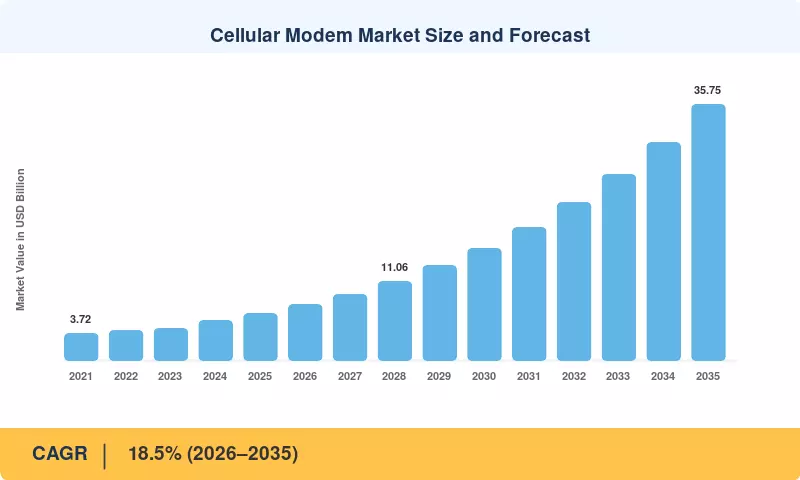
The Cellular Modem Market was valued at USD 6.58 billion in 2025 and is projected to reach USD 7.76 billion in 2026, then climb to USD 35.75 billion by 2035 at a CAGR of 18.5% over 2026–2035. Two catalysts anchor this outlook. The U.S. Broadband Equity, Access, and Deployment (BEAD) program allocates USD 42.45 billion to close connectivity gaps, a portion of which flows into fixed-wireless and cellular endpoints [13]. China had also built out roughly 4.25 million 5G base stations by the end of 2024, creating the densest addressable network for new modem designs anywhere [16].

But under the headline statistics, the installed base is being rebuilt. Legacy 2G and 3G radios are disappearing as operators re-farm airwaves. AT&T and Verizon completed their U.S. 3G shutdowns in 2022, and UK carriers are shutting down 3G in preparation for a 2033 2G cut-off [14][20]. Their alternatives are 4G Cat-1 bis, LTE-M and 3GPP Release 17 RedCap silicon, trading off peak throughput for reduced cost and longer battery life [3]. According to GSMA, operators will invest around USD 1.5 trillion in networks between 2023 and 2030, most of which will be spent on 5G [2].


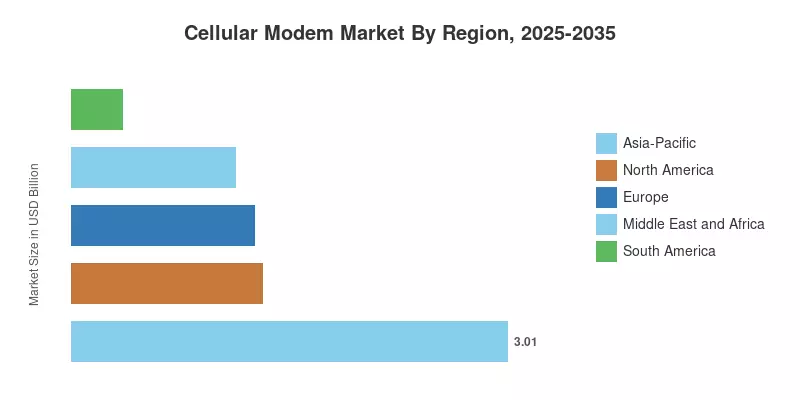
In terms of geography, Asia-Pacific has the highest share at 45.8%, owing to Chinese handset and module manufacture. North America is the second largest and the fastest expanding market with a CAGR of 20.1%, thanks to fixed-wireless access and connected-vehicle programs. The second region is Europe, where entrenched demand is stable with eCall compliance and the Digital Decade 5G coverage targets [12][17]. The next decade will be about rewarding manufacturers who match silicon to use case, rather than pursuing peak speed.


Key Report Takeaways

• By Technology

  • 4G LTE remains the volume workhorse of the Cellular Modem Market, holding a 49.3% share in 2025
  • 5G NR (Sub-6 GHz), including RedCap variants, is the fastest-growing technology at a 19.4% CAGR through 2035
  • 4G Cat-1 bis generated USD 0.41 billion in 2025 as a low-cost replacement for retiring 2G/3G radios

• By Form Factor

  • Integrated SoC with Modem captured a 47.4% share, supported by smartphone and tablet refresh cycles.
  • Embedded Cellular Modules are expanding at a 20.2% CAGR as industrial OEMs outsource RF design and certification.

• By Application

  • Smartphones and Feature Phones accounted for a 59.6% share of the Cellular Modem Market in 2025
  • Automotive and Connected Vehicles is the fastest-growing application at a 20.0% CAGR.
  • CPE / Fixed-Wireless Access generated USD 0.33 billion as operators bundle high-gain home gateways

• By Region

  • Asia-Pacific leads with a 45.8% share, anchored by China's manufacturing base
  • North America is growing fastest at a 20.1% CAGR
  • Europe generated USD 1.26 billion in 2025

Cellular Modem Market Size and Forecast (2021–2035)

Market Research Future (MRFR) estimated the cellular modem market using a bottom-up approach, where blended average selling prices are multiplied by chipset and module shipments by technology and application. Results were cross-checked with supplier filings, operator capex disclosures and device shipment trackers [5][6][7]. Historical numbers are 2021-2024, the base year is 2025, and the projected window is 2026-2035.
Cellular Modem Market Size and Forecast
Our Impact

Enabled $4.3B Revenue Impact for Fortune 500 and Leading Multinationals

Partnering with 2000+ Global Organizations Each Year

30K+ Citations by Top-Tier Firms in the Industry

Driver Impact Analysis

Driver ~% Impact on CAGR Geographic Relevance Impact Timeline
RedCap and Sub-6 GHz 5G adoption in mid-tier devices +3.1% Global Medium-term (2–4 yr)
Connected-vehicle mandates and software-defined vehicles +2.6% Europe, North America, China Long-term (≥4 yr)
Fixed-wireless access rollouts +2.2% North America, India Short-term (≤2 yr)
Massive IoT in utilities and metering +2.0% Asia-Pacific, Europe Medium-term (2–4 yr)
2G/3G network sunsets +1.8% North America, Europe Short-term (≤2 yr)
Public connectivity funding and localization +1.5% North America, India Long-term (≥4 yr)
Non-terrestrial network integration +1.1% Global Long-term (≥4 yr)


RedCap and Sub-6 GHz 5G Adoption in Mid-Tier Devices

3GPP Release 17, frozen in 2022, defined Reduced Capability (RedCap) NR with bandwidths of 20 MHz in sub-6 GHz bands, cutting modem complexity compared to full 5G [3]. The result is 5G-grade latency and network longevity at price points close to 4G. Smartwatch, industrial sensor and mid-tier tablet makers can now adopt 5G without the power budget of flagship silicon. Ericsson projects 5G subscriptions reaching about 6.3 billion by 2030, which gives OEMs confidence to design RedCap into platforms with long service lives [1].

Connected-Vehicle Mandates and Software-Defined Vehicles

EU Regulation 2015/758 has required eCall in all new car and light-van types since March 2018, making an embedded cellular modem a homologation requirement [12]. Software-defined vehicle architectures now push beyond compliance into over-the-air updates, V2X and in-car streaming. The IEA reports that more than 17 million electric cars were sold in 2024, and nearly all ship with telematics units [25]. Qualcomm reported automotive revenue of roughly USD 2.9 billion in fiscal 2024, showing how quickly this content is scaling [5].

Fixed-Wireless Access Rollouts

Operators are using spare 5G capacity to sell home broadband, and each subscription requires a modem-equipped customer premises unit. Ericsson expects fixed-wireless connections to reach around 350 million by 2030 [1]. In the United States, FWA has captured a large share of net broadband additions since 2022. India's operators are rolling out FWA as a faster alternative to fiber in tier-2 cities. Both trends lift demand for high-gain, temperature-hardened modems with carrier aggregation support.

Massive IoT in Utilities and Metering

IoT Analytics estimated about 18.8 billion connected IoT devices worldwide at the end of 2024 [19]. Smart meters, water sensors and asset trackers are migrating from proprietary radios to NB-IoT, LTE-M and Cat-1 bis because operator networks remove the need for private gateways. Chinese utilities have deployed NB-IoT meters at national scale. European water and gas utilities specify ten-year battery life, a requirement only low-power cellular modems can meet reliably in deep-indoor locations.

2G/3G Network Sunsets

Network retirements force a hardware replacement cycle that no marketing campaign could create. U.S. carriers finished 3G shutdowns in 2022, stranding alarm panels, fleet trackers and medical devices that needed new radios [14]. UK operators have committed to switching off 3G and ending 2G by 2033 [20]. Each shutdown converts an installed base of legacy endpoints into replacement demand, typically for Cat-1 bis or LTE-M modules that promise a service horizon beyond 2035.

Public Connectivity Funding and Localization

The USD 42.45 billion BEAD program funds last-mile broadband, and state plans increasingly include fixed-wireless in hard-to-reach areas [13]. India's Production Linked Incentive scheme for telecom and networking products carries an outlay of INR 12,195 crore, encouraging domestic assembly of modules and CPE [15]. Both programs shift demand toward locally assembled hardware. They also create procurement preferences that favor suppliers with regional manufacturing footprints.

Non-Terrestrial Network Integration

3GPP Release 17 introduced non-terrestrial network (NTN) support, and Release 18 extended it under the 5G-Advanced banner [4]. Standard cellular modems can now reach satellites for messaging and low-rate data. This matters for maritime, agriculture and logistics buyers operating outside terrestrial coverage. Smartphone emergency-messaging features have already made satellite links familiar to consumers, and IoT operators are now building hybrid terrestrial-satellite plans that require NTN-capable basebands.

Restraints Impact Analysis

These negative impact estimates are directional and overlap with one another. They should not be subtracted directly from the headline Cellular Modem Market CAGR.

Restraint ~% Impact on CAGR Geographic Relevance Impact Timeline
Lengthening smartphone replacement cycles −1.9% Global Short-term (≤2 yr)
OEM vertical integration of modems −1.6% Global Medium-term (2–4 yr)
Geopolitical restrictions on connected hardware −1.3% North America, Europe Medium-term (2–4 yr)
Module average selling price erosion −1.2% Asia-Pacific Short-term (≤2 yr)
Cybersecurity compliance and certification costs −0.9% Europe Long-term (≥4 yr)


Lengthening Smartphone Replacement Cycles

Smartphones remain the largest revenue pool, so slower upgrades hit chipset volumes directly. Tracking shows replacement cycles in mature markets stretching past three years as incremental camera and processor gains fail to motivate upgrades. The 2023 destocking episode, when chipset growth fell below 8%, showed how quickly handset softness spreads across the supply chain.

OEM Vertical Integration of Modems

Apple introduced its in-house C1 modem in the iPhone 16e in February 2025, beginning a transition away from merchant basebands [9]. Samsung already ships Exynos modems across parts of its Galaxy range [8]. Every in-house design removes tens of millions of units from the merchant pool. That concentrates competition among Qualcomm, MediaTek and UNISOC for the remaining Android volume.

Geopolitical Restrictions on Connected Hardware

In January 2025, the U.S. Bureau of Industry and Security finalized rules barring connected-vehicle hardware linked to China or Russia, effective from model year 2030 [22]. Chinese module suppliers hold leading global shipment positions, so Western OEMs face requalification costs and supply shifts. Similar scrutiny of IoT modules in government procurement adds uncertainty to multi-year sourcing decisions.

Module Average Selling Price Erosion

Chinese module vendors compete aggressively on price, particularly in Cat-1 bis and NB-IoT. Quectel's filings describe intense pricing pressure in low-end categories, which compresses revenue per unit even as shipments grow [7]. Vendors respond by bundling antennas, firmware and cloud services. Dollar-denominated growth nonetheless trails unit growth in commoditized segments.

Cybersecurity Compliance and Certification Costs

The EU Radio Equipment Directive cybersecurity delegated regulation began applying on 1 August 2025, covering internet-connected radio equipment [23]. The Cyber Resilience Act follows, with core obligations from December 2027 [24]. Module makers must add secure boot, vulnerability disclosure and long-term patching. These requirements raise engineering costs and lengthen time-to-market for smaller OEMs.

Cellular Modem Market Opportunities

Each opportunity below links a technology shift or policy gap to addressable revenue across the forecast period.

RedCap Silicon for Wearables and XR Devices

Smartwatches and XR headsets have mostly relied on LTE Cat-1 or tethered phones. RedCap offers a 5G path with markedly lower power draw, giving suppliers a new premium tier in devices that previously carried no standalone cellular link [3]. Vendors that pair RedCap with integrated GNSS and sensor hubs can capture design wins before the category standardizes.

Emerging-Market Migration from 2G to Cat-1 bis

India, Brazil, Egypt and much of Africa still run large 2G feature-phone and IoT bases. Cat-1 bis modules, which need only a single antenna, allow OEMs to hit feature-phone price points on LTE networks. India's PLI scheme adds a local manufacturing incentive for suppliers willing to build domestically [15]. The regional growth profiles in and show where this migration should arrive first.

Connectivity-as-a-Service and Data Monetization

Module vendors are moving from one-time hardware sales to recurring revenue through bundled data plans, device management and eSIM provisioning. The GSMA's IoT eSIM specification lets enterprises switch operator profiles remotely, turning M2M connectivity into a managed subscription [2]. Suppliers that own the device-to-cloud stack can earn software-like margins on commoditized hardware.

Hybrid Terrestrial–Satellite Modems

Release 18 NTN enhancements open maritime, mining and agricultural monitoring to standard modems [4]. Buyers in these sectors pay for coverage certainty rather than throughput. Dual-mode modules can therefore command higher ASPs than terrestrial-only equivalents.

Replacement Demand from Network Sunsets

Europe's remaining 2G/3G shutdowns will strand millions of alarm panels, elevators and telecare devices [20]. Suppliers offering pin-compatible Cat-1 bis or LTE-M drop-in replacements can shorten redesign cycles for installers. Firmware migration toolkits turn a compliance problem into a straightforward procurement decision.

Cellular Modem Market Future Outlook

Four themes will shape how value is created and captured in the Cellular Modem Market over the next decade.

AI-Native Modems and 5G-Advanced

Release 18 formally introduced AI and machine learning into the air interface, covering beam management, positioning and channel-state feedback [4]. Future modems will run on-device inference to optimize power and link quality in real time. That shifts differentiation from raw throughput to software and model quality, and it favors vendors with large field-data sets and dedicated neural processing blocks.

Platform Economics and eSIM

Remote SIM provisioning turns the modem into a platform for recurring services. The GSMA projects continued growth in eSIM-capable devices across consumer and IoT categories [2]. Module suppliers that combine hardware, connectivity management and security updates can lock in multi-year relationships. Buyers gain the ability to switch operators without touching the device.

Vehicle Electrification Supercycle

The IEA expects electric car sales to keep rising after exceeding 17 million units in 2024 [25]. Each EV carries a telematics control unit for battery monitoring, charging coordination and over-the-air updates. As software-defined vehicles consolidate electronics into zonal architectures, a single high-performance modem increasingly serves infotainment, safety and V2X, raising content per vehicle.

Sustainability and Lifecycle Compliance

Energy efficiency now counts as a purchasing criterion alongside price. Operators want lower network energy per bit, and enterprises want devices that last a decade on one battery. The Cyber Resilience Act's patching obligations extend supplier responsibility across the product lifecycle [24]. Vendors that can guarantee long support windows and low-power operation will win long-horizon industrial contracts.

Regional Market Share Analysis

Region Metric (2025) Primary Investment Themes
North America 20.1% (CAGR) Fixed-wireless access, connected vehicles, BEAD funding
South America 5.3% (share) 2G replacement, agritech telemetry
Europe USD 1.26 billion eCall, network sunsets, cybersecurity compliance
Asia-Pacific 45.8% (share) Handset manufacturing, NB-IoT metering, 5G density
Middle East and Africa 17.2% (CAGR) Smart-city programs, 4G expansion
Total USD 6.58 billion —

The Cellular Modem Market shows a clear split between manufacturing-heavy Asia-Pacific and deployment-led North America and Europe.


North America

Country Metric (2025) Key Driver
United States 82.4% (share of region) FWA subscriber growth and automotive telematics
Canada USD 0.17 billion Rural broadband and utility metering
Mexico 21.3% (CAGR) Nearshored automotive and electronics assembly


The United States sets the pace through three overlapping forces: FWA home broadband from national carriers, BEAD-funded rural deployments and connected-vehicle programs at domestic automakers [13]. The 2022 3G shutdowns cleared legacy radios from the installed base, so new designs now default to LTE-M or 5G [14]. Mexico's growth reflects nearshoring, as automotive tier-1 suppliers relocate telematics assembly close to U.S. plants. Canada's demand leans on utility and resource-sector telemetry across sparsely populated territory.

South America

Country Metric (2025) Key Driver
Brazil 58.6% (share of region) Smart metering and 5G spectrum rollout
Argentina 15.9% (CAGR) Agricultural telemetry and fleet tracking
Rest of South America USD 0.07 billion 4G expansion in Chile, Colombia and Peru


Brazil anchors the region after its 2021 5G spectrum auction, which carried coverage obligations that operators are still meeting. Utility smart-meter programs and a large vehicle-tracking market, driven by theft-recovery demand, support steady module shipments. Argentina's agricultural exporters deploy cellular telemetry on machinery and grain silos. Across the rest of the continent, 4G densification is gradually pushing 2G devices toward replacement.

Europe

Country Metric (2025) Key Driver
Germany 27.8% (share of region) Automotive OEM telematics and Industry 4.0
United Kingdom 17.9% (CAGR) 3G switch-off and telecare migration
France USD 0.19 billion Smart-meter and connected-car deployments
Italy 10.4% (share of region) Utility metering and industrial gateways
Spain 17.1% (CAGR) FWA and rural 5G coverage
Rest of Europe USD 0.27 billion Nordic IoT adoption and Eastern European manufacturing


Germany leads because its automakers embed modems in every new vehicle to meet eCall and deliver connected services [12]. The UK is growing quickly as the 3G shutdown forces replacement of telecare and alarm equipment ahead of the 2033 2G deadline [20]. The EU Digital Decade target of 5G in all populated areas by 2030 sustains operator investment across the bloc [17]. Cybersecurity rules under the Radio Equipment Directive raise the entry bar for suppliers [23].

Asia-Pacific

Country Metric (2025) Key Driver
China 51.3% (share of region) Handset manufacturing and NB-IoT metering
Japan USD 0.39 billion Automotive and industrial automation
South Korea 17.6% (CAGR) Early 5G-Advanced adoption and handset OEMs
India 22.8% (CAGR) FWA, PLI-backed manufacturing and 4G feature phones
Rest of Asia-Pacific 13.2% (share of region) Southeast Asian electronics assembly


China dominates both production and consumption, with the world's largest 5G network and national-scale NB-IoT and Cat-1 bis deployments in utilities [16]. Domestic module vendors ship from Chinese factories to global customers. India is the fastest-growing country in the region, driven by operator FWA rollouts and PLI incentives that have pulled module and CPE assembly onshore [15]. Japan and South Korea contribute through automotive electronics and early adoption of new 3GPP releases.

Middle East and Africa

Country Metric (2025) Key Driver
Saudi Arabia (Middle East) 24.5% (share of region) Vision 2030 smart-city and utility projects
United Arab Emirates (Middle East) 19.4% (CAGR) 5G FWA and logistics digitization
Rest of Middle East USD 0.05 billion Oil and gas telemetry
South Africa (Africa) 16.8% (share of region) Fleet tracking and prepaid smart metering
Egypt (Africa) 18.2% (CAGR) 4G expansion and local device assembly
Rest of Africa USD 0.05 billion Mobile-money point-of-sale terminals


Saudi Arabia's Vision 2030 giga-projects specify cellular connectivity for utilities, transport and building management, creating concentrated procurement opportunities. The UAE combines early 5G coverage with a logistics hub economy that relies on asset tracking. In Africa, South Africa's mature fleet-telematics sector and Egypt's expanding 4G footprint drive demand. Across the rest of the continent, point-of-sale terminals for mobile-money merchants form a quiet but durable source of low-cost module volume.

Cellular Modem Market By Region, 2025-2035

Cellular Modem Market Segmentation

By Technology

Segment Metric (2025) Primary Demand Driver
2G/3G 3.1% (share) Residual legacy replacements in emerging markets
4G LTE 49.3% (share) Cost-effective bandwidth for mainstream devices
4G Cat-1 bis USD 0.41 billion Single-antenna 2G/3G replacement
5G NR (Sub-6 GHz) 19.4% (CAGR) RedCap and mid-tier smartphone adoption
5G NR (mmWave) 2.4% (share) Dense venues and premium FWA
NB-IoT / LTE-M 14.8% (CAGR) Utility metering and asset tracking


Within the Cellular Modem Market, 4G LTE retains the largest share because it offers proven, low-cost bandwidth for mainstream handsets and industrial devices. Growth is moderating as operators refarm spectrum for 5G. 5G NR (Sub-6 GHz) is the fastest-growing technology as RedCap variants bring 5G into wearables and sensors. 5G NR (mmWave) stays confined to stadiums and dense urban FWA by propagation limits. NB-IoT / LTE-M holds its place in deep-indoor metering, while 2G/3G shrinks with each network sunset.

By Form Factor

Segment Metric (2025) Primary Demand Driver
Discrete Baseband Chips USD 1.09 billion Custom RF designs and in-house OEM modems
Integrated SoC with Modem 47.4% (share) Smartphone and tablet bill-of-materials savings
Embedded Cellular Modules 20.2% (CAGR) Pre-certified designs for industrial OEMs
Standalone USB/LTE Dongles 4.1% (share) Legacy laptop and temporary connectivity


Across form factors, the Cellular Modem Market favors integration. Integrated SoC with Modem leads because combining the application processor and baseband on one die cuts cost, board space and power. Embedded Cellular Modules grow fastest, since industrial and automotive OEMs without RF teams buy pre-certified modules to save months of carrier approval. Discrete Baseband Chips persist in flagship and custom designs, including Apple's C1 [9]. Standalone USB/LTE Dongles continue to decline as connectivity becomes native to endpoints.

By Application

Segment Metric (2025) Primary Demand Driver
Smartphones and Feature Phones 59.6% (share) Mass-market 5G upgrades
Tablets and PCs USD 0.46 billion Always-connected laptops and hybrid work
Automotive and Connected Vehicles 20.0% (CAGR) eCall, OTA updates and V2X
Industrial Routers and Gateways 5.2% (share) Redundant WAN links for factories
IoT Sensors and Meters 17.9% (CAGR) Utility and logistics digitization
Wearables and XR Devices 2.8% (share) RedCap-enabled standalone connectivity
CPE / Fixed-Wireless Access USD 0.33 billion Operator FWA broadband bundles


By application, the Cellular Modem Market still depends on handsets, with Smartphones and Feature Phones holding the largest share. Lengthening upgrade cycles are pushing suppliers to diversify. Automotive and Connected Vehicles grow fastest as regulatory mandates and software-defined architectures make modems standard in every vehicle [12]. IoT Sensors and Meters benefit from utility digitization. CPE / Fixed-Wireless Access expands with operator broadband bundles, and Wearables and XR Devices open a new niche for low-power RedCap silicon.

Competitive Benchmarking

The market for cellular modems is moderately concentrated. Market Research Future (MRFR) predicts the Herfindahl-Hirschman Index to be at 1,400-1,700, with the top five suppliers holding an estimated 62-70% of sales. The chipset layer is dominated by Qualcomm and MediaTek, while the module layer is fragmented, with Chinese and European specialists vying on price, breadth of certification and software. Apple and Samsung’s vertical integration is changing the composition of the merchant pool. Consolidation is also happening in industrial IoT as demonstrated by Qualcomm’s acquisition of Sequans’ 4G IoT innovation [10].

Company Est. Revenue Share Range Key Offerings for Cellular Modem Market Strategic Positioning
Qualcomm Technologies Inc. ~26–31% Snapdragon X-series modem-RF systems, automotive and IoT platforms Technology leader with deep 3GPP IP portfolio
MediaTek Inc. ~17–22% Dimensity SoCs with integrated 5G, standalone M-series modems Volume leader in mid-tier and value Android
Samsung Electronics Co., Ltd. ~7–10% Exynos modems and integrated SoCs Vertically integrated for Galaxy devices
Apple Inc. ~5–8% C1 in-house modem Captive supply transitioning from merchant silicon
UNISOC ~4–6% Low-cost 4G/5G SoCs and Cat-1 bis chips Price leader in entry handsets and IoT
Quectel Wireless Solutions ~4–6% LTE, 5G, LPWA and automotive modules with antennas Largest module shipper, broad certification catalog
Fibocom Wireless Inc. ~2–4% 5G, FWA and automotive modules Strong in PC and FWA customer designs
Telit Cinterion ~1–3% Industrial LTE-M, NB-IoT and 5G modules Western-sourced alternative for secure IoT
Semtech (Sierra Wireless) ~1–3% AirPrime modules and managed connectivity Hardware-plus-connectivity service model
Nordic Semiconductor ~1–2% nRF91 series LTE-M/NB-IoT system-in-package Ultra-low-power specialist
u-blox ~0.5–1.5% LPWA modules with integrated GNSS Positioning-led industrial niche


Recent News & Developments

  • Semtech (January 2023): Completed its acquisition of Sierra Wireless, combining LoRa and cellular IoT portfolios with managed connectivity services. [21]
  • Qualcomm (February 2023): Introduced Snapdragon X35, the first commercial 5G RedCap modem-RF system, establishing the mid-tier 5G category for wearables and sensors. [5]
  • Nordic Semiconductor (November 2023): Launched the nRF9151 system-in-package, shrinking footprint and power draw for LTE-M/NB-IoT devices. [11]
  • Qualcomm (August 2024): Agreed to acquire Sequans' 4G IoT technology for about USD 200 million, deepening its industrial portfolio while removing a merchant competitor. [10]
  • European Union (November 2024): Published the Cyber Resilience Act, setting lifecycle security obligations for connected products from 2027. [24]
  • U.S. Bureau of Industry and Security (January 2025): Finalized connected-vehicle rules restricting China- and Russia-linked hardware and software, reshaping automotive module sourcing. [22]
  • Apple (February 2025): Shipped the in-house C1 modem in the iPhone 16e, beginning its shift away from merchant basebands. [9]
  • European Commission (August 2025): Radio Equipment Directive cybersecurity requirements took effect for internet-connected radio products sold in the EU. [23]

Cellular Modem Market Report Scope

Parameter Details
Market Scope Global Cellular Modem Market covering chipsets, integrated SoCs, embedded modules and dongles by technology, form factor, application and region
Study Period 2021–2035 (Historical: 2021–2024; Base Year: 2025; Forecast: 2026–2035)
CAGR 18.5% (2026–2035)
Market Size checkpoints USD 6.58 billion (2025); USD 7.76 billion (2026); USD 35.75 billion (2035)
Fastest Growing Segments 5G NR (Sub-6 GHz); Embedded Cellular Modules; Automotive and Connected Vehicles
Companies Profiled Qualcomm, MediaTek, Samsung, Apple, UNISOC, Quectel, Fibocom, Telit Cinterion, Semtech (Sierra Wireless), Nordic Semiconductor, u-blox
Valuation Currency USD billion

FAQs

When should an OEM in the Cellular Modem Market choose a module over a chip-down design?
Modules usually make sense below a few hundred thousand units a year, because carrier and regulatory certification is already done. Chip-down designs cut unit cost at scale but add RF engineering and certification time. [7]
How does eSIM change modem procurement for IoT fleets?
Remote provisioning lets enterprises switch operator profiles over the air instead of swapping SIMs in the field. Buyers can therefore negotiate connectivity separately from hardware and avoid carrier lock-in. [2]
How will satellite connectivity affect the Cellular Modem Market?
Release 17 and 18 NTN features let standard modems reach satellites for messaging and low-rate data. For the Cellular Modem Market, this opens up maritime and remote-asset buyers that terrestrial networks never served. [4]
What lifecycle support should industrial buyers demand from modem suppliers?
Ask for written commitments covering ten or more years of availability and security patches. EU rules now make lifecycle patching a legal obligation, so weak support terms create compliance risk. [24]
Which indicators best reveal supplier strength in the Cellular Modem Market?
Automotive design-win backlogs are a strong signal, since vehicle programs lock in suppliers for five to seven years. Recurring software and connectivity revenue also shows which Cellular Modem Market vendors can defend margins as hardware commoditizes. [5]
Is 4G Cat-1 bis a practical alternative to LTE-M?
Yes, where LTE-M coverage or roaming is patchy. Cat-1 bis runs on standard LTE networks with a single antenna, which gives it broader compatibility, especially in China and emerging markets. [19]
How do connected-vehicle security rules affect module sourcing?
U.S. rules bar China- and Russia-linked vehicle connectivity hardware from model year 2030. Automakers are qualifying alternative suppliers now, since automotive validation cycles take several years. [22]
Author
Author Author Profile Aarti Dhapte LinkedIn AVP - Research
A consulting professional focused on helping businesses navigate complex markets through structured research and strategic insights. I partner with clients to solve high-impact business problems across market entry strategy, competitive intelligence, and opportunity assessment. Over the course of my experience, I have led and contributed to 100+ market research and consulting engagements, delivering insights across multiple industries and geographies, and supporting strategic decisions linked to $500M+ market opportunities. My core expertise lies in building robust market sizing, forecasting, and commercial models (top-down and bottom-up), alongside deep-dive competitive and industry analysis. I have played a key role in shaping go-to-market strategies, investment cases, and growth roadmaps, enabling clients to make confident, data-backed decisions in dynamic markets.
Co-Author Co-Author Profile Aarti Dhapte LinkedIn AVP - Research
A consulting professional focused on helping businesses navigate complex markets through structured research and strategic insights. I partner with clients to solve high-impact business problems across market entry strategy, competitive intelligence, and opportunity assessment. Over the course of my experience, I have led and contributed to 100+ market research and consulting engagements, delivering insights across multiple industries and geographies, and supporting strategic decisions linked to $500M+ market opportunities. My core expertise lies in building robust market sizing, forecasting, and commercial models (top-down and bottom-up), alongside deep-dive competitive and industry analysis. I have played a key role in shaping go-to-market strategies, investment cases, and growth roadmaps, enabling clients to make confident, data-backed decisions in dynamic markets.
Download Free Sample

Kindly complete the form below to receive a free sample of this Report

Download PDF ×

We do not share your information with anyone. However, we may send you emails based on your report interest from time to time. You may contact us at any time to opt-out.