Automotive Charge Air Cooler Market (2026 - 2035)

Automotive Charge Air Cooler Market Research Report By Vehicle Type (Passenger Cars, Light Commercial Vehicles, Medium & Heavy Commercial Vehicles, Off-Road Vehicles), By Product Type (Air-Cooled, Liquid-Cooled), By Engine Type (Diesel, Gasoline, CNG/LPG), By Design (Fin & Tube, Bar & Plate), By Material (Aluminum, Stainless Steel, Other Materials), By Sales Channel (OEM, Aftermarket) and By Regional (North America, Europe, South America, Asia Pacific, Middle East and Africa) - Forecast to 2035
ID: MRFR/AT/9571-HCR 110 Pages Triveni Bhoyar, Sejal Akre Last Updated: October 31, 2026
Automotive Charge Air Cooler Market
Market Size
Forecast Period2026-2035
CAGR (2026-2035)6.6%
2025 Market SizeUSD 4.10 Billion
2035 Market SizeUSD 7.77 billion
Key Players
MAHLE GmbH
Valeo SA
DENSO Corporation
Modine Manufacturing
Hanon Systems
Dana Incorporated
Opportunities
  • Hydrogen-Ready Stainless Architectures
  • Off-Highway Retrofit Economics
  • Emerging-Market Commercial Fleets

Automotive Charge Air Cooler Market Summary

The Automotive Charge Air Cooler Market reached USD 4.10 billion in 2025 and opens the forecast window at USD 4.37 billion in 2026, climbing to USD 7.77 billion by 2035 at a 6.6% CAGR. Two catalysts anchor that trajectory. The EPA's 2027 heavy-duty NOx rule keeps a compliant internal-combustion pathway open in North America, and Euro 7 — adopted in 2024 with phase-in from November 2026 — forces sharper thermal management on every boosted powertrain sold in the bloc [1][3]. Neither rule bans combustion; both make it harder to certify without better intake-air density control. That is precisely what the Automotive Charge Air Cooler Market sells.

Legacy single-pass tube-and-fin units sized for 1.8–2.2 bar boost are giving way to high-density brazed assemblies and liquid-cooled blocks integrated into the intake manifold. Volkswagen Group, Stellantis, and Cummins have collectively committed more than USD 6.8 billion to combustion-engine efficiency programs running through 2030, much of it directed at thermal subsystems rather than combustion chamber redesign [5]. Suppliers now quote a complete thermal module, not a cooler.

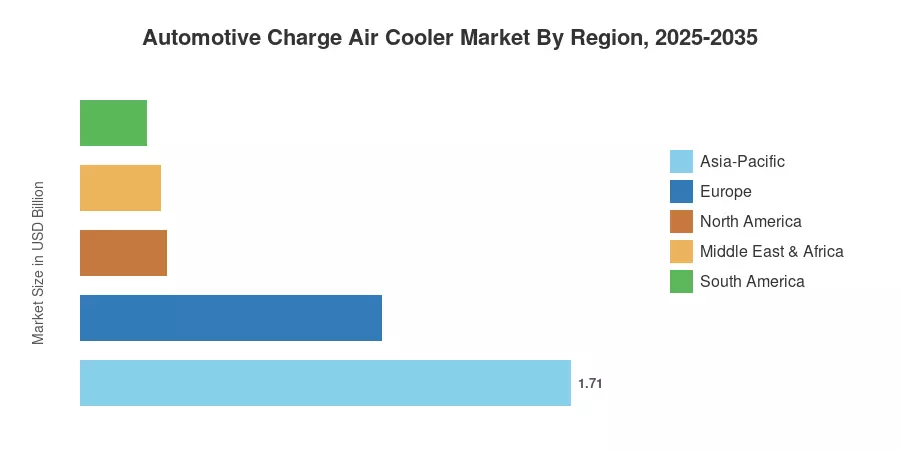
Regionally, Asia-Pacific holds 41.8% of 2025 revenue on the strength of Chinese and Indian commercial-vehicle output. North America grows fastest at a 7.4% CAGR through 2035, while Europe contributes USD 1.05 billion in 2025 under Stage V off-highway enforcement [11]. The next decade rewards suppliers who treat cooling as a platform, not a part.


Key Report Takeaways

• By Product Type

  • Air-cooled units held 77.5% of Automotive Charge Air Cooler Market revenue in 2025, sustained by cost advantage on high-volume passenger platforms
  • Liquid-cooled designs advance at a 7.9% CAGR through 2035 as packaging constraints tighten on downsized engines


• By Design


  • Bar-and-plate cores register an 8.4% CAGR, favoured wherever vibration and pressure-pulsation loads run high

• By Vehicle Type

  • Passenger cars accounted for 49.6% of 2025 revenue across the Automotive Charge Air Cooler Market
  • Off-road vehicles post a 7.8% CAGR, tracking Stage V and Tier 4 Final retrofit cycles


• By Sales Channel


  • Aftermarket channel revenue expands at an 8.8% CAGR as turbocharged fleets cross the eight-year replacement threshold

• By Region

  • Asia-Pacific commands 41.8% share, led by China's commercial-vehicle base
  • North America delivers a 7.4% CAGR, the fastest of any region
  • Europe generated USD 1.05 billion in 2025


Market Size and Forecast (2021–2035)

Figures below blend OEM production schedules from Mobility, customs-level trade data on heat-exchanger HS codes, and bottom-up revenue modelling across 42 profiled suppliers. Historical values are reconciled against audited segment disclosures in supplier annual reports; forecast years apply platform-level attach rates to announced production programs. The Automotive Charge Air Cooler Market is measured at supplier sell-in value, excluding installation labour.
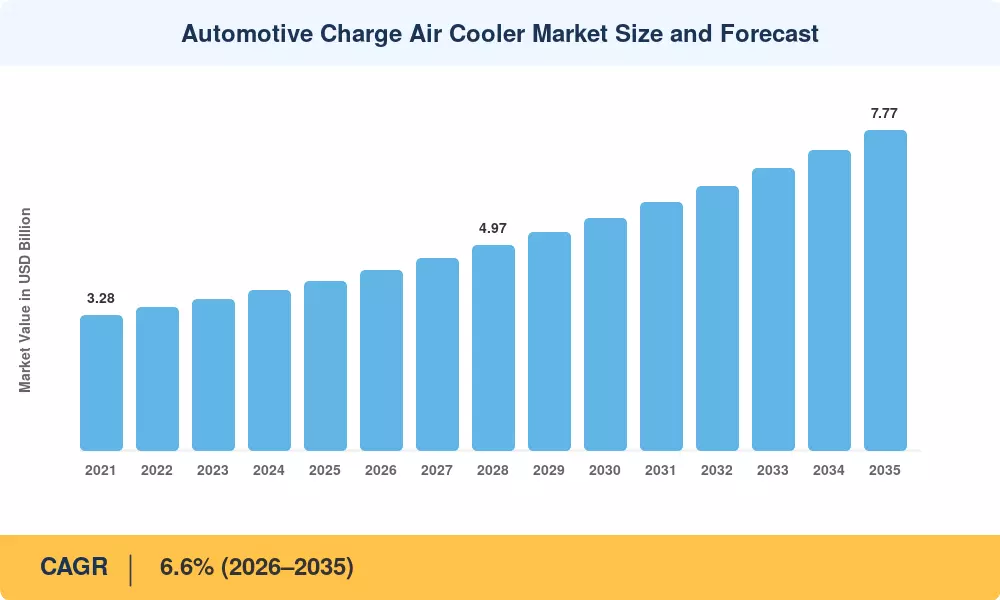
Automotive Charge Air Cooler Market Size and Forecast
Our Impact

Enabled $4.3B Revenue Impact for Fortune 500 and Leading Multinationals

Partnering with 2000+ Global Organizations Each Year

30K+ Citations by Top-Tier Firms in the Industry

Driver Impact Analysis

Driver ~% Impact on CAGR Geographic Relevance Impact Timeline
Turbo-downsizing under Euro 7 and EPA 2027 +1.4 pp Global Medium-term (2–4 yr)
High-output commercial-vehicle ICE demand +1.1 pp Asia-Pacific, North America Long-term (≥4 yr)
Modular thermal-module sourcing by OEMs +0.9 pp Europe, North America Medium-term (2–4 yr)
Aftermarket replacement on ageing turbo fleets +0.8 pp Global Short-term (≤2 yr)
Stage V and Tier 4 Final off-highway compliance +0.7 pp Europe, North America Medium-term (2–4 yr)
Liquid-cooled architecture in premium segments +0.6 pp Europe, Asia-Pacific Long-term (≥4 yr)
Hydrogen combustion pilot programs +0.4 pp Europe, Japan Long-term (≥4 yr)


Emissions Regulation Forces Denser Intake Charge

Crucially, Euro 7 expands compliance to 200,000 km or ten years—double the Euro 6 durability window—and tightens particle restrictions to 10 nm measurement [3]. OEMs are forced to utilize higher-efficiency cores because meeting that requirement over the course of a full useful life necessitates stable intake temperatures during frequent thermal cycling. According to the European Commission's own impact estimate, the cost of compliance per vehicle is EUR 304 for light-duty vehicles and EUR 2,681 for heavy-duty vehicles, with thermal hardware accounting for a significant portion of these costs.


Commercial Vehicles Refuse to Electrify on Schedule

In 2024, the number of medium- and heavy-duty trucks produced worldwide remained above 3.1 million, with less than 2% of these vehicles being battery-electric outside of China [4][2]. Diesel continues to dominate thanks to long-haul duty cycles and payload economics, and all of those engines run more efficiently. A 15°C drop in intake temperature results in around 1.5% fuel savings on a loaded grade; therefore fleet operators using total-cost-of-ownership models are increasingly specifying bigger coolers to maintain fuel economy at high ambient temperatures [9].


OEMs Buy Modules, Not Components

Purchasing organisations at Stellantis and Hyundai have consolidated front-end cooling into single-supplier awards covering radiator, condenser, and charge cooler as one assembly. That shift raises content per vehicle for tier-one suppliers with integration capability while squeezing standalone core manufacturers. Valeo disclosed that thermal-module awards carried 22% higher content per platform than component-level awards across its 2024 order book [17].

The Replacement Wave Arrives

Turbocharged vehicles sold between 2015 and 2018 are now entering the failure window for end-tank cracking and boost leaks. Independent workshop data across Germany and the United States shows charge-cooler replacement volumes rising 11% year over year in 2024 [16]. Distributors report margins on replacement cores running 300–500 basis points above radiator equivalents.


Restraints Impact Analysis


Restraint ~% Impact on CAGR Geographic Relevance Impact Timeline
Global ICE production plateau after 2027 −1.2 pp Global Long-term (≥4 yr)
Battery-electric share gains in passenger cars −0.9 pp Europe, China Medium-term (2–4 yr)
Aluminum price volatility −0.8 pp Global Short-term (≤2 yr)
Tightening durability and leak-rate homologation −0.5 pp Europe Medium-term (2–4 yr)
Price compression from low-cost exporters −0.4 pp Global Short-term (≤2 yr)


Combustion Volumes Flatten, Then Fall

According to the report's stated-policies scenario, sales of ICE light vehicles will peak in 2027 before continuing to drop, with electric models accounting for about 45% of new sales in key countries by 2030 [2]. With a brief lag, passenger-car cooler demand follows that curve. The decline is mitigated by commercial and off-highway volumes, but beyond 2030, vendors that cater primarily to passenger platforms will face a structurally declining addressable base.


Aluminum Refuses to Behave

LME three-month aluminum saw a 29% peak-to-trough volatility in 2024, ranging from USD 2,150 to USD 2,780 per ton [14]. Since 80–90% of brazed cores are made of aluminum by mass, raw materials can account for 38–45% of the cost of a unit. Suppliers are not fully protected by contracts with quarterly indexation; in 2024, contracts with annual fixed pricing absorbed about 240 basis points of margin loss [17].


Homologation Bars Keep Rising

UNECE GTR durability provisions now require leak-rate verification after accelerated thermal-shock cycling, adding an estimated USD 1.8–2.4 million in validation spend per new core family [18]. Smaller manufacturers rationally skip programs rather than fund the testing, consolidating awards toward suppliers with in-house laboratories.


Automotive Charge Air Cooler Market Opportunities

Hydrogen-Ready Stainless Architectures

Hydrogen combustion runs leaner and hotter than diesel, driving peak charge temperatures beyond aluminum's practical service envelope. Stainless-steel cores carry a 7.9% CAGR profile in the material dimension and command 2.5–3x the unit price of aluminum equivalents [12]. Early positioning on JIVE and Clean Hydrogen Partnership demonstrator fleets converts into platform lock-in when volume programs launch after 2030.

Off-Highway Retrofit Economics

Construction and agricultural equipment operators face Stage V enforcement without the option of scrapping USD 400,000 machines. Retrofit cooling packages priced at USD 3,500–6,000 per unit deliver compliance at a fraction of replacement cost [11]. Europe's installed base of pre-Stage V machinery exceeds 2.1 million units.

Emerging-Market Commercial Fleets

India's commercial-vehicle production surpassed 1.06 million units in FY2024, with BS-VI Phase 2 mandating on-board monitoring that penalises thermal drift [19]. Local content requirements under the PLI-Auto scheme reward suppliers who localise brazing capacity rather than import cores. Southeast Asian assembly hubs offer similar arbitrage.

Thermal Data as a Revenue Line

Coolers instrumented with inlet and outlet temperature sensors feed predictive-maintenance platforms that fleet operators already pay for. Suppliers can license degradation-prediction algorithms rather than sell only hardware, converting a one-time component sale into recurring per-vehicle subscription revenue. Pilot programs at two European tier-ones price this at EUR 4–7 per vehicle annually.

Range-Extender Platforms

Range-extended battery vehicles pair a small boosted engine with a traction battery, preserving cooler content on a nominally electrified platform. Chinese OEMs shipped over 1.2 million extended-range units in 2024 [15]. Suppliers who write off combustion entirely will miss this segment.


Automotive Charge Air Cooler Market Future Outlook

Sensorisation and Predictive Thermal Management

By 2030, most heavy-duty coolers will ship with integrated temperature and differential-pressure sensing. Engine control units already arbitrate boost against knock margin; feeding them real cooler-efficiency data rather than modelled estimates recovers 2–3% of thermal headroom. The DOE's SuperTruck 3 program targets 25% freight-efficiency gains, and participants list intake-air thermal control among the enabling subsystems [8].

Platform Consolidation Among Suppliers

Ten distinct core families per supplier will become four. OEM module sourcing rewards scale, and validation costs of USD 1.8–2.4 million per family make niche variants uneconomic [18]. Expect two or three tier-one acquisitions of specialist bar-and-plate manufacturers before 2029.

Electrification Coexistence Rather Than Displacement

Range-extenders, hybrids, and fuel-cell auxiliaries all require air-side cooling. The IEA projects that even under accelerated scenarios, over 900 million combustion vehicles remain on roads in 2035 [2]. Aftermarket revenue therefore outlives OEM revenue by a full decade, and turbo engine charge air cooling retains a service base long after new-build volumes peak.

Material Circularity Reporting

The EU Battery and End-of-Life Vehicles regulatory package extends recycled-content disclosure to aluminum-intensive components from 2027 [3]. Suppliers able to certify 25%+ post-consumer aluminum in an aluminum-brazed CAC core gain a documented procurement advantage with European OEMs already publishing Scope 3 targets.


Regional Market Share Analysis

Region Metric Primary Investment Themes
North America 7.4% CAGR (2026–2035) EPA 2027 compliance, heavy-duty pre-buy, nearshoring
Europe USD 1.05 Billion (2025) Euro 7 phase-in, Stage V retrofit, hydrogen pilots
Asia-Pacific 41.8% share (2025) Commercial-vehicle volume, local brazing capacity
South America 5.7% share (2025) Agricultural equipment, flex-fuel boosted engines
Middle East & Africa 6.9% CAGR (2026–2035) High-ambient derating, mining fleet renewal
Total USD 4.10 Billion (2025) —

Regional performance in the Automotive Charge Air Cooler Market tracks two variables above all others: commercial-vehicle production density and the enforcement rigour of the local emissions regime.


North America

Country Metric Key Driver
US 71.4% of regional revenue EPA 2027 heavy-duty NOx rule
Canada 7.1% CAGR (2026–2035) Resource-sector off-highway fleets
Mexico 16.8% of regional revenue Tier-one manufacturing footprint expansion


North America is the fastest-growing territory in the Automotive Charge Air Cooler Market because the EPA chose a stringency pathway rather than a prohibition. The 2027 rule cuts NOx by roughly 80% against 2010 standards while extending useful-life requirements to 800,000 miles for tractors [1]. Manufacturers respond with larger, more durable cooling hardware. Mexican assembly plants captured USD 1.4 billion in announced automotive thermal-component investment during 2023–2024 as suppliers shortened supply lines [10].

Europe

Country Metric Key Driver
Germany 27.3% of regional revenue Premium diesel and heavy-duty engineering base
UK USD 0.14 Billion (2025) Off-highway and specialist vehicle output
France 12.4% of regional revenue Light commercial vehicle assembly
Italy 6.8% CAGR (2026–2035) Agricultural machinery cluster
Spain 9.2% of regional revenue Export-oriented LCV production
Nordic Countries 7.2% CAGR (2026–2035) Forestry and mining equipment
Russia 7.8% of regional revenue Domestic heavy-truck substitution
Rest of Europe 14.2% of regional revenue Central European tier-two supply base


Europe's demand rests less on new-vehicle growth than on regulatory retrofit. Stage V has applied to all new non-road engines since 2020, but the installed base predates it, and national scrappage incentives in Germany and Italy explicitly fund emissions retrofits [11]. ACEA reports heavy-duty registrations holding near 340,000 units annually across the EU, a stable rather than expanding base [6].

Asia-Pacific

Country Metric Key Driver
China 44.2% of regional revenue Largest commercial-vehicle production base
India 8.1% CAGR (2026–2035) BS-VI Phase 2 and PLI-Auto localisation
Japan 14.8% of regional revenue Hydrogen combustion R&D leadership
South Korea USD 0.14 Billion (2025) Tier-one export manufacturing
ASEAN 11.3% of regional revenue Pickup and LCV assembly hubs
Rest of Asia-Pacific 6.9% CAGR (2026–2035) Mining and agricultural equipment


Asia-Pacific anchors the Automotive Charge Air Cooler Market through sheer volume. China produced 3.87 million commercial vehicles in 2024, and China VI-b enforcement now includes real-driving emissions testing that penalises poor intake-temperature control [15]. India's trajectory is steeper: SIAM data shows commercial-vehicle output rising while BS-VI Phase 2 on-board diagnostics flag thermal faults that previously went unrecorded [19].

South America

Country Metric Key Driver
Brazil 58.4% of regional revenue PROCONVE P8 heavy-duty standard
Argentina 7.0% CAGR (2026–2035) Agricultural machinery replacement
Rest of South America 23.7% of regional revenue Mining fleet operations


Brazil's PROCONVE P8 aligned heavy-duty limits with Euro VI from 2023, immediately raising thermal specification on locally built trucks [13]. Agricultural demand adds a second leg — Argentina's harvester and tractor fleet averages fourteen years, and replacement cycles accelerate whenever grain prices hold above trend.

Middle East & Africa

Country Metric Key Driver
Saudi Arabia 27.6% of regional revenue Giga-project construction equipment
UAE 7.4% CAGR (2026–2035) Logistics fleet expansion
South Africa 22.1% of regional revenue Mining haul truck operations
Egypt USD 0.02 Billion (2025) Domestic assembly incentives
Rest of MEA 19.6% of regional revenue Aftermarket parts distribution


Ambient temperature is the defining variable here. Coolers sized for European conditions derate sharply above 45°C, so Gulf operators specify oversized cores and dual-pass configurations as standard [10]. Saudi construction demand tied to NEOM and Red Sea developments sustains off-highway equipment imports through the decade.


Automotive Charge Air Cooler Market By Region, 2025-2035

Automotive Charge Air Cooler Market Segmentation

By Vehicle Type

Segment Metric Primary Demand Driver
Passenger Cars 49.6% share (2025) Turbo-downsizing across mainstream platforms
Light Commercial Vehicles USD 0.88 Billion (2025) Last-mile delivery fleet growth
Medium & Heavy Commercial Vehicles 20.3% share (2025) Long-haul duty cycles and durability rules
Off-Road Vehicles 7.8% CAGR (2026–2035) Stage V and Tier 4 Final compliance


Passenger cars dominate the Automotive Charge Air Cooler Market on unit volume, though average selling price per unit sits well below commercial equivalents. Off-road is the segment to watch: machines run at sustained high load in dusty, hot environments, so specification runs heavy and replacement intervals run short. Fleet operators in mining report a cooler service life of 4,000–6,000 hours against 12,000 in on-highway applications [9].

By Product Type

Segment Metric Primary Demand Driver
Air-Cooled 77.5% share (2025) Lowest cost per kW of heat rejection
Liquid-Cooled 7.9% CAGR (2026–2035) Packaging density and transient response


Air-cooled units retain the volume position because they need no coolant circuit, pump, or secondary radiator. Liquid-cooled designs win where engine-bay space is scarce and where boost-pressure transients demand faster thermal response — increasingly the case on three-cylinder turbo platforms.

By Engine Type

Segment Metric Primary Demand Driver
Diesel 58.4% share (2025) Commercial and off-highway dominance
Gasoline USD 1.44 Billion (2025) Downsized turbo passenger platforms
CNG/LPG 8.7% CAGR (2026–2035) Municipal fleet fuel-switching mandates


By Design, Material and Sales Channel

Segment Metric Primary Demand Driver
Fin & Tube 69.6% share (2025) Cost efficiency at passenger-car volumes
Bar & Plate 8.4% CAGR (2026–2035) Vibration and pressure-pulsation resistance
Aluminum 89.2% share (2025) Weight, conductivity, brazing maturity
Stainless Steel 8.5% CAGR (2026–2035) Hydrogen ICE thermal envelope
Other Materials 3.4% share (2025) Composite end tanks on light-duty units
OEM 84.7% share (2025) Platform-level sourcing agreements
Aftermarket 8.8% CAGR (2026–2035) Ageing turbocharged vehicle parc


Aluminum's grip on the Automotive Charge Air Cooler Market reflects six decades of brazing process refinement, not inherent superiority at every operating point. Stainless gains only where temperature demands it. On the channel side, aftermarket growth outpaces OEM by more than two percentage points annually — a margin-rich shift that distributors have been slow to resource.


Competitive Benchmarking

Concentration sits in medium territory, with an estimated HHI between 780 and 920 and a top-five combined share near 46%. No single supplier exceeds 13%. Fragmentation persists in the aftermarket and off-highway niches, where regional specialists compete effectively against global tier-ones on lead time and customisation rather than price.

Company Est. Revenue Share Range Key Offerings for Automotive Charge Air Cooler Market Strategic Positioning
MAHLE GmbH ~11–14% Air and liquid-cooled cores, integrated intake modules Broadest thermal-module portfolio; strong Euro 7 alignment
Valeo SA ~9–12% Front-end cooling modules, indirect charge cooling Module-level OEM awards across European platforms
DENSO Corporation ~8–11% Brazed aluminum cores, commercial-vehicle assemblies Japanese OEM lock-in; hydrogen ICE validation work
Modine Manufacturing ~6–9% Bar-and-plate and fin-and-tube, off-highway packages Off-highway and heavy-duty specialist
Hanon Systems ~5–8% Liquid-cooled charge coolers, thermal management Korean OEM base; electrification hedging
Dana Incorporated ~4–6% Heavy-duty and off-highway cooling assemblies Strong Tier 4 Final retrofit channel
T.RAD Co., Ltd. ~3–5% High-durability truck and bus cores Asia-Pacific commercial-vehicle depth
Marelli Holdings ~3–5% Passenger-car intake and cooling systems Platform integration with European OEMs
Nissens Automotive ~2–4% Aftermarket replacement cores Independent aftermarket distribution leader
Garrett Motion ~2–4% Boosting systems with matched cooling hardware Turbo-cooler system pairing advantage
PWR Advanced Cooling ~1–3% High-performance and motorsport cores Premium niche and low-volume programs
Vestas Aircoil A/S ~1–3% Marine and large-engine charge coolers Heavy-engine and stationary applications


Recent News & Developments

Deal flow across the Automotive Charge Air Cooler Market has skewed toward capacity localisation and hydrogen validation rather than outright consolidation.

  • US EPA (March 2023): Finalised the 2027 heavy-duty NOx standard, cutting limits roughly 80% below 2010 levels and extending useful-life requirements — locking in a compliant ICE pathway through the next decade [1]
  • European Council (April 2024): Formally adopted Euro 7, confirming a November 2026 phase-in for light-duty and extended durability testing to 200,000 km [3]
  • MAHLE (September 2023): Opened an expanded thermal-management line in Ramos Arizpe, Mexico, adding brazing capacity aimed at North American heavy-duty programs [10]
  • DENSO (June 2024): Announced hydrogen-combustion cooling validation with a Japanese commercial-vehicle OEM, targeting stainless core durability above 250°C charge temperatures [12]
  • Modine (November 2024): Reported off-highway thermal segment growth outpacing group average, attributing gains to Stage V retrofit demand across European rental fleets [17]
  • Valeo (February 2025): Secured a multi-platform front-end module award covering charge cooling for a European OEM's 2027 light-commercial range [17]
  • Government of India (July 2024): Extended PLI-Auto incentives to thermal-component localisation, favouring domestic brazing investment over imported cores [19]
  • Nissens (May 2025): Expanded remanufactured cooler programme across twelve European markets, targeting bar-and-plate cores from commercial fleets [16]


Automotive Charge Air Cooler Market Report Scope

Report Attribute/Metric Details
Market Scope Global supplier sell-in value of charge air coolers for on-highway and off-highway vehicles, OEM and aftermarket
Study Period 2021-2035
Base Year 2025
Historical Data 2021–2024
Forecast Period 2026–2035
Market Size in 2025 USD 4.10 Billion
Market Size in 2035 USD 7.77 billion
CAGR (2026–2035) 6.6%
Fastest Growing Segments Aftermarket channel (8.8% CAGR); CNG/LPG engines (8.7% CAGR); stainless steel material (8.5% CAGR); bar-and-plate design (8.4% CAGR)
Regions Covered North America, Europe, South America, Asia Pacific, Middle East and Africa and ROW
Companies Profiled MAHLE GmbH, Valeo SA, DENSO Corporation, Modine Manufacturing, Hanon Systems, Dana Incorporated, T.RAD Co., Ltd., Marelli Holdings, Nissens Automotive, Garrett Motion, PWR Advanced Cooling, Vestas Aircoil A/S
Valuation Currency USD Billion
Methodology 350+ primary expert interviews; bottom-up market sizing; top-down validation; data triangulation; scenario-based forecasting; real-time project tracking

FAQs

How should procurement teams evaluate supplier risk in the Automotive Charge Air Cooler Market?
Weight aluminum hedging policy, dual-site brazing capacity, and validated thermal-cycle test data above unit price. Suppliers without in-house core furnaces typically pass raw-material volatility through within one quarter. [Ref 14]
What warranty exposure do fleet operators face from cooler failure?
Boost-leak and cracked end-tank claims dominate heavy-duty warranty files, averaging roughly USD 1,400 per repair event, including downtime. Fleets increasingly demand 500,000-km durability commitments before awarding contracts. [Ref 9]
Which certification hurdles slow entry into the Automotive Charge Air Cooler Market?
New entrants must clear OEM-specific pressure-pulsation, thermal-shock, and salt-spray protocols that typically run 14–18 months. IATF 16949 certification is table stakes, not a differentiator. [Ref 18]
Does hydrogen combustion change cooler design requirements?
Hydrogen ICE runs leaner and hotter, pushing charge temperatures beyond aluminum's comfortable envelope. Stainless and nickel-clad cores are under validation, though tooling costs run three to four times higher. [Ref 12]
How does the Automotive Charge Air Cooler Market intersect with battery-electric platforms?
Range-extender and fuel-cell architectures still need air-side cooling for the auxiliary engine or stack inlet. Suppliers repositioning coolers as modular thermal blocks retain content on electrified platforms. [Ref 21]
What pricing pressure comes from low-cost exporters?
Tier-two Asian manufacturers quote 18–25% below European benchmarks on standard fin-and-tube units. European buyers respond with local-content clauses and shorter logistics lead times rather than matching price. [Ref 20]
Are remanufactured coolers a credible aftermarket proposition?
Remanufacturing works for bar-and-plate cores where end tanks can be separated and rebrazed. Core recovery rates near 60% limit scale, but margins exceed new-unit distribution by several points. [Ref 16]    
Author
Author Author Profile Triveni Bhoyar LinkedIn Senior Research Analyst
Triveni Bhoyar has over 5 years of experience in the market research industry, specializing in the Automotive and Aerospace & Defense sectors. She has contributed to 200+ reports, including numerous custom projects for leading global companies, delivering solutions to complex business challenges. Renowned for her ability to generate valuable insights, Triveni excels in addressing unique market dynamics with precision and depth. Her expertise spans market sizing, competitive intelligence, and trend analysis, enabling clients to craft data-driven growth strategies. With strong analytical rigor and a client-centric approach, she plays a pivotal role in driving impactful, strategic decision-making.
Co-Author Co-Author Profile Sejal Akre LinkedIn Senior Research Analyst
She has over 5 years of rich experience, in market research and consulting providing valuable market insights to client. Hands on expertise in management consulting, and extensive knowledge in domain including ICT, Automotive & Transportation and Aerospace & Defense. She is skilled in Go-to market strategy, industry analysis, market sizing, in depth company profiling, competitive intelligence & benchmarking and value chain amongst others.

Research Approach


Secondary Research

The secondary research process involved comprehensive analysis of regulatory databases, technical SAE standards, automotive engineering publications, and authoritative transportation organizations. Key sources included the U.S. Environmental Protection Agency (EPA), National Highway Traffic Safety Administration (NHTSA), U.S. Department of Transportation (DOT), European Automobile Manufacturers' Association (ACEA), European Association of Automotive Suppliers (CLEPA), Organisation Internationale des Constructeurs d'Automobiles (OICA), Society of Automotive Engineers (SAE International), International Council on Clean Transportation (ICCT), Japan Automobile Manufacturers Association (JAMA), China Association of Automobile Manufacturers (CAAM), International Energy Agency (IEA) Global EV Outlook, EPA fuel economy and emission certification databases, EU Eurostat Transport Statistics, National Center for Biotechnology Information (NCBI/PubMed) for thermal engineering research, and international trade statistics from UN Comtrade. These sources were used to collect vehicle production statistics, turbocharger adoption trends, emission regulation compliance data, material pricing trends, and thermal management technology landscapes for air-cooled systems, liquid-cooled systems, fin & tube designs, and bar & plate configurations.


Primary Research

During the primary research process, both supply-side and demand-side stakeholders were interviewed to gather qualitative and quantitative information. Supply-side sources were CEOs, VPs of Engineering, thermal systems directors, and business development heads from companies that make charge air coolers, heat exchangers, and aluminum extrusions. Thermal management engineers, powertrain directors, procurement heads from global automotive OEMs, and fleet managers from commercial vehicle operators were all demand-side sources. Primary research confirmed that the market is divided into passenger cars and commercial vehicles. It also confirmed the timelines for developing products for gasoline and diesel applications and gathered information on how OEM specifications change, how aluminum prices change, and how aftermarket distribution channels work.

Primary Respondent Breakdown:

By Designation: C-level Primaries (32%), Director Level (31%), Others (37%)

By Region: North America (32%), Europe (30%), Asia-Pacific (33%), Rest of World (5%)


Market Size Estimation

Global market valuation was derived through revenue mapping and vehicle parc analysis. The methodology included:

Identification of 50+ key manufacturers across air-cooled and liquid-cooled charge air cooler technologies in North America, Europe, Asia-Pacific, and Latin America

Product mapping across fin & tube and bar & plate designs, segmentation by aluminum, stainless steel, and copper materials

Analysis of reported and modeled annual revenues specific to thermal management portfolios and charge air cooler business units

Coverage of manufacturers representing 75-80% of global market share in 2024, including MAHLE, Dana, Valeo, Modine, Hanon Systems, and tier-2 regional suppliers

Extrapolation using bottom-up (vehicle production volumes × charge air cooler penetration rate × ASP by country/region) and top-down (manufacturer revenue validation and heat exchanger industry benchmarking) approaches to derive segment-specific valuations for OEM and aftermarket channels

Download Free Sample

Kindly complete the form below to receive a free sample of this Report

Download PDF ×

We do not share your information with anyone. However, we may send you emails based on your report interest from time to time. You may contact us at any time to opt-out.


















