Artificial Intelligence (AI) in Supply Chain Market Summary
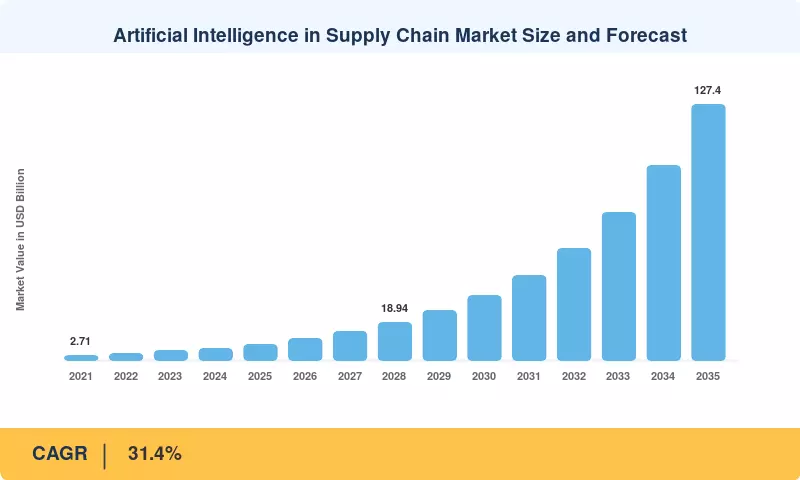
The Artificial Intelligence In Supply Chain Market was valued at USD 8.13 Billion in 2025 and is projected to reach USD 10.91 Billion in 2026, climbing to USD 127.40 Billion by 2035 at a CAGR of 31.4% over 2026–2035. Two catalysts anchor this trajectory. Executive Order 14017 pushed U.S. agencies and their suppliers to map critical supply chains and fund resilience programs [3], while the CHIPS and Science Act committed USD 52.7 billion to domestic semiconductor capacity, creating new multi-tier networks that need algorithmic coordination from day one [4].
Rule-based planning engines, spreadsheet-driven sales and operations planning, and batch MRP runs are being replaced by machine learning forecasting, constraint solvers accelerated on GPUs, and generative copilots that let planners interrogate scenarios in plain language. Capital is following the shift. U.S. private AI investment reached USD 109.1 billion in 2024, and 78% of surveyed organizations reported using AI in at least one business function, up from 55% a year earlier [5].
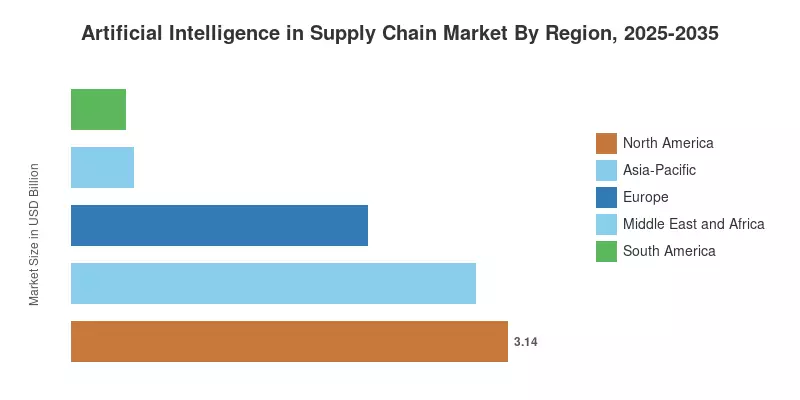
North America holds the leading position with a 38.6% share in 2025, supported by hyperscaler infrastructure and early enterprise adoption. Asia-Pacific is the fastest-growing region of the Artificial Intelligence In Supply Chain Market at a 35.8% CAGR, driven by manufacturing automation in China and national logistics programs in India. Europe ranks second, with demand shaped by due diligence and AI governance rules. Over the next decade, competitive advantage will shift from owning models to owning clean, connected operational data.
Key Report Takeaways
• By Offering
- Software held a 44.2% share of the Artificial Intelligence In Supply Chain Market in 2025, led by integrated planning and execution suites
- Services are expanding at a 20.3% CAGR as enterprises outsource integration, model tuning, and managed operations
• By Technology
- Machine Learning accounted for a 34.8% share in 2025, remaining the default engine for demand prediction and replenishment
- Context-Aware Computing is advancing at a 23.8% CAGR as IoT telemetry feeds real-time decision engines
• By Application
- Warehouse and inventory management captured a 30.1% share in 2025 on the back of fast-payback picking and slotting automation
- Risk and disruption management is growing at a 21.4% CAGR as boards demand quantified resilience
• By End-User Industry
- Retail and E-commerce represented a 25.3% share of the Artificial Intelligence In Supply Chain Market in 2025
- Healthcare and Life Sciences is expanding at an 18.2% CAGR, propelled by cold-chain and traceability requirements
- Manufacturing generated USD 1.52 Billion in 2025 revenue across planning and quality use cases
• By Region
- North America led with a 38.6% share in 2025
- Asia-Pacific is the fastest-growing region at a 35.8% CAGR
- Europe generated USD 2.13 Billion in 2025, the second-largest regional pool
Market Size and Forecast (2021–2035)
Estimates for the Artificial Intelligence In Supply Chain Market combine vendor revenue mapping for more than 40 platform, hardware, and services providers with bottom-up deployment counts across end-user industries, validated through primary interviews with supply chain leaders and integrators. Historical values for 2021–2024 are reconstructed from company filings and contract disclosures, while forecast values apply adoption curves by application and region. Two spike years stand out: 2023, when generative AI pilots moved planning budgets forward, and 2026, when copilots and agentic workflows shift from pilot to production. A second uplift from 2032 reflects autonomous operations scaling into emerging markets.




 Noah Malgeri
Co-Founder

 Peter Groot koerkamp
Account and Business Manager

 Younghwan Choi
Senior Retail Manager

 Mark Irwin
Management Consultant

 Akif Moroglu
Strategy & Business Development Director

 Guilherme Gomes Martins
Product Management Director

 Joseph Aguayo
Sales Operations & Pricing Manager

 La Terria Dodd
Program Support Specialist

 Rob Kooiker
Group Product Manager HVAC & Fire Protection GMA



