Anti Money Laundering Solutions Market Summary
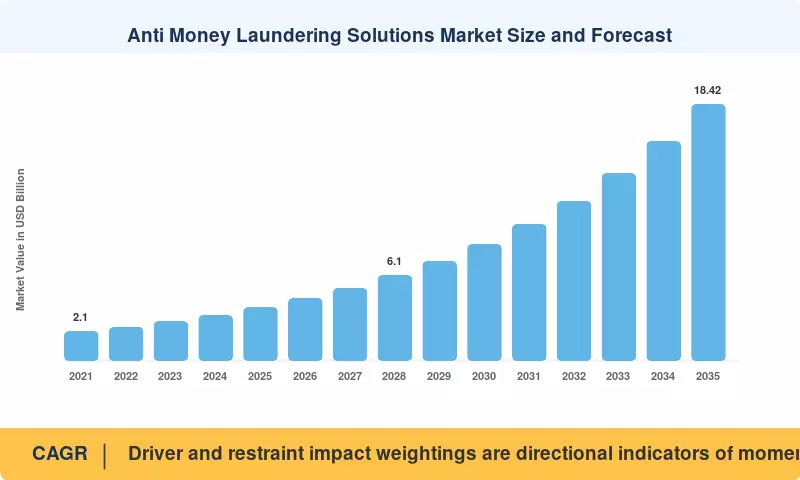
The Anti Money Laundering Solutions Market was valued at $3.80 billion in 2025 and opens the forecast window at $4.45 billion in 2026, reaching $18.42 billion by 2035 at a 17.1% CAGR. Two catalysts anchor that trajectory. The European Union's Anti-Money Laundering Authority became operational in Frankfurt during 2025 with direct supervisory authority over roughly 40 cross-border institutions [1]. In parallel, global enforcement penalties tied to compliance failures exceeded $4.6 billion in 2024, a figure that has pushed remediation spending out of discretionary budgets and into board-mandated programs .
Technology replacement is the second engine. Rules-based screening engines written in the 2000s — batch-scored, scenario-threshold driven, and typically producing 95% or higher false-positive rates — are being displaced by machine-learning risk scoring, entity resolution graphs, and agentic case narration [3]. Tier-1 institutions now allocate between 11% and 14% of total compliance technology budgets to model development alone, according to supervisory benchmarking published by the Bank for International Settlements [4]. The Anti Money Laundering Solutions Market reflects that shift in its mix: software licences still dominate revenue, but configuration, tuning, and managed triage services grow faster.
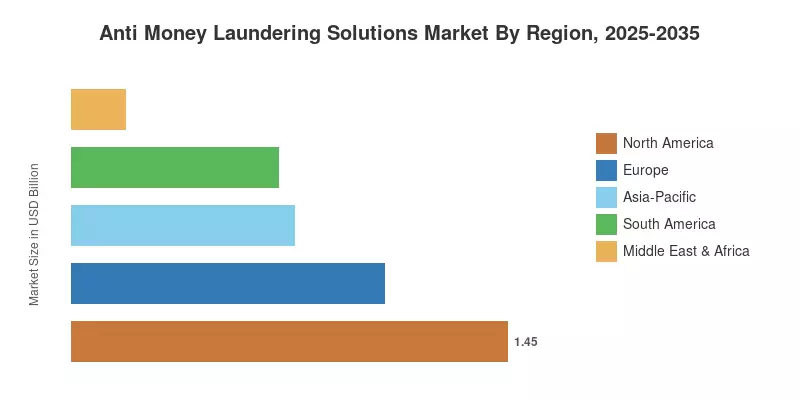
Geographically, North America holds 38.2% of 2025 revenue, sustained by FinCEN's beneficial-ownership reporting regime and sustained OFAC sanctions activity. Asia-Pacific expands at a 19.4% CAGR as Singapore, India, and Japan tighten virtual-asset licensing. Europe ranks second at $1.04 billion, driven by the single rulebook harmonisation program. Through 2035, the Anti Money Laundering Solutions Market will increasingly reward vendors that can prove model explainability to supervisors rather than those that simply detect more.
Key Report Takeaways
• By Solution
- Transaction Monitoring Systems retained 39.5% of 2025 revenue across the Anti Money Laundering Solutions Market, reflecting entrenched scenario libraries at deposit-taking institutions
- Trade Finance Analytics is the fastest-expanding solution line at a 17.6% CAGR, as customs and invoice data feed into payment-flow correlation engines
- Know-Your-Customer and Customer Due Diligence contributed $0.91 billion in 2025, buoyed by perpetual re-verification mandates
• By Component
- Software accounted for 59.1% of 2025 revenue, a legacy of on-premises rules engines amortised over long licence cycles
- Services grow at a 17.5% CAGR as institutions outsource alert triage and suspicious-activity report drafting to specialist providers
• By Deployment Model
- On-Premise deployments held 54.8% share in 2025, concentrated in jurisdictions with strict data-residency rules
- Cloud deployment advances at a 17.2% CAGR, driven by elastic screening capacity for instant-payment rails
• By Organization Size
- Large Enterprises generated 63.8% of 2025 spending, anchored by global systemically important banks
- Small and Medium-Sized Enterprises post an 18.0% CAGR as per-seat SaaS pricing lowers entry barriers
• By End-User Industry
- Banking supplied 50.7% of 2025 revenue within the Anti Money Laundering Solutions Market, underpinned by mature supervisory frameworks
- Cryptocurrency Exchanges and Virtual Asset Service Providers form the fastest-growing customer set at a 17.8% CAGR
- Insurance contributed $0.36 billion in 2025 as life and annuity carriers formalised source-of-funds checks
• By Region
- North America held 38.2% revenue share in 2025
- Asia-Pacific expands at a 19.4% CAGR through 2035
- Europe generated $1.04 billion in 2025 under single-rulebook convergence
Market Size and Forecast (2021–2035)
Figures below blend vendor revenue disclosures, supervisory levy filings, procurement notices from central banks, and interview-based sizing with 42 compliance technology buyers across five regions. Historical years are reconciled against audited segment reporting where vendors disclose financial-crime software separately; forecast years apply a demand model weighted to regulated-entity counts, payment volumes, and enforcement intensity. The Anti Money Laundering Solutions Market is measured at end-user value in $, excluding internal staffing costs.




 Noah Malgeri
Co-Founder

 Peter Groot koerkamp
Account and Business Manager

 Younghwan Choi
Senior Retail Manager

 Mark Irwin
Management Consultant

 Akif Moroglu
Strategy & Business Development Director

 Guilherme Gomes Martins
Product Management Director

 Joseph Aguayo
Sales Operations & Pricing Manager

 La Terria Dodd
Program Support Specialist

 Rob Kooiker
Group Product Manager HVAC & Fire Protection GMA



