Request Free Sample ×

Kindly complete the form below to receive a free sample of this Report

* Please use a valid business email

Leading companies partner with us for data-driven Insights

clients tt-cursor
Hero Background

Amyl Nitrite Market

ID: MRFR/CnM/0244-HCR
145 Pages
Chitranshi Jaiswal
Last Updated: April 06, 2026

Amyl Nitrite Market Outlook - Research Report, by End Users (Heart Patients and General Public), by Applications (Pharmaceutical Industry, Healthcare Industries, Households and Industrial Purpose) and Forecast to 2035

Share:
Download PDF ×

We do not share your information with anyone. However, we may send you emails based on your report interest from time to time. You may contact us at any time to opt-out.

Amyl Nitrite Market Infographic
Purchase Options
⚠ CRITICAL SUPPLY CHAIN & PRICE VOLATILITY ALERT
Middle East Conflict Disrupts Chemical Feedstock Flows & Triggers Price Volatility Across Naphtha, LPG, Natural Gas Derivatives, Steel Feedstocks & Fertilizers — 20% of Global LNG Exports at Risk, Supply Chains Rerouting | Get Real-Time Impact Analysis, Pricing Scenarios & Alternative Sourcing Strategies

Amyl Nitrite Market Summary

As per MRFR analysis, the Amyl Nitrite Market Size was estimated at 10.42 USD Million in 2024. The Amyl Nitrite industry is projected to grow from 10.88 in 2025 to 16.72 by 2035, exhibiting a compound annual growth rate (CAGR) of 4.39% during the forecast period 2025 - 2035.

Key Market Trends & Highlights

The Amyl Nitrite Market is experiencing a dynamic evolution driven by diverse applications and regulatory support.

  • The market is witnessing a growing emphasis on medical applications, particularly in North America, which remains the largest market.
  • In Asia-Pacific, the recreational use of amyl nitrite is rapidly expanding, indicating a shift in consumer preferences.
  • The pharmaceutical segment continues to dominate, while emergency services are emerging as the fastest-growing segment.
  • Key drivers include increasing demand for recreational use and regulatory support for medical applications, which are shaping market dynamics.

Market Size & Forecast

2024 Market Size 10.42 (USD Million)
2035 Market Size 16.72 (USD Million)
CAGR (2025 - 2035) 4.39%

Major Players

Boehringer Ingelheim (DE), Mylan (US), AstraZeneca (GB), Bristol-Myers Squibb (US), Teva Pharmaceuticals (IL), Hikma Pharmaceuticals (GB), Amgen (US), Eli Lilly and Company (US)

Our Impact
Enabled $4.3B Revenue Impact for Fortune 500 and Leading Multinationals
Partnering with 2000+ Global Organizations Each Year
30K+ Citations by Top-Tier Firms in the Industry

Amyl Nitrite Market Trends

The Amyl Nitrite Market is currently experiencing a notable evolution, driven by various factors that influence its demand and supply dynamics. This compound, primarily recognized for its applications in the medical field, particularly in the treatment of angina pectoris, is also gaining traction in recreational use. The increasing awareness regarding its therapeutic benefits, coupled with a growing acceptance in certain social circles, appears to be propelling its market presence. Furthermore, regulatory frameworks surrounding the use of amyl nitrite are evolving, which may impact its availability and distribution channels. As such, stakeholders in the Amyl Nitrite Market must navigate a complex landscape characterized by both opportunities and challenges. In addition to medical applications, the Amyl Nitrite Market is witnessing a diversification of its usage, particularly in the fragrance industry and as a solvent in various chemical processes. This diversification suggests a potential for growth beyond traditional applications, as industries seek innovative solutions to meet consumer demands. Moreover, the increasing focus on product safety and quality assurance is likely to shape the market's future trajectory. As the Amyl Nitrite Market continues to develop, it is essential for industry participants to remain vigilant and adaptable to the changing regulatory and consumer landscapes, ensuring they can capitalize on emerging trends while mitigating risks associated with market fluctuations.

Growing Medical Applications

The Amyl Nitrite Market is seeing an increase in demand due to its recognized medical benefits, particularly in treating cardiovascular conditions. As healthcare professionals continue to explore its therapeutic potential, the market is likely to expand, attracting new players and innovations.

Diversification of Uses

Beyond its medical applications, amyl nitrite is finding new roles in various industries, including fragrances and chemical manufacturing. This diversification indicates a broader acceptance and potential for growth, as different sectors seek to leverage its unique properties.

Regulatory Developments

The evolving regulatory landscape surrounding amyl nitrite is influencing its market dynamics. As governments reassess safety standards and usage guidelines, stakeholders must adapt to these changes, which could either facilitate or hinder market growth.

Amyl Nitrite Market Drivers

Market Growth Projections

The Global Amyl Nitrite Market Industry is projected to experience substantial growth over the coming years. With an estimated market value of 161.1 USD Million in 2024, it is expected to reach 256.5 USD Million by 2035, reflecting a compound annual growth rate of 4.32% from 2025 to 2035. This growth trajectory indicates a robust demand for amyl nitrite across various sectors, including recreational and medical applications. The increasing acceptance of nitrites in different markets may further bolster this trend, suggesting a promising future for the industry.

Innovations in Product Formulations

The Global Amyl Nitrite Market Industry is poised for growth due to innovations in product formulations. Manufacturers are exploring new ways to enhance the efficacy and safety of amyl nitrite, which could attract a broader consumer base. Advances in delivery methods and formulations may lead to improved user experiences, thereby increasing demand. As the market evolves, these innovations could play a crucial role in shaping consumer preferences. The anticipated growth from 161.1 USD Million in 2024 to 256.5 USD Million by 2035 suggests that such innovations may significantly impact market dynamics.

Increasing Demand for Recreational Use

The Global Amyl Nitrite Market Industry experiences a notable surge in demand due to its recreational use, particularly in social settings. This compound is often associated with enhancing sensory experiences, which appeals to certain demographics. As societal acceptance of various recreational substances evolves, the market is likely to witness growth. In 2024, the market is projected to reach 161.1 USD Million, reflecting a growing consumer base. This trend suggests that as more individuals seek out products that enhance social interactions, the demand for amyl nitrite may continue to rise, potentially influencing market dynamics significantly.

Rising Awareness of Health and Wellness

The Global Amyl Nitrite Market Industry is likely to benefit from the increasing awareness surrounding health and wellness. As consumers become more health-conscious, there is a growing interest in products that offer therapeutic benefits. Amyl nitrite, with its potential applications in treating cardiovascular issues, aligns with this trend. The market may see an uptick in demand as individuals seek alternatives that promote well-being. This shift could contribute to the market's growth trajectory, potentially leading to a significant increase in revenue by 2035, as consumers prioritize health-oriented products.

Medical Applications and Therapeutic Use

The Global Amyl Nitrite Market Industry benefits from its established medical applications, particularly in the treatment of angina and other cardiovascular conditions. Amyl nitrite acts as a vasodilator, providing relief to patients experiencing chest pain. The ongoing research into its therapeutic benefits may further solidify its position in the healthcare sector. As healthcare providers increasingly recognize the value of amyl nitrite in clinical settings, the market is expected to expand. This growth could be reflected in the projected increase from 161.1 USD Million in 2024 to 256.5 USD Million by 2035, indicating a robust demand trajectory.

Regulatory Changes and Legalization Trends

The Global Amyl Nitrite Market Industry is influenced by evolving regulatory frameworks surrounding the use of nitrites. As governments reassess their stances on recreational substances, potential legalization could lead to increased market accessibility. Countries that have begun to relax restrictions may see a corresponding rise in demand, as consumers seek legal avenues for obtaining amyl nitrite. This shift in regulatory landscape could catalyze market growth, as evidenced by the projected CAGR of 4.32% from 2025 to 2035. Such changes may not only enhance market visibility but also encourage further research into the compound's applications.

Market Segment Insights

By Application: Medical (Largest) vs. Industrial (Fastest-Growing)

The Amyl Nitrite Market displays a varied distribution among its application segments. The medical sector holds the largest share, driven by its established use in treating angina pectoris and as a vasodilator. The industrial application is gaining momentum as companies increasingly utilize amyl nitrite in manufacturing processes, indicating a shift in focus towards its utility across various sectors. Moreover, as public awareness grows regarding the medical benefits of amyl nitrite, particularly in emergency treatment scenarios, significant investments in medical research continue to drive sales. On the industrial front, advancements in production technology are enhancing the compound's properties, thus fostering application in sectors like manufacturing and chemicals, making it the fastest-growing segment as demand burgeons.

Medical: Treatment (Dominant) vs. Industrial: Manufacturing (Emerging)

The medical application of amyl nitrite is characterized by its essential role in therapies and emergency treatments. This segment's dominance is rooted in its historical usage and the proven therapeutic benefits it provides, particularly for cardiac conditions. Healthcare professionals prescribe it reliably due to its effectiveness and quick onset of action. In contrast, the industrial application, particularly in manufacturing processes, presents an emerging yet rapidly evolving landscape. Companies are exploring amyl nitrite's potential in contributing to innovative chemical processes, enhancing product quality and efficiency. This emerging segment is being driven by the industry's need for more effective materials and methods, highlighting a shift in focus from traditional uses to more progressive, application-driven innovations.

By End Use: Pharmaceuticals (Largest) vs. Emergency Services (Fastest-Growing)

In the Amyl Nitrite Market, the distribution of end-use applications reveals that pharmaceuticals hold the largest share, primarily driven by their usage in treating conditions such as angina pectoris and cyanide poisoning. Chemical manufacturing and laboratories also contribute notably to the market, but their shares are comparatively lower. Personal use, though present, maintains a minimal footprint in the overall market. This segment dynamic illustrates the pivotal role pharmaceuticals play in sustaining demand for amyl nitrite.

Pharmaceuticals (Dominant) vs. Emergency Services (Emerging)

Pharmaceuticals stand out as the dominant segment in the Amyl Nitrite Market due to their extensive applications in healthcare, particularly in prescribing amyl nitrite for its therapeutic benefits. This segment is characterized by rigorous regulatory standards and a consistent demand stemming from healthcare professionals. In contrast, emergency services represent an emerging segment, witnessing rapid growth as the awareness of amyl nitrite's effectiveness in acute medical situations gains traction. The drive for faster response times in emergency protocols is propelling the demand for amyl nitrite in these contexts, presenting a significant opportunity for growth.

By Formulation Type: Liquid (Largest) vs. Gas (Fastest-Growing)

In the Amyl Nitrite Market, the formulation types exhibit distinct market shares influenced by various factors. Liquid formulations hold the largest share due to their established use in medical applications and recreational contexts, offering a consistent delivery method. Meanwhile, gas formulations are gaining traction due to their ease of use and portability, which cater to changing consumer preferences and trends.

Liquid (Dominant) vs. Gas (Emerging)

Liquid formulations remain the dominant choice in the Amyl Nitrite Market, characterized by their stability and effectiveness in delivering therapeutic benefits. They are widely recognized for their reliability in both clinical and personal use, providing a fluid administration method favored by users. In contrast, gas formulations are emerging rapidly, appealing to a younger demographic seeking convenience and immediacy in consumption. Their compact nature and readiness for use in various settings are significant drivers of their growth. This duality in market preference underscores the dynamic nature of consumer demands within the formulation segment.

By Distribution Channel: Online (Largest) vs. Offline (Fastest-Growing)

In the Amyl Nitrite Market, the distribution channel landscape is primarily dominated by online sales, which have gained significant traction due to the increasing shift towards digital platforms and e-commerce. This segment holds the largest market share as consumers prefer the convenience and privacy that online purchasing offers. In contrast, offline channels such as retail and wholesale are still relevant, but their share is gradually declining as online options expand and evolve. The growth trends in the distribution channels reveal that while online sales continue to thrive, offline platforms are not far behind, particularly with the resurgence of physical retail experiences. Direct sales and wholesale channels are witnessing moderate growth as they adapt to changing consumer preferences, yet online remains the preferred route as technology and digital marketing strategies enhance customer engagement.

Online (Dominant) vs. Offline (Emerging)

The emergence of Online distribution channels represents a significant shift in the Amyl Nitrite Market, marking it as a dominant force in terms of consumer preference and market outreach. The convenience, broader reach, and seamless shopping experience offered by online platforms contribute to its robust position in the market. Meanwhile, Offline channels, including retail and wholesale, are adapting to the fast-changing landscape, seeking to enhance the in-store experience and leverage a more personalized approach to cater to their growing consumer base. The dynamic between these channels illustrates a blend of traditional and modern marketing methods that are essential for meeting consumer needs, with online sales drawing the largest segment while offline channels emerge to retain significant traction in the market.

Get more detailed insights about Amyl Nitrite Market

Regional Insights

North America : Market Leader in Amyl Nitrite

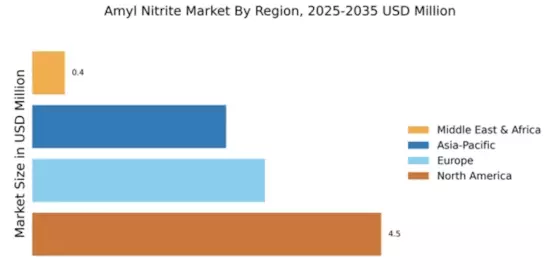
North America is poised to maintain its leadership in the Amyl Nitrite market, holding a significant market share of 4.5 in 2025. The region's growth is driven by increasing healthcare expenditure, rising awareness of the therapeutic benefits of Amyl Nitrite, and supportive regulatory frameworks. The demand for this product is further fueled by its applications in treating angina and other cardiovascular conditions, making it a critical component of modern medical treatments. The competitive landscape in North America is robust, featuring key players such as Boehringer Ingelheim, Mylan, and AstraZeneca. The U.S. stands out as the leading country, supported by advanced healthcare infrastructure and a strong focus on pharmaceutical innovation. The presence of major pharmaceutical companies enhances market dynamics, ensuring a steady supply of Amyl Nitrite and fostering competitive pricing strategies.

Europe : Emerging Market Dynamics

Europe's Amyl Nitrite market is projected to grow, with a market size of 3.0 in 2025. The region benefits from stringent regulatory standards that ensure product safety and efficacy, driving demand for high-quality pharmaceutical products. Additionally, the increasing prevalence of cardiovascular diseases and the aging population are significant growth drivers. Regulatory bodies are actively promoting research and development in this sector, which is expected to further enhance market potential. Leading countries in Europe include Germany, the UK, and France, where the presence of established pharmaceutical companies like AstraZeneca and Hikma Pharmaceuticals strengthens the market. The competitive landscape is characterized by innovation and strategic partnerships, enabling companies to expand their product offerings and improve market penetration. The European market is thus positioned for substantial growth in the coming years.

Asia-Pacific : Emerging Powerhouse in Pharmaceuticals

The Asia-Pacific region is witnessing a burgeoning Amyl Nitrite market, with a projected size of 2.5 in 2025. This growth is driven by increasing healthcare investments, rising awareness of cardiovascular health, and expanding access to medical treatments. Regulatory bodies in countries like India and China are enhancing their frameworks to support pharmaceutical innovation, which is expected to catalyze market expansion. The demand for Amyl Nitrite is also rising due to its therapeutic applications in various medical conditions. Key players in the Asia-Pacific market include local and international companies, with significant contributions from India and China. The competitive landscape is evolving, with firms focusing on research and development to introduce new formulations and improve existing products. The region's diverse healthcare needs and growing population present ample opportunities for market players to capitalize on, making it a focal point for future growth.

Middle East and Africa : Untapped Market Potential

The Middle East and Africa region represents an untapped market for Amyl Nitrite, with a market size of 0.42 in 2025. The growth in this region is primarily driven by increasing healthcare investments and a rising prevalence of cardiovascular diseases. Governments are focusing on improving healthcare infrastructure and access to essential medications, which is expected to boost demand for Amyl Nitrite. Regulatory initiatives aimed at enhancing pharmaceutical standards are also contributing to market growth. Leading countries in this region include South Africa and the UAE, where there is a growing presence of both local and international pharmaceutical companies. The competitive landscape is gradually evolving, with firms exploring partnerships and collaborations to enhance their market reach. As healthcare systems improve, the Amyl Nitrite market is likely to see significant growth opportunities in the coming years.

Amyl Nitrite Market Regional Image

Key Players and Competitive Insights

The Amyl Nitrite Market is currently characterized by a competitive landscape that is both dynamic and multifaceted. Key growth drivers include increasing demand for therapeutic applications, particularly in the treatment of angina and other cardiovascular conditions, alongside a rising trend in recreational use. Major players such as Boehringer Ingelheim (DE), Mylan (US), and AstraZeneca (GB) are strategically positioned to leverage their extensive research and development capabilities. Boehringer Ingelheim (DE) focuses on innovation in drug formulations, while Mylan (US) emphasizes cost-effective production methods. AstraZeneca (GB) is actively pursuing partnerships to enhance its market reach, thereby collectively shaping a competitive environment that is increasingly reliant on innovation and strategic collaborations.In terms of business tactics, companies are localizing manufacturing to reduce costs and optimize supply chains, which is particularly relevant in the context of fluctuating global trade dynamics. The market structure appears moderately fragmented, with a mix of established players and emerging companies vying for market share. The collective influence of these key players is significant, as they not only drive technological advancements but also set industry standards that smaller firms often follow.
In November Boehringer Ingelheim (DE) announced a strategic partnership with a leading biotechnology firm to develop a novel formulation of amyl nitrite aimed at enhancing bioavailability. This collaboration is expected to bolster Boehringer's product portfolio and strengthen its position in the therapeutic segment, reflecting a broader trend towards innovation in drug delivery systems. The strategic importance of this move lies in its potential to capture a larger share of the market by addressing specific patient needs more effectively.
In October Mylan (US) launched a new generic version of amyl nitrite, which is anticipated to significantly lower treatment costs for patients. This initiative not only enhances Mylan's competitive edge but also aligns with the growing demand for affordable healthcare solutions. The introduction of this product is likely to disrupt pricing strategies within the market, compelling other players to reassess their pricing models in order to remain competitive.
In September AstraZeneca (GB) expanded its distribution network in Asia, focusing on increasing access to amyl nitrite in emerging markets. This strategic move is indicative of AstraZeneca's commitment to global health and its recognition of the untapped potential in these regions. By enhancing its distribution capabilities, AstraZeneca is positioning itself to capitalize on the growing demand for cardiovascular treatments in Asia, which could lead to substantial revenue growth.
As of December current competitive trends are increasingly defined by digitalization, sustainability, and the integration of artificial intelligence in drug development processes. Strategic alliances are becoming more prevalent, as companies recognize the value of collaborative innovation. The competitive differentiation is likely to evolve from traditional price-based competition towards a focus on technological advancements, product innovation, and supply chain reliability. This shift suggests that companies that prioritize these areas will be better positioned to thrive in the Amyl Nitrite Market.

Key Companies in the Amyl Nitrite Market include

Future Outlook

Amyl Nitrite Market Future Outlook

The Amyl Nitrite Market is projected to grow at a 4.39% CAGR from 2025 to 2035, driven by increasing demand in medical applications and recreational use.

New opportunities lie in:

  • Expansion into emerging markets with tailored marketing strategies. Development of innovative delivery systems for enhanced user experience. Partnerships with healthcare providers for integrated treatment solutions.

By 2035, the Amyl Nitrite Market is expected to achieve robust growth and increased market penetration.

Market Segmentation

Amyl Nitrite Market End Use Outlook

  • Pharmaceuticals
  • Chemical Manufacturing
  • Laboratories
  • Emergency Services
  • Personal Use

Amyl Nitrite Market Application Outlook

  • Medical
  • Industrial
  • Recreational
  • Research
  • Chemical

Amyl Nitrite Market Formulation Type Outlook

  • Liquid
  • Gas
  • Aerosol
  • Solid
  • Powder

Amyl Nitrite Market Distribution Channel Outlook

  • Online
  • Pharmacy
  • Retail
  • Direct Sales
  • Wholesale

Report Scope

MARKET SIZE 2024 10.42(USD Million)
MARKET SIZE 2025 10.88(USD Million)
MARKET SIZE 2035 16.72(USD Million)
COMPOUND ANNUAL GROWTH RATE (CAGR) 4.39% (2025 - 2035)
REPORT COVERAGE Revenue Forecast, Competitive Landscape, Growth Factors, and Trends
BASE YEAR 2024
Market Forecast Period 2025 - 2035
Historical Data 2019 - 2024
Market Forecast Units USD Million
Key Companies Profiled Boehringer Ingelheim (DE), Mylan (US), AstraZeneca (GB), Bristol-Myers Squibb (US), Teva Pharmaceuticals (IL), Hikma Pharmaceuticals (GB), Amgen (US), Eli Lilly and Company (US)
Segments Covered Application, End Use, Formulation Type, Distribution Channel
Key Market Opportunities Growing demand for Amyl Nitrite in recreational and therapeutic applications presents significant market opportunities.
Key Market Dynamics Rising demand for Amyl Nitrite in recreational use drives regulatory scrutiny and market consolidation efforts.
Countries Covered North America, Europe, APAC, South America, MEA

Market Highlights

Author
Author
Author Profile
Chitranshi Jaiswal LinkedIn
Team Lead - Research
Chitranshi is a Team Leader in the Chemicals & Materials (CnM) and Energy & Power (EnP) domains, with 6+ years of experience in market research. She leads and mentors teams to deliver cross-domain projects that equip clients with actionable insights and growth strategies. She is skilled in market estimation, forecasting, competitive benchmarking, and both primary & secondary research, enabling her to turn complex data into decision-ready insights. An engineer and MBA professional, she combines technical expertise with strategic acumen to solve dynamic market challenges. Chitranshi has successfully managed projects that support market entry, investment planning, and competitive positioning, while building strong client relationships. Certified in Advanced Excel & Power BI she leverages data-driven approaches to ensure accuracy, clarity, and impactful outcomes.
Leave a Comment

FAQs

What is the projected market valuation of the Amyl Nitrite Market by 2035?

The Amyl Nitrite Market is projected to reach a valuation of 16.72 USD Million by 2035.

What was the overall market valuation of the Amyl Nitrite Market in 2024?

In 2024, the overall market valuation of the Amyl Nitrite Market was 10.42 USD Million.

What is the expected CAGR for the Amyl Nitrite Market during the forecast period 2025 - 2035?

The expected CAGR for the Amyl Nitrite Market during the forecast period 2025 - 2035 is 4.39%.

Which companies are considered key players in the Amyl Nitrite Market?

Key players in the Amyl Nitrite Market include Boehringer Ingelheim, Mylan, AstraZeneca, Bristol-Myers Squibb, Teva Pharmaceuticals, Hikma Pharmaceuticals, Amgen, and Eli Lilly and Company.

What are the projected valuations for the Medical segment of the Amyl Nitrite Market by 2035?

The Medical segment is projected to grow from 2.5 USD Million to 4.0 USD Million by 2035.

How does the Chemical Manufacturing end-use segment perform in the Amyl Nitrite Market?

The Chemical Manufacturing end-use segment is expected to increase from 3.0 USD Million to 4.5 USD Million by 2035.

What is the anticipated growth for the Liquid formulation type in the Amyl Nitrite Market?

The Liquid formulation type is projected to rise from 3.12 USD Million to 4.92 USD Million by 2035.

What distribution channel is expected to show significant growth in the Amyl Nitrite Market?

The Wholesale distribution channel is anticipated to grow from 2.63 USD Million to 4.05 USD Million by 2035.

What is the expected performance of the Recreational application segment by 2035?

The Recreational application segment is likely to increase from 3.0 USD Million to 4.5 USD Million by 2035.

How does the Personal Use end-use segment project to change by 2035?

The Personal Use end-use segment is expected to grow from 1.42 USD Million to 2.72 USD Million by 2035.
Download Free Sample

Kindly complete the form below to receive a free sample of this Report

Compare Licence

×
Features License Type
Single User Multiuser License Enterprise User
Price $4,950 $5,950 $7,250
Maximum User Access Limit 1 User Upto 10 Users Unrestricted Access Throughout the Organization
Free Customization
Direct Access to Analyst
Deliverable Format
Platform Access
Discount on Next Purchase 10% 15% 15%
Printable Versions