Ambulatory EHR Market

Ambulatory EHR Market Research Report: Size, Share, Trend Analysis By Deployment Model (Cloud-Based, On-Premises), By End-User (Hospitals, Clinics, Physicians Groups), By Functionalities (Scheduling and Appointments, Electronic Health Records, Billing and Revenue Management, Electronic Prescribing, Patient Engagement), By Size of Facility (Small Practices, Medium-Sized Facilities, Large Hospitals), By Specialty Focus (Primary Care, Cardiology, Orthopedics, Pediatrics, Behavioral Health) and By Regional (North America, Europe, South America, Asia Pacific, Middle East and Africa) - Growth Outlook & Industry Forecast 2025 To 2035
ID: MRFR/HS/7404-HCR 128 Pages Satyendra Maurya, Rahul Gotadki Last Updated: September 30, 2026
Ambulatory EHR Market
Market Size
Forecast Period2025 - 2035
CAGR (2025 - 2035)8.78%
2024 Market Size$ 20.65 Billion
2025 Market Size$ 22.46 Billion
2035 Market Size$ 52.12 Billion
Key Players
Companies such as Epic Systems Corporation
Cerner Corporation
Allscripts Healthcare Solutions
Athenahealth
Inc.
NextGen Healthcare
Opportunities
  • Market Growth Projections
  • Focus on Patient-Centric Care
  • Regulatory Support and Incentives

Ambulatory EHR Market Summary

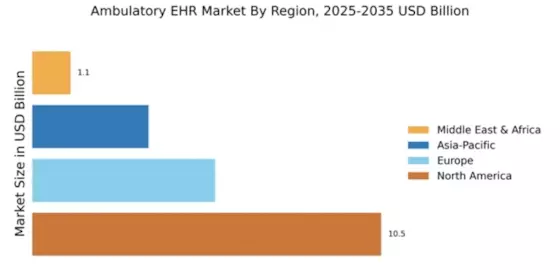
According to Market Reasearch Future analysis, the Ambulatory EHR Market size was valued at USD 20.65 Billion in 2024. The market is projected to grow from USD 22.46 Billion in 2025 to USD 52.12 Billion by 2035, exhibiting a CAGR of 8.78% during the forecast period 2025-2035. North America led the market with over 50.85% share, generating around USD 10.5 billion in revenue.
 
The primary growth driver of the market is the increasing adoption of digital healthcare solutions to enhance efficiency, streamline workflows, and improve patient outcomes. Rising regulatory requirements and demand for accurate data management further accelerate EHR implementation globally.
 
According to WHO, over 60% of countries have implemented national digital health strategies, while CDC reports nearly 88% of office-based physicians in the U.S. use EHR systems, highlighting strong global momentum toward digital record adoption and healthcare data optimization.

Key Market Trends & Highlights

The market is experiencing a transformative shift towards enhanced interoperability and patient-centric solutions.

  • North America dominates with over 50.85% revenue share in 2024, driven by high digital healthcare adoption.
  • Europe shows strong expansion, reaching approximately USD 5.5 billion market size in 2024 with increasing EHR investments.
  • The market is expected to grow at a steady CAGR of 8.78% from 2025 to 2035.
  • Cloud-based deployment leads with over 58% share in 2024 due to scalability, flexibility, and cost-effective healthcare IT solutions.

Market Size & Forecast

2024 Market Size 20.65 (USD Billion)
2035 Market Size 52.12 (USD Billion)
CAGR (2025 - 2035) 8.78%

Major Players

Companies such as Epic Systems Corporation (US), Cerner Corporation (US), Allscripts Healthcare Solutions (US), Athenahealth, Inc. (US), NextGen Healthcare, Inc. (US), eClinicalWorks LLC (US), Greenway Health, LLC (US), Meditech (US), Kareo, Inc. (US) are some of the major participants in the global market.

Ambulatory EHR Market Drivers

Market Growth Projections

The Global market is on a growth trajectory, with projections indicating a substantial increase in market size.
 
In 2024, the market is expected to reach 20.6 USD Billion, and by 2035, it is projected to expand to 52.1 USD Billion. This remarkable growth reflects the increasing adoption of electronic health records across various healthcare settings, driven by factors such as regulatory support, technological advancements, and the rising demand for patient-centric care.
 
The anticipated compound annual growth rate of 8.78% from 2025 to 2035 further underscores the potential for continued expansion in the market. This upward trend suggests a robust future for the industry as it adapts to the evolving needs of healthcare providers and patients alike.

Focus on Patient-Centric Care

The Industry is increasingly aligning with the trend towards patient-centric care, which emphasizes the importance of patient engagement and satisfaction.
 
Healthcare providers are recognizing that incorporating EHR systems can significantly enhance the patient experience by offering features such as online appointment scheduling, access to medical records, and personalized health information.
 
This shift towards a more patient-focused approach is likely to drive the adoption of ambulatory EHR systems, as providers seek to improve patient outcomes and foster stronger relationships with their patients. As this trend continues, the market is set to expand, reflecting the growing emphasis on patient-centered healthcare delivery.

Regulatory Support and Incentives

Regulatory frameworks and government incentives play a pivotal role in the expansion of the market.
 
 Governments worldwide are implementing policies that encourage the adoption of electronic health records, thereby enhancing interoperability and data security. For instance, initiatives aimed at promoting the use of EHRs in outpatient settings are becoming increasingly prevalent.
 
These regulations not only facilitate compliance but also provide financial incentives for healthcare providers to transition to digital systems. As a result, the market is expected to witness a robust growth trajectory, with projections indicating a rise to 52.1 USD Billion by 2035, reflecting the positive impact of regulatory support on EHR adoption.

Technological Advancements in EHR Systems

Technological advancements are a key driver of growth in the market. Innovations such as artificial intelligence, machine learning, and data analytics are transforming the capabilities of EHR systems, enabling healthcare providers to leverage data for improved decision-making and operational efficiency.
 
These advancements not only enhance the functionality of EHR systems but also contribute to better patient care by providing actionable insights. As the industry evolves, the integration of advanced technologies is expected to attract more healthcare organizations to adopt ambulatory EHR solutions, thereby fueling market growth. The anticipated compound annual growth rate of 8.78% from 2025 to 2035 underscores the potential of these technological innovations.

Increasing Demand for Digital Health Solutions

The Ambulatory EHR Industry is experiencing a surge in demand for digital health solutions, driven by the need for efficient patient management and streamlined workflows. As healthcare providers increasingly adopt technology to enhance patient care, the market is projected to reach 20.6 USD Billion in 2024.
 
This shift towards digitalization is not only improving patient outcomes but also reducing operational costs for healthcare facilities. The integration of EHR systems allows for better data sharing and communication among providers, which is essential in a rapidly evolving healthcare landscape. Consequently, the industry is poised for substantial growth as more organizations recognize the benefits of adopting ambulatory EHR systems.

Rising Need for Cost-Effective Healthcare Solutions

The market is witnessing a growing demand for cost-effective healthcare solutions, as providers seek to optimize their operations while maintaining high-quality care. The implementation of ambulatory EHR systems can lead to significant cost savings by reducing paperwork, minimizing errors, and streamlining administrative processes.
 
As healthcare costs continue to rise, organizations are increasingly turning to EHR systems as a means to enhance efficiency and reduce expenditures. This trend is likely to drive the market forward, as more providers recognize the financial benefits associated with adopting electronic health records. The industry's growth trajectory appears promising, with projections indicating a substantial increase in market size over the coming years.

Market Segment Insights

By Application:

Clinical Documentation emerged as the largest segment, owing to its essential role in documenting patient encounters, maintaining comprehensive health records, and enhancing overall clinical workflows. It holds a significant 62% share of the Ambulatory EHR Market compared to its counterparts, showcasing its critical importance in ambulatory settings. Patient Management, on the other hand, is the fastest-growing segment, reflecting the increasing need for efficient patient scheduling, engagement, and follow-up processes as healthcare providers aim to improve patient experiences and outcomes. The growth trends in the market are driven by several factors including the rising demand for improved healthcare delivery, increased regulatory compliance, and an emphasis on value-based care models. Additionally, advancements in technology, such as mobile health applications and telehealth solutions, are enhancing patient management capabilities, thereby contributing to its rapid expansion. The integration of these solutions in ambulatory care settings is expected to further bolster both patient management and clinical documentation functionalities, setting the stage for continuous innovation in the sector.

By End User:

The distribution of the market shows that Physicians hold the largest share at 66% among end users, driven by their essential role in patient care and treatment decision-making. Following them, Nurses represent the fastest-growing segment, driven by the increasing recognition of their vital contributions to healthcare delivery, particularly in ambulatory settings. The scales are tilting as more healthcare facilities recognize the importance of integrating EHR systems that cater to the diverse roles within the medical team.

By Deployment Model:

The market is segmented into three primary deployment models: On-Premise, Cloud-Based, and Hybrid. Currently, the Cloud-Based model dominates the market, accounting for 58% of the market share, due to its widespread adoption among healthcare providers seeking to streamline operations and improve accessibility. On-Premise solutions, while traditionally favored for their control and customization, are gradually losing ground to the flexibility and scalability offered by Cloud-Based systems. The Hybrid model, which combines both on-premise and cloud capabilities, is emerging as a viable alternative for organizations wanting the best of both worlds.

By Size of Practice:

The market is segmented by the distribution of practices categorized by size. Currently, small practices hold the largest share of the market, accounting for 61% of the market share, driven by their increasing need for streamlined operations and patient management solutions. They account for a significant proportion of ambulatory care settings, as these physicians seek efficient technologies to improve patient outcomes and enhance their workflow. In contrast, large practices are emerging as the fastest-growing segment within this market. The rapid adoption of sophisticated EHR systems among larger groups is fueled by the increasing demand for integrated health solutions and data analytics capabilities. As these practices look to improve their overall efficiency and patient care, the trend towards investing in advanced EHR technology is expected to accelerate significantly over the coming years.

By Regulatory Compliance:

In the Ambulatory EHR Market, HIPAA Compliance emerges as the largest segment, reflecting its critical role in ensuring patient data privacy and security. This segment captures a substantial 54% of the market share, as healthcare providers prioritize the protection of health information against unauthorized access. Following closely, the Meaningful Use Standards segment is rapidly gaining traction, as more providers focus on meeting federal guidelines to qualify for incentive programs, thus expanding its influence in the market.

Get more detailed insights about Ambulatory EHR Market

Regional Insights

North America : Market Leader in EHR Solutions

North America leads in the Ambulatory EHR Market Size, accounting for over 50.85% of the global revenue in 2024.The growth is driven by increasing demand for digital health solutions, regulatory support for EHR adoption, and a focus on improving patient care. The region's robust healthcare infrastructure and technological advancements further fuel this growth, making it a hub for innovation in healthcare technology.

The competitive landscape is dominated by key players such as Epic Systems Corporation, Cerner Corporation, and Allscripts Healthcare Solutions. These ambulatory ehr vendors are continuously innovating to enhance their offerings, ensuring compliance with regulations while meeting the evolving needs of healthcare providers. The presence of these major players solidifies North America's position as a leader in the market.

Europe : Growing Adoption of EHR Systems

Europe's market is witnessing substantial growth, with a market size of 5.5 in 2024. The increasing emphasis on digital transformation in healthcare, coupled with supportive government initiatives, is driving the adoption of EHR systems across the region. Regulatory frameworks are evolving to encourage interoperability and data sharing, which are crucial for enhancing patient care and operational efficiency.

Leading countries such as Germany, the UK, and France are at the forefront of this transformation, with a competitive landscape featuring key players like Cerner and Allscripts. The European market is characterized by a mix of established companies and innovative startups, all striving to meet the diverse needs of healthcare providers. As the region continues to invest in healthcare technology, the demand for advanced EHR solutions is expected to rise significantly.

Asia-Pacific : Rapid Growth in Healthcare Technology

The Asia-Pacific market is experiencing rapid growth, with a market size of 3.5 in 2024. Factors such as increasing healthcare expenditure, a growing aging population, and rising awareness of digital health solutions are driving this trend. Governments in the region are also implementing policies to promote the adoption of EHR systems, enhancing the overall healthcare landscape.

Countries like China, India, and Japan are leading the charge in EHR adoption, supported by a mix of local and international players. The competitive landscape is characterized by a blend of established ambulatory ehr vendors and innovative startups, all vying to capture market share. As healthcare providers focus on improving patient care and operational efficiency, the demand for EHR solutions is expected to rise significantly.

Middle East and Africa : Emerging Market with Potential

The Middle East and Africa market, with a size of 1.15 in 2024, presents unique growth opportunities despite facing challenges. The region is witnessing an increase in healthcare investments and a push towards digital transformation. Governments are recognizing the importance of ambulatory ehr systems in enhancing healthcare delivery, which is driving demand for these solutions. Countries like South Africa and the UAE are at the forefront of EHR adoption, supported by both local and international players.

The competitive landscape is evolving, with a mix of established companies and new entrants. As healthcare providers strive to improve patient outcomes and operational efficiency, the demand for EHR solutions is expected to grow, albeit at a slower pace compared to other regions.

Ambulatory EHR Market Regional Image

Key Players and Competitive Insights

The Ambulatory EHR Market is characterized by a dynamic competitive landscape, driven by technological advancements, regulatory changes, and an increasing demand for efficient healthcare delivery. Major players such as Epic Systems Corporation (US), Cerner Corporation (US), and Athenahealth, Inc. (US) are at the forefront, each adopting distinct strategies to enhance their market positioning. Epic Systems Corporation (US) focuses on innovation through continuous software updates and user-friendly interfaces, while Cerner Corporation (US) emphasizes partnerships with healthcare providers to expand its reach and improve service delivery. Athenahealth, Inc. (US) is leveraging cloud-based solutions to enhance accessibility and streamline operations, collectively shaping a competitive environment that prioritizes technological integration and user experience.

 
The market structure appears moderately fragmented, with numerous players vying for market share. Key business tactics include localizing services to meet regional needs and optimizing supply chains to enhance efficiency. The collective influence of these major players fosters a competitive atmosphere where innovation and customer-centric solutions are paramount. As companies strive to differentiate themselves, the focus on tailored services and operational excellence becomes increasingly evident.


In November 2025, Epic Systems Corporation (US) announced a strategic partnership with a leading telehealth provider to integrate virtual care capabilities into its EHR platform. This move is likely to enhance patient engagement and expand service offerings, positioning Epic as a leader in the evolving landscape of digital health. The integration of telehealth services aligns with current trends towards remote patient monitoring and virtual consultations, potentially increasing Epic's market share. In October 2025, Cerner Corporation (US) launched a new analytics tool designed to improve clinical decision-making by providing real-time data insights.

 
This initiative underscores Cerner's commitment to leveraging data analytics to enhance patient outcomes and operational efficiency. By equipping healthcare providers with actionable insights, Cerner may strengthen its competitive edge in a market increasingly driven by data-informed strategies. In September 2025, Athenahealth, Inc. (US) expanded its cloud-based EHR solutions to include advanced AI capabilities for predictive analytics. This strategic enhancement is indicative of a broader trend towards AI integration in healthcare, which could significantly improve patient care and operational workflows. By adopting AI technologies, Athenahealth positions itself as a forward-thinking player, likely attracting a tech-savvy clientele seeking innovative solutions.


As of December 2025, the market is witnessing trends such as digitalization, sustainability, and AI integration, which are reshaping competitive dynamics. Strategic alliances among key players are fostering innovation and enhancing service delivery. The shift from price-based competition to a focus on technological advancement and supply chain reliability is becoming increasingly pronounced. Moving forward, competitive differentiation will likely hinge on the ability to innovate and adapt to the rapidly changing healthcare landscape.

Key Companies in the Ambulatory EHR Market include

Recent Industry Developments

September 2026, athenahealth announced new AI-native capabilities in athenaOne, designed to help healthcare organizations succeed in value-based care. One feature, Clinically Inferred Diagnosis Gaps, is now in beta. It uses AI to analyze chart data and surface undocumented diagnoses that may warrant review. The company also launched Sage for Analytics, which uses athenaOne's AI assistant to analyze population data, track performance and flag opportunities for improvement. It shows a leading ambulatory vendor building value-based-care analytics directly into the EHR workflow rather than as an add-on. (Source: finance.yahoo.com)

September 2026, Oracle announced the Oracle Health Oncology EHR at its Health and Life Sciences Summit. It builds on the capabilities of Oracle's AI-powered ambulatory EHR and is purpose-built for cancer care. Planned features include unified cancer-care timelines, nurse-navigator worklists and chemotherapy regimen planning. It shows Oracle extending its new ambulatory EHR into specialty workflows. One trade outlet notes the announcement names no customers or launch date, so treat it as planned rather than shipping. (Source: prnewswire.com)

August 2026, Epic outlined an AI strategy called Ergo, built on EHR, MyChart and Cosmos data. Ergo Visit is now live at Ochsner Health, using Art for pre-visit chart summaries and Emmie to interact with patients through MyChart. Epic also showed Agent Factory, a no-code platform for health systems to build their own AI agents, expected to be widely available in 2027. It also showed Curiosity, a generative model trained on Cosmos data to predict outcomes such as readmission and stroke risk. It matters because Epic is moving from standalone AI features to an integrated outpatient-visit workflow. Note that this is trade press coverage rather than an Epic press release. (Source: digitalhealthnews.com)

Future Outlook

Ambulatory EHR Market Future Outlook

The Ambulatory EHR Market size is projected to reach USD 52.12 Billion by 2035, growing at a CAGR of 8.78%

New opportunities lie in:

  • Integration of AI-driven analytics for patient management Expansion of telehealth capabilities within EHR systems Development of customizable EHR solutions for specialty practices

By 2035, the market is expected to be robust, reflecting substantial growth and innovation.

Market Segmentation

Ambulatory EHR Market End User Outlook

  • Physician Practices
  • Ambulatory Surgery Centers
  • Specialty Clinics
  • Urgent Care Centers

Ambulatory EHR Market Technology Outlook

  • Artificial Intelligence
  • Interoperability Solutions
  • Mobile Health Applications
  • Telehealth Integration

Ambulatory EHR Market Functionality Outlook

  • Clinical Documentation
  • Patient Management
  • Billing and Revenue Cycle Management
  • Reporting and Analytics

Ambulatory EHR Market Deployment Model Outlook

  • On-Premise
  • Cloud-Based
  • Hybrid

Ambulatory EHR Market Regulatory Compliance Outlook

  • HIPAA Compliance
  • Meaningful Use Standards
  • Quality Payment Program

Report Scope

MARKET SIZE 2024 20.65(USD Billion)
MARKET SIZE 2025 22.46(USD Billion)
MARKET SIZE 2035 52.12(USD Billion)
COMPOUND ANNUAL GROWTH RATE (CAGR) 8.78% (2025 - 2035)
REPORT COVERAGE Revenue Forecast, Competitive Landscape, Growth Factors, and Trends
BASE YEAR 2024
Market Forecast Period 2025 - 2035
Historical Data 2019 - 2024
Market Forecast Units USD Billion
Key Companies Profiled Epic Systems Corporation (US), Cerner Corporation (US), Allscripts Healthcare Solutions (US), Athenahealth, Inc. (US), NextGen Healthcare, Inc. (US), eClinicalWorks LLC (US), Greenway Health, LLC (US), Meditech (US), Kareo, Inc. (US)
Segments Covered Deployment Model, End User, Functionality, Technology, Regulatory Compliance
Key Market Opportunities Integration of artificial intelligence enhances clinical decision-making in the market.
Key Market Dynamics Rising demand for interoperability drives innovation and competition in the Ambulatory Electronic Health Record market.
Countries Covered North America, Europe, APAC, South America, MEA

Frequently Asked Questions

What is the current valuation of the Ambulatory EHR Market as of 2024?
The market was valued at 20.65 USD Billion in 2024.
What is the projected market size for the market by 2035?
The market is projected to reach 52.12 USD Billion by 2035.
What is the expected CAGR for the Ambulatory EHR Market during the forecast period 2025 - 2035?
The expected CAGR for the market during 2025 - 2035 is 8.78%.
Which companies are considered key players in the market?
Key players include Epic Systems Corporation, Cerner Corporation, Allscripts Healthcare Solutions, and Athenahealth, among others.
How does the market perform in terms of application segments?
By application, Clinical Documentation and Patient Management segments are projected to grow from 4.5 to 11.5 USD Billion and 5.0 to 12.5 USD Billion, respectively.
What are the projected valuations for the Ambulatory EHR Market by end user?

The market is expected to grow from 8.25 to 20.5 USD Billion for Physicians and from 4.1 to 10.25 USD Billion for Nurses.

What deployment models are available in the market?
The market includes On-Premise, Cloud-Based, and Hybrid models, with Cloud-Based expected to grow from 8.5 to 24.0 USD Billion.
How does the size of practice affect the market?
The market for Large Practices is projected to grow from 8.26 to 20.1 USD Billion, indicating a strong demand in this segment.
What is the growth potential for the Population Health Management segment?

The Population Health Management segment is expected to grow from 4.0 to 10.0 USD Billion, reflecting its increasing importance.

What trends are influencing the Ambulatory EHR Market in 2025?

Trends such as increased data analytics and patient management capabilities are likely to drive market growth in 2025.

Author
Author Author Profile Satyendra Maurya LinkedIn Research Analyst
An accomplished research analyst with high proficiency in market forecasting, data visualization, competitive benchmarking, and others. He holds a pronounced track record in research and consulting projects for sectors such as life sciences, medical devices, and healthcare IT. His capabilities in qualitative and quantitative analysis have resulted in positive client outcomes. Working on niche market trends, opportunities, sales, and forecasted value is part of his skill set.
Co-Author Co-Author Profile Rahul Gotadki LinkedIn Research Manager
He holds an experience of about 9+ years in Market Research and Business Consulting, working under the spectrum of Life Sciences and Healthcare domains. Rahul conceptualizes and implements a scalable business strategy and provides strategic leadership to the clients. His expertise lies in market estimation, competitive intelligence, pipeline analysis, customer assessment, etc.

Research Approach


Secondary Research

The secondary research process involved comprehensive analysis of regulatory databases, healthcare IT publications, government health statistics, and authoritative health informatics organizations. Key sources included the US Department of Health and Human Services (HHS), Office of the National Coordinator for Health Information Technology (ONC), Centers for Medicare & Medicaid Services (CMS), Healthcare Information and Management Systems Society (HIMSS), American Medical Association (AMA), American Academy of Family Physicians (AAFP), Healthcare Financial Management Association (HFMA), National Institutes of Health (NIH), National Center for Health Statistics (NCHS), World Health Organization (WHO) Digital Health Repository, European Commission Health and Digital Executive Agency (HaDEA), OECD Health Statistics, and national health IT authority reports from key markets.

EHR adoption statistics, interoperability standards, healthcare spending trends, regulatory compliance data (HIPAA, Meaningful Use, 21st Century Cures Act), and market landscape analysis for cloud-based, on-premises, and hybrid deployment models across physician practices, ambulatory surgery centers, and hospital outpatient departments were gathered from these sources.


Primary Research

In order to gather both qualitative and quantitative insights, supply-side and demand-side stakeholders were interviewed during the primary research process. CEOs, CTOs, VPs of Product Development, heads of regulatory affairs, and commercial directors from EHR software providers, healthcare IT service providers, and medical device integration firms were examples of supply-side sources. Chief medical information officers (CMIOs), practice administrators, revenue cycle management directors, and procurement leads from independent physician practices, multispecialty groups, ambulatory surgery centers, and clinics connected to hospitals were examples of demand-side sources. Primary research verified product roadmap timelines for AI integration and telehealth capabilities, validated market segmentation across deployment models (cloud-based, on-premises, hybrid), and collected data on clinical workflow adoption patterns, subscription pricing models, interoperability issues, and value-based care reimbursement dynamics.

Primary Respondent Breakdown:

By Designation: C-level Primaries (32%), Director Level (31%), Others (37%)

By Region: North America (32%), Europe (30%), Asia-Pacific (28%), Rest of World (10%)


Market Size Estimation

Revenue mapping and installation base analysis were used to determine the global market valuation. The methodology comprised:

Finding more than fifty major EHR suppliers and healthcare IT service providers across North America, Europe, Asia-Pacific, Latin America, and the Middle East and Africa

Product mapping across on-premises licensed software, cloud-based SaaS, and hybrid deployment topologies

Clinical documentation, practice management, revenue cycle management, e-prescribing, patient interaction portals, and analytics/reporting modules are all functionally divided.

Analysis of annual recurring revenues (ARR) for ambulatory EHR portfolios, both reported and modeled

coverage of suppliers accounting for 75–80% of the world market in 2024

Extrapolation of segment-specific valuations across end-users (physician practices, ambulatory surgery centers, hospital outpatient departments), facility sizes (small practices, medium-sized facilities, large groups), and specialty focuses (primary care, cardiology, orthopedics, pediatrics, behavioral health) using top-down (vendor revenue validation) and bottom-up (facility count × penetration rate × ASP by country/segment) techniques

Download Free Sample

Kindly complete the form below to receive a free sample of this Report

Download PDF ×

We do not share your information with anyone. However, we may send you emails based on your report interest from time to time. You may contact us at any time to opt-out.