플라즈마 절단기 시장 요약
주요 시장 동향 및 하이라이트
시장 규모 및 예측
| CAGR (2025 - 2035) | 4.01% |
| CAGR (2025 - 2035) | 4.01% |
The Plasma Cutting Machine Market is currently experiencing a notable transformation, driven by advancements in technology and increasing demand across various industries. The integration of automation and digitalization into plasma cutting processes appears to enhance efficiency and precision, thereby attracting a broader range of applications. Industries such as manufacturing, automotive, and construction are increasingly adopting these machines due to their ability to deliver high-quality cuts with minimal waste. Furthermore, the growing emphasis on sustainability and energy efficiency is likely to influence the development of more eco-friendly plasma cutting solutions, which may appeal to environmentally conscious consumers and businesses alike. In addition, the competitive landscape of the Plasma Cutting Machine Market is evolving, with numerous manufacturers striving to innovate and differentiate their offerings. This trend suggests a potential increase in collaboration between companies and research institutions to foster innovation. As the market continues to expand, it is essential for stakeholders to remain vigilant regarding emerging technologies and shifting consumer preferences. The future of the Plasma Cutting Machine Market seems promising, with opportunities for growth and diversification as industries seek to optimize their operations and enhance productivity.
Recent innovations in plasma cutting technology are reshaping the market landscape. Enhanced automation and smart features are being integrated into machines, allowing for improved precision and efficiency. This trend indicates a shift towards more sophisticated equipment that can adapt to various cutting requirements.
There is a growing emphasis on environmentally friendly practices within the Plasma Cutting Machine Market. Manufacturers are increasingly developing machines that consume less energy and produce less waste. This focus on sustainability may attract businesses looking to reduce their carbon footprint.
The Plasma Cutting Machine Market is witnessing diversification in applications across different sectors. Industries such as aerospace, shipbuilding, and metal fabrication are exploring the benefits of plasma cutting technology. This trend suggests a broadening of the market's reach and potential customer base.
The Plasma Cutting Machine Market is significantly influenced by the growth in construction activities across various regions. As urbanization accelerates, the demand for infrastructure development, including residential, commercial, and industrial projects, increases. This surge in construction activities necessitates efficient metal cutting solutions, which plasma cutting machines provide. According to industry reports, the construction sector is projected to grow at a CAGR of around 5% over the next few years, further fueling the demand for plasma cutting machines. These machines are essential for fabricating structural components, reinforcing bars, and other metal elements used in construction. Consequently, the Plasma Cutting Machine Market stands to gain from the ongoing expansion of construction projects, as companies seek reliable and efficient cutting technologies to support their operations.
The Plasma Cutting Machine Market experiences a notable surge in demand, primarily driven by the expanding manufacturing sector. As industries increasingly adopt automation and advanced manufacturing techniques, the need for precise cutting solutions becomes paramount. In recent years, the manufacturing sector has shown a compound annual growth rate (CAGR) of approximately 4.5%, indicating a robust growth trajectory. This growth is likely to propel the demand for plasma cutting machines, which offer efficiency and accuracy in metal fabrication processes. Furthermore, the integration of Industry 4.0 technologies enhances the appeal of plasma cutting machines, as manufacturers seek to optimize production lines and reduce operational costs. Consequently, the Plasma Cutting Machine Market is poised to benefit from this upward trend in manufacturing, as companies invest in modern equipment to remain competitive.
In the Plasma Cutting Machine Market, the industry application segment is characterized by significant contributions from various sectors, with manufacturing holding the largest share. This segment harnesses plasma cutting technology for various applications, from sheet metal processing to component fabrication. The metal fabrication sector closely follows, highlighting its critical role in processing operations across multiple industries. Other notable contributors include construction and shipbuilding, both leveraging plasma cutting machines for precision and efficiency in their operations.
In the Plasma Cutting Machine Market, manufacturing stands out as the dominant segment, leveraging advanced plasma cutting technology to enhance productivity and precision in metal processing. This sector encompasses a wide range of activities, including the production of machinery, consumer goods, and industrial components. Meanwhile, the automotive segment is emerging as a significant player, fueled by the growing demand for high-precision cutting in vehicle manufacturing and customization. The trend towards electric vehicles and lightweight materials necessitates the adoption of advanced cutting techniques, positioning the automotive industry for robust growth in the coming years.
CNC Plasma Cutting technology plays a crucial role in the Plasma Cutting Machine Market, being the dominant segment due to its ability to deliver high precision and repeatability in cutting operations. With its integration into automated systems and enhanced software controls, CNC technology allows for significant improvements in productivity and efficiency. In contrast, Traditional Plasma Cutting, while still relevant for specific applications, is seen as an emerging technology that often lacks the same level of precision and efficiency as its CNC counterpart. This segment is characterized by manual operation and simplicity, which may appeal to smaller workshops or industries with less stringent quality requirements. However, as automation takes precedence in production environments, Traditional Plasma Cutting faces challenges in maintaining market relevance against the backdrop of rapid technological advancements.
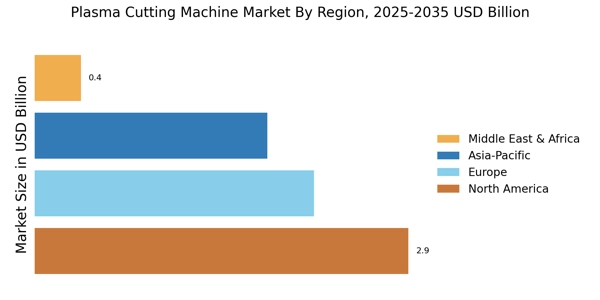
North America is the largest market for plasma cutting machines, holding approximately 40% of the global market share. The growth is driven by advancements in manufacturing technologies, increased automation, and a rising demand for precision cutting in various industries. Regulatory support for manufacturing and safety standards further catalyzes market expansion, making it a key player in the global landscape. The United States dominates this region, with significant contributions from Canada and Mexico. Key players like Hypertherm, Miller Electric, and Lincoln Electric are headquartered here, fostering a competitive environment. The presence of advanced manufacturing facilities and a skilled workforce enhances the region's capability to innovate and meet the growing demand for plasma cutting solutions. The competitive landscape is characterized by continuous technological advancements and strategic partnerships among leading companies.
Europe is the second-largest market for plasma cutting machines, accounting for around 30% of the global market share. The region benefits from a robust manufacturing sector, particularly in automotive and aerospace industries, which drives demand for high-precision cutting technologies. Regulatory frameworks promoting energy efficiency and sustainability are also significant growth catalysts, encouraging investments in advanced cutting solutions. Germany, France, and Italy are the leading countries in this market, with Germany being the largest contributor. The competitive landscape features key players like ESAB and Kjellberg Finsterwalde, which are known for their innovative technologies. The presence of established manufacturing hubs and a focus on R&D further enhance the region's market position. The European market is characterized by a strong emphasis on quality and compliance with stringent regulations, ensuring high standards in plasma cutting technologies.
Asia-Pacific is witnessing rapid growth in the plasma cutting machine market, holding approximately 25% of the global market share. The region's expansion is fueled by increasing industrialization, urbanization, and a growing demand for automation in manufacturing processes. Countries like China and India are leading this growth, supported by government initiatives aimed at enhancing manufacturing capabilities and infrastructure development. China is the largest market in this region, followed by India and Japan. The competitive landscape is marked by the presence of both local and international players, including Mitsubishi Electric and Linde. The region's focus on cost-effective manufacturing solutions and technological advancements positions it as a significant player in The Plasma Cutting Machine Market. The increasing adoption of advanced cutting technologies across various industries further drives market growth in Asia-Pacific.
The Middle East and Africa region is gradually emerging in the plasma cutting machine market, holding about 5% of the global market share. The growth is primarily driven by industrialization efforts, particularly in the oil and gas sector, and increasing investments in infrastructure development. Government initiatives aimed at diversifying economies and enhancing manufacturing capabilities are also contributing to market growth in this region. Countries like South Africa and the UAE are leading the market, with a growing presence of international players. The competitive landscape is evolving, with local manufacturers beginning to emerge alongside established companies. The region's focus on adopting advanced technologies and improving operational efficiencies is expected to drive further growth in the plasma cutting machine market, making it a potential hub for future investments.





플라즈마 절단기 시장은 2025년부터 2035년까지 4.01%의 CAGR로 성장할 것으로 예상되며, 기술 발전, 자동화 증가 및 제조 부문에서의 수요 증가에 의해 추진됩니다.
새로운 기회는 다음에 있습니다:
2035년까지 플라즈마 절단기 시장은 강력한 성장과 향상된 시장 존재감을 달성할 것으로 예상됩니다.
| Parameter | Detail |
| Market Scope | Global Plasma Cutting Machine Market — equipment, consumables and integrated cutting systems |
| Study Period | 2021–2035 (Historical 2021–2024; Base Year 2025; Forecast 2026–2035) |
| CAGR | 4.5% (2026–2035) |
| Market Size Checkpoints | USD 1.94 Billion (2025); USD 2.02 Billion (2026); USD 3.00 Billion (2035) |
| Fastest Growing Segments | Advanced HD technology; above-300-amp power capacity; shipbuilding and offshore end use |
| Companies Profiled | 11 major suppliers including Hypertherm, Lincoln Electric, ESAB, Kjellberg, Messer, Koike Aronson |
| Valuation Currency | USD Billion, constant 2025 basis |
플라즈마 절단기 시장은 2035년까지 111.2억 달러의 가치를 가질 것으로 예상됩니다.
2024년 플라즈마 절단기 시장의 가치는 72.13억 달러였습니다.
2025년부터 2035년까지의 예측 기간 동안 플라즈마 절단기 시장의 예상 CAGR은 4.01%입니다.
자동화된 플라즈마 절단기 세그먼트는 2024년 25억 달러에서 2035년까지 40억 달러로 성장할 것으로 예상됩니다.
플라즈마 절단기 시장의 주요 플레이어로는 하이퍼썸, 밀러 일렉트릭, 링컨 일렉트릭, ESAB가 있습니다.
CNC 플라즈마 절단 세그먼트는 2024년 28억 달러에서 2035년까지 40억 달러로 성장할 것으로 예상되며, 이는 전통적인 플라즈마 절단보다 더 강한 성장 궤적을 나타냅니다.
제조 산업 응용 분야는 2024년 25억 달러에서 2035년까지 40억 달러로 성장할 것으로 예상됩니다.
삼상 전원 세그먼트는 2024년 30억 달러에서 2035년까지 50억 달러로 증가할 것으로 예상됩니다.
두꺼운 재료 절단 세그먼트는 2024년 22.13억 달러에서 2035년까지 33.2억 달러로 증가할 가능성이 있습니다.
고화질 플라즈마 절단 세그먼트는 2024년 19억 달러에서 2035년까지 36억 달러로 증가할 것으로 예상됩니다.
 Snehal Singh

The secondary research process involved comprehensive analysis of industrial manufacturing databases, peer-reviewed engineering journals, technical publications, and authoritative industry organizations. Key sources included the US Department of Commerce (Bureau of Industry and Security), European Commission (Directorate-General for Internal Market, Industry, Entrepreneurship and SMEs), International Organization for Standardization (ISO) for machinery safety standards, American Welding Society (AWS), Fabricators & Manufacturers Association (FMA), Society of Manufacturing Engineers (SME), Occupational Safety and Health Administration (OSHA) for industrial safety regulations, National Institute of Standards and Technology (NIST), US Census Bureau (Manufacturing & Construction Statistics Division), Eurostat (Industrial Production Database), International Labour Organization (ILO) manufacturing employment statistics, World Steel Association for metal consumption trends, Organisation for Economic Co-operation and Development (OECD) industrial machinery trade data, and national manufacturing ministry reports from key markets including China Ministry of Industry and Information Technology (MIIT), Japan Ministry of Economy, Trade and Industry (METI), and India Ministry of Heavy Industries. These sources were used to collect industrial production statistics, machinery safety certifications, technological advancement studies, automation adoption trends, and market landscape analysis for air plasma cutting machines, water plasma cutting machines, dual gas plasma cutting machines, automated plasma cutting systems, and portable plasma cutting technologies.
Qualitative and quantitative insights were obtained by interviewing supply-side and demand-side stakeholders during the primary research process. Plasma cutting machine manufacturers, CNC system integrators, and industrial automation OEMs were among the supply-side sources, which included CEOs, VPs of Manufacturing Operations, product development leaders, and commercial directors. Plant managers, production engineers, procurement heads from metal fabrication shops, automotive manufacturing facilities, shipyards, construction equipment manufacturers, and aerospace component suppliers constituted demand-side sources. Market segmentation was validated across machine types (air, water, dual gas, automated, portable) through primary research. Industry 4.0 integration timelines were confirmed, and insights regarding automation adoption patterns, capital expenditure cycles, and after-sales service dynamics were extracted.
Primary Respondent Breakdown:
By Designation: C-level Primaries (28%), Director Level (32%), Others (40%)
By Region: North America (32%), Europe (30%), Asia-Pacific (33%), Rest of World (5%)
Global market valuation was derived through revenue mapping and equipment shipment analysis. The methodology included:
Identification of 50+ key manufacturers across North America, Europe, Asia-Pacific, and Latin America
Product mapping across air plasma cutting, water plasma cutting, dual gas plasma cutting, automated CNC plasma cutting, and portable plasma cutting machine categories
Analysis of reported and modeled annual revenues specific to plasma cutting machine portfolios
Coverage of manufacturers representing 75-80% of global market share in 2024
Extrapolation using bottom-up (equipment unit shipments × ASP by country/region) and top-down (manufacturer revenue validation) approaches to derive segment-specific valuations across power source types (single phase, three phase, hybrid), cutting thickness categories (thin, medium, thick material), and technology adoption segments (traditional, CNC, high definition plasma cutting)
이 보고서의 무료 샘플을 받으려면 아래 양식을 작성하십시오


“This is really good guys. Excellent work on a tight deadline. I will continue to use you going forward and recommend you to others. Nice job”
 Noah Malgeri
Co-Founder

“Thanks for sending the report it gives us a good global view of the Betaïne market.”
 Peter Groot koerkamp
Account and Business Manager

“We found the report very insightful! we found your research firm very helpful. I'm sending this email to secure our future business.”
 Younghwan Choi
Senior Retail Manager

“I am very pleased with how market segments have been defined in a relevant way for my purposes (such as "Portable Freezers & refrigerators" and "last-mile"). In general the report is well structured. Thanks very much for your efforts.”
 Mark Irwin
Management Consultant

“We got the report in time, we really thank you for your support in this process. I also thank to all of your team as they did a great job.”
 Akif Moroglu
Strategy & Business Development Director

“The Automotive 48V ECU Components Procurement Intelligence Study” was a complex project, but the Market Research Future (MRFR) team handled it with quality, agility, and customer-centricity. They delivered all requested data on time and within the agreed scope. The team, including Shubhendra Anand and Rahul Gotadki, was always readily available to clarify questions and swiftly implement necessary adjustments, driving the project to a successful conclusion within a very demanding timeframe.
I would also like to specifically commend Akshay Agarwal for his responsiveness and support at every stage—from our initial inquiry on May 6th through to final delivery on June 18th. His dedication made the entire process seamless.”
 Guilherme Gomes Martins
Product Management Director

“Thanks. It’s been a pleasure working with you, please use me as reference with any other Intel employees.”
 Joseph Aguayo
Sales Operations & Pricing Manager

“Thank you, this will be very helpful for OQS.”
 La Terria Dodd
Program Support Specialist

“I have been reading the first document or the study, ,the Global HVAC and FP market report 2021 till 2026. Must say, good info! I have not gone in depth at all parts, but got a good indication of the data inside!”
 Rob Kooiker
Group Product Manager HVAC & Fire Protection GMA


